Xi’an Muslim Quarter and the Silk Road City Beside the Ancient One
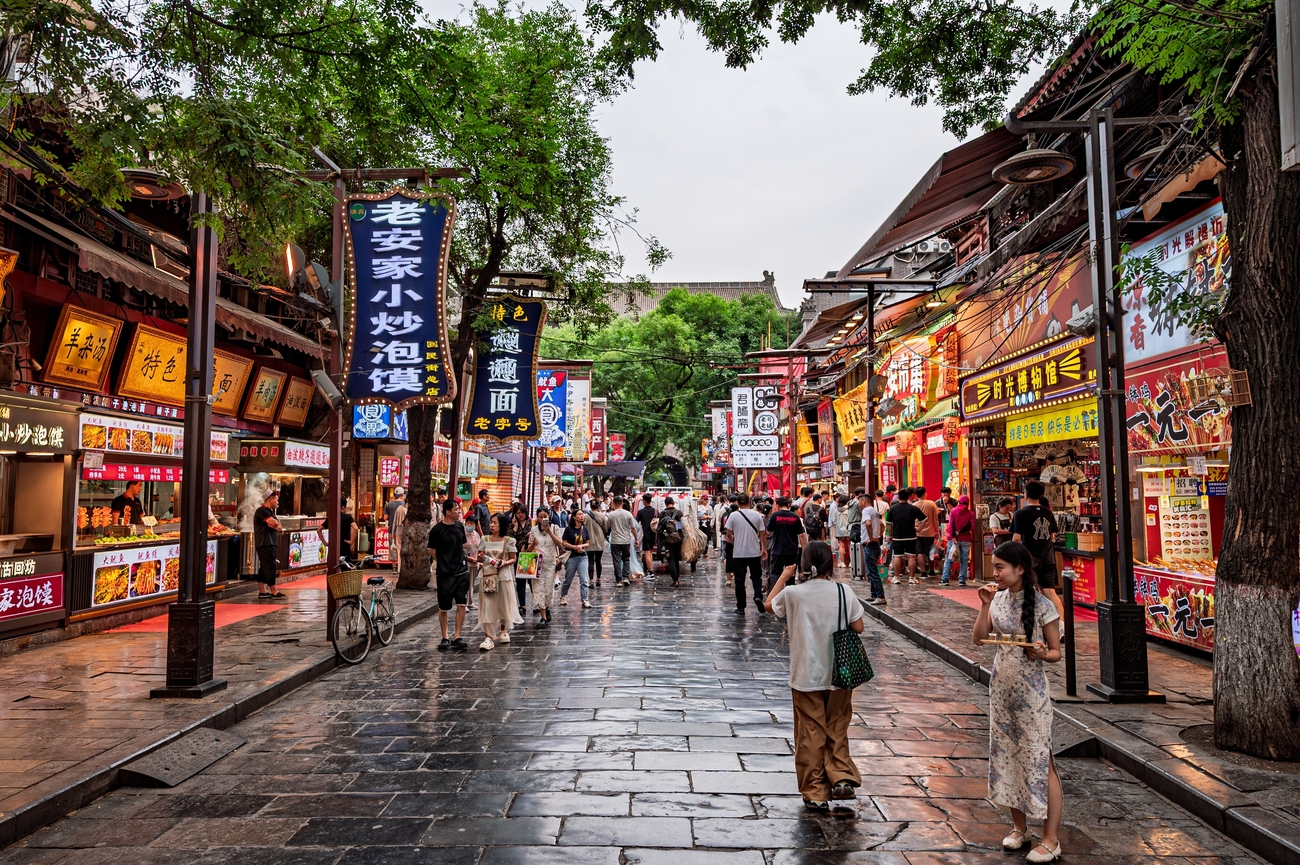
Xi’an Muslim Quarter is one of the city’s most atmospheric historic districts, where Silk Road heritage, Hui Muslim culture, the Great Mosque and centuries of food tradition sit beside imperial Xi’an.
The Tang Dynasty ended in 907. The community it invited to stay is still here. For more than thirteen centuries, Hui Muslims in Xi’an have lived in the same northwest quarter of the city, tracing part of their heritage to Arab and Persian traders who reached Chang’an through the Silk Road. The lanes are still theirs. The mosque is still theirs. The lamb broth, hand-pulled noodles and street kitchens still give the district its rhythm.
This is the Xi’an that exists beside the famous one. Most travellers arrive knowing the city of the Terracotta Army and ancient walls. The Xi’an Muslim Quarter is often the part they leave having felt most deeply.
How Tang
Dynasty Chang’an Became a Muslim Neighbourhood
Chang’an during the Tang Dynasty was the largest city in the world. A million people within its walls. Fifty foreign nations represented in its markets. The point where the Silk Road’s westward caravans began their journey and its eastward ones concluded theirs.
Islam reached China in the 7th century CE, during the Tang Dynasty, primarily through Arab and Persian traders travelling along the Silk Road. The first recorded contact between the Islamic world and China occurred around 651 CE, when the third caliph, Uthman ibn Affan, sent an envoy to the Tang imperial court. The merchants who settled in Chang’an’s northwestern quarter built prayer spaces, married into Han Chinese families, and raised children who were Chinese in language and culture and Muslim in faith and practice. Their descendants became the Hui people.
The same Silk Road network that carried Arab merchants east to Xi’an carried Buddhist teachings further east into Sichuan, where they found their first permanent home on the slopes of Mt. Emei. Two faiths, one network of trade routes, two cities shaped by the same flow of ideas across the same mountains and deserts. That story, of what happened when Buddhism reached the end of that road, is in our Mt. Emei guide.
The Ming Dynasty Structure That Still Holds Xi’an’s Muslim Quarter
During the Ming Dynasty, the Xi'an Muslim Quarter developed into a structured community organised around seven mosques and thirteen lanes. That layout is still the skeleton of what exists today. The commercial overlay has changed. The community beneath it has not.
Today, some 60,000 ethnic Hui Chinese, descendants of Arab and Persian traders who married Han people, live in this historical city. A community that has maintained its religious identity, its dietary practice, and its architectural vocabulary for thirteen consecutive centuries in the same quarter of the same city is one of the more remarkable continuities in urban history.
The Great Mosque of Xi’an
The entrance to the Great Mosque of Xi’an is on Huajue Lane, a narrow alley running west off Beiyuanmen, lined with souvenir stalls and food vendors. The transition from the lane’s noise to the mosque’s first courtyard is immediate and total.
The mosque was built in 742 CE during the Tang Dynasty, when Xi’an, then Chang’an, was the world’s largest city. Its current form was largely constructed in 1384 CE during Emperor Hongwu’s reign of the Ming Dynasty, as recorded by the Records of Xi’an Municipality.
What makes it unlike any other mosque in the world is not its age. It is its architecture.
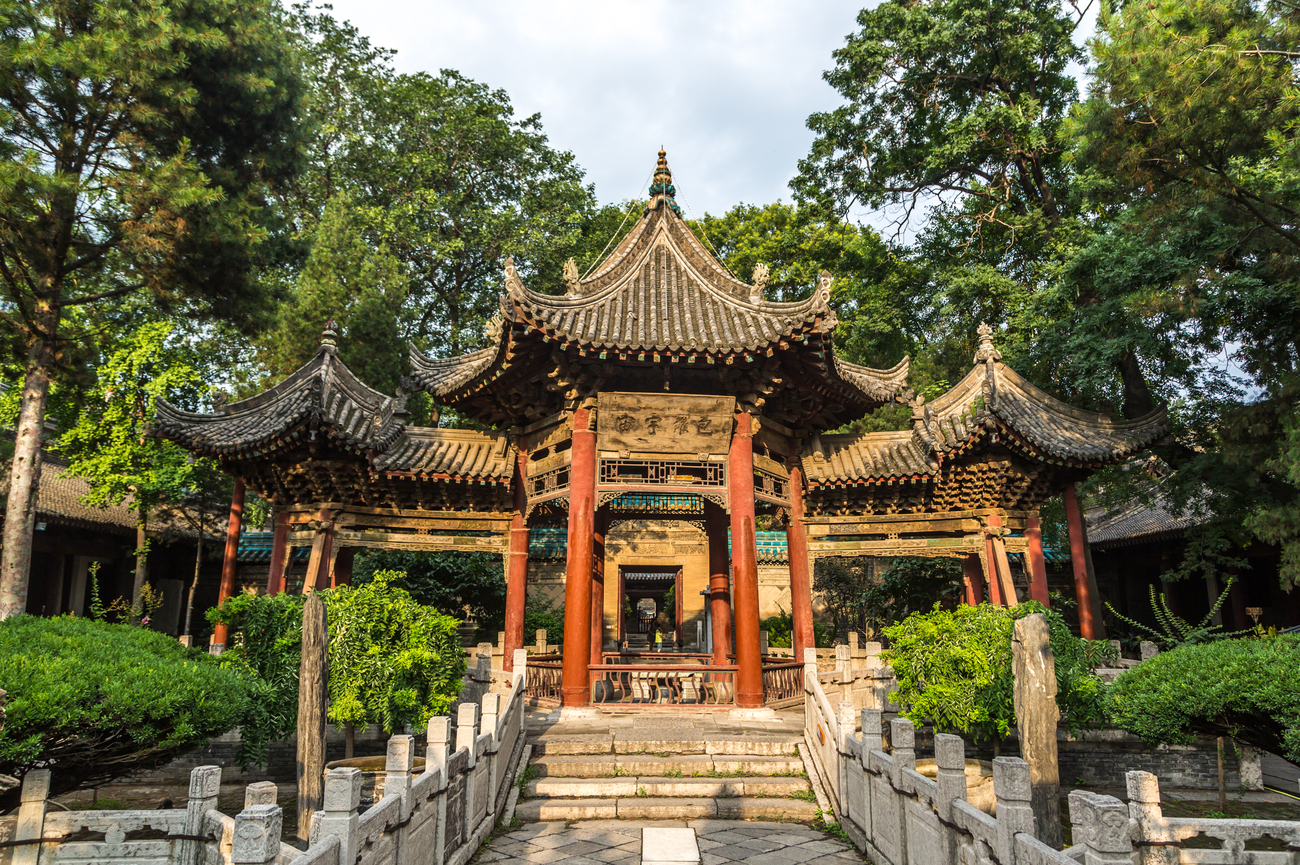
Unlike the domes and minarets typical of Islamic religious structures, the Great Mosque is built in the style of a traditional Chinese temple. The mosque is directed west towards Mecca, while still conforming to the axes of the imperial city. Calligraphy in both Chinese and Arabic appears throughout the complex, sometimes exhibiting a fusion of styles, Arabic text written in Chinese-influenced script.
The mosque’s plan is distinguished by its symmetrical east-west axis with five courtyards, the prayer hall at the west end, following native Chinese architectural traditions. The roofs sweep upward at the eaves in the Ming style. The carved timber archways read, from a distance, as classical Chinese decorative work. Only up close does the Arabic calligraphy surface from the ornamental patterns, language embedded in architecture the way culture embeds itself in people: visible when you look, invisible when you do not.
The Five Courtyards
The first courtyard contains an elaborate wooden arch nine metres high covered with glazed tiles, dating to the 17th century. In the centre of the second courtyard, a stone arch stands with two steles on both sides, one carrying the script of the Song Dynasty calligrapher Mi Fu, the other from Dong Qichang of the Ming Dynasty. Their calligraphy is considered a great treasure in the art of handwriting.
Three avenues lead to the third courtyard, whose focus is an octagonal building named the Examining the Heart Tower, whose height and shape have led many to assume it is a minaret, but this has never been proved. Three storeys of carved timber, its colour faded to the amber of wood that has stood in wind and rain for centuries. It is the most visually distinctive structure in the complex and the one that most clearly embodies the architectural negotiation the mosque represents: a minaret that may or may not be a minaret, in a mosque that looks like a temple, facing Mecca from the heart of a Tang Dynasty imperial capital.
The fourth courtyard holds the Phoenix Pavilion, named for the way its roofline spreads like a bird in flight, which screens the direct view to the prayer hall beyond. Behind the prayer hall, two circular moon gates lead to the fifth courtyard, where two small man-made hills were constructed for the ceremonial viewing of the new moon.

The Prayer Hall
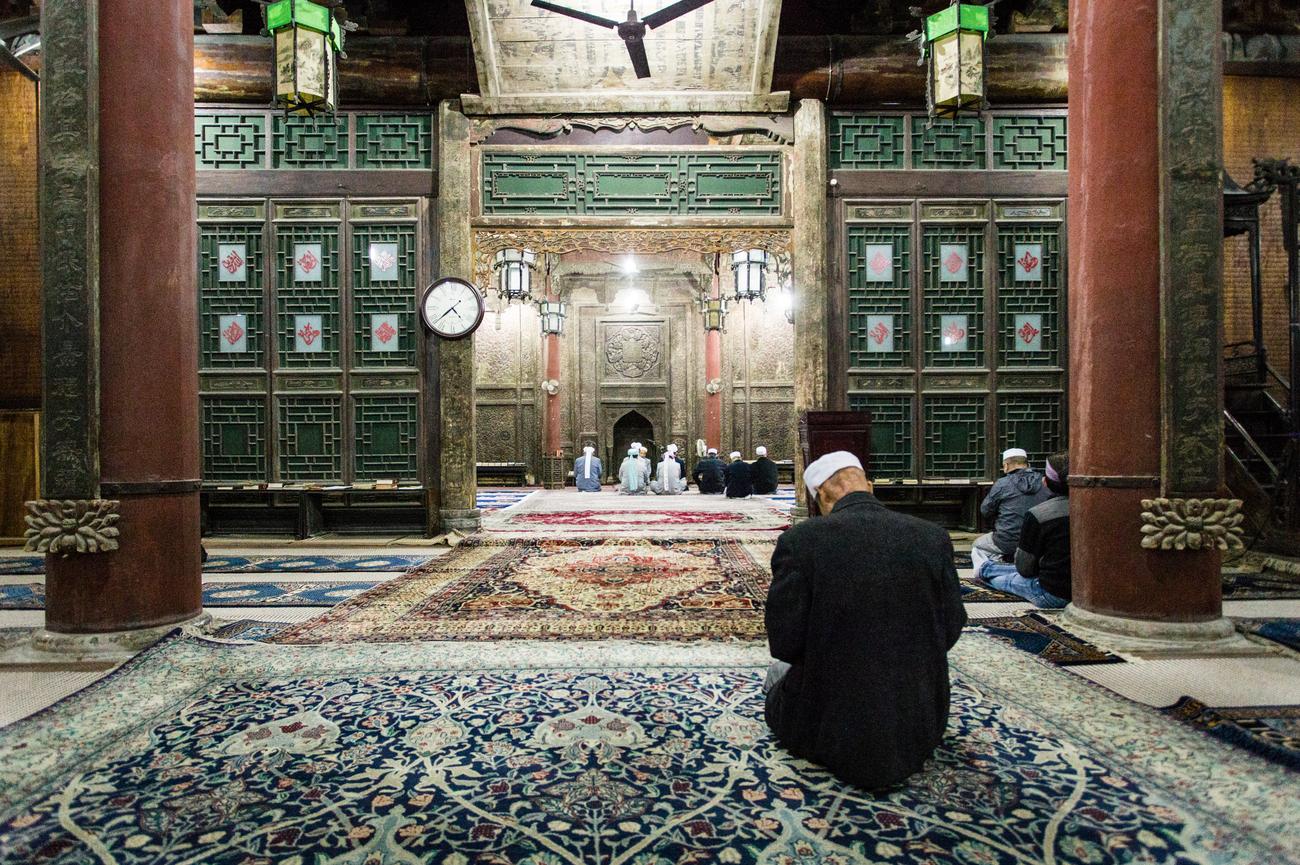
The prayer hall is a monumental timber building with a turquoise hip roof, painted wooden brackets, a six-pillared portico, and five doors. Contrary to most mosques in Muslim-majority states, the prayer hall does not feature a dome-shaped ceiling but has a traditional Chinese pointed ceiling covered with ceramic decorative tile. The hall can hold 1,000 people at a time, with prayer services held five times daily: at dawn, noon, afternoon, dusk, and night.
Non-Muslim visitors are welcome in the outer courtyards and garden areas. The prayer hall is reserved for worshippers. The mosque survived the Cultural Revolution virtually unscathed. Scholars attribute its survival to the same architectural camouflage that makes it unique: a building so thoroughly Chinese in its exterior vocabulary that the Red Guards destroying religious sites across the country did not immediately recognise it as one.
Entrance: CNY 25 from March to November, CNY 15 from December to February. Opening hours: 8:00 to 18:30.
Our China Panda & Peaks journey includes a guided visit to the Great Mosque with a specialist who carries the architectural and cultural context across all five courtyards rather than leaving it to the signage.
The Streets Beyond Beiyuanmen
Beiyuanmen, the Hui Muslim street’s primary lane, is its most visited and most commercialised face. The stalls and restaurants that line it are genuinely good. They are also genuinely crowded.
The lanes that branch from it are where the neighbourhood’s daily life is most visible. Xiyangshi, the West Sheep Market Street, runs parallel to Beiyuanmen to the west, where family businesses of the kind that have operated from the same premises for generations sit alongside residents doing their shopping. Dapiyuan, the Great Skin Yard, holds some of the quarter’s best yangrou paomo restaurants. The queue outside Lao Mi Jia on a weekday lunchtime tells you everything about what is being served inside.
Huajue Lane, the alley leading to the Great Mosque, transitions in character as it moves westward: commercial at its eastern end, residential and quieter in its middle stretch, and arriving finally at the mosque’s courtyard wall at its western terminus.
Gao's Grand Courtyard
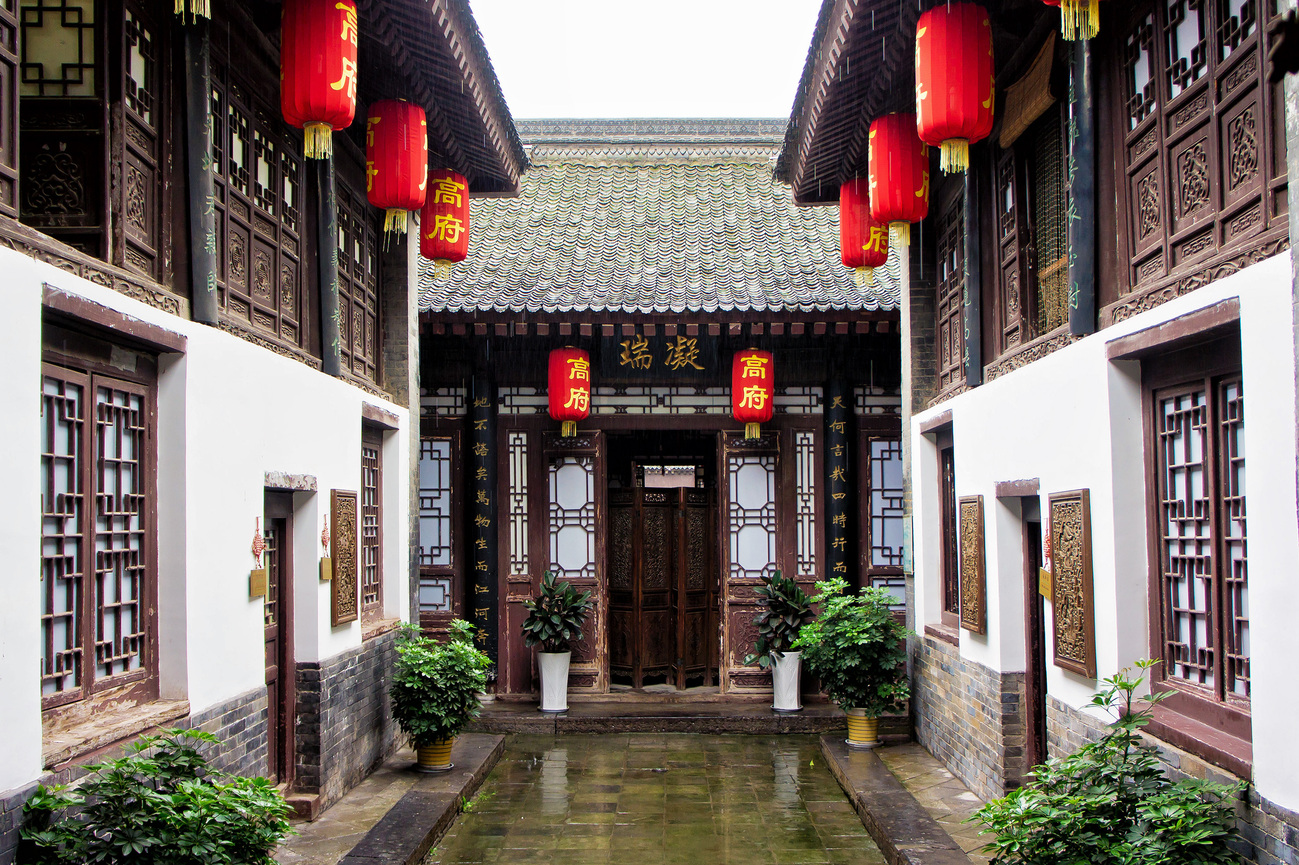
On Beiyuanmen itself, the Gao Family Courtyard offers one of the few opportunities to see the domestic architecture that existed alongside the commercial life of the quarter. A Ming Dynasty merchant residence with stone-carved gates, tiled courtyards, and wooden lattice windows. The private face of a neighbourhood that has mostly shown only its street.
The Bell Tower and Drum Tower
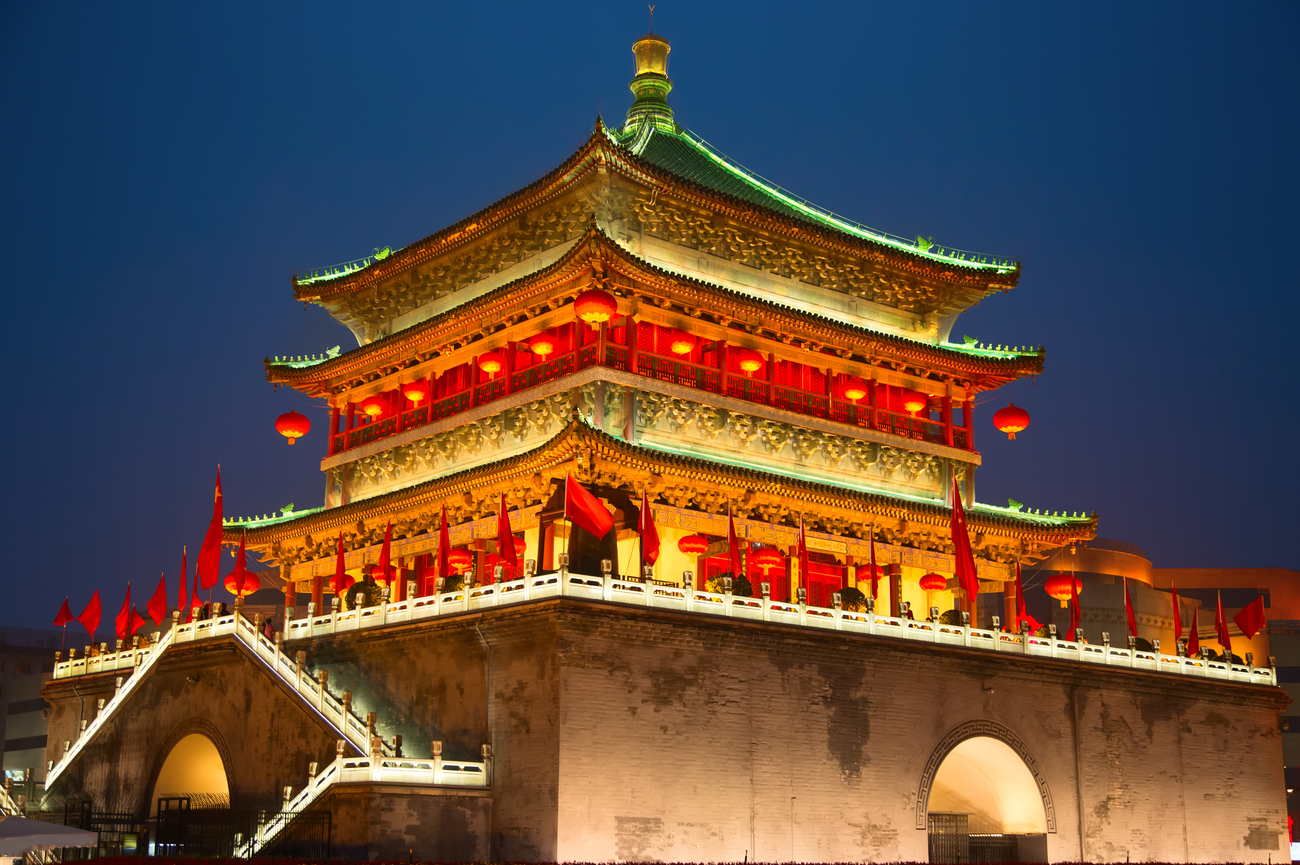
The Bell Tower, built in 1384 during Emperor Hongwu’s reign, and the Drum Tower, completed four years earlier in 1380, mark the quarter’s southern boundary and the historic walled city’s ceremonial centre. From the Drum Tower’s upper level, the view across the quarter’s rooflines reveals its true scale: considerably larger than the main street suggests, the traditional roof construction extending across multiple city blocks in every direction.
The Bell Tower at night, illuminated against the Xi’an sky, is one of those images that arrives without announcement and stays longer than expected.
The Food of Xi’an’s Muslim Quarter and What It
Carries
The food of the Xi’an Muslim Quarter is the most direct surviving evidence of the Silk Road’s cultural reach. Every dish carries a trace: an ingredient that arrived from the west and stayed because it worked.
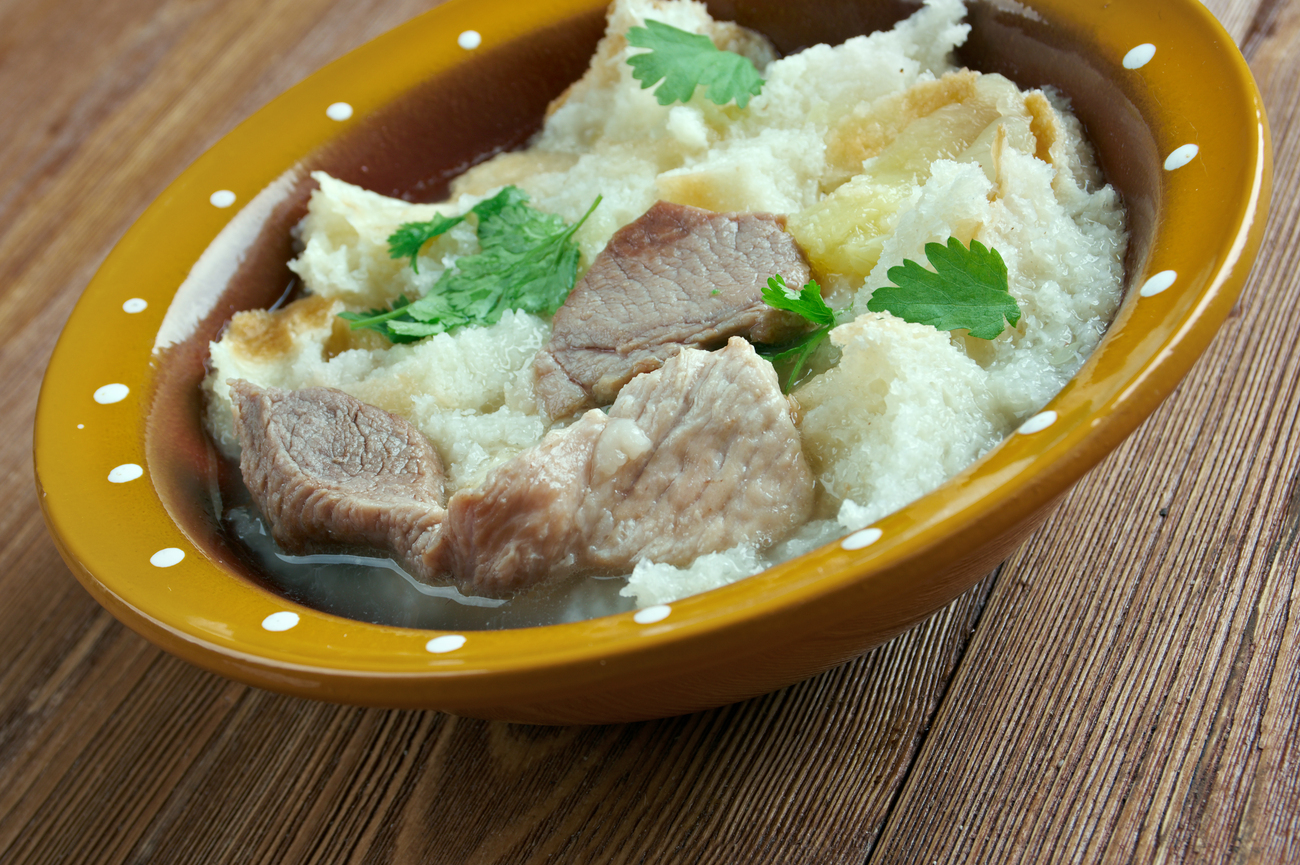
Yangrou Paomo
Xi’an’s most celebrated dish begins before it arrives at the table. The flatbread comes unleavened and whole. The diner tears it, not cuts it, into pieces roughly the size of a thumbnail. The specific size matters: too large and the bread does not absorb the broth; too small and it dissolves. Most serious eaters spend twenty minutes tearing. The bowl returns to the kitchen.
What comes back is lamb broth. The soup base is simmered for nearly 48 hours, flavoured with over 20 spices added at different times throughout the cooking process. Tender lamb, glass noodles, and the torn bread now fully saturated with the broth. Sugar-pickled garlic and chilli sauce on the side. It is savoury and rich and entirely unique to this city.
The best restaurants for this dish are on North Guangji Street, Lao Mi Jia and Lao Liu Jia among them. Tong Sheng Xiang, founded by three brothers from the quarter and now more than a century old, is the name that comes up most consistently among people who know Xi’an’s food.
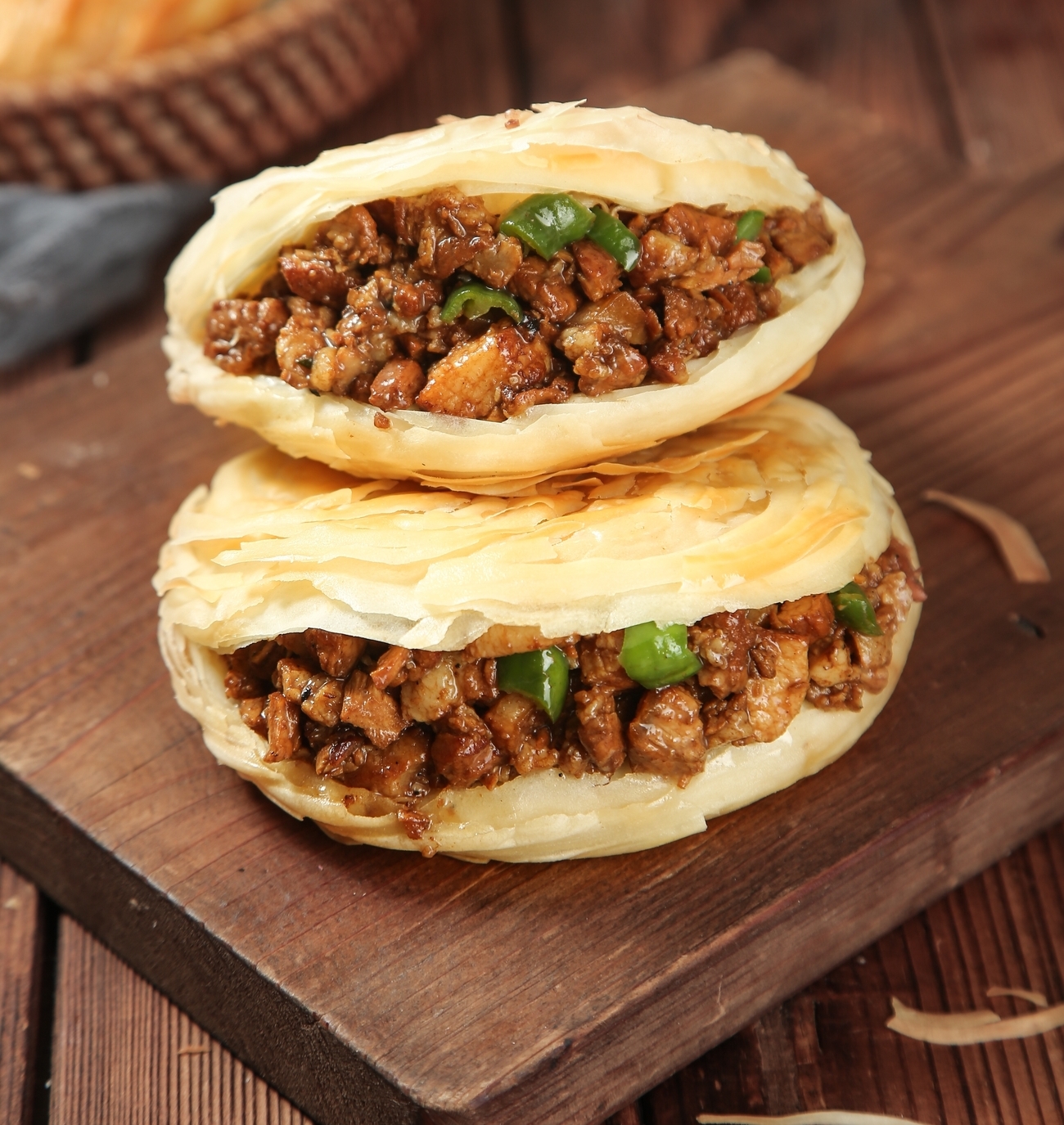
Roujiamo
Slow-braised lamb or beef, cooked for a minimum of five hours in a broth of star anise, cinnamon, dried chilli, and over a dozen other spices, packed into a freshly baked flatbread that is crispy outside and soft within. It has been sold in Xi’an in some form since the Tang Dynasty. Lao Sun Jia and Fan’s Roujiamo, both family-run across generations, are the two names local consensus returns to most consistently.
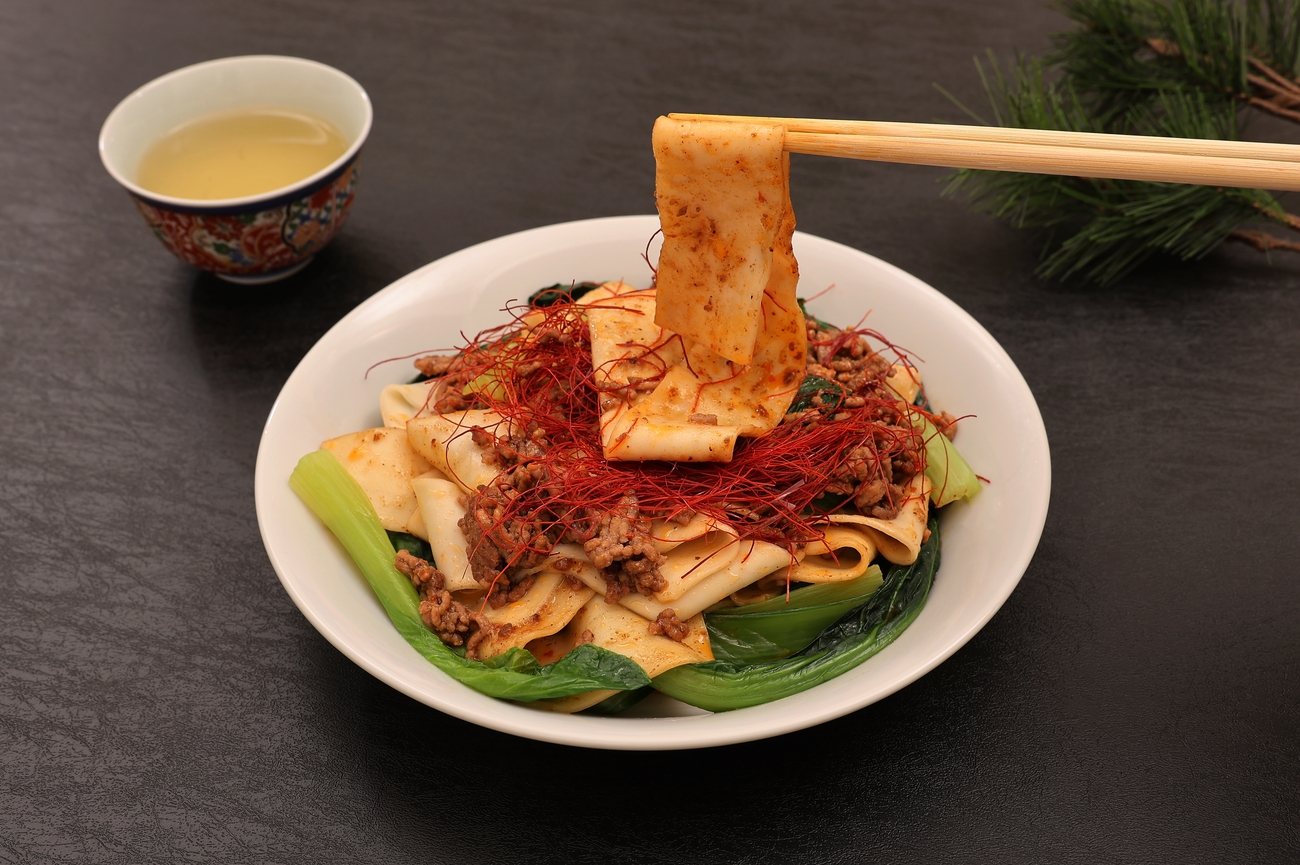
Biangbiang Noodles
Named for the sound the dough makes when being prepared, these wide, hand-pulled noodles are typically served with a spicy and aromatic sauce made from chilli oil, garlic, vinegar, and a mix of herbs and spices. Each bowl usually contains three to four noodles, each roughly a metre long and the width of a belt. The character used to write “biang” is the most complex character in the Chinese writing system, used only for this noodle, only in Shaanxi.
The Cumin Thread
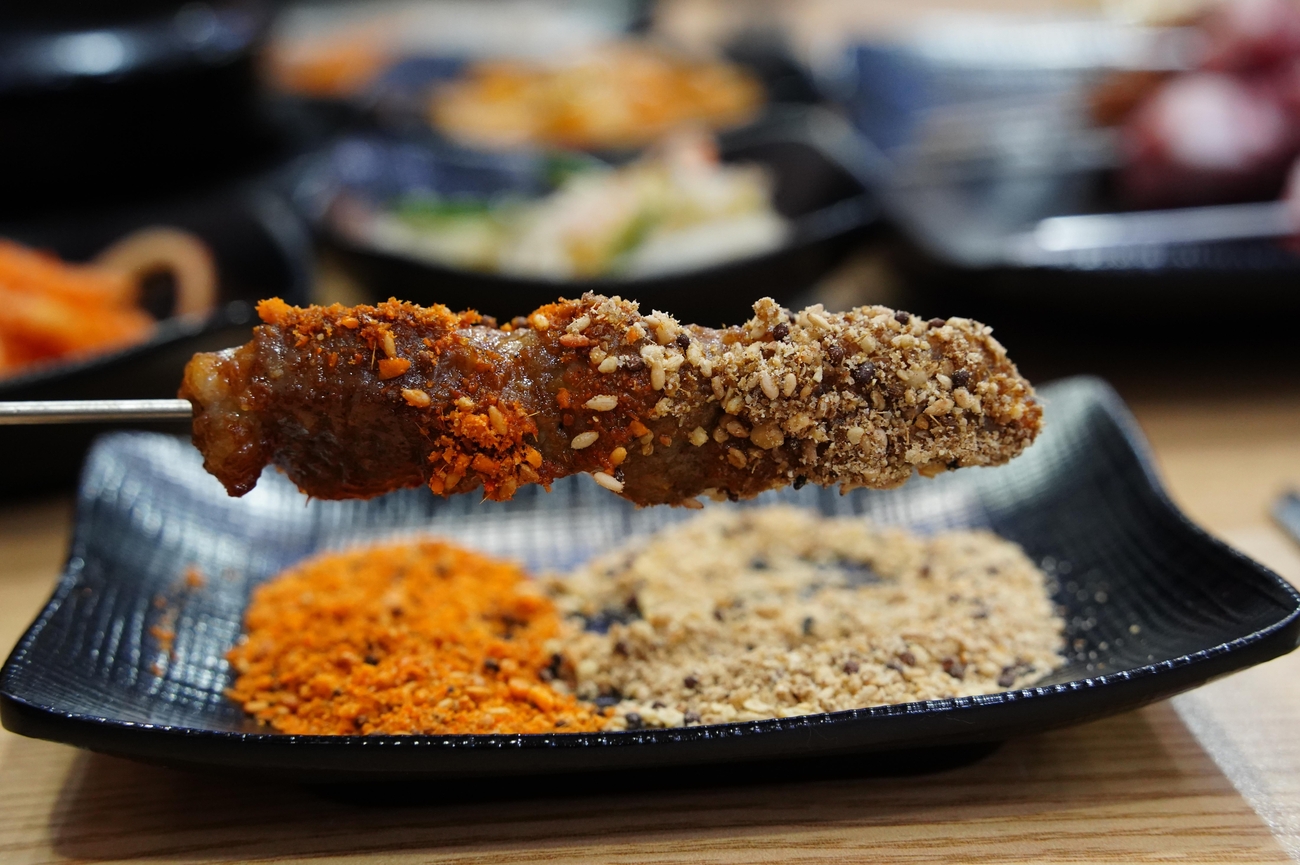
The cumin on the lamb skewers arrived from Central Asia via the Silk Road. The pomegranate juice pressed to order at the stalls came from Persia. The flatbread in paomo and roujiamo carries traces of the Central Asian bread traditions the founding merchants brought with them. The food of the Xi’an Muslim Quarter is not a recreation of a historical menu. It is the living result of a cultural exchange that has been refining itself in these specific lanes for thirteen centuries.
The Chengdu leg of this route follows Xi’an, and it carries its own deep food identity. A UNESCO City of Gastronomy, a hotpot culture built on málà heat and two-hour communal tables, a city that has been thinking seriously about how to eat for over two thousand years. That narrative, the broth, the dishes, and the restaurants that earn the reputation are covered in our Sichuan food guide.
Reading Xi'an as a Whole
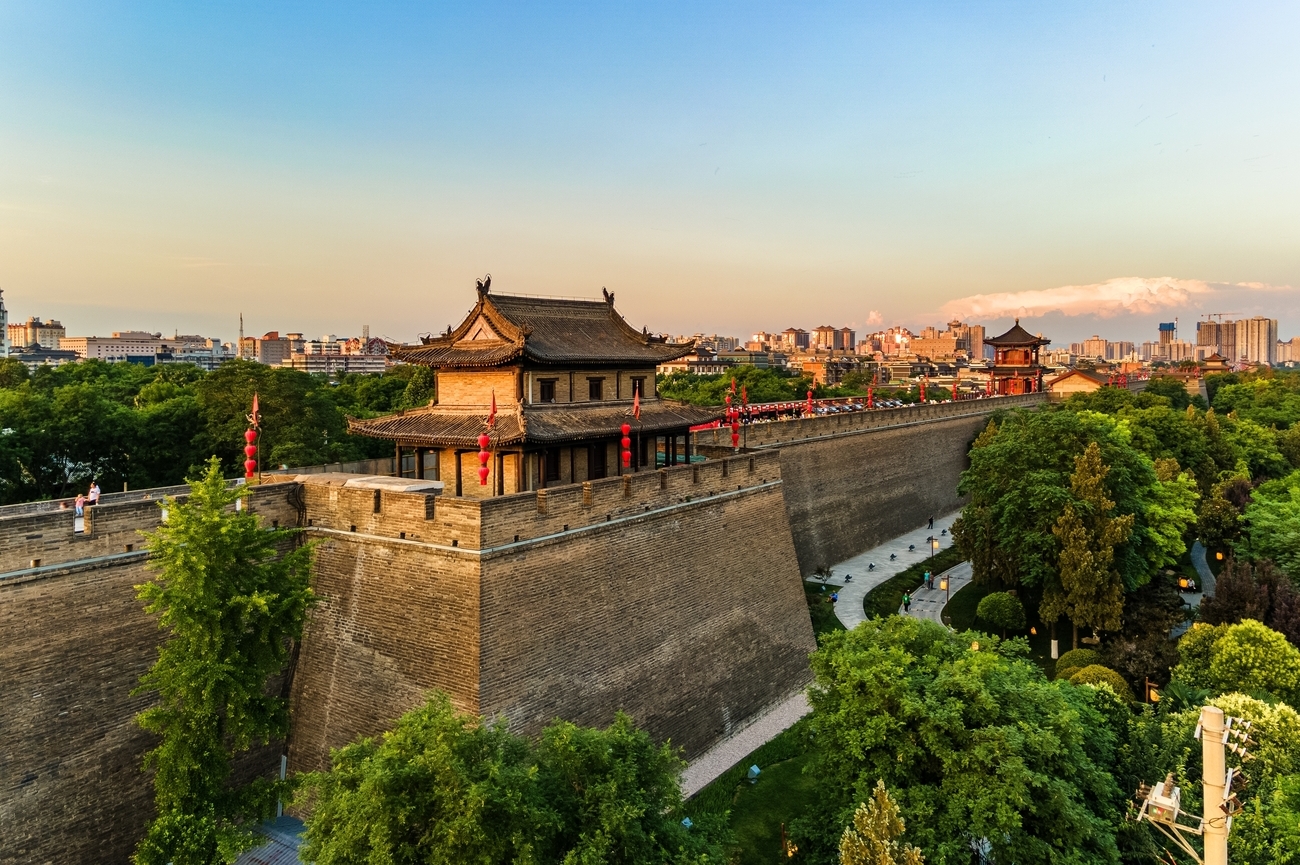
The Silk Road Xi’an that the Muslim Quarter represents and the ancient dynastic capital that the Terracotta Warriors represent are not two versions of the same story. They are genuinely different stories that happen to share a city. The Qin emperor who built the underground army died in 210 BCE. The Arab merchants who built the Great Mosque arrived nine centuries later. The city they both chose was already, by the time the merchants arrived, one of the oldest and most layered places in the world.
The full Sichuan route that places Xi’an between Beijing and Chengdu, the panda base that waits on the other side of the flight south, and the sacred mountain above the city that follows the next morning, is mapped in our Panda & Peaks guide. What the panda base feels like at 7:30 AM, and what 240 giant pandas look like in bamboo forest before the city wakes, is covered in our Chengdu Panda Base guide.
Where Thirteen Centuries Taste Like Cumin and
Lamb
The Xi’an Muslim Quarter did not preserve itself. It simply never stopped being used. The lanes were not restored for tourists. The recipes were not archived for posterity. The Great Mosque was not placed under heritage protection until long after it had already survived everything that might have destroyed it.
What endures here endured because a community decided, generation by generation, that it was worth continuing. That is a different kind of preservation from anything a government programme produces. It is the kind that leaves a flavour in the air and a specific quality of silence inside a courtyard that has been prayed in for thirteen hundred years.
Revigorate’s China Panda & Peaks journey brings a guide into this neighbourhood who understands both what it is and what it has been, so the visit delivers the full weight of both.



Let us know what you love, where you want to go, and we’ll design a one-of-a-kind adventure you’ll never forget.
Get in touch
Miriam
Travel Specialist

Nina
Travel Specialist

Abigail
Travel Specialist
Our offices:



Revigorate, Iberian Escapes and Algarve Lifestyle are the registered brand names of APCS Lda . We are a fully authorised travel agency licensed by Turismo de Portugal RNAVT/6867.
In the event of a dispute, the consumer may refer to: RAL - Centros de Arbitragem
Avª. 5 de Outubro, nº. 55, R/C Dtº. 8000-075 Faro, Portugal | Tel: +351 289 823 135 *
* national landline call
E-mail: info@consumoalgarve.pt| www.consumidoronline.pt | Mon to Fri: 9:00 - 13:00 / 14:00 - 17:00