The Sichuan Route: Chengdu's Giant Pandas and the Sacred Mountain Above the City
Chengdu is at its best in the morning.
At 7:30 AM, before the city fully wakes, the Chengdu giant pandas are eating breakfast. Bamboo cracks between their molars in the still morning air. A fully grown panda eats between twelve and thirty-eight kilograms a day and does so with a focus that is almost ceremonial. Standing a few metres from the enclosure, watching an animal that was nearly gone from the earth two decades ago going about its morning with complete indifference to your presence, is one of those travel experiences that resists summary long after the trip is over.
Sichuan does that. It produces moments that don't translate.
The route through Beijing, Xi'an, Chengdu, Mt. Emei, and Shanghai is not the shortest path between China's great cities. It is the one that earns its length, the one where the Sichuan leg, the Chengdu giant pandas at dawn, the sacred Buddhist mountain that rises above the city, and the food culture of a UNESCO City of Gastronomy reshape what a first luxury journey through China can become.
Our China Panda & Peaks journey follows this exact sequence, combining Chengdu's giant panda conservation centres, the sacred Buddhist temples of Mt. Emei, Xi'an's Silk Road heritage, and the contrasting energy of Beijing and Shanghai into one curated route across China.

Beijing:
China’s Imperial Opening Chapter
China announces itself through Beijing. The Forbidden City, the Great Wall, the Temple of Heaven, and the hutong lanes threading between courtyard houses that have held the same residential logic for centuries all give the city its unmistakable weight. Beijing layers its history visibly and without apology. Beijing is the correct place to begin a first luxury journey through China. For a broader overview of the capital, our Things to Do in Beijing guide covers the city’s leading landmarks, museums, neighbourhoods and practical visitor advice. The deeper imperial story continues in our dedicated Beijing guide.
What Beijing does for the rest of this route is establish the register. Imperial authority at its most physical, deliberate, and permanent. Sichuan, which comes later, answers it with something entirely different: a city that has never been interested in declaring itself.

Xi'an:
Ancient Capital and Silk Road Crossroads
Xi’an’s weight is archaeological. Eleven dynasties administered their empires from here. The Silk Road’s eastern terminus sat at these city gates. In the fields east of the city, Qin Shi Huang’s burial army of over 8,000 terracotta soldiers has been standing in formation since 210 BCE, the most dramatic surviving evidence of any ruler’s belief in the continuity of power beyond death.
Xi'an also holds a different story entirely, one that has nothing to do with the Qin Dynasty and everything to do with what the city became in the centuries that followed. Our Things to Do in Xi'an guide explores the city's walls, pagodas, museums, food culture and historic neighbourhoods beyond the famous Terracotta Army.

The Muslim
Quarter: Xi’an’s Living Silk Road Neighbourhood
The Muslim Quarter, Huimin Jie, is a living neighbourhood of 60,000 Hui Muslims whose ancestors arrived in Chang’an as Arab and Persian traders during the Tang Dynasty and chose to stay. Walking through its lanes today, past lamb skewers over charcoal, fresh pomegranate juice pressed at wooden stalls, and the carved timber archways of the Great Mosque founded in 742 AD, you are walking through the direct evidence of a migration that began thirteen centuries ago and has continued without interruption since.
The Great Mosque is the neighbourhood’s most remarkable structure. Built in classical Chinese garden architecture, with five courtyards in sequence, sweeping tiled rooftops and carved timber archways, it faces Mecca. The Arabic calligraphy on its surfaces reads, at a distance, as classical Chinese decorative carving. Tang Dynasty aesthetics and the spatial requirements of Islamic worship arrived at something in this building that exists nowhere else. The food of the Quarter carries the same synthesis: cumin from Central Asia on lamb skewers, pomegranate juice from Persia, flatbread soaked in lamb broth that has been sold in these lanes for over a thousand years.
The Quarter’s full story, the mosque’s architectural logic, the Hui community’s thirteen centuries of unbroken settlement, and the streets beyond the main tourist thoroughfare where the neighbourhood functions as a neighbourhood rather than an attraction, is in our guide to Xi’an’s Muslim Quarter and the Silk Road city that exists alongside the ancient one.

Chengdu:
The Sichuan Capital That Moves at Its Own Pace
The flight from Xi’an deposits you in a different China. Not a different register of the same imperial story. A genuinely different place, with its own climate, its own pace, and its own philosophy about how a day should be spent.
Chengdu is the capital of Sichuan Province. Twenty-one million people live in a fertile basin ringed by mountains, enclosed on three sides by the geography that shaped everything from the city’s food culture to its character. The Sichuan Basin’s humidity, warmth, and agricultural abundance have made it what ancient Chinese texts called Tianfu Zhi Guo, the Land of Abundance. Chengdu has been its capital for over 2,300 years without once relocating or changing its name. That kind of continuity leaves marks.
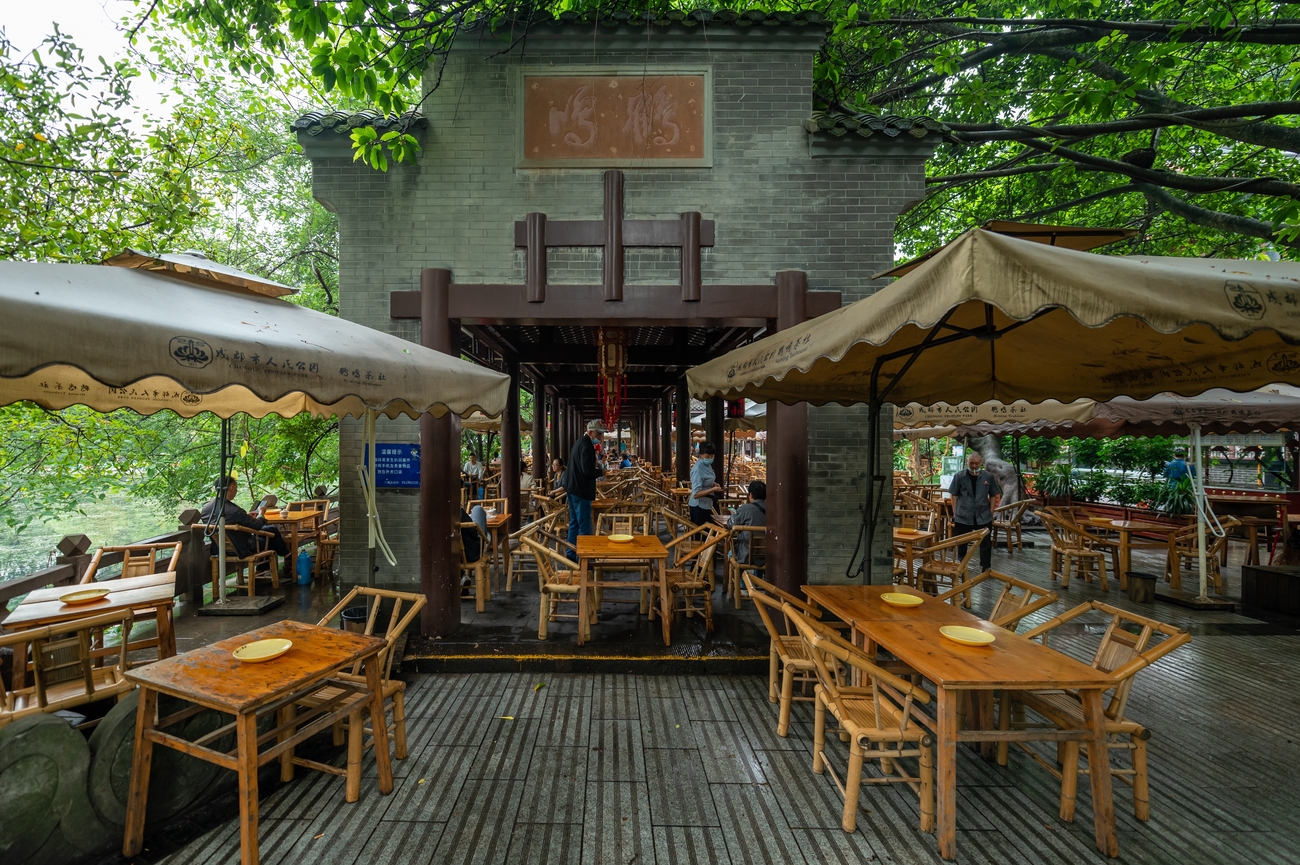
The one that visitors feel most immediately is the pace. Chengdu moves differently from Beijing and Xi’an. The teahouse is its clearest expression. Over 10,000 teahouses operate in the city, a density three times that of cafés in New York. At Heming Teahouse in People’s Park, open since 1923, bamboo chairs face a willow-lined lake and green tea arrives in covered gaiwan bowls. The afternoon clientele is mostly retired residents playing mahjong, conducting unhurried debates, or simply watching the park. The concept of manmanlai, taking it slow, is not a slogan here. It is an operating principle.
Kuanzhai Alley, the Wide and Narrow Lanes, is a preserved Qing Dynasty residential neighbourhood built during Emperor Kangxi’s reign between 1661 and 1722. Three parallel lanes, Wide Alley, Narrow Alley, and Well Alley, each with its own character. Blue-grey brick, stone-paved streets, courtyard houses whose proportions have not changed since they were built. The neighbourhood is still used the way it was built to be used: for sitting, for eating, and for the kind of social proximity that only works at a specific scale.
The Wuhou Shrine, dedicated to Zhuge Liang, the Three Kingdoms strategist whose reputation for tactical intelligence has survived seventeen centuries of Chinese history and literature, sits inside a garden of ancient trees and stone-carved memorial halls. Red walls in bamboo shadow. The kind of quiet that a city chooses to preserve. It is most usefully visited slowly, and Chengdu is a city that rewards slowness.
Chengdu Giant
Pandas and the Conservation Story Behind the Base
The Chengdu Research Base of Giant Panda Breeding sits 10 kilometres north of the city centre in Chenghua District. Founded in 1987 with six rescued giant pandas following a bamboo die-off in the Wolong Nature Reserve that left wild populations without food, the base has grown into the most significant ex-situ panda conservation facility in the world.
Today it holds over 240 Chengdu giant pandas across 3.07 square kilometres of terrain with 96% bamboo and plant coverage. Open-air enclosures, nursery houses, research laboratories, a panda hospital, and, as of 2025, a new 69.8-metre observation tower and upgraded facilities supporting wild reintroduction science. The base has won the UN Global 500 Roll of Honor for Environmental Achievement twice. Its international research collaborations include Zoo Atlanta, Chester Zoo, the University of Denver, and the University of Queensland.
The conservation context matters because the stakes were real. In 1987, the global wild giant panda population was estimated at around 1,000. The IUCN listed the species as Endangered. By 2016, driven by breeding programmes and habitat restoration, that status was reclassified to Vulnerable. The shift represents one of the more meaningful conservation achievements in recent wildlife science, and the Chengdu base is central to it.
Practically, visiting the base well requires a few specific things:
- The pandas are most active between 7:30 and 10 AM during morning bamboo feeding. After 10 AM, most withdraw indoors or into shaded areas.
- The South Gate route covers the established enclosures. The West Gate route, quieter in the morning, leads into newer sections where thirty to forty pandas are often visible across sixteen pavilions.
- The Sunshine Nursery House is where cubs are raised in their first months. What a newborn giant panda weighs at birth, roughly the size of a stick of butter, against the adult it becomes within three years, is information the nursery house makes visceral.
- The Giant Panda Museum, the only one of its kind in the world, holds over 2,140 specimens across three exhibition halls covering panda biology, conservation history, and the species' diplomatic significance.
- No tickets are sold on-site. Advance booking is mandatory, CNY 55 per person.
The breeding programme's technical breakthroughs, the science behind the Vulnerable reclassification, and the red pandas that share the base are all covered in our guide to Chengdu's Giant Panda Research Base and the Conservation Story Behind the Glass.

Sichuan Food Culture: Chengdu After Dark
Chengdu's teahouse culture is its daytime face. Its food culture is its evening one, and it is equally serious.
UNESCO designated Chengdu a City of Gastronomy in 2010, the first city in China to receive the honour. The designation covers the full breadth of Sichuan cuisine: its seven basic tastes, its more than twenty distinct cooking methods, and the food philosophy embedded in its most famous concept. Málà, the pairing of má, the numbing quality of the Sichuan peppercorn, and là, the heat of chilli, is not simply a flavour profile. It is the logic of Sichuan cooking made legible in a single bite.
The hotpot is where that logic is most fully expressed. A simmering pot of Pixian broad bean paste broth, chilli, and Sichuan peppercorns at the centre of the table. Raw ingredients arriving sliced thin on plates. A dipping sauce the diner assembles from sesame oil, minced garlic, and coriander. A table with nowhere to be for the next two hours. The numbness arrives before the heat. By the time the meal is finished, no one wants it to end.
The origins of the broth, the dishes that built the UNESCO designation, the Mapo Tofu, Dan Dan Noodles and Kung Pao Chicken that exported Sichuan's food identity across the world, and the specific restaurants in Chengdu that earn the city's reputation, are covered in our Sichuan food guide.

Mt. Emei and the Sacred Buddhist Mountain Above
Chengdu
Ninety kilometres southwest of Chengdu, Mt. Emei rises to 3,099 metres from the edge of the Sichuan Basin. The surrounding terrain drops away so sharply that the mountain stands in clear visual isolation from everything around it, its profile visible from the Chengdu plains on clear days as a single sharp ridge against the western sky.
In the 1st century CE, the first Buddhist temple in China was built on its summit. Buddhism had arrived from India via the Silk Road routes carrying ideas eastward through Central Asia and Chang'an. Mt. Emei was the site where it first took permanent root in Chinese soil. The temple that stands at the Golden Summit today, Huazang Temple, received its current name in 1614. Its founding story reaches back two thousand years.
UNESCO inscribed Mt. Emei as a Mixed Cultural and Natural Heritage Site in 1996, recognising both its Buddhist significance and its extraordinary biodiversity. The mountain holds over 3,200 vegetation types across subtropical, temperate, and subalpine zones. Some of its trees are over a thousand years old. The Tibetan macaques that inhabit the middle slopes have coexisted with pilgrims for centuries, wild and unmanaged, occasionally audacious.

The Temple Circuit
Thirty active Buddhist temples are distributed across Mt. Emei's vertical range. Three define the mountain's character.
- Baoguo Temple, at approximately 550 metres, was built during the Wanli Emperor's reign between 1572 and 1620. It is the mountain's main entry point and administrative heart. Its grounds hold the Seven-Storey Huayan Pagoda, which contains a complete Tripitaka cast in bronze.
- Wannian Temple, at 1,020 metres, was founded in 399 CE during the Eastern Jin Dynasty, making it the oldest surviving temple on the mountain and among the oldest active Buddhist temples in China. It houses the bronze statue of Samantabhadra Bodhisattva on his white elephant, cast in the 10th century during the Song Dynasty, 7.85 metres high and weighing approximately 62 tonnes. The temple's Brick Hall, built without wooden beams, has survived eighteen earthquakes over 400 years.
- The Golden Summit (Jinding), at 3,079 metres, is the highest point accessible to visitors and the experience that defines Mt. Emei for everyone who reaches it. Huazang Temple here is China's highest active Buddhist temple. Beside it stands the defining image of the mountain: a 48-metre copper-gilt statue of Samantabhadra Bodhisattva, ten faces arranged across three tiers in reference to the Bodhisattva's Ten Great Vows, weighing 660 tonnes, completed in 2006. When sunlight strikes the summit, the gilded surface reflects in every direction. The name Golden Summit is entirely literal.

The Four Wonders
The Golden Summit is known for four natural phenomena: the sunrise, the sea of clouds, the Buddha's halo, and the sacred lamps.
The sea of clouds is the one most likely to be encountered. Mt. Emei sits at the edge of the Sichuan Basin where warm moist southern air converges with cold northern air near the summit, producing dense cloud layers that settle in the surrounding valleys while the Golden Summit platform rises above them. Standing at 3,079 metres, watching the peaks of neighbouring mountains emerge as islands in a white ocean below the platform while the copper-gilt Samantabhadra catches the first morning light above, is the version of Mt. Emei that stays with travellers for years.
The Buddha's halo is rarer and more extraordinary. When sunlight strikes the clouds from behind at the right angle, a circular rainbow forms around the observer's own shadow on the cloud surface. Every person who witnesses it sees only their own shadow at the centre, regardless of how many people are standing on the platform. The phenomenon is documented and observed here more frequently than at any other location in China.

The Leshan Giant Buddha
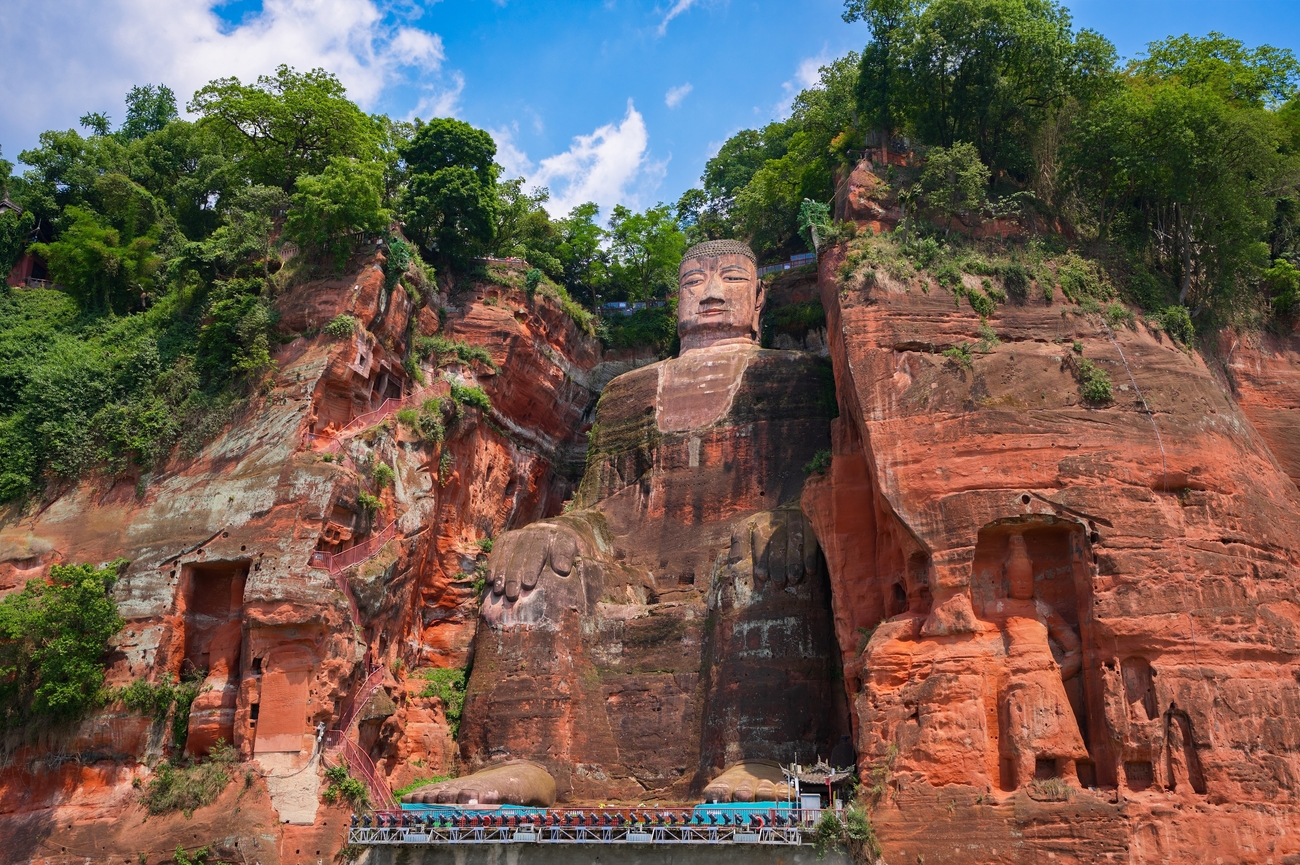
Thirty-five kilometres from Mt. Emei, carved into the west cliff of Mount Lingyun overlooking the confluence of the Min, Dadu, and Qingyi rivers, the Leshan Giant Buddha was begun in 713 AD by the monk Haitong, who believed that a Buddha overlooking the dangerous river confluence would calm its currents and protect the boatmen who regularly drowned there. Construction took ninety years and was completed in 803 AD.
At 71 metres, it is the largest carved stone Buddha in the world. Seated, representing Maitreya, the Future Buddha, with feet resting at river level. A drainage system carved into its hair, collar, and sleeve folds has protected the stone from water erosion for over 1,200 years, an empirical engineering solution that has outlasted every political and social upheaval since the Tang Dynasty.
The boat approach from the river below is the only perspective that shows the figure's full 71-metre scale with the cliff above and the water below. From the water, the size becomes comprehensible in a way the cliff-side stairs, which descend past the ears and nose, cannot provide. Haitong's reasoning becomes visible too: the Buddha's feet rest precisely at the level of the river confluence he was built to calm.
The UNESCO inscription covers both Mt. Emei and the Leshan Giant Buddha within a single designation. They belong to the same day.
Everything the Golden Summit holds, the full temple circuit across the mountain's slopes, what the sea of clouds looks like before sunrise, and the Leshan Giant Buddha's construction history in full, is discussed in detail in our Mt. Emei guide.
Shanghai: China’s Modern Finale
The flight from Xi’an to Shanghai covers the distance between China’s most ancient inhabited capital and its most globally facing city. The landing always carries a slight shock. Not because Shanghai is surprising, but because the contrast with everything preceding it is complete.
The Bund’s 52 colonial facades, built between the 1860s and 1930s by competing foreign trading institutions, stand on the western bank of the Huangpu River facing the Pudong skyline. Shanghai Tower, completed in 2015, rises 632 metres on the eastern bank. The Jin Mao Tower, the Shanghai World Financial Centre, and the Oriental Pearl Tower are buildings from three consecutive decades of China’s economic ascent, each one a monument to a different moment in that ambition. The two skylines have been facing each other long enough that Shanghainese have stopped noticing. First-time visitors do not.
Yu Garden, five acres of Ming Dynasty private garden built between 1559 and 1577 by the official Pan Yunduan, sits preserved inside one of the city’s most commercially dense neighbourhoods. Rockeries, koi ponds, covered walkways, and pavilions with upturned rooftops: the garden’s interior calm is absolute regardless of the noise outside its walls. Zhangyuan, the restored shikumen lane complex in Jing’an, reopened in 2022 after meticulous restoration as the city’s most considered argument about what preservation means. Shanghai Tower’s 118th-floor observation deck at 546 metres gives the only vantage point at which both skylines resolve into a single coherent image.
Shanghai closes this route at the right moment. After Beijing’s imperial gravity, Xi’an’s Silk Road depth, and Sichuan’s living, breathing, spice-filled particularity, the city’s unapologetic contemporaneity feels like the correct final note. Visitors extending their stay can also explore our Things to Do in Shanghai guide, covering the Bund, Yu Garden, Pudong, museums, shopping districts and the city’s best cultural experiences.

Where You Stay on the China Panda & Peaks
Route
The five-star thread across this route is not incidental. Each property is the correct hotel for its city in ways that are practical as much as aspirational.
- The Grand Hyatt Beijing at Orient Plaza places guests within walking distance of Tiananmen Square and the Forbidden City. The first Beijing morning begins at the gate rather than in a taxi.
- The Ritz-Carlton Xi'an sits inside the historic walled city. Xi'an's most atmospheric hours, the Muslim Quarter in the evening, the City Wall at dawn, reward proximity to the historic centre. The Ritz-Carlton provides it.
- In Chengdu, five-star accommodation positioned close to the city's cultural and culinary districts means the panda base is a straightforward morning departure and the old lanes are an afternoon walk. Chengdu's pleasures are local and unhurried, and the right hotel works with that.
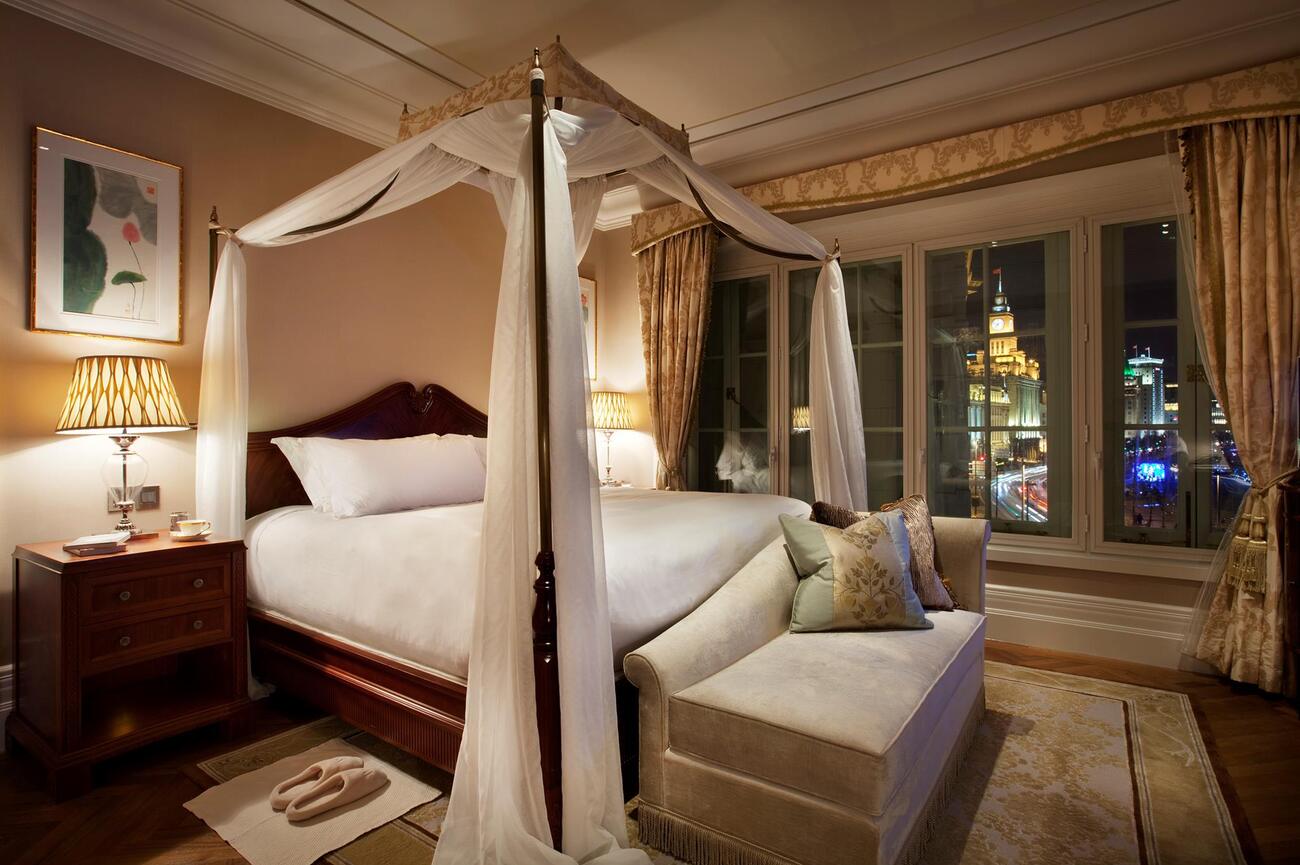
- The Waldorf Astoria Shanghai on the Bund has occupied the building at No. 2 since 1910, when it opened as the Shanghai Club. The Long Bar on the ground floor was historically the longest bar in Asia. The hotel's position at the southern anchor of the Bund promenade gives direct river views and puts the full waterfront on foot. It is where the journey ends, and it is a building that has earned its place in this city's story many times over.
Our curated China Panda & Peaks journey arranges these properties as the route’s operational backbone, with pre-arranged access to the panda base, specialist guides across Beijing, Xi’an, Chengdu, Mt. Emei and Shanghai, and every transition handled so the journey can be experienced rather than managed.
What Sichuan Adds to a First China Journey
Most first China journeys follow the Golden Triangle: Beijing, Xi'an, Shanghai. The three cities make a coherent, powerful case for what China is. The Sichuan route makes a different case, and it does so through a different kind of evidence.
Not a dynasty or an excavation or a waterfront. A species that almost disappeared. A mountain where Buddhism took root in Chinese soil two thousand years ago and is still tended. A food culture so specific to its geography that UNESCO identified it as a globally significant heritage. A city that has been refining its philosophy about how life should be spent for over two thousand years, and whose answer, bamboo chairs, gaiwan tea, mahjong tiles, and nowhere to be for the afternoon, turns out to be genuinely compelling.
The Chengdu giant pandas are the route's most famous offering. They are also its most accurate metaphor. An animal the world nearly lost, held carefully, brought back, still wild enough to eat thirty-eight kilograms of bamboo a day without acknowledging your existence. Sichuan takes care of things. It has been doing so for a very long time.

A China Journey Worth the Distance
The morning the panda didn't look at you is the moment most travellers cite when they describe this route. Not the sea of clouds above the Golden Summit, though that stays too. Not the hotpot broth at midnight or the Great Mosque's Arabic calligraphy hiding inside Chinese timber archways. The panda, at 7:30 AM, eats bamboo with complete indifference to your presence, alive and unhurried and entirely itself.
Ten days from Beijing to Shanghai with Sichuan at the centre. The itinerary is built. The pandas are already awake. Make it yours.


Let us know what you love, where you want to go, and we’ll design a one-of-a-kind adventure you’ll never forget.
Get in touch
Miriam
Travel Specialist

Nina
Travel Specialist

Abigail
Travel Specialist
Frequently Asked Questions
- Do I need a visa to visit China?
Visa requirements depend on your nationality. China currently offers visa-free entry or transit policies for a growing number of countries, while others require a tourist visa in advance. Always check the latest entry requirements before booking.
- How much walking is involved on the China Panda & Peaks route?
This itinerary involves moderate walking. Visitors should expect time on foot in historic districts, temple complexes, gardens, and at sites such as the Great Wall, the Terracotta Army, and Mt. Emei. Comfortable walking shoes are recommended.
- How do travellers get between Beijing, Xi'an, Chengdu, Mt. Emei, and Shanghai?
The route combines domestic flights and China's high-speed rail network. High-speed trains connect Chengdu and Mt. Emei efficiently, while flights reduce travel time between the country's major regions.
- Are there altitude concerns on Mt. Emei?
Most visitors experience no significant issues, but the Golden Summit sits at over 3,000 metres above sea level. Some travellers may notice mild shortness of breath, particularly when climbing stairs or walking quickly near the summit.
- Is Chengdu suitable for travellers who do not enjoy spicy food?
Yes. While Sichuan cuisine is famous for spice, Chengdu offers many non-spicy dishes, including soups, dumplings, stir-fries, and regional specialities that focus on flavour rather than heat.
- How many days are recommended for a first trip to China?
A journey of around 10 to 14 days allows travellers to experience China's major cultural, historical, and natural highlights without rushing. This route is designed to balance iconic cities with deeper regional experiences in Sichuan.
Our offices:



Revigorate, Iberian Escapes and Algarve Lifestyle are the registered brand names of APCS Lda . We are a fully authorised travel agency licensed by Turismo de Portugal RNAVT/6867.
In the event of a dispute, the consumer may refer to: RAL - Centros de Arbitragem
Avª. 5 de Outubro, nº. 55, R/C Dtº. 8000-075 Faro, Portugal | Tel: +351 289 823 135 *
* national landline call
E-mail: info@consumoalgarve.pt| www.consumidoronline.pt | Mon to Fri: 9:00 - 13:00 / 14:00 - 17:00