Chengdu Hotpot Culture and the Food Identity of Sichuan
Chengdu hotpot is one of the defining food experiences of Sichuan, combining chilli heat, Sichuan peppercorns, communal dining and a culinary culture recognised by UNESCO.
Nobody warned you about the Sichuan peppercorn. The heat from the chilli you were ready for. What arrives first is different: a slow tingle that starts at the lips, spreads across the palate and gently changes the way your mouth feels. Then the chilli follows, moving into a palate already partly numbed. That sequence is málà, one of the most distinctive flavour sensations in Chinese cuisine.
Chengdu has been perfecting it for centuries, and hotpot is its most communal expression. But Sichuan cuisine goes far beyond the bubbling pot. Mapo Tofu, Kung Pao Chicken and Dan Dan Noodles each carry a story as specific as their flavour, revealing a city that treats food as memory, identity and daily ritual.

The
Soul of Sichuan Cuisine
Before anything else, the Sichuan peppercorn deserves its own explanation, because nothing in the cuisine makes full sense without it.
It is not actually a peppercorn. Botanically it is the dried husk of the prickly ash berry, a member of the citrus family with no relation to black pepper. Its active compound, hydroxy-alpha-sanshool, produces a numbing sensation technically called paresthesia: a gentle electrical buzz across the soft tissues of the mouth that alters the perception of every flavour that follows it. The citrus fragrance that accompanies this sensation is why good Sichuan food smells floral even when it is searingly hot. The peppercorn is doing two things simultaneously: perfuming the dish and rewiring the mouth.
Sichuan cuisine is built on seven basic tastes: spicy, numbing, sweet, sour, salty, fragrant, and bitter. The most famous combination is málà, the pairing of the Sichuan peppercorn’s numbing quality with chilli’s heat. The numbness arrives before the heat. The heat arrives into a palate that has already been partially desensitised. The result is not simply spicy but layered, different sensations occupying the mouth at different depths simultaneously. No other regional cuisine in China produces this. No other regional cuisine anywhere does either.
Chilli peppers arrived in Sichuan relatively late, carried from South America by Portuguese traders in the 16th century. Before that, the peppercorn’s numbing quality was paired with ginger, cassia, and black cardamom for heat. The chilli’s arrival into a cuisine already structured around complex spice combinations accelerated Sichuan cooking into the flavour identity it holds today. The marriage was immediate and permanent.

Pixian
Doubanjiang: The Paste That Carries Everything
Pixian Doubanjiang is often called the soul of Sichuan cuisine. It is more than a condiment. It is a living witness to centuries of fermentation wisdom and culinary evolution.
Around 1688, during the reign of the Kangxi Emperor, a member of the Chen family from Fujian province who had migrated to Pixian accidentally mixed sun-dried broad beans with chilli peppers during the drying process. The mixture fermented. The result was something nobody had planned and everybody wanted more of: a dark, oily, intensely savoury paste with heat, depth, and a sweetness that moves underneath both. The accident became a technique. The technique became a tradition. The tradition became a China Geographical Indication product, legally protected, produced exclusively in Pidu District in Chengdu.
The region’s humid climate and ample sunshine proved ideal for slow fermentation. Over centuries, the craft was refined, and by the Qing Dynasty, Pixian Doubanjiang had become a prized staple, its fame spreading across Sichuan and beyond. The minimum fermentation period is three years. The finest batches are left for five. During that time the paste is turned regularly in its clay jars under the open sky, absorbing the specific microorganisms and seasonal variations of the Chengdu Plain that no other environment can replicate.
The technique of producing Doubanjiang was listed as a national intangible cultural heritage in 2008. Sichuan cuisine’s cooking skills were added to China’s national intangible cultural heritage list in 2021.
Every major Sichuan dish builds on this paste. The hotpot broth. Mapo Tofu. Twice-Cooked Pork. The paste is fried in oil at the start of cooking, releasing its colour and fragrance into the fat before anything else is added. That oil, now brick-red and deeply aromatic, is the foundation on which the dish is built. No substitute exists.
The full route that brings travellers to this table, through Beijing’s imperial core and Xi’an’s ancient Muslim Quarter before landing in Chengdu, is mapped in our Panda & Peaks guide.

The
Hotpot
The Chengdu hotpot is not a dish. It is a structure for an evening.
A simmering pot of broth at the centre of the table, usually split down the middle: the traditional beef-tallow and Pixian Doubanjiang broth on one side, dark and intensely flavoured, and a lighter clear broth on the other. Raw ingredients arrive on plates: beef and lamb sliced paper-thin for fast cooking, tripe, tofu skin, lotus root in coins, leafy greens, mushrooms, glass noodles, quail eggs, enoki, wood ear fungus. The diner cooks their own food in the broth, retrieves it with chopsticks, dips it in a personal sauce assembled from sesame oil, minced garlic, coriander, and chilli paste, and eats it while the next thing cooks.
The dipping sauce is the diner’s signature. Everyone makes it differently. The sesame oil coating on each piece of food also acts as a buffer against the broth’s heat, which is the traditional technique for eating at a proper Sichuan hotpot for two hours without losing the ability to taste by the end of the meal.
The broth grows more complex as the evening deepens. What goes in changes what comes out. By the end, it is a record of the meal, and the meal is a record of the company, and both are considerably richer than they were two hours earlier.

The Origin
The Chengdu hotpot appeared in its recognisable form during the Daoguang period of the Qing Dynasty, between 1821 and 1851, originating in the riverside communities along the Yangtze tributaries where dock workers cooked offal in spiced broth to stay warm and make use of the cheapest available ingredients. The Pixian Doubanjiang paste was already old by this point. The hotpot format gave it a new context: a communal pot in which everything cooked together, the broth becoming richer and more complex with each ingredient that passed through it.
The beef-tallow base that defines the traditional hotpot broth is a specific adaptation to the Sichuan Basin’s climate. The fat solidifies on the surface between uses, preserving the broth and concentrating its flavour. A hotpot broth maintained across weeks is different in character from one made fresh that morning, the way a sourdough starter differs from plain yeast: the accumulated history of what has cooked in it changes its personality.
Chengdu’s hotpot eventually distinguished itself from Chongqing’s, the other great Sichuan hotpot city, primarily in the ratio of Doubanjiang to tallow and the specific spice combinations used. Chongqing hotpot runs hotter and more aggressively. Chengdu’s version is more aromatic, more layered, and more interested in fragrance than challenge.

Where to Go
The most celebrated names in Chengdu hotpot are not difficult to find. Haidilao, which began here in 1994 and now operates over a thousand locations worldwide, is known as much for its service as its broth: free manicures, phone pouches, noodle-pulling performances while you wait. It is the reliable, excellent, slightly theatrical version.
The more interesting version requires local knowledge. Xiaolongkan, founded in Chengdu in 2016, built its reputation on a particularly complex beef-tallow broth and unusual attention to ingredient sourcing. Shu Jiulong, in the Jinjiang District, is the name that comes up among Chengdu food writers when the conversation turns to which table best represents the format at its highest expression.
The best places book out. The difference between arriving with a reservation and the knowledge of which tables to request, and arriving without either, is the difference between the meal and a version of the meal.
An evening like this, in a city whose mornings begin at the panda base and whose afternoons belong to teahouses and old lanes, is the kind of thing that needs to be held together by someone who knows how all the pieces fit. The morning at the Chengdu panda base and the hotpot table are, between them, a full portrait of what this city values.
A table at one of Chengdu’s finest hotpot restaurants is part of what our ten-day China journey holds for travellers who want the evening arranged alongside everything else.

The
Dishes That Built Chengdu’s UNESCO Food Identity
The Chengdu hotpot is the most famous Sichuan export. It is not the most important one. The dishes that gave Chengdu its UNESCO City of Gastronomy designation are older, more specific, and in some cases attached to origin stories so particular they read like short fiction.
Mapo Tofu
In the early 1860s, near the Bridge of Ten Thousand Blessings in the north of Chengdu, a woman named Mrs. Chen ran a small restaurant catering to porters and labourers who needed to eat well for very little money. Mrs. Chen, nicknamed Chen Mapo, delighted passing labourers with her hearty braised tofu, cooked up at her restaurant by the Bridge of 10,000 Blessings in the north of the city. The nickname meant pockmarked old woman. The smallpox scars on her face were the least remarkable thing about her.
The oil carriers who stopped at the restaurant would scoop some oil from their containers for the tofu dish. Sometimes they would also bring beef with them and give both to Mrs. Chen to cook with the tofu. The restaurant always treated customers well and cooked delicious food, and the word went out.
The dish she built from those transactions, silken tofu braised in Pixian Doubanjiang, chilli oil, fermented black beans, minced beef, ginger, garlic, and finished with freshly ground Sichuan peppercorn, has a specific flavour profile that Chinese cooks describe using seven adjectives: má (numbing), là (spicy hot), tàng (hot temperature), xiān (fresh), nèn (tender and soft), xiāng (aromatic), and sū (flaky). All seven must be present simultaneously. The tofu holds its shape but yields to a chopstick. The sauce clings without becoming greasy. The peppercorn arrives as a tingle, not a shock.
The dish helped earn Chengdu its UNESCO City of Gastronomy status and has become a global sensation, appearing on Sichuan menus from San Francisco to Singapore. The Chen Mapo restaurant still operates in Chengdu today, over 160 years after Mrs. Chen first made this for tired porters by the bridge.

Kung Pao
Chicken
Kung Pao Chicken is named after Ding Baozhen, who lived from 1820 to 1886, a governor of Sichuan Province in the late Qing Dynasty. He was granted the title of Taizi Shaobao, also known as Kung Pao, meaning the Guardian of the Palace. People named this dish to honour and remember him.
Ding Baozhen was a serious eater who treated his guests to a specific preparation: diced chicken, dry-roasted peanuts, and dried chillies stir-fried over high heat in a sauce that is simultaneously sweet, sour, spicy, and numbing. The peanuts must be roasted to just-crispy. The chicken cubes must be small enough to cook in seconds. The dried chillies are fried in oil until darkened but not burnt, a window measured in moments. The dish should be eaten immediately. It does not wait.
The versions served internationally under this name, usually without Sichuan peppercorns and considerably more sauce, is a different dish wearing the same name. The original, available in Chengdu at restaurants that have not adjusted for external palates, is more precise and considerably more interesting.

Dan Dan
Noodles
Dan Dan Noodles began as street food sold by vendors carrying the ingredients through Chengdu’s lanes on a shoulder pole. The pole is gone. The noodles remain.
Wheat noodles in a sauce of sesame paste, chilli oil, Yibin preserved vegetables, minced pork, garlic, and Sichuan peppercorn. The sesame paste provides the base. The chilli oil provides the heat. The preserved vegetables provide acidity and texture. The peppercorn provides the inevitable tingle that arrives late and lingers. The portions are small by design: the street vendors who sold them carried limited stock and priced them for a single serving. The restaurant version respects this by not inflating the portion into something the dish was never meant to be.

The
Teahouse and the Pace That Holds Everything Together
The food culture of Sichuan cuisine cannot be separated from the city’s relationship with time.
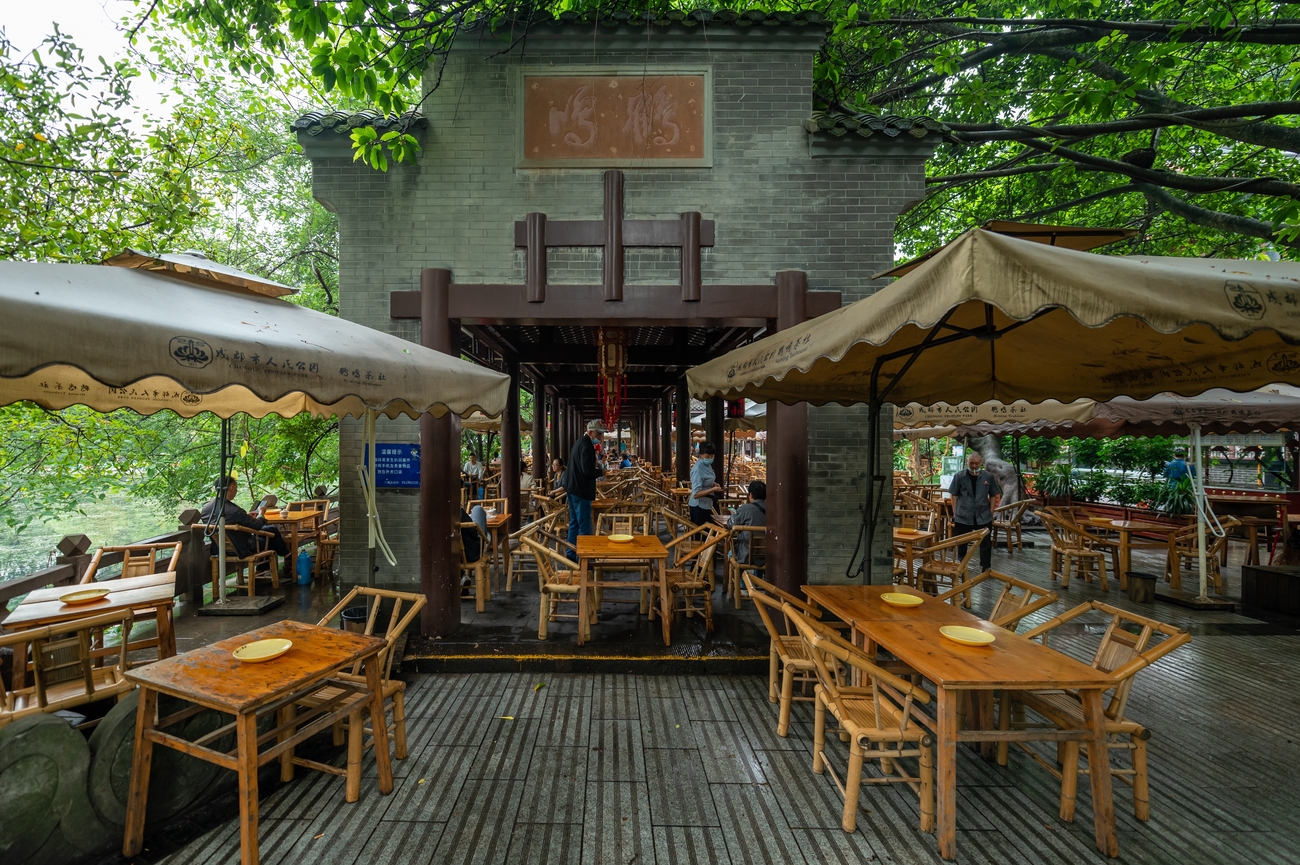
Chengdu has more teahouses per capita than any other city in China. Heming Teahouse in People’s Park, open since 1923, fills every morning with residents who have nowhere specific to be and consider this a feature rather than a problem. Green tea arrives in covered gaiwan bowls. The ambient sound is mahjong tiles and the particular quality of conversation between people who have known each other for decades.
The teahouse is the context in which the hotpot table makes complete sense. A city that builds its daytime around the teahouse pace builds its evenings around a meal that does not rush. Chengdu hotpot takes between two and three hours. The ingredient plates arrive throughout. The broth grows richer as the evening deepens. Nobody is in a hurry, and nobody pretends otherwise.
The Food
Alongside the Mountain
The sacred mountain that sits 90 kilometres southwest of Chengdu has been the site of continuous Buddhist practice for two thousand years. The monks who ascend to the Golden Summit each morning and the vendors who light the charcoal beneath the hotpot pots each evening share a province shaped by the same mountains and the same particular quality of Sichuan air. The day on the mountain and the evening at the hotpot table belong to the same journey.

What Xi'an
Adds to the Story
Xi’an’s food culture, which comes earlier on this route, tells a different story about what street food can be: thirteen centuries of Silk Road flavour deposited in one neighbourhood, cumin and lamb and flatbread torn by hand into broth. The two cities hold the most distinct regional food identities on the entire journey and can be found in our guide to Xi’an’s Muslim Quarter.

The
Geography of Sichuan Flavour
The Sichuan cuisine identity is inseparable from the geography that produced it.
The Sichuan Basin is enclosed on three sides by mountains, the fourth opening south towards Yunnan. The climate inside is humid and mild, the fog settling thick in winter, the summers hot and wet. This specific microclimate produces the conditions in which Pixian Doubanjiang ferments correctly, in which the particular mould cultures that give the paste its character thrive, and in which the preserved vegetables and fermented black beans across the cuisine develop their specific depth.
The traditional argument in Chinese medicine held that the basin’s humidity required spicy food to drive perspiration and reduce internal dampness. Whether or not the logic holds medically, the result is a cuisine built around heat, fermentation, and the preservation techniques that the climate made both necessary and possible. The Sichuan peppercorn grows natively in the surrounding mountains. The chilli arrived late and fit immediately. The geography was waiting for it.

The
Burn That Stays on the Right Side of the Line
Chengdu’s food reputation travels. The hotpot restaurants, the Mapo Tofu, the Dan Dan Noodles, the Kung Pao Chicken: all of them have spread across the world in versions that approximate the original and rarely match it.
The gap between the international approximation and the actual dish, eaten in Chengdu, from the broth or paste that can only be made here, is the gap between knowing a song and hearing it performed by the person who wrote it.
The málà sensation, the specific sequence in which the Sichuan peppercorn’s tingle precedes the chilli’s heat, is not reproducible outside the right ingredients in the right proportions with the right Pixian Doubanjiang underneath everything. It is a flavour that requires geography. It is a reason to go.

Still
Tasting It on the Flight Home
Chengdu hotpot and the city’s food culture as a living, UNESCO-recognised identity, from the teahouse mornings to the hotpot evenings to the specific dishes refined over 160 years since Mrs. Chen first fed tired porters by the bridge, is the part of the Sichuan route that stays longest after everything else has been processed and filed away. Not as a memory of a meal. As a physical memory. The kind that lives in the palate.
The evening at the hotpot table, the morning at the panda base, the sacred mountain between them: the Panda & Peaks journey holds all of it within a ten-day itinerary that gives each experience the time it deserves, with the reservations and local knowledge that turn a good evening into a great one.
Chengdu’s best hotpot tables do not hold themselves. Secure yours today.


Let us know what you love, where you want to go, and we’ll design a one-of-a-kind adventure you’ll never forget.
Get in touch
Miriam
Travel Specialist

Nina
Travel Specialist

Abigail
Travel Specialist
Our offices:



Revigorate, Iberian Escapes and Algarve Lifestyle are the registered brand names of APCS Lda . We are a fully authorised travel agency licensed by Turismo de Portugal RNAVT/6867.
In the event of a dispute, the consumer may refer to: RAL - Centros de Arbitragem
Avª. 5 de Outubro, nº. 55, R/C Dtº. 8000-075 Faro, Portugal | Tel: +351 289 823 135 *
* national landline call
E-mail: info@consumoalgarve.pt| www.consumidoronline.pt | Mon to Fri: 9:00 - 13:00 / 14:00 - 17:00