Mt. Emei: The Sacred Buddhist Mountain Above Chengdu
Mt. Emei is one of China’s most important sacred Buddhist mountains, rising above Sichuan with ancient temples, forested slopes, the Golden Summit and sweeping views from 3,079 metres above sea level.
At some point during the ascent, the clouds drop below you. The cable car rises through a white wall of mist and then, in the final minutes, the platform at the Golden Summit emerges into open sky. Below, the surrounding valleys disappear. Neighbouring peaks appear like islands in a white ocean, while the copper-gilt statue of Samantabhadra catches the early light above the summit.
This is what Mt. Emei feels like at altitude, and why pilgrims and travellers have been drawn here for centuries.
The Sichuan route that brings travellers to this mountain, from Beijing’s imperial core through Xi’an’s ancient streets and Chengdu’s panda-filled mornings, is mapped in our complete Panda & Peaks guide.

Mt.
Emei: Where Buddhism Took Root in China
Mt. Emei is recognised as the site where Buddhism first established itself on Chinese soil. The religion arrived from India via the Silk Road trade routes in the 1st century CE, carried east by monks and merchants through Central Asia into Chang’an. Mt. Emei, rising from the southwestern edge of the Sichuan Basin, is where a monk named Pu Gong encountered Samantabhadra Bodhisattva on its summit and built the first Buddhist temple in China. The temple that stands at the Golden Summit today, Huazang Temple, received its current name in 1614 under the Ming Dynasty. Its founding story reaches back two thousand years before that.
The same Silk Road routes that carried Buddhism to Mt. Emei carried Arab and Persian merchants east to Xi’an, where they settled for thirteen centuries and built the Great Mosque on Huajue Lane. That story belongs to a different mountain city, and it is told in full in our guide to Xi’an’s Muslim Quarter.
Mt. Emei is one of the Four Sacred Buddhist Mountains of China, alongside Wutai, Jiuhua, and Putuo. Each is associated with a specific Bodhisattva: Wutai with Manjushri, Jiuhua with Ksitigarbha, Putuo with Guanyin. Mt. Emei belongs to Samantabhadra, the Bodhisattva of virtuous action and kind deeds, whose mount is a white elephant with six tusks. His presence on this mountain is not metaphorical. Every temple, every carved surface, every piece of ceremonial bronze on the Emeishan UNESCO heritage site is oriented toward him.
UNESCO inscribed Mt. Emei and the Leshan Giant Buddha as a joint Mixed Cultural and Natural Heritage Site in 1996, recognising both the Buddhist historical significance and the mountain’s extraordinary biodiversity. Over 3,200 vegetation types grow across its subtropical, temperate, and subalpine zones. Some of its trees are over a thousand years old. The rare dove tree, Davidia involucrata, called the ghost tree for the white bracts that flutter from its branches in spring, grows here in numbers not found elsewhere in Sichuan. The mountain has been called a plants kingdom, an animal paradise, and a geological museum. All three descriptions are accurate.

The
Mt. Emei Ascent from Baoguo Temple to the Golden Summit
Mt. Emei does not begin at the Golden Summit. It begins at Baoguo Temple, approximately 550 metres above sea level, and the mountain reveals itself across the full vertical distance between them.
Baoguo Temple, built during the Wanli Emperor’s reign between 1572 and 1620, is the mountain’s administrative heart and primary entry point. Its grounds hold the Seven-Storey Huayan Pagoda, which contains a complete Tripitaka, the Buddhist canonical texts, cast in bronze. The complex also houses the Shengji Bell, cast in 1564, which weighs 12.5 tonnes. When it rings, the sound carries for fifteen kilometres across the valley below.
The ascent from Baoguo Temple to the Golden Summit covers roughly 50 kilometres of mountain terrain through six distinct climate zones. The route passes through bamboo forest giving way to ancient tree stands, then through the alpine zone where the vegetation thins and the temperature drops sharply as elevation rises. In the middle sections, the path is often shrouded in mist, the light diffuse and white, the surrounding slopes visible only in suggestions. Emei Shan is hard to capture in photographs or video. Much of the path is shrouded in otherworldly mists, which float through and obscure the path and the views out over the dramatically plunging slopes. It is the movement of the mystical clouds, the chill of the cold mountain forests, and the epic sense of history that give the route its appeal.
The practical reality of visiting Mt. Emei on a single day from Chengdu is this: the eco-bus from Baoguo Temple carries visitors to Leidongping at 2,430 metres, from where the Golden Summit cable car covers the final ascent to 3,079 metres in ten minutes. The cable car costs CNY 65 one-way. Mountain entry ticket is CNY 160 per person. The full day runs comfortably with this combination, leaving time for both the summit and Wannian Temple on the descent.

Wannian
Temple: Mt. Emei’s Oldest Surviving Temple
Wannian Temple, at 1,020 metres, was founded in 399 CE during the Eastern Jin Dynasty. It is the oldest surviving temple on Mt. Emei and among the oldest active Buddhist temples in China. It is famous for two treasures: a Ming Dynasty beamless brick hall and a 7.85-metre-tall bronze statue of Samantabhadra from the Song Dynasty.
The beamless brick hall is worth the specific attention its name suggests. Built during the Wanli period using a self-supporting dome construction without internal wooden beams, it has survived eighteen earthquakes over four centuries. The engineering solution, a brick vault that distributes load without the timber framework that most structures of its period relied upon, was arrived at by builders who had no modern structural theory behind them. The hall has outlasted every other building of its generation on this mountain.
The bronze Samantabhadra statue inside it was cast during the Northern Song Dynasty in the 10th century, 7.85 metres high and weighing approximately 62 tonnes. The Bodhisattva is seated on his white elephant, which stands on a lotus base above a stone platform. The casting is intricate enough that Song Dynasty craftsmen are believed to have cast it in sections and assembled it on-site. Eight hundred years of incense smoke have darkened the bronze to a deep amber in places. The statue was made before the Wannian Temple that now houses it. It has been here longer than the building itself.
The Wannian cable car, a separate system from the Golden Summit cable car, reduces the ascent from a two-hour climb to eight minutes. The forested walk from the cable car terminus to the temple gates is fifteen minutes through ancient trees. It is among the most atmospheric approaches on the mountain.

The
Tibetan Macaques of Mt. Emei
Between Wannian Temple and the Xixiangchi area at 2,070 metres, the mountain belongs partly to its primates.
The Tibetan macaques that inhabit Mt. Emei’s middle slopes are wild animals. They have coexisted with pilgrims and visitors for centuries and have developed what might charitably be described as a pragmatic attitude towards human presence. They are not aggressive by default, but they are opportunistic, and they have decades of experience extracting food from visitors who did not intend to offer it. The standard guidance is consistent: lock backpacks, do not make eye contact, do not eat in front of them, and follow the guide’s instructions when moving through the monkey areas.
They are also, in their environment, genuinely impressive animals. A fully grown male Tibetan macaque weighs up to 13 kilograms, with a distinctive pink face that becomes redder during mating season. The troops at Mt. Emei number in the hundreds and occupy specific territorial ranges on the mountain’s middle slopes. Watching one cross a path five metres ahead, unhurried and entirely authoritative, is a reminder that the mountain was theirs before it was anyone’s pilgrimage site.
The monkeys on Mt. Emei are well known and very active during the summer. Because they have lived alongside visitors for generations, many are used to human presence. They are not tame. They have simply been around long enough to have no fear, which is a different thing entirely.

The
Golden Summit and the Four Wonders of Mt. Emei
The Golden Summit of Mt. Emei sits at 3,079 metres. The highest peak, Wanfo Ding, at 3,099 metres, is closed for ecological protection. The cable car from Leidongping takes ten minutes and arrives at a platform that, on clear days, opens to a view across the Sichuan Basin and westward towards the snow-capped peaks of the Tibetan Plateau.
Huazang Temple occupies the summit platform. At this elevation it is China’s highest active Buddhist temple, classified as one of the national Han Chinese Buddhist temples in 1983. Morning prayer begins at 5:30 AM. Monks in grey and saffron robes move through the temple’s courtyard while the sky is still dark and the surrounding peaks are invisible beneath clouds. The sound of the prayer carries across the platform in the cold air.
The defining image of Mt. Emei stands beside the temple: the Samantabhadra statue, 48 metres of copper-gilt bronze, ten faces of the Buddha arranged across three tiers corresponding to his Ten Great Vows, weighing 660 tonnes, completed in 2006. The height, 48 metres, is taken from Buddhist scripture and refers to the 48 Vows of Amitabha Buddha. When sunlight strikes the gilded surface, the reflection is visible from the Chengdu plains 90 kilometres distant. The name Golden Summit is not metaphorical.
The summit is known for four specific natural phenomena.
The Sunrise
At 3,079 metres, the horizon is unobstructed in every direction. For the best sunrise views, aim for 5:30 AM in summer and 7:00 AM in winter. The pre-dawn sky over the Sichuan Basin opens gradually: a line of colour at the horizon, then the red glow spreading, then the sun clearing the horizon line and sending its first light across the copper-gilt Samantabhadra in a moment that explains, viscerally, why this mountain has been a pilgrimage destination for two thousand years.
The Sea of Clouds
On sunny days, when the sky is clear and blue, rising clouds from the surrounding mountains and valleys spread across the horizon like a white blanket. As the wind gathers or drops, the cloud blocks form, drift and break apart, turning the visible peaks into islands over and over again. The best viewing window is between 9:00 and 10:00 AM or between 15:00 and 17:30. In summer, the evening cloud sea that forms as warm air rises from the basin is particularly dramatic.
The Buddha's Halo
The rarest and most sought-after of the four wonders. Rainbow rings appear around a person’s shadow in the cloud sea below the summit. The phenomenon is an optical effect produced when sunlight strikes the cloud layer from behind an observer, creating a circular iridescent halo around their own shadow on the clouds. Every person who witnesses it sees only their own shadow at the halo’s centre. The best time to witness this phenomenon is between 2 PM and 5 PM, and it occurs approximately every five days. You are most likely to see the Buddha’s Halo in the afternoon after a rain shower.
The Sacred Lamps
The least predictable of the four. On moonless nights following clear weather, floating green lights appear in the valleys below the summit, coalescing and dispersing in patterns that have resisted explanation for centuries. The phenomenon requires four specific conditions: clear weather after rain, no moon, no cloud cover at the mountain’s base, and no heavy wind at the summit. It is rare and is observed here more consistently than anywhere else in China.

The
Buddhist Temple Circuit on Mt. Emei
Between Baoguo Temple at the base and Huazang Temple at the summit, the mountain holds a sequence of significant temple stops. Not every traveller reaches all of them on a single day. The ones worth knowing:
- Qingyin Pavilion, at approximately 710 metres, stands at the confluence of two clear mountain streams. Its name means “Pavilion of Pure Sound”, and the sound of the two streams meeting below its bridge is the most cited sensory experience on the mountain’s lower slopes. The pavilion’s twin bridges face each other across the confluence and the surrounding forest is old growth, the canopy high and filtering the light into long afternoon shafts.
- Xixiangchi Temple, at 2,070 metres, sits in the middle altitude zone and its name means “Elephant Bathing Pool”, referring to the legend that Samantabhadra bathed his white elephant in the pool here. This is the zone where the Tibetan macaques are most active and where the temperature drops noticeably from the lower slopes. Night Moon over the Elephant Washing Pool is one of the Ten Classic Sceneries in Mt. Emei. When the bright moon hangs high in the sky, moonlight covers the fir forest and the pool in silver.
- Jieyin Hall, at approximately 2,900 metres, is the last stopping point before the cable car to the Golden Summit. The alpine azaleas that flower on the approach path in early summer, covering the ground in purple and red, make the pre-cable car section of the ascent one of the mountain’s more distinctive seasonal experiences. The 450-year-old azalea tree near Leidongping, 13 metres high and 2.7 metres in diameter, is the oldest on the mountain.
The morning at the Chengdu panda base that precedes this mountain sits in a different register entirely, closer, warmer, organised around an animal rather than an altitude. The full panda base experience, the conservation science behind 240 giant pandas, and the nurseries where the breeding programme becomes visible are covered in our Chengdu Panda Base guide.
Revigorate’s China Panda & Peaks journey arranges the Mt. Emei day with timing built around the Golden Summit’s best windows and a guide who carries the Buddhist history across every temple stop rather than leaving it to signs.

The
Leshan Giant Buddha Near Mt. Emei
The Leshan Giant Buddha is not on Mt. Emei. It is 35 kilometres away, carved into the cliff of Mount Lingyun at the confluence of the Min, Dadu, and Qingyi rivers. It belongs to the same UNESCO inscription and to the same day.
Construction began in 713 AD when the monk Haitong, watching boatmen drown in the dangerous confluence, believed that a Buddha overlooking the waters would calm their currents and protect the people who worked them. He spent decades fundraising, lost his sight in a confrontation with a corrupt official who demanded his funds, and was still overseeing the project when he died. His successor completed it in 803 AD. Total construction: ninety years.
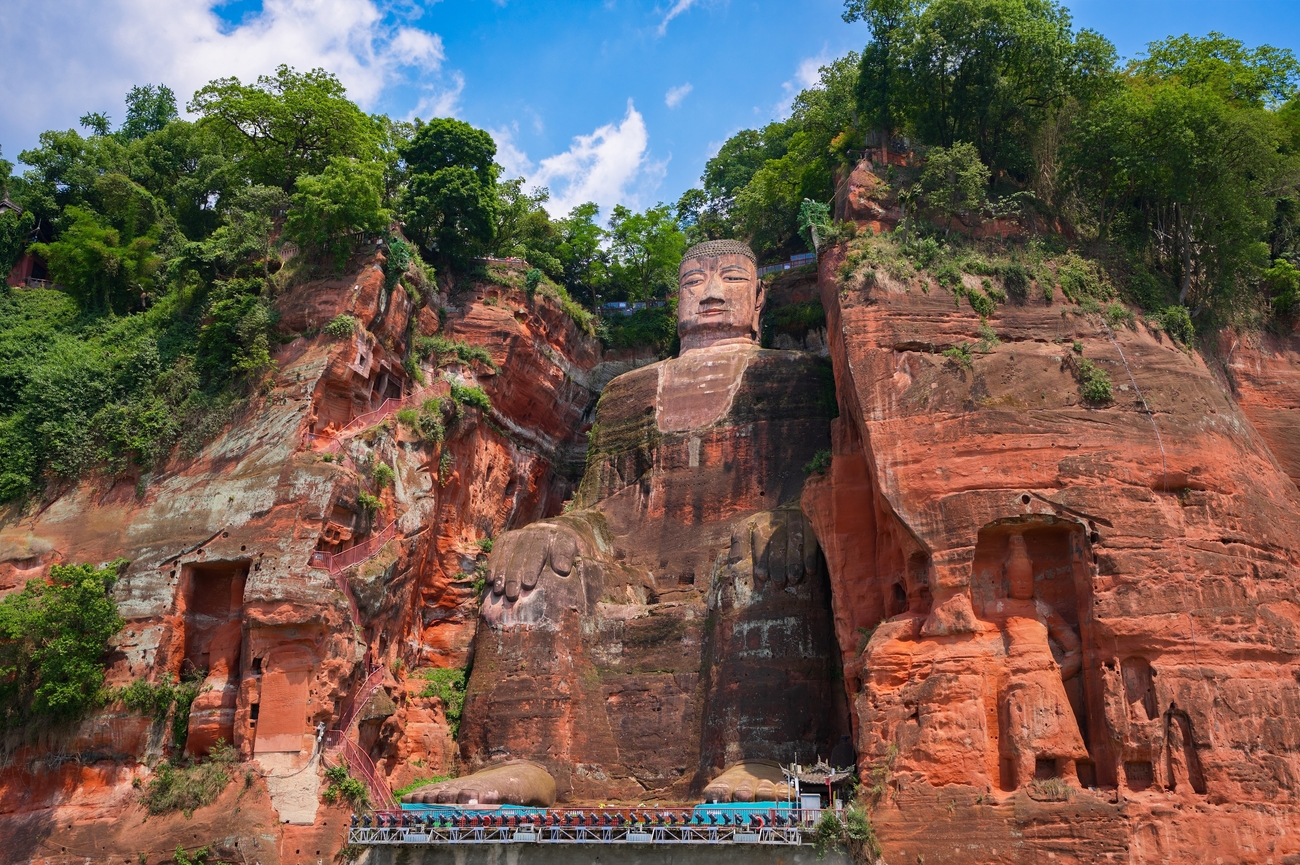
At 71 metres, the Leshan Giant Buddha is the largest carved stone Buddha in the world and the largest pre-modern statue of any kind. It is seated in the form of Maitreya, the Future Buddha, with feet resting at river level and a head that rises to the top of the surrounding cliff. A drainage system carved into its hair, collar, and sleeve folds has protected the stone from water erosion for over 1,200 years. The drainage channels are invisible from most viewing angles. The engineering that preserves the statue from the river mist and seasonal flooding is built into the sculpture itself.
The scale becomes comprehensible from the water. The boat approach from the river below is the only perspective that shows all 71 metres simultaneously, with the cliff above, the river level at the feet, and the surrounding landscape visible for context. From the cliff-side stairs, which descend past the ears and nose in a route that puts individual features at eye level, the total scale is harder to grasp than from the water.
Buddhism began to spread from Mount Emei as early as the 1st century AD. The Leshan Giant Buddha was carved six centuries after the first temple was built on Mt. Emei’s summit. Both monuments exist within the same UNESCO inscription. The same morning that includes the Emeishan UNESCO heritage site includes the Buddha at the river’s confluence, and the boat that shows it properly is forty minutes from the mountain’s base.
What
Mt. Emei’s Buddhist Temples Reveal About the Mountain
Thirty active Buddhist temples on a single mountain, distributed from 550 metres to 3,079 metres of elevation, represent something more than a collection of religious buildings. They represent an unbroken chain of practice stretching from the 1st century to the present.
The monks at Huazang Temple on the Golden Summit begin morning prayer at 5:30 AM. The monks at Wannian Temple below them have maintained their practice at 1,020 metres since 399 CE. The incense burning in the Baoguo Temple courtyards at the mountain’s base has been lit every morning for over four centuries. The Four Sacred Buddhist Mountains of China designation is formal recognition of a reality that predates the designation by two millennia.
For travellers moving through China on a first journey, Mt. Emei is where the country’s relationship with Buddhism becomes tangible in a way that temple visits in the cities cannot quite approximate. The temples in Beijing and Xi’an are monuments. The temples on Mt. Emei are functioning institutions. The pilgrims climbing the stairs alongside visitors are not recreating a historical practice. They are continuing one.
The Chengdu that the mountain returns to in the evening is a city whose character was shaped by this mountain’s proximity. The hotpot table, the teahouse culture, the particular unhurried quality of a city that has had a sacred mountain at its shoulder for two thousand years: all of that is covered in our Sichuan food guide.

Practical
Notes
- Tickets: Mountain entry CNY 160. Wannian cable car CNY 65 up, CNY 45 down. Golden Summit cable car CNY 65 up, CNY 55 down. Eco-bus from Baoguo to Leidongping CNY 90 return.
- Getting there: High-speed rail from Chengdu to Emeishan Station takes approximately 1.5 hours. Bus No. 8 runs directly from the station to the scenic area.
- What to bring: The temperature difference between the mountain's base and the Golden Summit can reach 15 degrees Celsius. Even in summer, the summit requires an additional layer. Rain gear is practical at any time of year. The summit receives over 300 days of mist or cloud annually.
- Best seasons: Spring (April to May) for alpine azaleas and moderate temperatures. Autumn (September to October) for stable weather and the highest frequency of the Buddha's Halo phenomenon. Winter for sunrise visibility and the clearest sea of clouds, though temperatures at the summit can reach minus 10 degrees Celsius.
- The macaque zones: Concentrated between Wannian Temple and Xixiangchi. Keep food inside locked bags and follow the guide's instructions when passing through these areas.

The Mountain That Stays in the Peripheral Vision
Some things that happen at altitude feel diminished once you descend. The sea of clouds at the Golden Summit, the peaks below you like islands in a white ocean, the copper-gilt statue above them in clear sky: that one holds.
Mt. Emei has been drawing people to this specific elevation for two thousand years. The reasons have changed across the centuries. What has not changed is the view from the platform and the particular quality of standing above the clouds on a mountain where the first Buddhist temple in China was built and monks still begin morning prayer at 5:30 AM.
The Sichuan route that brings you to this mountain places it between the panda base in Chengdu and the flight to Shanghai, between an encounter with conservation science and the arrival at China’s most globally facing city. The Emeishan UNESCO heritage site sits at the centre of that sequence and earns its place there.
Revigorate’s China Panda & Peaks journey arranges this day within a ten-day itinerary that gives Mt. Emei the time it deserves rather than the time that is left over.
The mountain repays that arrangement.



Let us know what you love, where you want to go, and we’ll design a one-of-a-kind adventure you’ll never forget.
Get in touch
Miriam
Travel Specialist

Nina
Travel Specialist

Abigail
Travel Specialist
Our offices:



Revigorate, Iberian Escapes and Algarve Lifestyle are the registered brand names of APCS Lda . We are a fully authorised travel agency licensed by Turismo de Portugal RNAVT/6867.
In the event of a dispute, the consumer may refer to: RAL - Centros de Arbitragem
Avª. 5 de Outubro, nº. 55, R/C Dtº. 8000-075 Faro, Portugal | Tel: +351 289 823 135 *
* national landline call
E-mail: info@consumoalgarve.pt| www.consumidoronline.pt | Mon to Fri: 9:00 - 13:00 / 14:00 - 17:00