Tibetan Buddhism and the Monastery Circuit from Lhasa to Shigatse

Butter lamps. Juniper smoke. Prayer flags in five colours above the mountain passes between Lhasa and Shigatse. The deep sound of a dung chen horn before the monastery gates open. The sharp clap of a monk’s hands during afternoon debate at Sera Monastery.
Our Tibetan monastery circuit is a private journey from Lhasa to Shigatse designed to reveal Tibetan Buddhism as a living tradition. Over several days, it connects Jokhang Temple and the Barkhor pilgrimage circuit in Lhasa with Sera Monastery, Drepung Monastery, Gyantse, the Kumbum Stupa and Tashilhunpo Monastery in Shigatse.
This is not simply a sequence of historic religious sites. Each stop reveals a different expression of Tibetan Buddhist life: pilgrimage at Jokhang, monastic debate at Sera, scholarship and religious authority at Drepung, sacred art at the Kumbum Stupa and continuing ritual practice at Tashilhunpo. Together, they show how Tibetan Buddhism is expressed through learning, architecture, ceremony, devotion and daily life.
The road between the monasteries matters as much as the institutions themselves. It crosses high mountain passes, follows the turquoise waters of Yamdrok Lake and moves through a plateau landscape where religion, geography and Tibetan culture remain inseparable.
Our Tibet Heritage Route guide places this monastery journey within the wider story of Tibetan civilisation, from its origins in the Yarlung Valley to the religious centres of Lhasa and Shigatse. The timing of the journey is deliberate. Each institution is visited when its traditions are most visible, whether during the morning kora around Jokhang Temple, the afternoon debates at Sera or the early rhythm of Tashilhunpo before the main visitor groups arrive.
This is Tibetan Buddhism made visible across a landscape, and the road between Lhasa and Shigatse is as important to understanding it as the monasteries themselves.

Understanding
Tibetan Buddhism Before the Monastery Visits
Arriving at Sera Monastery without understanding the debate tradition is arriving at the opera without knowing the language. The physical spectacle is extraordinary regardless. But the specific thing happening in the courtyard, and why it has been happening in that specific courtyard every afternoon since 1419, requires a framework that the building itself cannot supply.
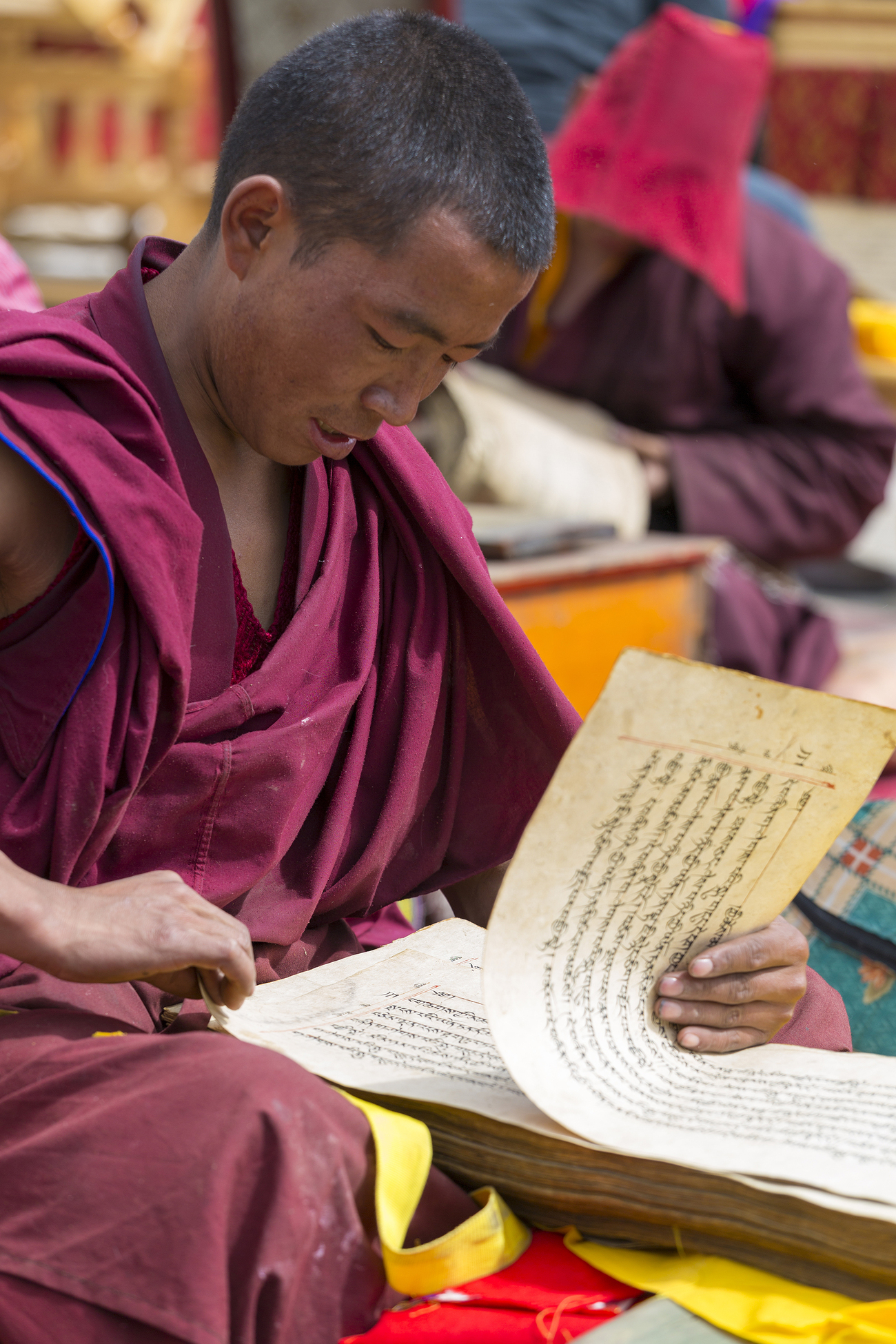
The framework is this: Tibetan Buddhism arrived in Tibet from India in the 7th century and took a form unique to the plateau, emphasising tantric practice, elaborate ritual, and the reincarnation of awakened masters into successive living bodies. The Gelugpa school, founded by Tsongkhapa in the late 14th century, codified this tradition through monastic debate as its primary educational method. A Gelugpa monk earns his degrees not through written examinations but through the ability to defend philosophical positions under aggressive challenge, at speed, in front of peers who are actively trying to demolish his reasoning.
The monasteries on the Tibetan Buddhism monastery circuit from Lhasa to Shigatse are all Gelugpa institutions. They are not preservation sites. They are schools, still running the same curriculum Tsongkhapa established six centuries ago, with living students and active faculty and a practice that continues whether visitors arrive to observe it or not.
Visiting the monasteries between Lhasa and Shigatse is far more rewarding when you understand the tradition behind them. Without that context, Sera Monastery's debate courtyard may look dramatic but confusing. With context, it becomes one of the clearest examples of how Tibetan Buddhist learning is still practised today.
Tibetan Buddhism developed from Indian Buddhism, which reached Tibet from the 7th century onwards. Over time, it took a form shaped by the plateau's geography, culture and spiritual traditions. It places strong emphasis on ritual practice, meditation, monastic learning, sacred art, reincarnation lineages and the guidance of realised teachers.
The monastery circuit on the Tibet Heritage Route is closely connected with the Gelugpa school of Tibetan Buddhism. Founded by Tsongkhapa in the late 14th century, the Gelugpa tradition became one of the most influential schools in Tibet and is closely associated with both the Dalai Lama and the Panchen Lama.
One of the defining features of Gelugpa monastic education is debate. Monks are trained to defend philosophical ideas through fast, disciplined exchanges with their peers. The hand claps and gestures seen at Sera are not performance for visitors. They are part of a serious intellectual method used to test memory, logic and understanding.
This matters because the monasteries on the route are not simply heritage buildings. They are places of learning, worship and daily practice. Sera, Drepung, Gyantse and Tashilhunpo are connected by a living tradition that continues whether visitors are present or not. Understanding that changes the experience completely.
Lhasa:
The Circuit's First Monasteries
The monastery circuit begins in Lhasa, the spiritual heart of Tibet and home to some of the most important institutions in Tibetan Buddhism. Before reaching the great monasteries of Sera, Drepung and Tashilhunpo, the journey starts at the Jokhang Temple, the most sacred pilgrimage destination on the Tibetan Plateau.
The Jokhang
Temple and the Barkhor Circuit
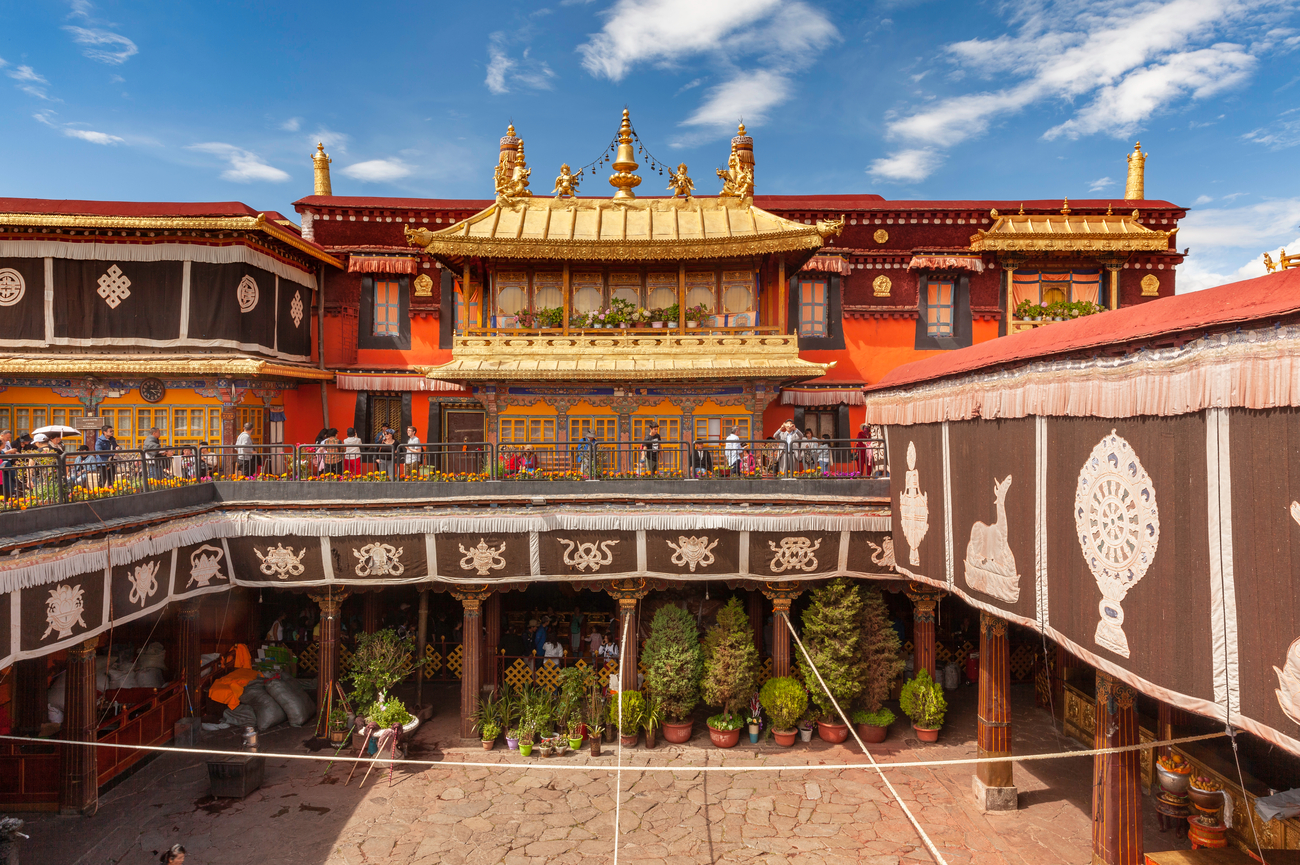
Founded in the 7th century by King Songtsen Gampo, the Jokhang Temple was built to house the Jowo Rinpoche, one of the most revered images of Buddha Shakyamuni in Tibetan Buddhism. For centuries, pilgrims have travelled across mountains, valleys and high-altitude plateaus to pray before this sacred image, making the Jokhang one of the most important religious destinations in Tibet.
Around the temple runs the Barkhor Circuit, an 800-metre kora route walked clockwise by pilgrims throughout the day. The atmosphere is especially powerful in the early morning, when prayer wheels turn steadily, butter lamps flicker inside the chapels and pilgrims begin their circuit through the old city. Unlike many historic religious sites around the world, the Jokhang remains a fully functioning place of worship, with daily ceremonies, offerings and devotional practice continuing as they have for generations.
The Jokhang Temple and the Potala Palace together form the spiritual and historical centre of Lhasa. While the Jokhang represents the devotional heart of Tibetan Buddhism, the Potala Palace reflects the political, religious and cultural authority that shaped Tibet for centuries. Our guide to the Potala Palace explores this relationship in greater depth.
Sera
Monastery: The Debate Tradition
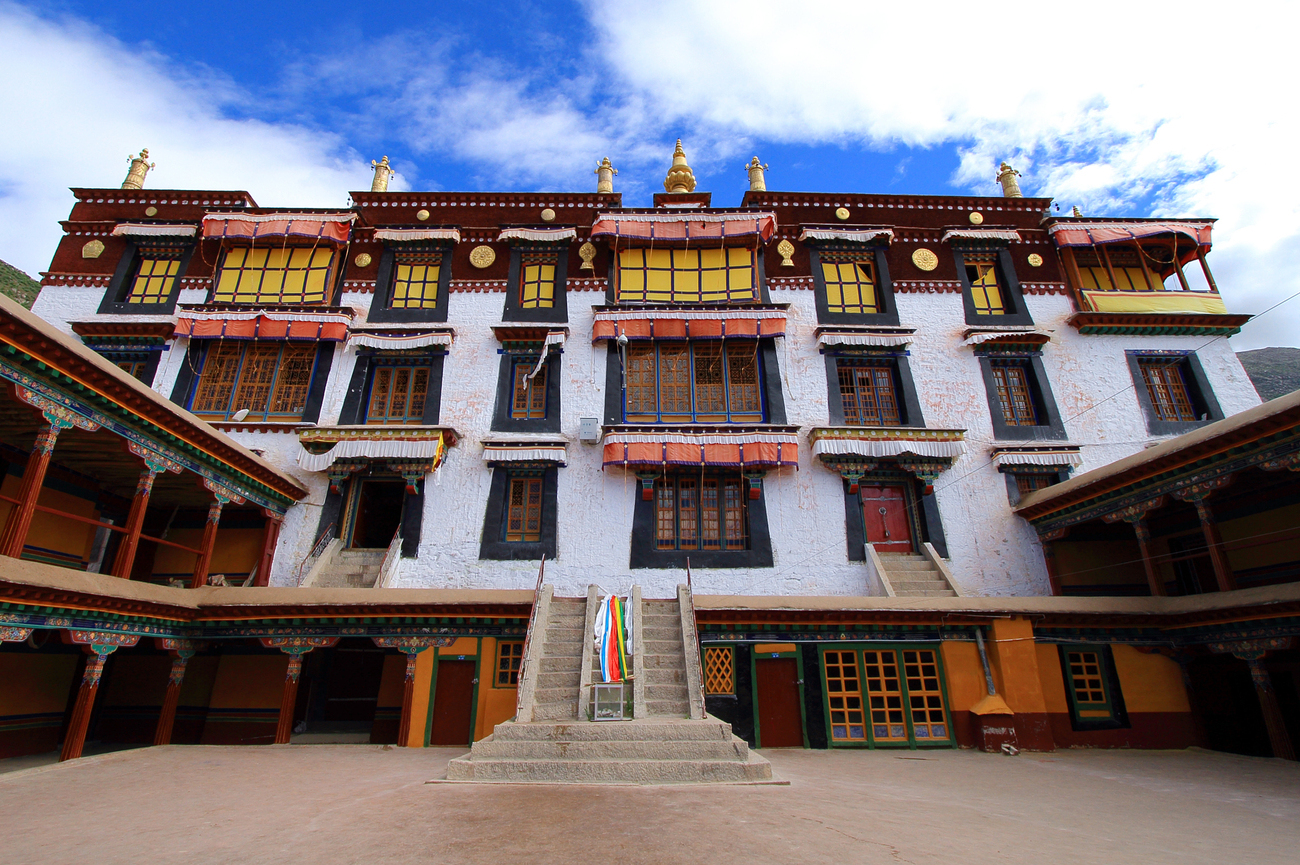
Located on the northern edge of Lhasa beneath the slopes of Tatipu Hill, Sera Monastery was founded in 1419 by Jamchen Chojey, one of Tsongkhapa's closest disciples. It quickly became one of the great centres of learning within the Gelugpa tradition and remains one of the most important monasteries in Tibet today.
The monastery is divided into several monastic colleges, each dedicated to different aspects of Buddhist study. Assembly halls, chapels, libraries and residential buildings form a large religious community that continues to function as a centre of education and practice.
Among its many highlights are the richly decorated chapels, historic scriptures and sacred images housed throughout the complex. The Great Assembly Hall remains one of the monastery's most impressive spaces, with towering wooden columns, detailed murals and large Buddhist statues reflecting centuries of religious patronage and scholarship.
The monastery is best known internationally for its debate courtyard. Every afternoon except Sunday, monks gather to debate Buddhist philosophy using a method that has been central to Gelugpa education for centuries. The format combines rigorous logic, memorisation and philosophical reasoning. Monks challenge one another through rapid exchanges punctuated by distinctive hand claps and physical gestures.
For visitors, the debate courtyard is often one of the most memorable experiences in Tibet. The energy, concentration and intensity are immediately apparent, even without understanding the Tibetan language. What appears theatrical at first quickly reveals itself as a serious intellectual tradition that remains central to monastic education today.
As the monastery chapels generally close before the debate sessions begin, it is best to explore the interior halls first before moving to the courtyard to watch the afternoon debates.

Drepung
Monastery: The Great Monastic City
Founded in 1416 by Jamyang Choje, Drepung Monastery sits on the hills west of Lhasa and was once the largest monastery in the world. At its height, it housed approximately 10,000 monks and played a central role in the religious, educational and political life of Tibet.
The name Drepung means "rice heap", a reference to the appearance of its white buildings cascading across the hillside. From a distance, the monastery resembles a vast settlement rather than a single religious institution.
Several Dalai Lamas received their education here, and before the expansion of the Potala Palace, the Ganden Palace within Drepung served as the residence of the Dalai Lama. Visiting these halls provides important context for understanding how the institution that later moved to Red Mountain first developed.
Drepung's scale is one of its defining characteristics. Assembly halls, monastic colleges, courtyards, chapels and residential quarters spread across the hillside, reflecting centuries of expansion rather than a single construction programme. Walking through the complex reveals the scale of Tibetan monastic life in a way that few other religious sites can match.
Together, the Jokhang Temple, Sera Monastery and Drepung Monastery provide the essential foundation for understanding Tibetan Buddhism before the journey continues westward across the plateau toward Gyantse and Shigatse.
The
Road West: From Lhasa to Gyantse
The journey from Lhasa to Gyantse covers approximately 260 kilometres and crosses some of the most dramatic landscapes on the monastery circuit. This is not simply a transfer between religious sites. It is a gradual movement from the sacred institutions of Lhasa into the open scale of the Tibetan Plateau.
Within the first hour, the city gives way to agricultural valleys, rising roads and wide grassland. As the altitude increases, the landscape becomes more open and the sense of distance changes. Mountains that seemed far away from Lhasa appear closer, only to reveal more peaks beyond them. The plateau unfolds gradually, and the road itself becomes part of the spiritual and visual experience.
Kamba Pass and
Yamdrok Lake
The Kamba Pass, at 4,794 metres above sea level, offers one of the most famous views in Tibet. From the summit, Yamdrok Lake appears far below, its turquoise water curving through the mountains. At 4,441 metres above sea level, Yamdrok is one of the three great sacred lakes of Tibet and holds deep significance within Tibetan Buddhist belief.
The lake stretches for approximately 72 kilometres, with arms and inlets extending beyond the first shoreline visible from the pass. Its colour changes with the light, shifting from bright turquoise to deeper blue as the day moves on. Prayer flags flutter at the summit, yaks graze on the surrounding slopes and the descent towards the lakeshore slowly reveals the true scale of the water below.
For many travellers, this is the moment when the Tibetan Plateau becomes fully visible. The monastery circuit is not only about temples and chapels. It is also about the sacred geography that surrounds them.

Gyantse and
the Kumbum Stupa
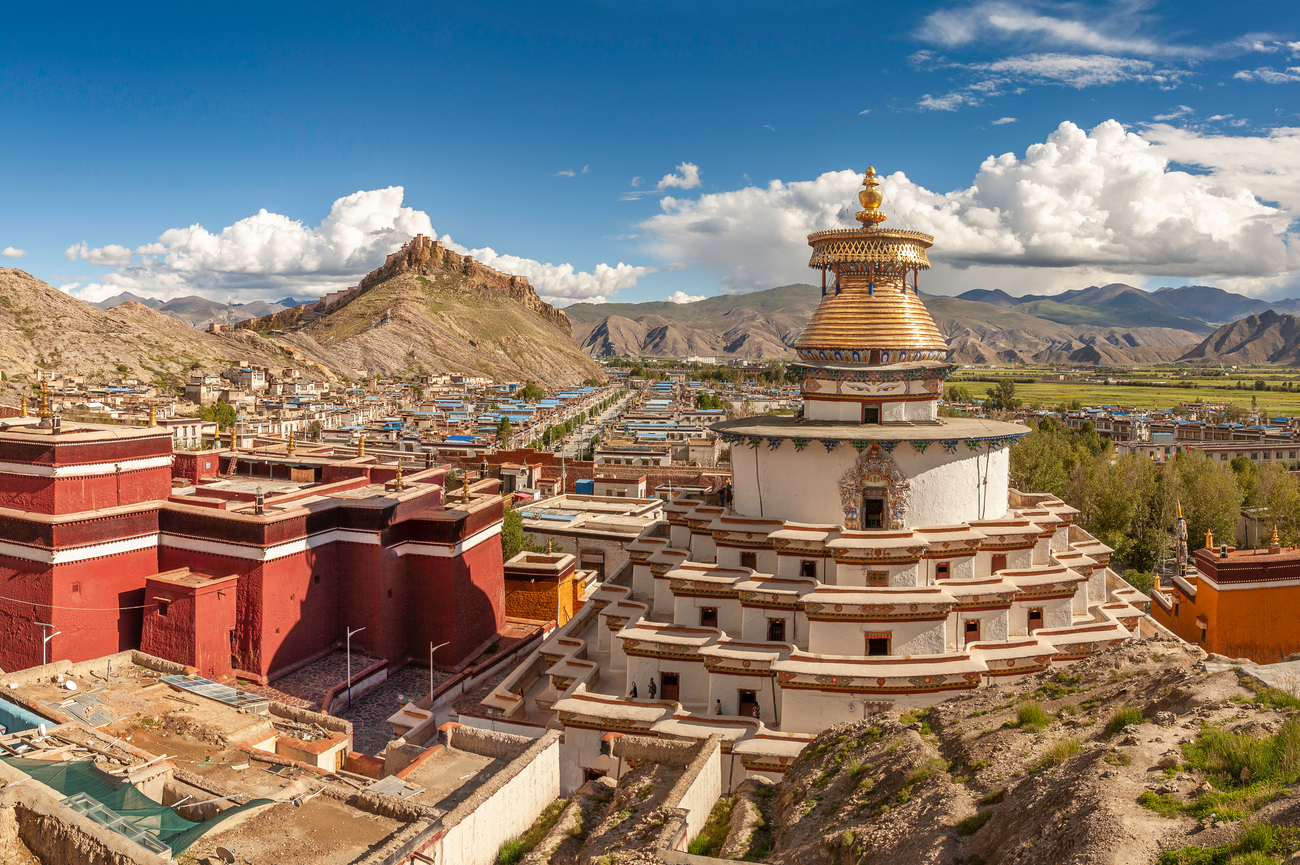
Gyantse sits at 3,977 metres in the Nyang Chu Valley and is one of Tibet's most important historic towns. Its main religious landmark is the Palkhor Monastery complex, home to the remarkable Kumbum Stupa.
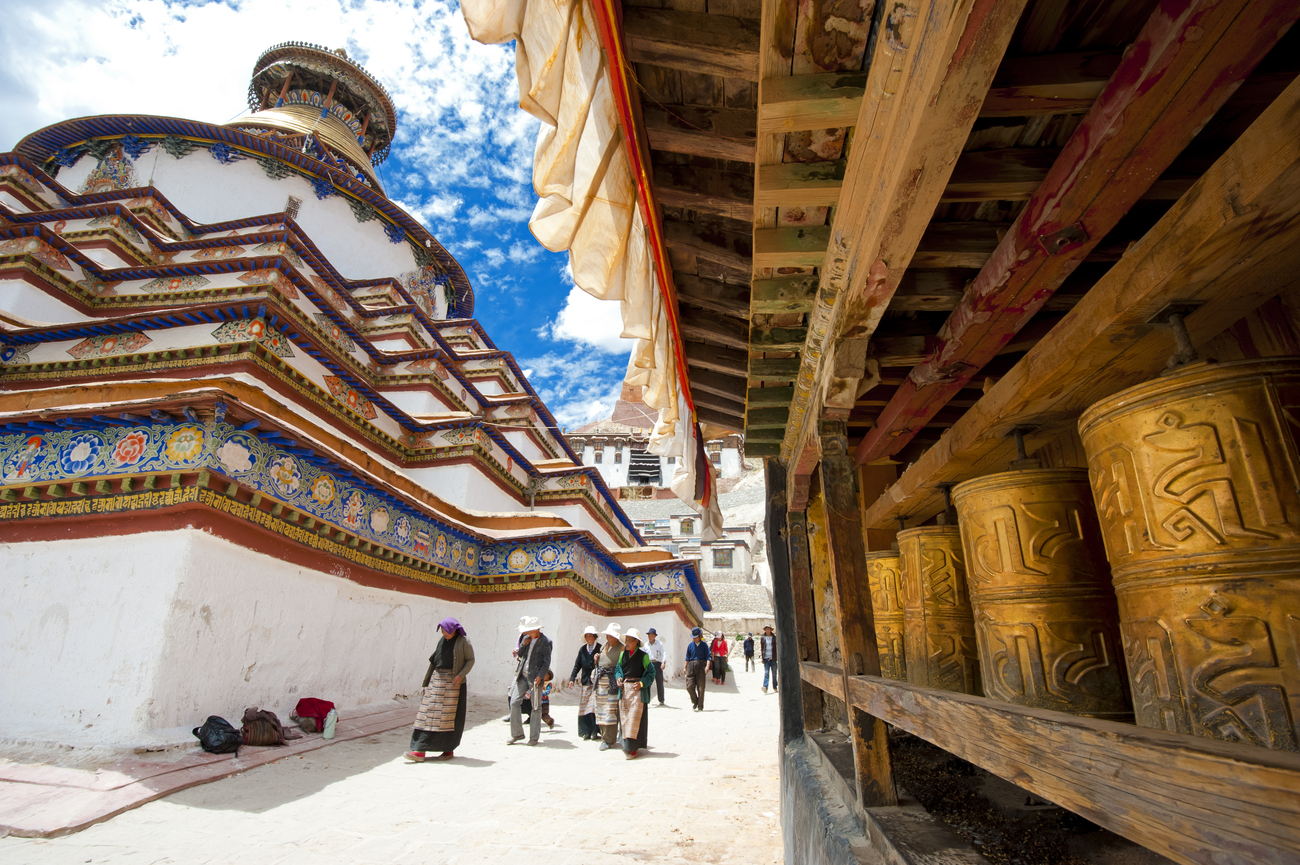
Built in 1440, the Kumbum Stupa rises through nine levels and contains 108 chapels. Its name means "one hundred thousand images", referring to the extraordinary concentration of Buddhist paintings, sculptures and sacred imagery within. Moving through the stupa is a physical journey through Tibetan Buddhist cosmology, from protective deities and guardian figures to mandala imagery and sacred spaces near the summit.
The wider Palkhor Monastery complex also contains important murals, assembly halls and working religious spaces maintained by resident monks. Walking the kora around the monastery offers views across the complex and the surrounding Nyang Chu Valley, helping visitors understand the relationship between the monastery, the town and the landscape around them.
Above Gyantse stands Gyantse Dzong, the hilltop fortress that overlooks the valley. It is closely associated with Tibetan resistance during the British Younghusband Expedition of 1903 to 1904. Today, the accessible parts of the fort provide one of the best elevated views of the Palkhor Monastery complex and the town below.
Gyantse marks an important stage in the journey west. After Lhasa's great institutions and Yamdrok Lake's sacred landscape, the Kumbum Stupa brings the monastery circuit back into focus through art, architecture and centuries of Buddhist devotion.
Tashilhunpo
Monastery: The Circuit's Destination
The white walls and golden rooflines of Tashilhunpo Monastery are visible as the road approaches Shigatse, rising above the city on the southern slope of Nyiseri Mountain. This is one of the great religious institutions of Tibet and the final major monastery on the circuit from Lhasa to Shigatse.
Tashilhunpo was founded in 1447 by Gedun Drupa, who was later recognised as the First Dalai Lama. It became the traditional seat of the Panchen Lama, the second-highest reincarnate lineage in the Gelugpa tradition after the Dalai Lama. For Shigatse, Tashilhunpo has long served as a religious centre, monastic university, political institution and place of pilgrimage.
Today, Tashilhunpo remains an active monastery with a resident monastic community. Its chapels, courtyards, assembly halls, stupas and kora path show Tibetan Buddhism not as something preserved only for visitors, but as a living practice that continues in daily use.

The Chapel of
Jampa
One of the most powerful spaces inside Tashilhunpo is the Chapel of Jampa, also known as the Maitreya Chapel. It contains a vast gilded statue of Maitreya, the Future Buddha, built during the time of the Ninth Panchen Lama in the early 20th century.
The chapel was constructed around the statue rather than the statue being placed inside an existing room. This gives the space its extraordinary vertical scale. Looking up at the gilded figure from below is one of the most memorable interior experiences on the monastery circuit.
The Panchen
Lama Tombs
Tashilhunpo is also known for the tombs and funerary stupas of the Panchen Lamas. These sacred structures preserve the memory and remains of important religious leaders in the Gelugpa tradition.
The tomb of the Fourth Panchen Lama was rebuilt after the damage of the Cultural Revolution, while the stupa of the Tenth Panchen Lama was completed in the 1990s. Together, these spaces connect Tashilhunpo's religious authority with the long history of the Panchen Lama lineage.
The Morning
Kora
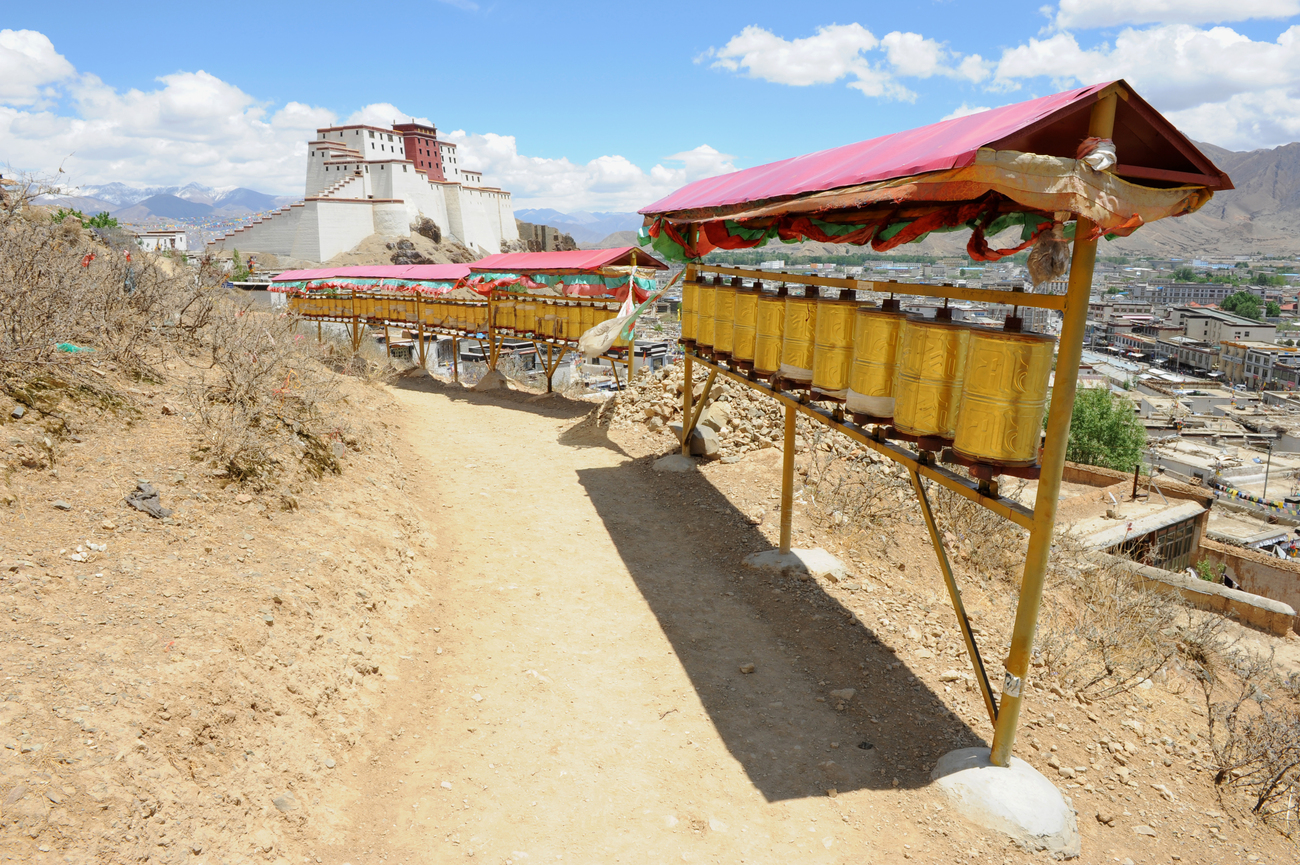
The kora around Tashilhunpo is one of the most rewarding experiences in Shigatse. The circuit takes approximately 40 minutes at a steady pace and offers views across the monastery, Shigatse and the surrounding hills.
The best time to walk it is in the morning, before larger groups arrive from Lhasa. At this hour, pilgrims move clockwise around the monastery, monks pass between buildings, butter-lamp offerings are renewed and chanting can sometimes be heard from the assembly halls. The rhythm is slower, quieter and more devotional.
Tashilhunpo brings the monastery circuit to a natural conclusion. After the Jokhang's pilgrimage life, Sera's debate tradition, Drepung's monastic scale and Gyantse's sacred art, Shigatse reveals the continuing authority of the Panchen Lama's seat and the living practice of one of Tibet's great monasteries.
Samye Monastery near Tsedang, founded in 779 AD, is where this tradition first took institutional form. That beginning is explored in our guide to Tsedang and the Yarlung Valley.
What
the Tibetan Monastery Circuit Reveals
The monastery circuit from Lhasa to Shigatse brings together the essential expressions of Tibetan Buddhist life: the morning pilgrims at the Jokhang Temple, the afternoon debates at Sera, the vast monastic scale of Drepung, the 108 chapels of the Kumbum Stupa and the living religious community at Tashilhunpo.
These are not separate experiences. They are connected parts of the same tradition, encountered at different scales and different moments across the Tibetan Plateau. The Jokhang reveals pilgrimage. Sera reveals learning and debate. Drepung reveals monastic education and institutional scale. Gyantse reveals sacred art and Buddhist symbolism. Tashilhunpo reveals continuity, authority and daily practice.
The road between them gives the journey its coherence. Travelling from Lhasa to Gyantse and onward to Shigatse allows each monastery to be understood in relation to the next, rather than as an isolated site. This is what makes the circuit so powerful: it shows Tibetan Buddhism not only through buildings, but through movement, landscape, ritual and time.
Across wars, political upheaval, the Cultural Revolution and the complexities of contemporary Tibet, these places continue to hold religious meaning. Eight days on the plateau gives travellers enough time to see that continuity properly, not as a museum record, but as a living tradition.
578
Years of Morning Practice
Tashilhunpo is at its most powerful in the morning, when pilgrims are already walking the kora, butter-lamp smoke rises from the chapels and monks cross the courtyards in burgundy robes. Long after the details of the journey have settled, this is often the moment that remains most clearly.
It may not be the scale of the Maitreya Chapel, the 108 chapels of the Kumbum Stupa or even the energy of the Sera debate courtyard that stays with you most. It may be the quieter experience of walking clockwise around Tashilhunpo beside pilgrims who are following a path used since the monastery was founded in 1447.
The pace is part of the meaning. The kora is not arranged around an itinerary. It follows the rhythm of the monastery itself, shaped by prayer, repetition and daily devotion.
September mornings at Tashilhunpo are especially memorable, as the plateau air is clear and the monastery feels fully awake before the day becomes busy.
That morning is closer than it seems.


Let us know what you love, where you want to go, and we’ll design a one-of-a-kind adventure you’ll never forget.
Get in touch
Miriam
Travel Specialist

Nina
Travel Specialist
Abigail
Travel Specialist
Our offices:



Revigorate, Iberian Escapes and Algarve Lifestyle are the registered brand names of APCS Lda . We are a fully authorised travel agency licensed by Turismo de Portugal RNAVT/6867.
In the event of a dispute, the consumer may refer to: RAL - Centros de Arbitragem
Avª. 5 de Outubro, nº. 55, R/C Dtº. 8000-075 Faro, Portugal | Tel: +351 289 823 135 *
* national landline call
E-mail: info@consumoalgarve.pt| www.consumidoronline.pt | Mon to Fri: 9:00 - 13:00 / 14:00 - 17:00