The Potala Palace: The Sacred Palace Above Lhasa

At dawn, while the Lhasa Valley below Red Mountain is still in shadow, the white walls of the Potala Palace are already catching the first light. Moments later, the ochre-red walls of the Red Palace begin to glow beneath gilded rooftops set against one of Tibet’s deepest blue skies. The city below is only just waking. The palace above appears timeless.
Butter-lamp smoke drifts through its chapels. Prayer flags stir across nearby rooftops. The stone steps leading towards the entrance are still cool from the night air. The earliest palace on this site was founded in the seventh century, while much of the complex seen today was constructed and expanded under the Fifth Dalai Lama from the seventeenth century onwards.
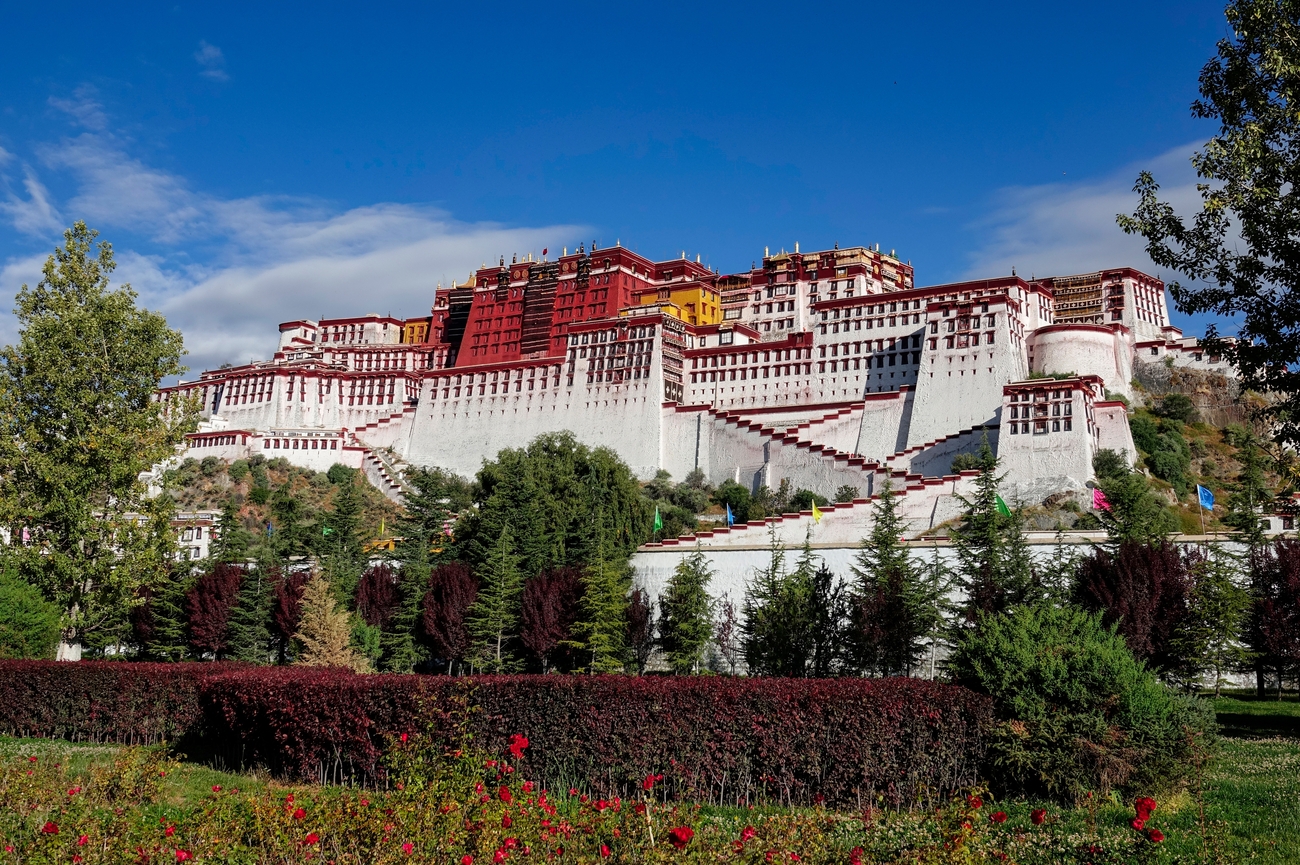
Nothing fully prepares you for seeing the Potala Palace for the first time. Photographs capture the building, but rarely convey its scale, its position on Red Mountain above the Lhasa Valley or the atmosphere created by the altitude, light and surrounding mountains. It feels larger than architecture alone.
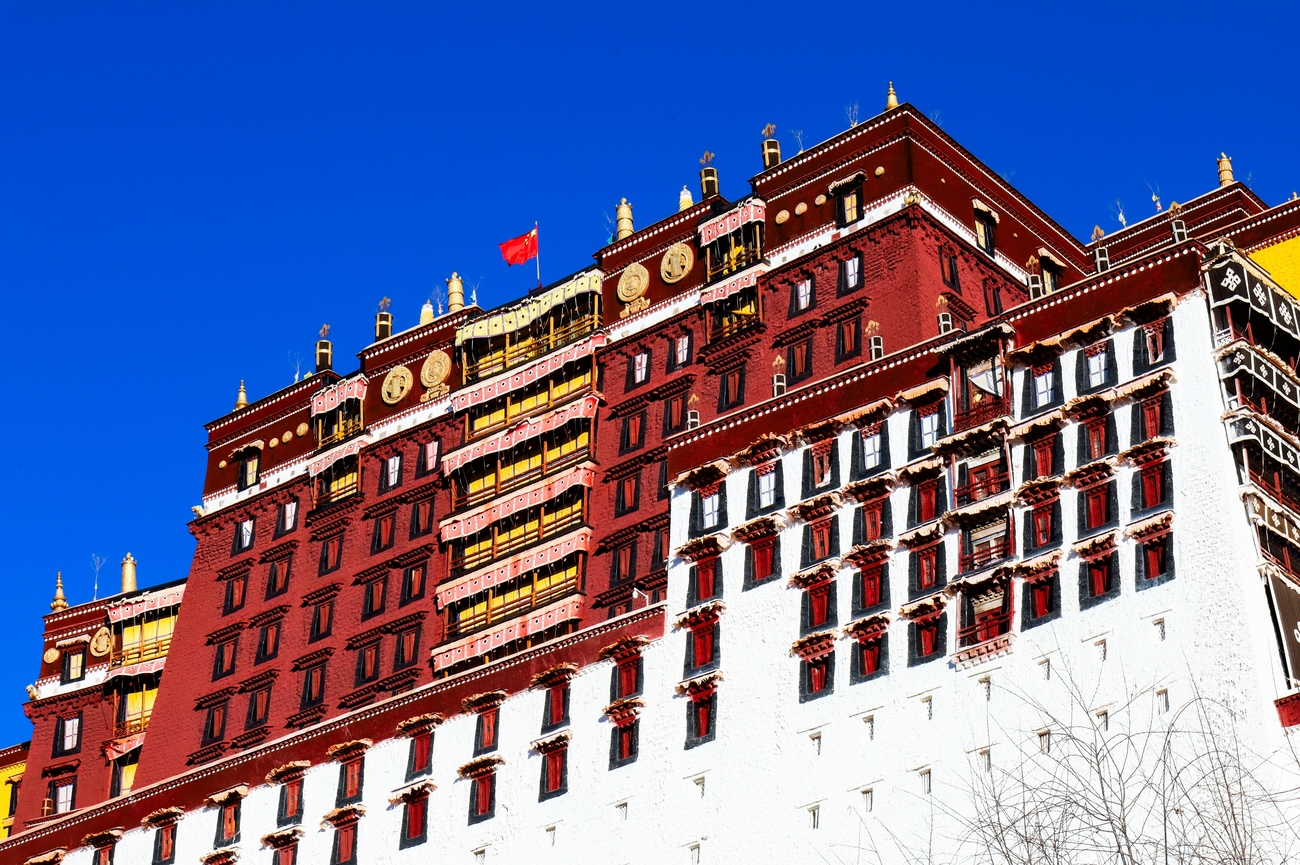
The Potala Palace is one of Tibet’s defining landmarks and one of the most important monuments associated with Tibetan Buddhism and the historic government of Tibet. The UNESCO-listed complex comprises the White Palace, the Red Palace and their surrounding buildings at an altitude of approximately 3,700 metres. The White Palace contained ceremonial and residential spaces connected with the Dalai Lamas, while the Red Palace became the spiritual heart of the complex, with chapels, shrines and funerary stupas.
Understanding the Potala Palace properly means understanding the history, religion, architecture and civilisation that produced it. The wider story of how the palace fits into Tibet’s cultural landscape is explored in our Tibet Heritage Route guide, while the complete journey that brings you here forms part of our Tibet Heritage Route vacation.

Red
Mountain and the Origins of the Potala Palace
Red Mountain, known in Tibetan as Marpo Ri, was a sacred site long before the Potala Palace dominated the Lhasa skyline. Its association with Avalokiteshvara, the Bodhisattva of Compassion, predates the palace by centuries and helps explain why this particular hill became the spiritual and political centre of Tibet.
At the heart of the complex lies the Phakpa Lhakhang, a cave traditionally associated with King Songtsen Gampo in the 7th century. According to Tibetan tradition, this was used as his personal meditation retreat. The palace that visitors see today grew around this sacred space over many centuries, expanding upward and outward as successive rulers and religious leaders added new halls, chapels, stupas and residences.
This gradual development is one of the reasons the Potala Palace feels different from many royal residences around the world. It was not designed and built in a single period. Instead, it evolved over more than a millennium into a complex that reflects the religious, political and cultural history of Tibet itself.

Songtsen Gampo
and the First Palace
The first palace on Red Mountain was built by King Songtsen Gampo in the early 7th century after he moved his capital from the Yarlung Valley to Lhasa. Positioned above the valley floor, it served as both a royal residence and a fortified seat of power.
Most of this original structure was destroyed over the centuries through warfare, natural disasters and political upheaval. What remained was the sacred importance of the site and the traditions associated with it.
The connection between the Potala Palace and the Yarlung Valley is significant. Before establishing Lhasa as his capital, Songtsen Gampo ruled from the Yarlung Valley, the birthplace of Tibetan civilisation. He is closely associated with both Yumbulagang Palace and the early development of Lhasa, linking the beginning of the Tibetan kingdom with the city that would become its spiritual centre. Our guide to Tsedang and the Yarlung Valley explores the origins of Tibetan kingship and the foundations that made Lhasa possible.

The Fifth
Dalai Lama's Great Reconstruction
The Potala Palace as it appears today is largely the work of the Fifth Dalai Lama, Ngawang Lobsang Gyatso. After consolidating political and religious authority across Tibet in 1642, he chose Red Mountain as the site for a new seat of government and began construction of the palace in 1645.
The White Palace was completed in 1648 and became both the residence of the Dalai Lama and the administrative centre of Tibet. Its construction symbolised the unification of political authority and religious leadership within a single institution.
The Red Palace followed later and was completed in 1693. It houses the most sacred parts of the complex, including chapels, libraries, assembly halls and the stupas of several Dalai Lamas. One of the most remarkable episodes in Tibetan history surrounds its construction. After the death of the Fifth Dalai Lama in 1690, his regent, Sangye Gyatso, concealed the news for many years to ensure the project could continue without political instability interrupting the work.
Successive Dalai Lamas expanded and enriched the palace over the following centuries, adding new chapels, ceremonial spaces and funerary stupas. The complex reached its present form during the early 20th century. The Fourteenth Dalai Lama lived here until 1959, when he left Tibet. No Dalai Lama has resided in the Potala Palace since.
Today, the palace stands not only as the most recognisable landmark in Tibet but also as a physical record of more than thirteen centuries of Tibetan history.

The
Ascent to the Potala Palace
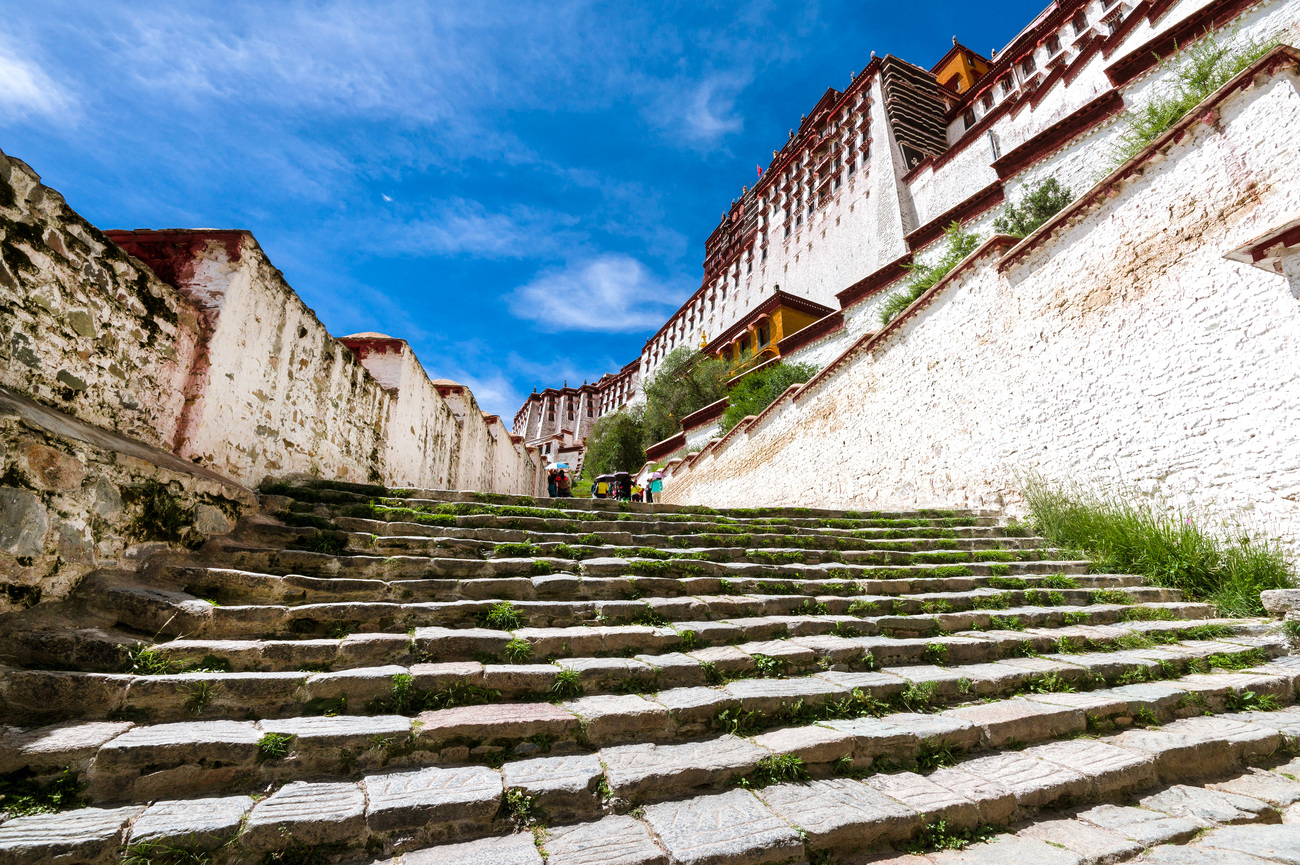
The visit to the Potala Palace begins before you enter the building. From the base of Red Mountain, the approach rises steadily towards the palace entrance, with Lhasa falling away below and the white and red walls of the complex growing larger above you.
This ascent is part of the experience. At approximately 3,700 metres above sea level, the climb feels different from a palace visit at lower altitude. The body works harder, the pace naturally slows and the height of the building becomes physical rather than simply visual. By the time you reach the entrance, the palace has already made its scale clear.
The 300 Steps
at 3,700 Metres
Around 300 stone steps lead from the lower approach to the palace entrance. The climb can be demanding at altitude, which is why visitors are usually advised to spend time acclimatising in Lhasa before attempting the visit. On the Tibet Heritage Route, this pacing is built into the journey so that the Potala Palace is approached with enough time for the body to adjust.
The steps themselves are part of the palace's history. Their stone surfaces have been worn smooth by generations of pilgrims, monks, officials and dignitaries who made the same climb when the palace was still a functioning seat of power. The route up Red Mountain is not only practical. It is a physical connection to the centuries of people who approached the palace before you.
The Eastern
Courtyard
The Eastern Courtyard, known as Deyang Shar, is one of the first major spaces encountered inside the palace complex. This large open courtyard was historically used for Tibetan opera, Cham dance and important religious ceremonies.
From here, the full scale of the palace becomes easier to understand. The Red Palace rises above the courtyard, its ochre walls and gilded roofs visible at close range. Murals on the surrounding walls record important scenes from Tibetan history, including Songtsen Gampo's original palace, the construction of the Jokhang Temple and the arrival of the sacred Sakyamuni image from China.
The courtyard gives visitors a moment to pause before entering the more enclosed interiors of the White and Red Palaces. It is one of the few places where the building's exterior, ceremonial function and historical storytelling can be experienced together.
The
White Palace: Government, Ceremony and Residence
The White Palace is the administrative and residential heart of the Potala Palace. While the Red Palace above it contains the complex's most sacred chapels and funerary stupas, the White Palace was where Tibet was governed and where the Dalai Lama lived.
This balance between political authority and religious leadership is central to understanding the Potala Palace. The two functions were not separated into different worlds. They existed within the same building. From the White Palace, the Dalai Lama could move between residence, government chambers, ceremonial halls and the sacred spaces of the Red Palace above.
The Throne
Room and Ceremonial Halls
The Throne Room is one of the most important spaces in the White Palace. It was used for formal ceremonies connected with the Dalai Lama's role as both spiritual and temporal leader of Tibet. The throne, raised above the room, represents the authority of the institution as much as the individual who occupied it.
Other ceremonial halls within the White Palace were used for major occasions, official gatherings and religious-political ceremonies. Large pillars, painted beams, ceremonial furnishings and historic murals give these rooms their formal character. The decoration is not simply ornamental. It records the events, relationships and traditions that shaped Tibet's political and religious life.
The murals throughout the White Palace act as a visual history of Tibet. They show the founding of the Tibetan empire, the spread of Buddhism, the relationship between Tibet and neighbouring powers, and scenes connected with the lives of successive Dalai Lamas. Created with traditional pigments, many still retain remarkable colour and detail.
The Dalai
Lama's Private Quarters
The private rooms associated with the Fourteenth Dalai Lama occupy the upper levels of the White Palace. They have been preserved largely as they were when he left Tibet in 1959. Compared with the ceremonial rooms below, these spaces are modest and practical, with personal objects, books, maps and furniture offering a more intimate view of life inside the palace.
This contrast is one of the most affecting parts of the visit. The Throne Room shows the scale of the institution. The private quarters reveal the person within it. Together, they show why the Potala Palace cannot be understood only as a monument. It was a seat of government, a residence, a place of ceremony and a sacred building, all contained within one extraordinary structure.
The
Red Palace: The Sacred Interior
Moving from the White Palace into the Red Palace, the atmosphere changes completely. The spaces become darker and more enclosed. The murals are denser, the smell of butter lamps is stronger and the sound of the city outside disappears.
This is the most sacred part of the Potala Palace. While the White Palace was connected with government, residence and ceremony, the Red Palace was built around worship, memory and devotion. Its chapels, stupas, murals and sacred objects hold some of the most important religious and artistic treasures in Tibet.
The Dalai Lama
Stupas
The Red Palace contains the funerary stupas of several Dalai Lamas. These elaborate structures house the remains of the spiritual leaders who once lived and ruled from the palace. They are among the most important sacred spaces in the complex.
The most famous is the stupa of the Fifth Dalai Lama, housed in the Serdung Lhakhang. It is the largest and most ornate of the palace stupas, richly decorated with gold, precious stones and religious ornamentation. It was completed in 1693, after the death of the Fifth Dalai Lama, whose role in rebuilding the Potala Palace made him one of the most important figures in its history.
The stupa of the Thirteenth Dalai Lama, completed in the 20th century, is also highly significant. Its decoration records moments from the later history of Tibet, combining religious commemoration with political memory. In this way, the stupas are not only devotional monuments. They are also historical records, preserving the lives and legacies of the Dalai Lamas within the palace itself.
The Red Palace and the White Palace create one of the strongest contrasts in the complex. Above and around the sacred stupas are the ceremonial spaces, administrative halls and private rooms of the Dalai Lama. The result is a building where government, personal life, religious devotion and remembrance are inseparably connected.
The Murals of
the Red Palace
The corridors and chapels of the Red Palace are covered with murals that form one of the most important visual records of Tibetan history and Buddhist belief. They depict the life of the Buddha, the spread of Buddhism into Tibet, the Yarlung Dynasty, the Dalai Lama lineage and the religious imagery of the Gelugpa tradition.
These murals are not simply decorative. They help explain the world that produced the Potala Palace. Walking through the corridors, visitors move through painted histories, sacred stories and symbolic images that connect Tibet's mythology, politics and religion.
The Great West Hall is one of the most important mural spaces in the Red Palace. Sometimes described as a historical gallery, it contains paintings connected with major religious and political events, including moments from the life of the Fifth Dalai Lama. The hall also contains precious objects, ceremonial items and historic gifts associated with the palace's long history.
The Potala Palace also preserves a vast collection of thangka paintings, statues, ritual objects, seals, robes and gifts from different periods of Tibetan history. The scale of the collection is far greater than any single visit can fully absorb, which is why a knowledgeable guide is so important when moving through the palace's timed route.
The Phakpa
Lhakhang
The Phakpa Lhakhang, also known as the Chapel of the Dharma King, is one of the oldest and most sacred areas of the Potala Palace. It is closely associated with King Songtsen Gampo and the earliest sacred use of Red Mountain.
The chapel contains images connected with Songtsen Gampo and Princess Wencheng, as well as sacred objects associated with the early history of Buddhism in Tibet. Its darkness, butter lamps and age give it a very different atmosphere from the larger ceremonial spaces elsewhere in the palace.
For many Tibetan pilgrims, the Phakpa Lhakhang is one of the most important parts of the entire complex. It is the spiritual centre around which the later palace developed, and it explains why Red Mountain became more than a strategic hill above Lhasa. It became one of the sacred places of Tibet.
The
View From the Roof
The roof terrace of the White Palace offers one of the most memorable views in the Potala Palace complex. From this height, the geography of Lhasa becomes clear. The city spreads across the valley floor, the Lhasa River lies to the south, and mountains surround the capital on every side.
At approximately 3,750 metres above sea level, the terrace gives visitors a sense of why Red Mountain was chosen as the site of the palace. The position is commanding, defensive and symbolic. From here, the Potala Palace feels not only like a building above the city, but like the point from which Lhasa's sacred and political geography can be understood.
The golden roofs of the Red Palace are visible at close range, with the ochre walls rising above the White Palace terrace. Looking outward, the old Tibetan quarter lies in the distance, where the Jokhang Temple and the Barkhor Circuit form the devotional heart of the city. Pilgrims continue their clockwise kora at street level while visitors stand high above them on the palace roof.
This view connects the main elements of Lhasa in a single moment: the Potala Palace on Red Mountain, the Jokhang Temple in the old city, the Barkhor pilgrimage circuit and the valley landscape that holds them all. Our guide to the Tibetan monastery circuit explores the Jokhang, the Barkhor, Sera Monastery and Drepung Monastery in more depth.
Practical
Notes for the Visit
Visiting the Potala Palace requires advance planning. Entry is controlled, the visit follows a fixed route and the altitude makes pacing important. These practical details are not minor. They shape how much you are able to enjoy and understand the experience.
- Tickets and booking: Visitor numbers are limited each day, and advance booking is required. For international travellers, tickets are usually arranged through the tour operator handling the Tibet Travel Permit, which is required to enter Tibet. During peak travel months, especially September and October, arrangements should be made well in advance.
- The prescribed route: Visitors usually enter through the east main entrance,
pass through the Eastern Courtyard, continue into the White Palace and then
move into the Red Palace before exiting through the north gate. The route is
controlled and cannot be freely reversed.
Time inside the palace is limited, so the visit is best approached with clear priorities. A knowledgeable guide makes a significant difference, helping you understand which halls, murals, chapels and viewpoints matter most within the available time.
- Photography: Photography is generally allowed in exterior areas such as the approach, courtyards and roof terraces. It is prohibited inside most chapels, halls and sacred spaces. As a result, many of the palace's most important interiors have to be experienced without a camera. The exterior can be photographed, but the interior is something you carry in memory.
- The altitude consideration: The Potala Palace sits at approximately 3,700 metres above sea level, and the approach involves around 300 steps. Visitors should spend time acclimatising before attempting the visit. The Tibet Heritage Route is paced so that the Potala Palace is not visited immediately on arrival, allowing the body more time to adjust before the ascent.
- The sunrise view: One of the best exterior views of the Potala Palace is from Chakpori Hill at sunrise. Before 7 AM, the first light catches the white and ochre walls while the valley below remains in shadow. This view does not require a palace ticket, but it does require an early start and the right positioning before the light changes.
The Palace That Defies Simple Definition
The Potala Palace has been a UNESCO World Heritage Site since 1994 and a major visitor attraction since the late 20th century. Yet neither designation fully explains what it is.
For more than three centuries, the Potala Palace functioned simultaneously as a royal residence, a seat of government, a monastery, a treasury, a library, a ceremonial centre and a sacred place of pilgrimage. Few buildings in the world have carried so many roles at once. Even today, it resists easy classification.
Visitors arrive to admire its architecture and history, but the palace remains connected to living traditions. Pilgrims continue to visit its sacred chapels. Butter lamps are still maintained. Religious devotion continues within a building that is also one of Asia's most important historic monuments.
This coexistence of history, faith and memory is what makes the Potala Palace different from many heritage sites. It is not simply a preserved relic of the past. It remains part of the cultural and spiritual landscape of Tibet.
Experiencing the palace with the wider context of Tibetan history behind it changes the visit considerably. Understanding the origins of Tibetan civilisation in the Yarlung Valley, the rise of Lhasa as a capital and the development of Tibetan Buddhism gives meaning to the halls, chapels and viewpoints encountered inside the complex.
That broader story is what the Tibet Heritage Route was designed to reveal. Beginning in the Yarlung Valley and continuing through Lhasa, Gyantse and Shigatse, the journey provides the historical and cultural context that allows the Potala Palace to be understood not simply as Tibet's most famous building, but as one of the defining monuments of an entire civilisation.
One Hour,
Thirteen Centuries
Butter-lamp smoke rises from somewhere inside the complex before the first visitors reach the top of the 300 steps. The building is already awake before you arrive.
Visitor numbers are limited, and time inside the palace is controlled. That makes preparation essential. A guide who knows which corridor murals to pause before, which stupa halls to explain, and how to make sense of centuries of history within a short visit can transform the experience.
The difference is simple: you can walk through the Potala Palace, or you can understand what you are seeing.


Let us know what you love, where you want to go, and we’ll design a one-of-a-kind adventure you’ll never forget.
Get in touch
Miriam
Travel Specialist

Nina
Travel Specialist

Abigail
Travel Specialist
Our offices:



Revigorate, Iberian Escapes and Algarve Lifestyle are the registered brand names of APCS Lda . We are a fully authorised travel agency licensed by Turismo de Portugal RNAVT/6867.
In the event of a dispute, the consumer may refer to: RAL - Centros de Arbitragem
Avª. 5 de Outubro, nº. 55, R/C Dtº. 8000-075 Faro, Portugal | Tel: +351 289 823 135 *
* national landline call
E-mail: info@consumoalgarve.pt| www.consumidoronline.pt | Mon to Fri: 9:00 - 13:00 / 14:00 - 17:00