Tibet Heritage: A Luxury Journey Across the Roof of the World

Lhasa slows you down before you choose to let it.
At approximately 3,650 metres above sea level, the lower atmospheric pressure means that each breath provides considerably less oxygen than it would at sea level. The body registers the difference soon after arrival. The walk from the arrivals hall takes longer than it should. The bags feel heavier. Then the sky begins to command your attention. At this altitude, the light above Lhasa appears deeper and more vivid, illuminating the white and ochre walls of the Potala Palace against the plateau.
Tibet requires this introduction. The altitude is not simply an inconvenience to be managed; it is the first thing the plateau teaches you about itself. This landscape operates at a different pace, under different conditions and according to rhythms that have shaped Tibetan civilisation for more than two thousand years.
The Tibet Heritage Route is an eight-day private journey through the cultural and spiritual heart of Tibet. It follows the development of Tibetan civilisation from the Yarlung Valley, widely associated with its earliest kings and dynasties, to the great religious centres of Lhasa and Shigatse.
Beginning in Tsedang, the route continues to Lhasa, where the UNESCO-listed Potala Palace and Jokhang Temple stand at the centre of Tibetan religious and political history. From there, it crosses the high plateau beside the turquoise waters of Yamdrok Lake before continuing towards Shigatse and the monasteries that remain central to Tibetan Buddhism today. The Potala Palace and Jokhang Temple form part of Lhasa’s UNESCO World Heritage ensemble.
Rather than simply linking Tibet’s most famous landmarks, the journey follows the development of Tibetan civilisation itself. Each destination builds upon the last, revealing how history, Buddhism, architecture, royal power and the geography of the plateau shaped one of the world’s most distinctive cultures.
Tibet is unlike anywhere else on Earth, and this itinerary was built around giving it the time it deserves.

Tsedang:
The Beginning of the Route
The Tibet Heritage Route starts in the Yarlung Valley before it reaches Lhasa, and this sequence is deliberate.
Tsedang sits at approximately 3,560 metres above sea level, making it one of the gentler places to begin a journey across the Tibetan plateau. Starting here gives the body time to adjust before the more demanding visits in Lhasa, while also placing the journey in its correct historical order. The Yarlung Valley is where Tibetan civilisation began. Arriving here before Lhasa means that the Potala Palace, the Jokhang Temple and the great monasteries that follow are understood as part of a longer story, not as isolated monuments.
The First
Kingdom
The first king of Tibet, Nyatri Tsenpo, established the first hereditary monarchy in the Yarlung Valley in approximately the 2nd century BC. According to Tibetan tradition, he descended from the heavens onto Yarlha Shampo Mountain above the valley. The local people carried him on their shoulders and made him king, giving him the name Nyatri Tsenpo, often understood as the “neck-enthroned king”.
The Yarlung Dynasty he founded continued for approximately 800 years. Its most influential ruler was Songtsen Gampo in the early 7th century AD. He unified the Tibetan plateau, moved the capital to Lhasa, supported the creation of the Tibetan script, helped introduce Buddhism into Tibet and established Tibet as one of Central Asia's major powers. Every major heritage site on this journey, from Lhasa to Shigatse, can be traced back to the dynasty that began in this valley.

Yumbulagang
Palace
Fourteen kilometres from Tsedang, on the east bank of the Yarlung River, Yumbulagang Palace stands on a ridge above the valley floor. It is widely regarded as the oldest palace in Tibet and one of the most important early sites in Tibetan history. Although much of the current structure dates from a 1982 reconstruction, the site and profile remain faithful to the original: a narrow tower rising from a rocky ridge, with wide views across the Yarlung Valley below.
Yumbulagang was built as the fortress-residence of King Nyatri Tsenpo. In the 5th century, Buddhist scriptures are said to have fallen from the heavens onto its roof. They were preserved but not understood until the Tibetan script was developed during the reign of Songtsen Gampo two centuries later. When Songtsen Gampo moved the capital to Lhasa, Yumbulagang was converted from a palace into a temple. Today, its chapel is consecrated to the ancient kings of Tibet, with a central Buddha image flanked by Nyatri Tsenpo and Songtsen Gampo.
The fields directly below the palace ridge are traditionally regarded as the first cultivated farmland in Tibet. They are still being farmed today. That continuity matters. From the ridge above them, Tsedang becomes more than a starting point on the map. It becomes the place where Tibet's political, agricultural and spiritual history first began to take form.
The full depth of the Yarlung Valley, including the royal tombs in the Chongye Valley, the Pearl Thangka at Tradruk Temple and the role Tsedang plays before Lhasa, is explored in our guide to Tsedang and the Yarlung Valley. Tsedang is where the route's oldest layer is found.

Samye
Monastery: Where Tibetan Buddhism Began
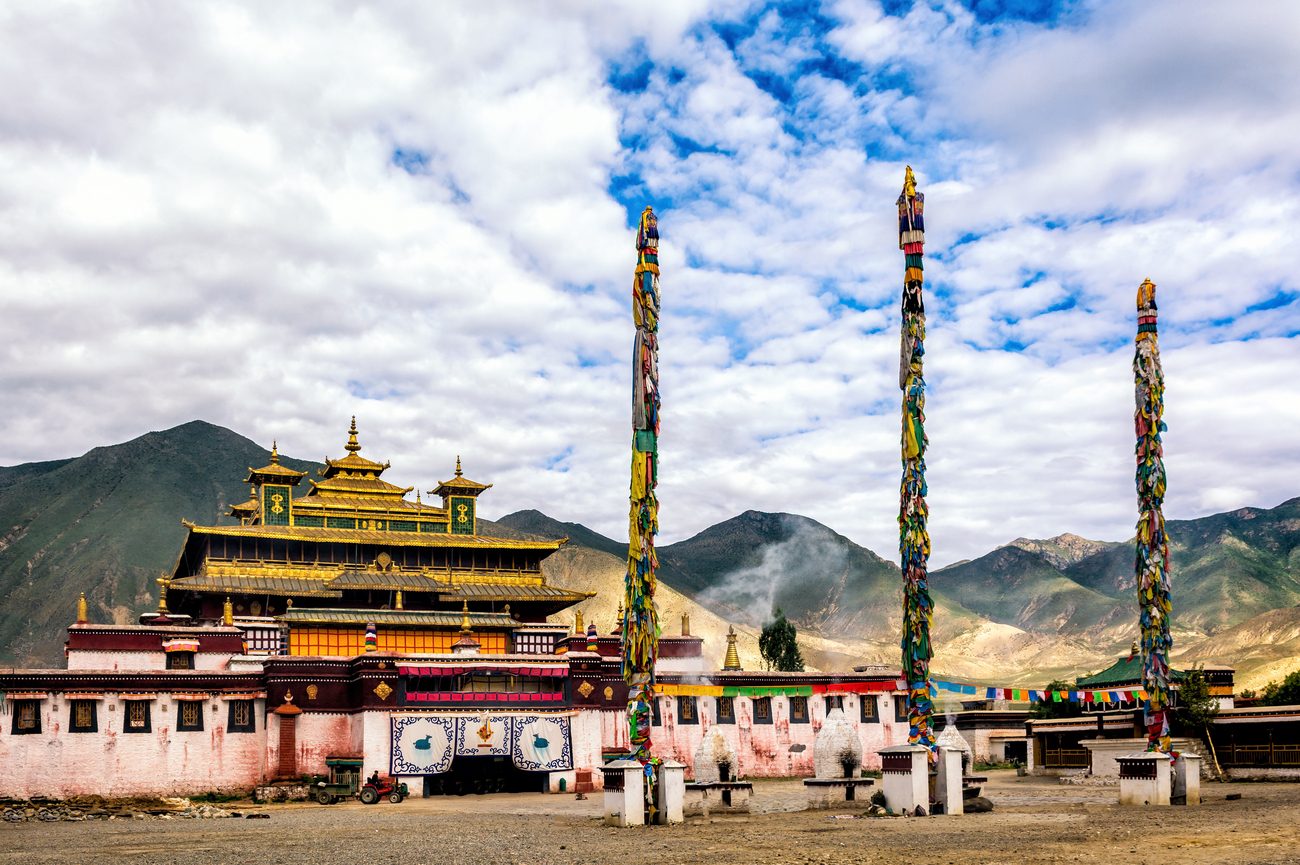
Forty kilometres from Tsedang, on the north bank of the Yarlung Tsangpo, Samye Monastery was founded in 779 AD by Padmasambhava, King Trisong Detsen and the Indian scholar Shantarakshita. It is recognised as the first Buddhist monastery established in Tibet and remains one of the most important religious sites in the Tibetan world.
Samye was designed as a three-dimensional mandala of the Buddhist cosmos. The central temple represents Mount Meru, the axis of the universe. Four temples at the cardinal points represent the surrounding continents, while the boundary wall represents the ocean around the world. Seen this way, the monastery is not only a place of worship. It is a model of Buddhist belief made visible in architecture, colour and space.
The monastery was damaged during the Cultural Revolution and has been progressively restored since the 1980s. Its original plan remains legible, and the monks in residence continue the practice that began here in the 8th century. Visiting Samye after Tsedang and before Lhasa gives the route its religious foundation: this is where Tibetan Buddhism first took institutional form before spreading across the plateau.
Lhasa:
The Capital at Altitude
King Songtsen Gampo chose the Lhasa valley in the early 7th century because its rivers, mountains and position made it both defensible and spiritually significant. It has remained the capital and religious heart of Tibet ever since. At 3,658 metres above sea level, Lhasa is also one of the highest major cities in the world, and its altitude shapes the way the city is experienced from the moment you arrive.
The Tibet Heritage Route reaches Lhasa after the journey has already begun in the Yarlung Valley. That order matters. By the time you enter the city, you have already seen where Tibetan kingship began, which makes Lhasa feel like the continuation of a story rather than a standalone destination. The Potala Palace, Jokhang Temple, Barkhor Circuit, Sera Monastery and Drepung Monastery are not simply historic attractions. They are active religious sites, living monastic communities and daily pilgrimage destinations for Tibetan Buddhists who may have travelled for weeks or months to reach them.
The Potala
Palace
The Potala Palace rises from Red Mountain, known as Marpo Ri, at approximately 3,700 metres above sea level. It is one of Tibet's most important landmarks and one of the defining images of Lhasa. The complex contains more than 1,000 rooms and preserves centuries of Tibetan political, religious and artistic history within its chapels, halls, murals, statues, scrolls and ceremonial spaces.
The palace is divided into two main sections. The White Palace, or Potrang Karpo, formed the administrative and residential part of the complex. It housed the government functions of Tibet as well as the Dalai Lama's private living quarters. The uppermost floor contains rooms associated with the Fourteenth Dalai Lama, preserved largely as they were when he left in 1959. Their modest scale contrasts strongly with the ceremonial spaces below, reminding visitors that the palace was both an institution and a residence.
The Red Palace, or Potrang Marpo, sits higher on the mountain and contains the most sacred areas of the complex. Eight Dalai Lamas are interred here in elaborate stupas, including the great stupa of the Fifth Dalai Lama. The atmosphere is darker and more devotional than in the White Palace, with butter lamps, sacred images and enclosed chapel spaces creating one of the most powerful interiors on the route.
The Potala Palace was designated a UNESCO World Heritage Site in 1994. Visitor numbers are controlled, advance booking is required, and the ascent to the entrance involves approximately 300 steps at altitude. This is why the route does not rush the visit. Proper acclimatisation changes the experience from a struggle into a meaningful approach.
The view of the Potala Palace from Chakpori Hill at sunrise is one of the great visual moments of the journey. The white and ochre walls catch the first light while the valley below remains in shadow, with the mountains behind Lhasa giving the palace its full setting. It is a view that explains why the building cannot be separated from the landscape around it.
The palace's room-by-room history, its White and Red Palace interiors, the Dalai Lama succession and the experience of visiting at altitude are explored in our dedicated Potala Palace guide. It goes deeper into the building than this overview can.

Jokhang Temple
and the Barkhor Circuit
In the old Tibetan quarter of Lhasa, the Jokhang Temple is the most sacred site in Tibetan Buddhism. Founded in the 7th century by King Songtsen Gampo, it was built to house the Jowo Rinpoche, a revered image of Buddha Shakyamuni traditionally associated with Princess Wencheng. For Tibetan pilgrims, this is one of the most important religious destinations on the plateau.
The Barkhor Circuit is the 800-metre kora, or pilgrimage path, that circles the Jokhang Temple. Pilgrims walk it clockwise from morning until evening, turning prayer wheels, murmuring mantras and making offerings as they move through the old city. The early morning is especially powerful, with butter-lamp smoke at the temple entrance, golden rooftops catching the light and the steady rhythm of pilgrims moving around the circuit.
The Jokhang was added to the UNESCO World Heritage designation connected with the Potala Palace in 2000. That recognition confirms its global importance, but it has not changed its essential role. It remains a living sacred site, used every day by worshippers rather than preserved only as a monument.

Sera and
Drepung Monasteries
Sera Monastery, founded in 1419 on the lower slopes north of Lhasa, is best known for its monastic debate tradition. In the afternoon, except on Sundays, monks gather in the debate courtyard to test philosophical arguments through rapid exchanges, hand claps and precise physical gestures. The format is disciplined, energetic and serious. Even without understanding the Tibetan language, visitors can feel the force of the intellectual training taking place.
Drepung Monastery, founded in 1416 northwest of Lhasa, was once one of the largest monasteries in the world. At its height, it housed around 10,000 monks and educated several Dalai Lamas before the Potala Palace became the main political centre. Its assembly halls, monastic colleges and white buildings climbing the hillside show the scale of Tibetan monastic life over many centuries.
Together, Sera and Drepung reveal why Lhasa is more than the site of the Potala Palace. It is a city shaped by Buddhist learning, pilgrimage, debate and daily religious practice. The Tibet Heritage Route gives Lhasa time because these institutions need to be experienced as living places, not simply checked off as landmarks.

The
Road West: Yamdrok Lake, Gyantse and the Tibetan Plateau
The journey from Lhasa to Shigatse covers approximately 280 kilometres and crosses some of the highest and most spectacular landscapes in central Tibet. This is far more than a transfer between destinations. It is the route's most sustained encounter with the Tibetan plateau itself, where mountain passes, sacred lakes, glaciers and historic towns reveal a side of Tibet that cannot be understood from its monasteries alone.
Yamdrok Lake
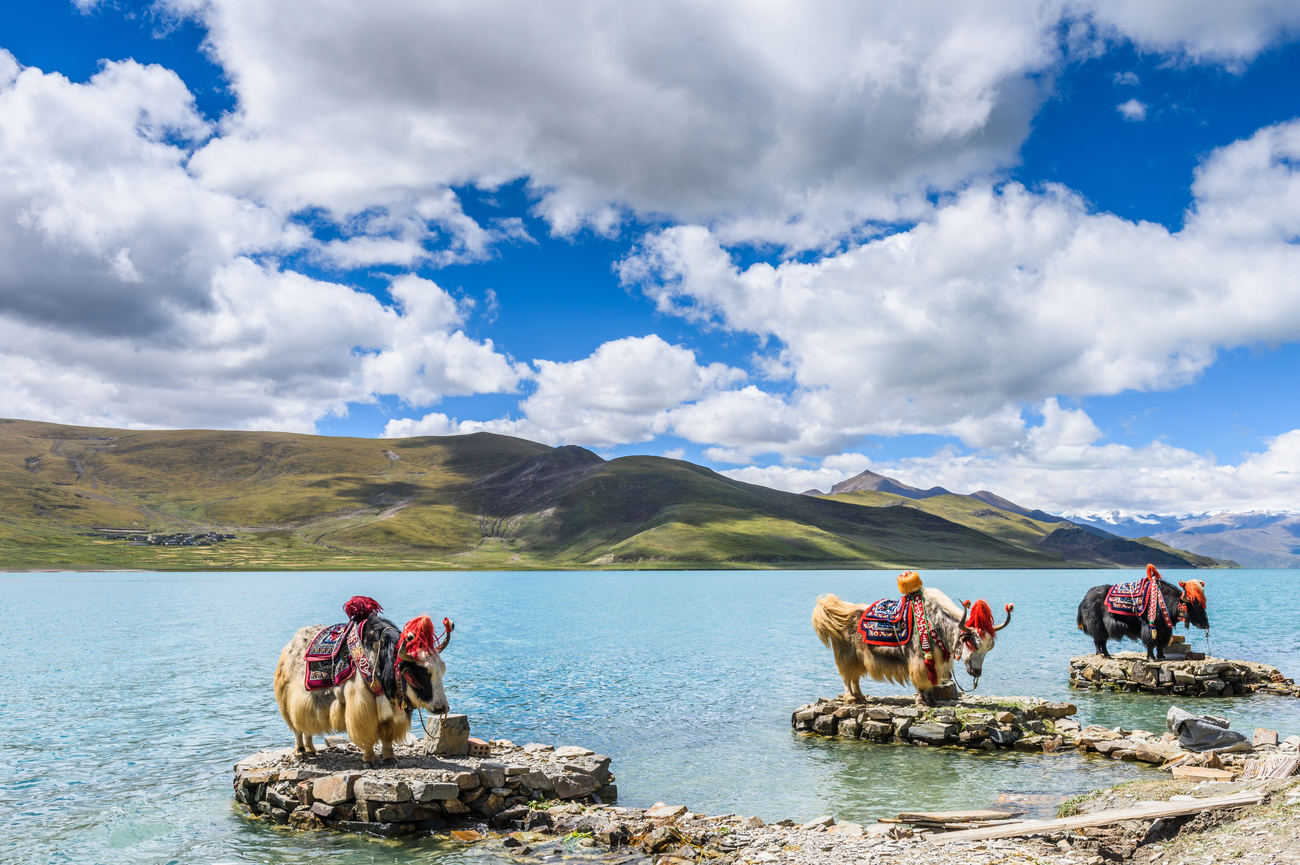
The Kamba Pass, at 4,794 metres above sea level, is where travellers first see Yamdrok Lake spread across the landscape below. The view is one of the most famous in Tibet. Far beneath the road, the lake curves through the mountains in shades of turquoise and deep blue that often appear almost unreal against the surrounding peaks.
At 4,441 metres above sea level, Yamdrok Lake is one of the three great sacred lakes of Tibet. In Tibetan Buddhist belief, the wellbeing of the lake is closely connected to the wellbeing of the plateau itself. Stretching for approximately 72 kilometres, its colour changes throughout the day depending on the angle of the light, the season and the clarity of the sky.
The altitude contributes to one of Tibet's most striking visual characteristics. With less atmosphere between the observer and the sun, colours appear sharper and the sky takes on a deeper blue than at lower elevations. On clear autumn days, the contrast between the intense blue sky, the turquoise waters of Yamdrok Lake and the snow-covered peaks beyond creates one of the defining landscapes of the entire Tibet Heritage Route.
For many travellers, the first view of Yamdrok Lake from the Kamba Pass is the moment when the scale of Tibet becomes fully apparent. The distances are vast, the mountains seem endless and the plateau begins to reveal its true dimensions.
Gyantse and
the Kumbum Stupa
At 3,977 metres above sea level, Gyantse is one of Tibet's most historically important towns and an essential stop between Lhasa and Shigatse. For centuries, it stood on major trade routes linking Tibet with Nepal, India and Central Asia, making it an important commercial, cultural and religious centre.
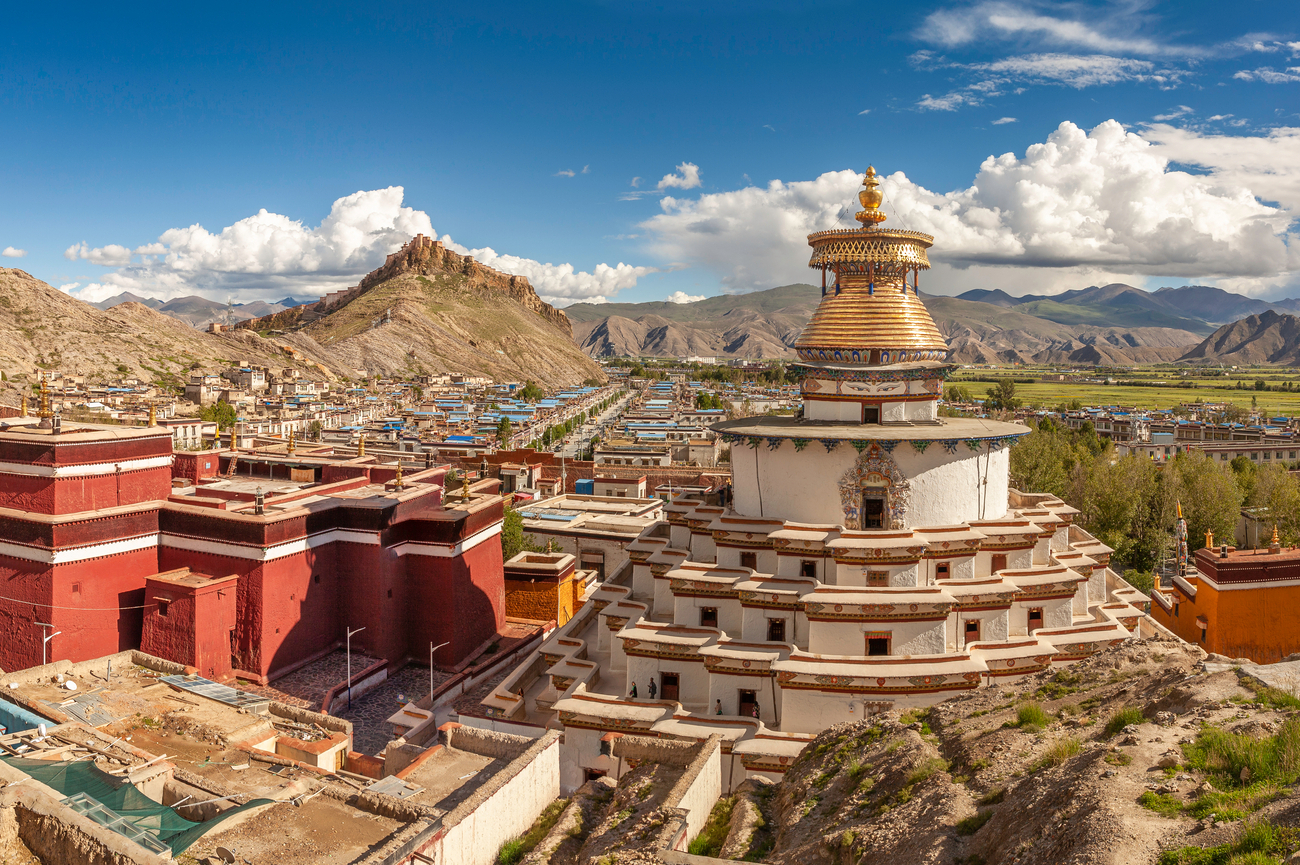
Its most famous monument is the Kumbum Stupa within the Palkhor Monastery complex. Built in 1440, the structure is considered one of the finest examples of Tibetan Buddhist architecture and one of the most significant stupas in the Tibetan world. Rising through nine levels and containing 108 chapels, it houses an extraordinary collection of Buddhist paintings, sculptures and religious imagery.
The name Kumbum means "one hundred thousand images", a reference to the remarkable concentration of sacred art contained within the structure. As visitors move upwards through its successive levels, they encounter a visual journey through Tibetan Buddhist cosmology, symbolism and artistic tradition, culminating beneath the gilded crown at the summit.
Overlooking the monastery complex is Gyantse Dzong, the hilltop fortress that dominates the town skyline. The fort became famous during the British Younghusband Expedition of 1903 to 1904, when Tibetan defenders resisted advancing British forces from its walls. Today, parts of the fortress are accessible and provide some of the finest views across Gyantse, the Palkhor Monastery complex and the surrounding Nyang Chu Valley.
Together, Yamdrok Lake and Gyantse represent an important transition in the journey. Leaving behind the concentrated religious landscape of Lhasa, the route opens onto the wider Tibetan plateau, where sacred geography, history and vast Himalayan scenery combine to create some of the most memorable experiences in Tibet.
The Plateau Between the Cities
One of the most rewarding aspects of the Tibet Heritage Route is that some of its most memorable moments take place between the major destinations. The journeys between Tsedang, Lhasa, Gyantse and Shigatse are not empty stretches of road. They are an opportunity to experience the Tibetan Plateau itself, one of the highest and most extraordinary landscapes on Earth.
With an average elevation exceeding 4,000 metres above sea level, the Tibetan Plateau is often called the "Roof of the World". The scale is difficult to grasp at first. Distances appear deceptive, mountains seem closer than they are, and horizons stretch uninterrupted for vast expanses. The air is thinner, the light is sharper and the landscape unfolds with a sense of openness that is unlike almost anywhere else.
Along the route, prayer flags flutter between mountain passes, their colours carrying symbolic meaning within Tibetan Buddhism. Blue represents the sky, white the clouds, red fire, green water and yellow earth. Together they create one of the most recognisable images of Tibet, adding colour and movement to an otherwise immense landscape.
The Karola Glacier
Between Yamdrok Lake and Gyantse, the road passes one of Tibet's most dramatic natural landmarks, the Karola Glacier. Descending from the slopes of Nojin Kangtsang, which rises to 7,191 metres above sea level, the glacier reaches down towards the road at approximately 4,980 metres, making it one of the most accessible glaciers in Tibet.
Its scale is immediately striking. Massive walls of blue-white ice descend from the mountains above, creating a landscape that feels more Himalayan than Tibetan. Unlike many glaciers around the world that require long hikes to reach, Karola can be viewed directly from the roadside, offering a rare opportunity to appreciate the size and power of a high-altitude glacier without leaving the route.
The glacier also tells a more recent story. Historical photographs show that Karola has retreated significantly over recent decades, reflecting the broader environmental changes affecting mountain regions across Asia. Standing before the ice today provides a visible reminder of how landscapes continue to evolve even in places that often appear timeless.

What the Road Reveals
The open plateau between Tibet's cities is where another side of the region becomes visible. Beyond the monasteries and historic sites, travellers encounter the pastoral landscapes that have sustained Tibetan communities for centuries.
The route passes agricultural valleys, open grasslands and seasonal grazing areas where nomadic herders continue to move yak and sheep between pastures. Black yak-hair tents dot the landscape, their appearance changing little from generation to generation. These communities represent a way of life that remains closely connected to the rhythms of the plateau.
The Kamba Pass, at 4,794 metres above sea level, is one of the highest points reached on the route and one of its most impressive viewpoints. Prayer flags cover the summit while Yamdrok Lake stretches across the landscape far below. On clear days, distant Himalayan peaks can sometimes be seen on the horizon, adding another layer to the scale of the scenery.
Travelling across the Tibetan Plateau is not simply a means of reaching the next destination. The road itself forms an essential part of the experience. The vast distances, dramatic landscapes and encounters with everyday life on the plateau provide the context that makes Tibet's monasteries, cities and sacred sites even more meaningful.

Shigatse:
Tashilhunpo Monastery and the End of the Circuit
Shigatse is Tibet's second-largest city and one of the most important religious centres on the plateau. Sitting at approximately 3,840 metres above sea level, it is closely associated with Tashilhunpo Monastery, the traditional seat of the Panchen Lama, the second-highest reincarnate lineage in the Gelugpa tradition of Tibetan Buddhism after the Dalai Lama.
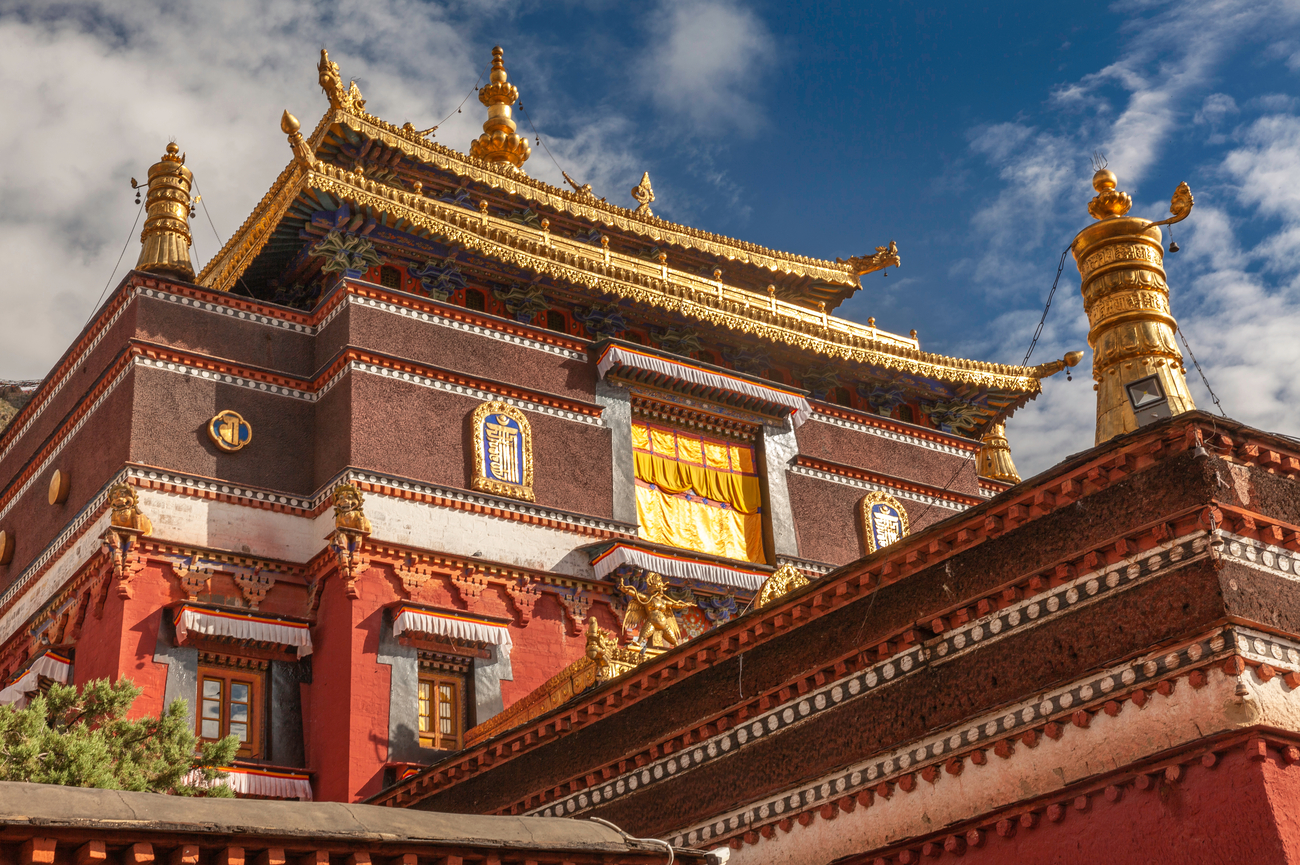
Tashilhunpo Monastery was founded in 1447 by Gedun Drupa, who was later recognised as the First Dalai Lama. Built on the southern slope of Nyiseri Mountain, the monastery became one of the great centres of Tibetan Buddhist learning, worship and political authority. Its white walls, golden roofs, chapels, courtyards and residential quarters dominate the city and give Shigatse its spiritual focus.
At its height, Tashilhunpo was home to several thousand monks. Today, it remains an active monastery, with a resident monastic community maintaining its rituals, chapels and daily practice. This is what makes Shigatse such an important final point on the route. After seeing the sacred institutions of Lhasa, the road west ends at a monastery that is still deeply woven into Tibetan religious life.
One of Tashilhunpo's most remarkable spaces is the Maitreya Temple. Inside stands a vast gilded statue of Maitreya, the Future Buddha, built under the Ninth Panchen Lama in the early 20th century. The chapel was constructed around the statue rather than the statue being placed inside an existing room, which gives the interior its extraordinary scale. Looking up at the figure from below is one of the most powerful experiences in the monastery.
The kora around Tashilhunpo's outer walls takes approximately 40 minutes at a steady pace. This circumambulation path offers views across the monastery and Shigatse while passing close to the working life of the institution. Monks move between buildings, pilgrims walk clockwise around the complex and butter-lamp offerings continue inside the chapels. The monastery is not simply preserved as heritage. It is still being used.
The journey from the Jokhang Temple in Lhasa through Sera, Drepung, Gyantse and Tashilhunpo represents one of the richest ways to understand the living Gelugpa tradition across a single Tibet itinerary. The debate tradition at Sera, the scale of Drepung, the sacred art of the Kumbum Stupa and the morning kora at Tashilhunpo are explored in more depth in our comprehensive guide to the Tibetan monastery circuit. This is where the practice behind the places becomes clearer.
The
Tibet Travel Permit and When to Travel
International travellers need a Tibet Travel Permit in addition to a Chinese tourist visa. This permit cannot be obtained independently. It must be arranged through an officially registered travel agency as part of a confirmed itinerary, and travellers cannot enter Tibet without it.
The application usually requires passport details, Chinese visa information and the full Tibet itinerary. Because the permit is linked to specific travel plans, flights, train journeys and entry points into Tibet need to be coordinated carefully. This is one of the reasons Tibet is not a destination that works well with last-minute improvisation. The journey needs to be arranged properly before departure.
Most international travellers enter Tibet by flying into Lhasa from a lower-altitude Chinese city such as Chengdu, Beijing, Xi'an or Shanghai. Flights from Chengdu usually take around two hours, while flights from Beijing take approximately three hours. The altitude change is immediate, especially when arriving from a lowland city, so the first days of the route are paced carefully to allow the body time to adjust.
Train travel to Lhasa is also possible, and the high-altitude trains are equipped with oxygen supply systems. The journey is slower but gives travellers a gradual sense of the plateau's scale before arrival.
The best times to follow the Tibet Heritage Route are generally April to June and September to November. Spring brings clearer conditions and comfortable temperatures, while autumn offers stable weather, post-monsoon clarity and harvest colour in the Yarlung Valley. September and October are especially rewarding, with deep blue skies, strong visibility, and excellent conditions for monastery visits, mountain passes and plateau drives.
July and August can still be travelled, but the summer monsoon often brings cloud cover that reduces the clarity of the landscape. Winter, from December to February, can offer some of the clearest skies of the year, but temperatures are cold and access may be more restricted. For most travellers, autumn gives the strongest balance of comfort, visibility, cultural atmosphere and visual beauty.
Where You Stay on the Tibet Heritage Route
Accommodation on the Tibet Heritage Route is chosen to support the journey itself. In Tibet, where altitude, early starts, monastery timings and road distances all matter, where you stay can shape the quality of the experience as much as the itinerary.
In Tsedang, the selected five-star property is positioned for easy access to the Yarlung Valley. This matters most in the early morning, when Yumbulagang catches the first light from its ridge and the fields below are at their most atmospheric. The acclimatisation day in Tsedang is not wasted time. It is a calm introduction to the pace, altitude and landscape of the plateau.
In Lhasa, the accommodation is chosen for access to the old city and the Barkhor Circuit. Staying close means the morning kora around the Jokhang Temple can be experienced on foot, before the day becomes busier. It also allows for early starts to key viewpoints such as Chakpori Hill, where the Potala Palace is at its most striking at sunrise.
In Shigatse, the accommodation is selected to make the morning visit to Tashilhunpo Monastery feel properly timed rather than rushed. The monastery is most powerful before the larger day groups arrive from Lhasa, when pilgrims are already walking the kora and the working rhythm of the institution is still the dominant sound.
The Tibet Travel Permit, acclimatisation pacing, monastery access timings, road journeys and accommodation choices across Tsedang, Lhasa, Gyantse and Shigatse are all arranged as part of Revigorate's Tibet Heritage Route. The plateau does not reward improvisation. A carefully planned journey allows you to experience Tibet with confidence, comfort and the right amount of time.

What
the Tibet Heritage Route Is
Revigorate's China portfolio includes journeys through Beijing, Xi'an, Shanghai, Guilin, Chengdu and Zhangjiajie. Each one reveals a different side of China, from imperial history and contemporary cities to food culture, river landscapes and dramatic mountain scenery.
The Tibet Heritage Route stands apart. It is shaped by altitude, Buddhist practice, ancient kingship and the vast landscapes of the Tibetan Plateau. This journey follows a civilisation that began in the Yarlung Valley in the 2nd century BC, developed through the sacred institutions of Lhasa and continues today in the monasteries, pilgrimage routes and daily rituals of Tibetan Buddhism.
It is the most remote and demanding of Revigorate's eight-day China journeys, but also one of the most rewarding. Tibet asks travellers to slow down, adjust to the altitude and experience each place with patience. The result is a journey through sacred architecture, mountain passes, high-altitude lakes, working monasteries and landscapes that feel unlike anywhere else on Earth.
For travellers interested in history, spirituality, culture and scenery, the Tibet Heritage Route is not simply another China itinerary. It is a journey into one of the world's most distinctive cultural landscapes, arranged with the time, care and context that Tibet requires.

The
Plateau in September Light
September is one of the finest times to experience the Tibet Heritage Route. The summer monsoon has passed, the skies are typically clear, and the plateau settles into a brief season of exceptional visibility before the arrival of winter.
At 3,658 metres above sea level, the September sky above Lhasa takes on a remarkable clarity. From Chakpori Hill before sunrise, the Potala Palace catches the first light of the day while the valley below remains in shadow. The contrast between the deep blue sky, the white palace walls and the ochre-red central palace creates one of the most memorable views in Tibet.
In Shigatse, mornings begin with pilgrims and monks moving around Tashilhunpo Monastery as butter lamps flicker inside the chapels. The monastery feels fully alive at this hour, with daily rituals unfolding against the backdrop of Nyiseri Mountain.
The Yarlung Valley around Tsedang takes on golden tones during the harvest season. Fields that have been cultivated for more than two thousand years glow beneath Yumbulagang Palace, connecting the landscape of today with the earliest chapters of Tibetan civilisation.
At Yamdrok Lake, viewed from the Kamba Pass, the clear autumn light reveals the lake at its most vivid. The turquoise water, surrounding mountains and endless Tibetan sky combine to create one of the defining landscapes of the entire route.
September brings together many of the elements that make this journey special: stable weather, exceptional visibility, harvest colours in the Yarlung Valley, comfortable temperatures for monastery visits and some of the clearest views of the Tibetan Plateau. For many travellers, it is the season that best captures the beauty, history and scale of Tibet.


Let us know what you love, where you want to go, and we’ll design a one-of-a-kind adventure you’ll never forget.
Get in touch
Miriam
Travel Specialist

Nina
Travel Specialist

Abigail
Travel Specialist
Frequently Asked Questions
- How physically demanding is the Tibet Heritage Route?
The Tibet Heritage Route is moderately demanding because of the high altitude, monastery visits, steps, walking circuits and long plateau drives. The route is paced carefully to allow acclimatisation and reduce unnecessary strain.
- How many days should travellers spend acclimatising in Tibet?
Travellers should allow at least one to two days for acclimatisation at the start of a Tibet journey. The route begins in Tsedang before reaching Lhasa, helping the body adjust before more demanding visits.
- Can the Tibet Heritage Route be customised?
Yes. The Tibet Heritage Route can be tailored around travel dates, hotel preferences, pacing, interests and wider China travel plans, while still respecting permit requirements, altitude considerations and local access rules.
- What should travellers pack for a high-altitude Tibet journey?
Travellers should pack layered clothing, comfortable walking shoes, sun protection, sunglasses, lip balm, a refillable water bottle and any personal medication. Warm layers are important even outside winter because temperatures can change quickly at altitude.
- Are private guides included throughout the Tibet Heritage Route?
Yes. The Tibet Heritage Route is arranged with private guiding, private transfers and careful coordination throughout the journey, including monastery visits, road journeys and permit-linked travel arrangements.
- What type of hotels are used in Tsedang, Lhasa and Shigatse?
Hotels are selected for comfort, location and suitability for the route. In Tsedang, Lhasa and Shigatse, accommodation is chosen to support acclimatisation, early starts, monastery access and the overall quality of the journey.
- Is the Tibet Heritage Route suitable for first-time visitors to China?
Yes, but it works best as part of a carefully planned China journey. Tibet has specific permit requirements, altitude considerations and travel logistics, so first-time visitors benefit from expert planning and guided arrangements.
- Why book the Tibet Heritage Route with Revigorate?
Revigorate arranges the Tibet Heritage Route with private guiding, carefully selected accommodation, permit coordination, acclimatisation pacing and a route structure that connects Tibet's history, monasteries, landscapes and living traditions.
Our offices:



Revigorate, Iberian Escapes and Algarve Lifestyle are the registered brand names of APCS Lda . We are a fully authorised travel agency licensed by Turismo de Portugal RNAVT/6867.
In the event of a dispute, the consumer may refer to: RAL - Centros de Arbitragem
Avª. 5 de Outubro, nº. 55, R/C Dtº. 8000-075 Faro, Portugal | Tel: +351 289 823 135 *
* national landline call
E-mail: info@consumoalgarve.pt| www.consumidoronline.pt | Mon to Fri: 9:00 - 13:00 / 14:00 - 17:00