Terracotta Warriors in Xi'an: The Burial Army That Redefined Ancient China
Nobody warned the farmers about the faces.
Yang Zhifa and his brothers were drilling for water in the dry fields east of Xi'an in March 1974 when the ground gave way to something that wasn't soil. Clay. Then the shape of a head. Then, as they kept digging, the outline of a figure, then another, then the realisation that they were not looking at pottery but at a person, rendered in clay, life-sized, with cheekbones and a jaw and an expression that had been set for 2,200 years and was now, suddenly, in the light again.
The Terracotta Warriors in Xi’an are one of those sites that travels well in photographs and incomprehensibly well in person. The photograph shows you the scale. Being there shows you the faces.
The eight-day journey through China's Golden Triangle passes through Xi'an midway through the route, and the Terracotta Warriors in Xi’an are its centrepiece. The full shape of the Golden Triangle itinerary, from Beijing's imperial palaces to Shanghai's Bund, is in our China’s Golden Triangle guide for anyone still weighing how the cities fit together. Xi'an sits at the route's ancient heart, and the Warriors are the reason.
Qin Shi Huang and His Afterlife Empire
Understanding the Terracotta Warriors Xi’an properly means understanding the man who ordered them built, and the logic behind the decision. Qin Shi Huang, born Ying Zheng in 259 BCE, became king of the Qin state at thirteen. By 221 BCE, after a military campaign that consumed the remaining six warring states of China’s fractured landscape, he had unified the country for the first time under a single ruler and declared himself its first emperor.
He then spent decades preparing for death as if it were another form of rule.
The mausoleum complex spreads across a vast area at the foot of Mount Li, outside Xi’an, and remains one of the largest burial complexes ever created. The emperor mobilised hundreds of thousands of workers. He standardised China’s weights, measures, currency and written script during his reign, while also planning an afterlife version of the empire he had built in life. The Terracotta Army was not simply a monument to military power. It was administrative planning for a reign he intended to continue after death.
“We find the underground pits are an imitation of the real organisation in the Qin dynasty,” says Duan Qingbo, head of the mausoleum excavation team. “People thought when the emperor died, he took just a lot of pottery army soldiers with him. Now they realise he took a whole political system with him.”
The soldiers were the most visible part of that system. They were not the whole of it.
The Discovery of the Terracotta Warriors
The site that became the Terracotta Warriors Xi'an was not unknown before 1974. For centuries, occasional reports surfaced of pieces of terracotta figures and fragments of the Qin necropolis: roofing tiles, bricks and chunks of masonry. Nobody connected the fragments. The mausoleum was a hill. The surrounding fields were farmland. The connection between the two had not been made in any official sense when Yang Zhifa's shovel broke through into Pit 1.
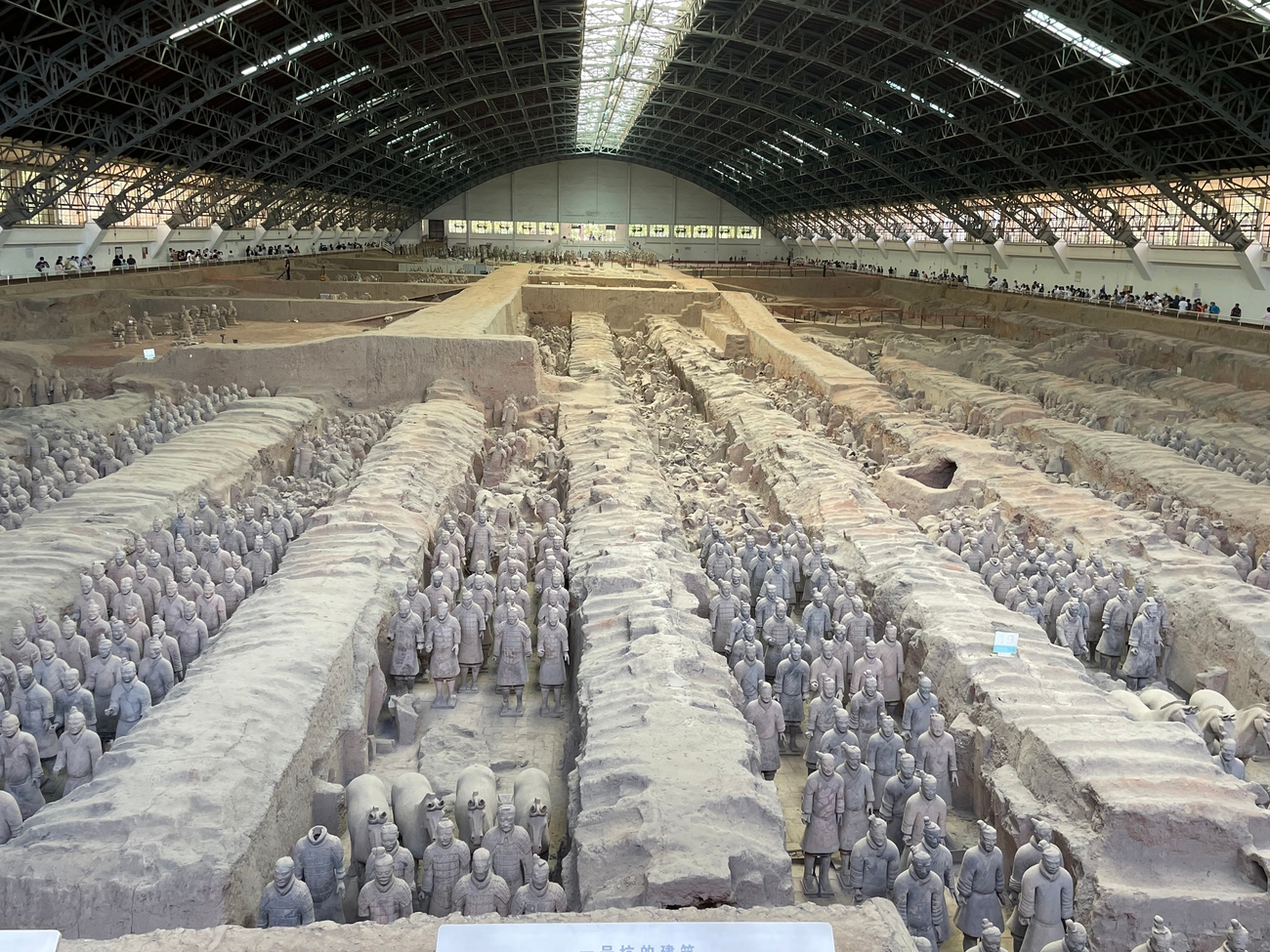
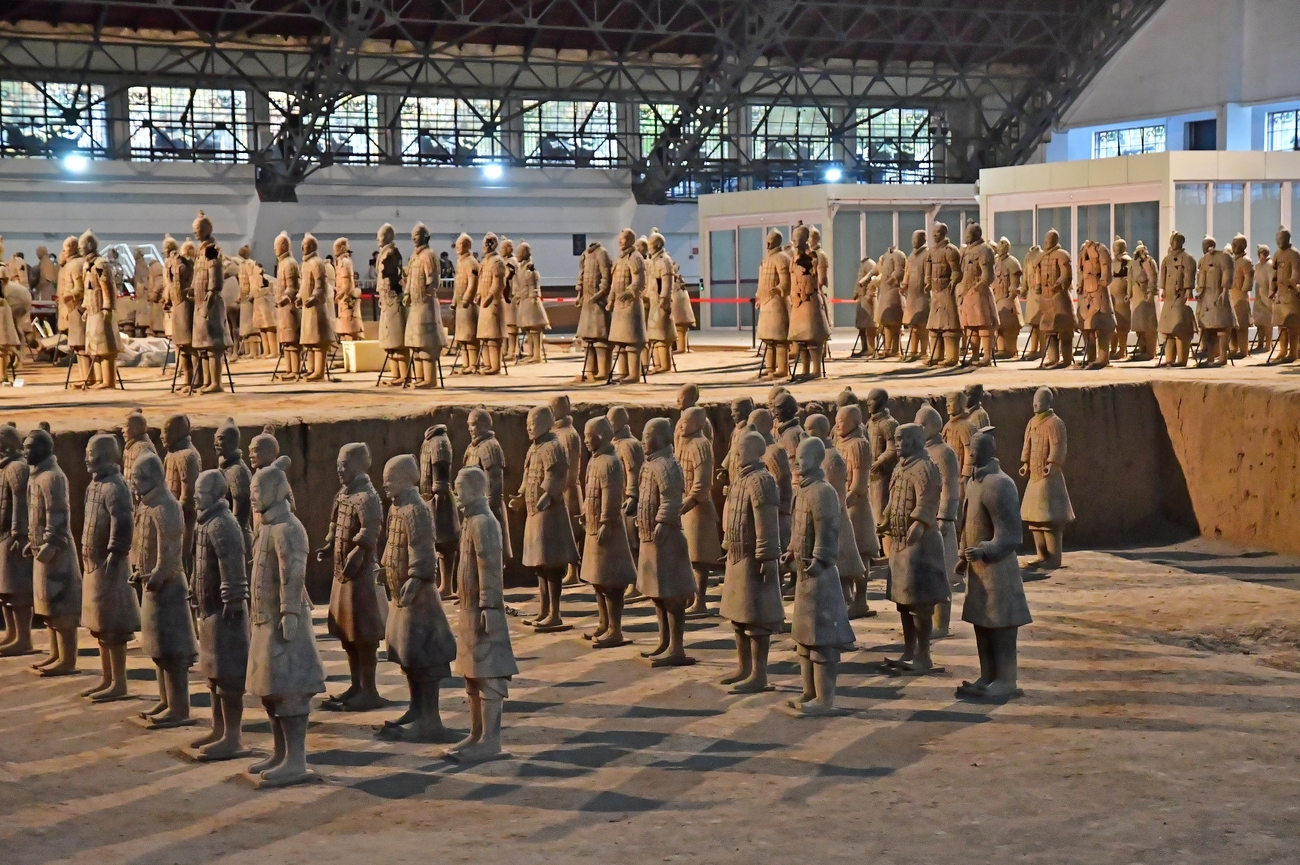
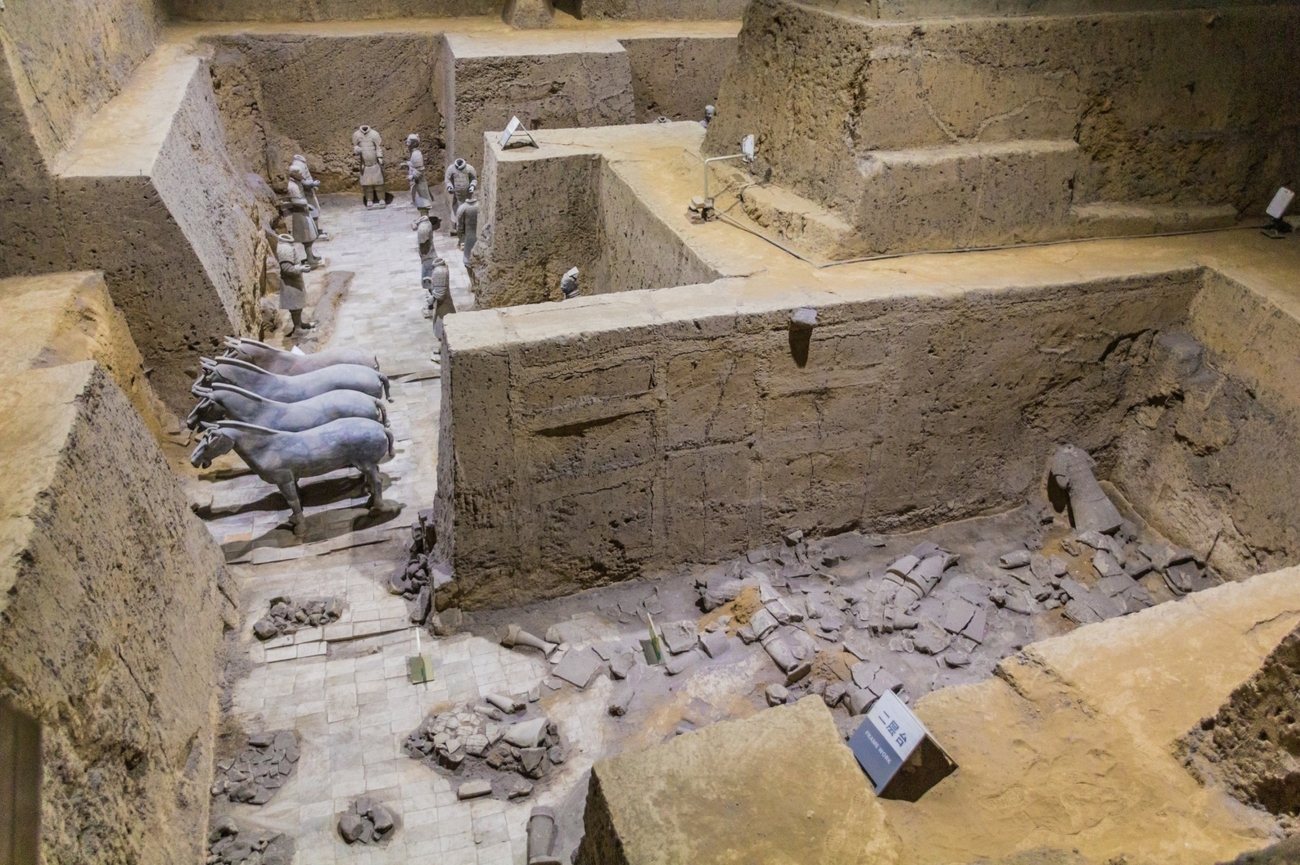
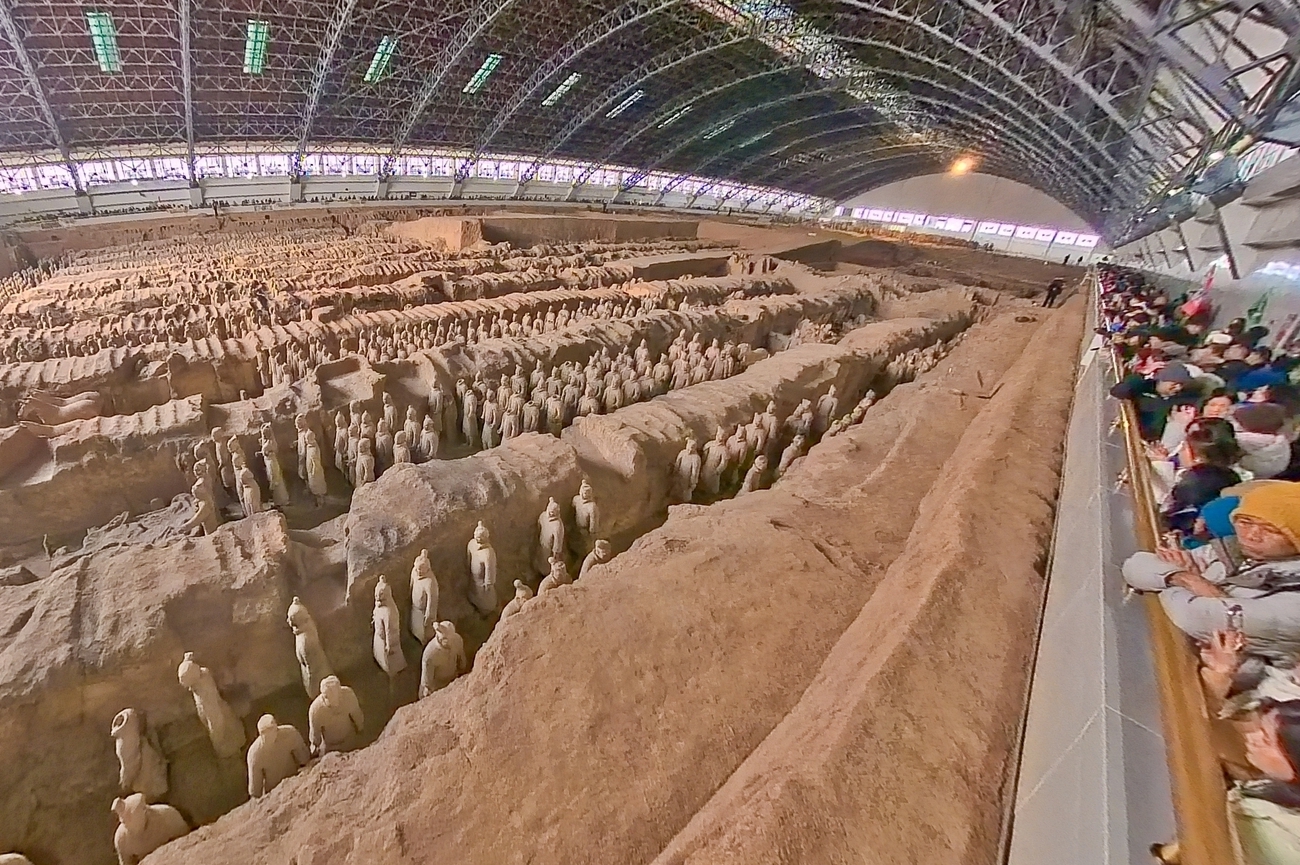
Chinese archaeologists arrived quickly. What the initial excavations revealed was not a burial chamber but a formation: row upon row of infantry in battle configuration, facing east, arranged in eleven parallel corridors, each corridor separated by rammed earth walls that had once supported a wooden ceiling. The ceiling had long since burned and collapsed. The figures beneath it had fractured. The excavation became, at once, an archaeological dig and a massive conservation effort to reconstruct what the collapse had broken.
What they found, assembled:
- Over 6,000 warriors in Pit 1 alone, in active battle formation
- Life-sized figures ranging from 1.7 to 2 metres in height, their height calibrated to rank
- Bronze weapons, including swords, lances, spears, and arrowheads, over 40,000 of them across the three pits
- Terracotta horses in full harness, positioned four to a chariot
- The ghost impressions of the wooden chariots themselves, decomposed but mapped in the earth
Recent studies have revealed the weapons were never used in battle but were produced specifically for burial with the terracotta army. The soldiers were armed with real bronze. They were never meant to fight. They were meant to serve.
Pit
1: The Army in Formation
Pit 1 is where the Terracotta Warriors Xi'an establishes itself in your understanding of what you are looking at.
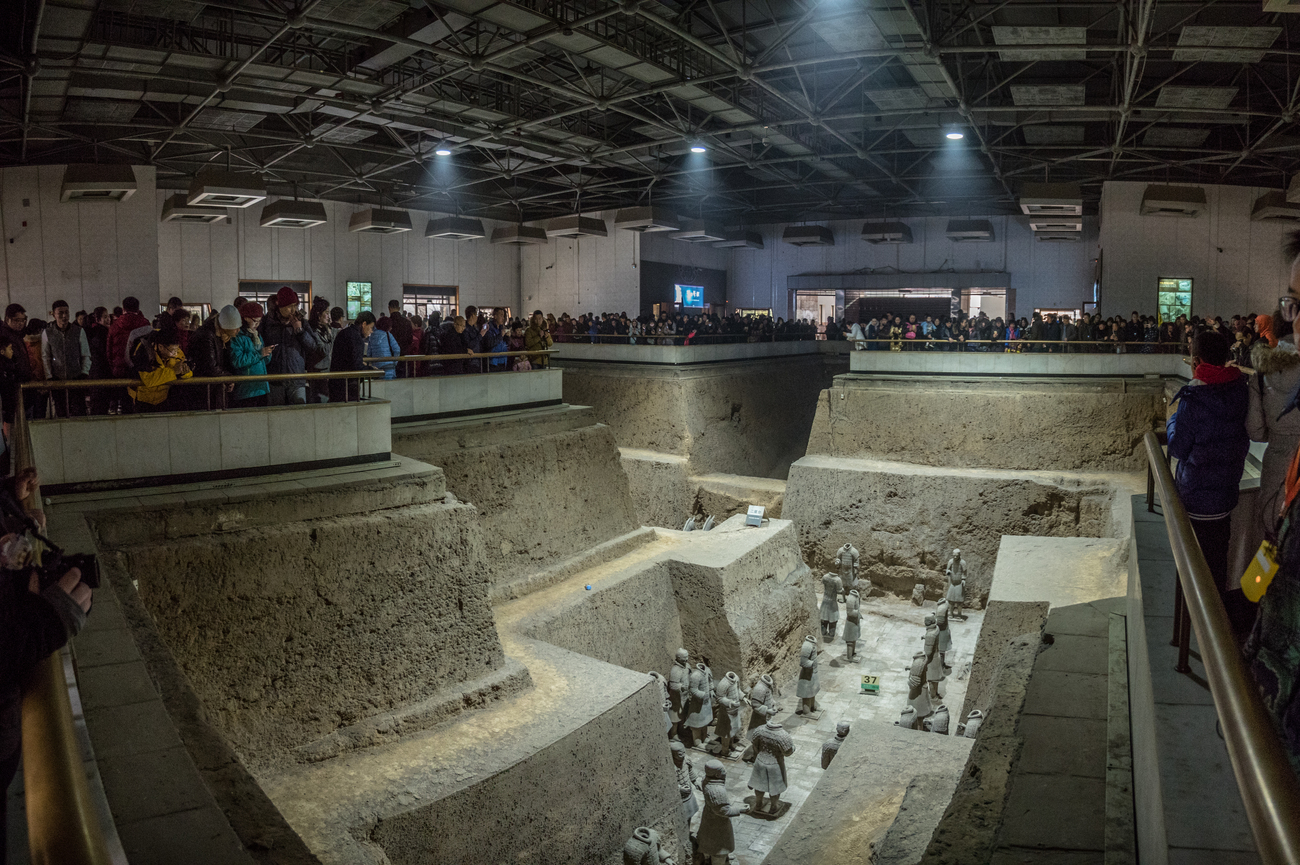
The structure is enormous: 14,260 square metres of excavated floor, enclosed now by a modern arched exhibition hall that preserves the dig as it progressed. Walking in from the entrance end, the scale resolves itself gradually. The first row of figures is closest. Then the second, then the third, then the perspective opens and you see it: a vaulted space the length of an aircraft hangar, filled with men.
They face east. The direction was deliberate. The enemies of the Qin state had come from the east. The army was positioned to meet them. The fact that these enemies had been dead for more than two thousand years before the army was even buried did not factor into the arrangement. The emperor intended a real army, deployed in real formation, for a real campaign that happened to take place in the afterlife.
The faces are what stop most people.
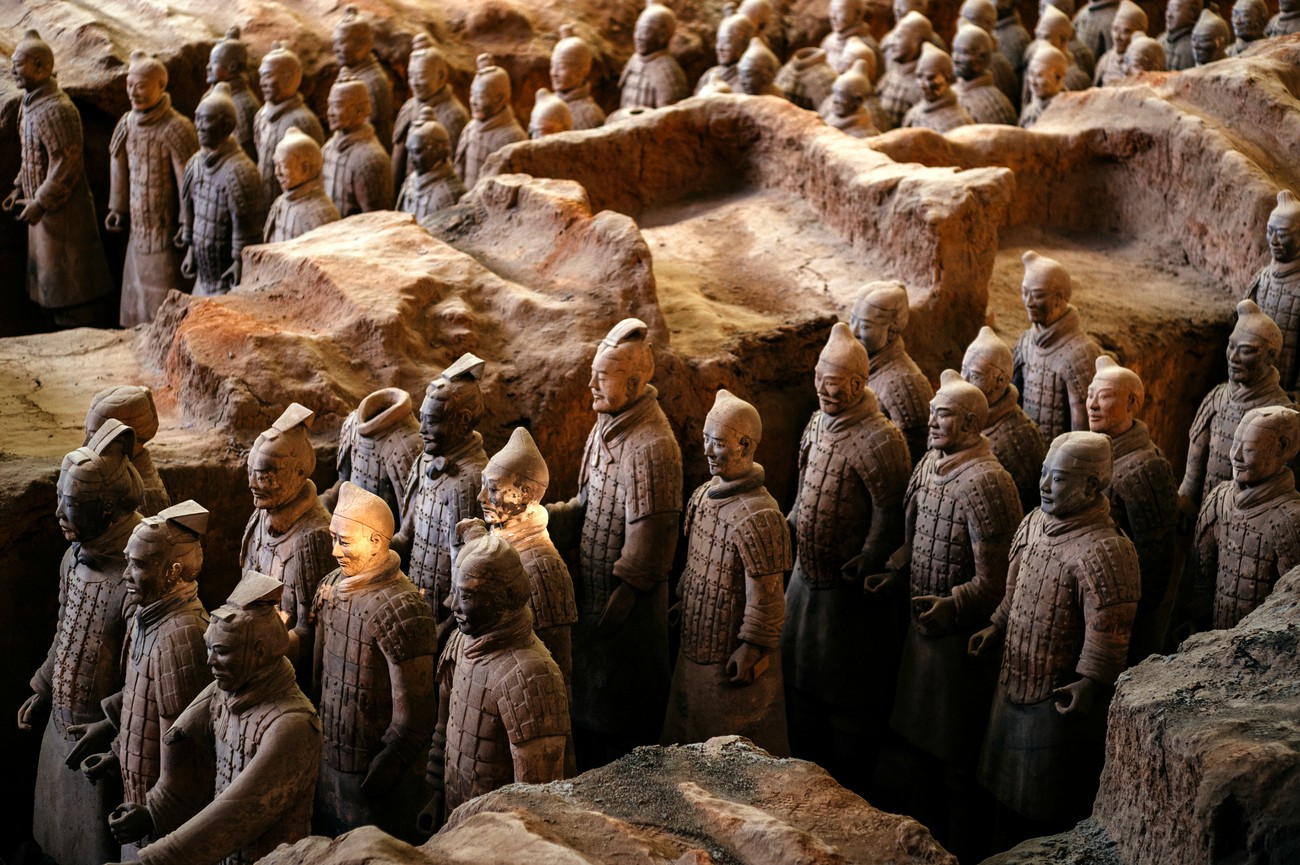
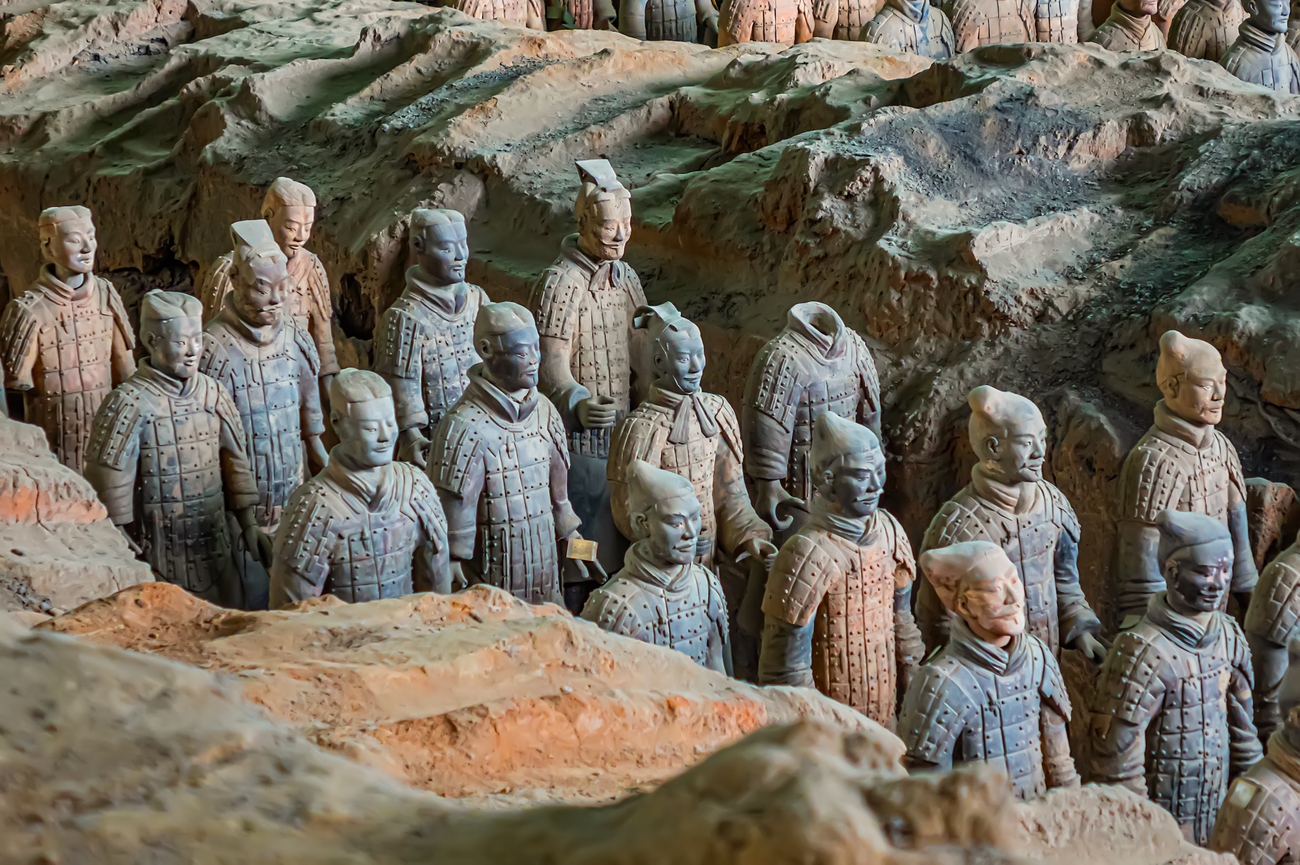
The artisans who built the Terracotta Army China used a production system: standardised moulds for the bodies, the torsos, the limbs. The heads were finished by hand. The warriors' ears are as unique as fingerprints; artisans used their own ears as models. Every face in Pit 1 is different from every other. In a formation of six thousand, that individual specificity is staggering. It suggests the Qin artisans were not making an army of identical soldiers but a portrait gallery of the men who had actually served. No two confirmed to be the same have been found. The excavation is not finished.
The soldiers' ranks are readable in the detail. Officers wear caps rather than buns, their armour more elaborate, their posture subtly different. Infantrymen stand in specific configurations according to their position in the formation. Kneeling archers occupy the outer flanks. The distinctions are precise enough that modern military historians have used the formation to draw conclusions about actual Qin battlefield tactics.
Standing along the elevated walkway above Pit 1, looking down the full length of the formation, the silence that the site enforces on most visitors is its own kind of information. Six thousand soldiers and the room is quiet.
The
Weapons and the Chromium Question
The bronze weapons found throughout the Terracotta Warriors Xi'an pits have produced one of archaeology's more striking discoveries.
Some weapons were dipped in chromium oxide, a technique that kept them rust-free for millennia. The swords and arrowheads recovered from the pits remain, after 2,200 years in the ground, still capable of taking an edge. The chromium-oxide coating that preserved them was not independently rediscovered in the West until the 20th century. The Qin metallurgists arrived at it empirically, without the chemistry to name what they had done, and it worked.
More than 40,000 bronze weapons have been recovered from the partially excavated pits. Recent studies have revealed they were never used in battle but were produced specifically for burial. The sharpness is not incidental. The emperor was not being buried with decorative props. He was being equipped for a campaign.
Pit
2: The Cavalry and the Colours
Pit 2, north and east of Pit 1, is smaller in scale and considerably more varied in composition. Where Pit 1 holds infantry, Pit 2 contains cavalry, standing archers, kneeling archers, and mixed military units, approximately 1,300 figures in total, representing the more mobile and specialised elements of the Qin army.
It is also where the original paint is most visible.
The Terracotta Warriors Xi'an were not grey when they were made. When archaeologists first unearthed the warriors, the lacquer dried instantly in the air, flaking off like brittle parchment and taking the pigments with it. In Pit 2, faint traces of red and purple linger on a cavalryman's sleeve — ghostly hints of their former brilliance.
The original pigments included:
- Mineral-based reds applied to fabric and armour detailing
- Purple and blue derived from a synthetic compound, Han Blue, produced at high temperatures
- Black lacquer as the binding layer between the clay surface and the painted finish
- Pink and green tones used to differentiate flesh, armour, and accessories
The army that stood in formation in 210 BCE was vivid. What the excavation exposed to air turned grey within minutes. Conservators now use freeze-drying techniques and synthetic resins to stabilise surviving pigments. A small number of figures behind glass in the exhibition halls show what the colour retention looks like when the paint is saved before it can oxidise. The contrast between these figures and the grey ones in the open pits is one of the more quietly devastating things the site offers. You are looking at what was lost, and at the sliver of it that survived.
Pit
3: The Command Centre
Pit 3 is the smallest of the three excavated pits and the most strategically significant.
Seventy-two figures. A single war chariot. Officers in full armour, facing each other in a configuration that archaeologists interpret as a command council rather than a combat formation. No infantry. No archers. The people in Pit 3 were not fighters in the conventional sense. They were the people who directed the fighting.
According to the arrangement in the pit, archaeologists believe that Pit 3 is the command centre of Pit 1 and Pit 2. Pit 3 is also the only pit to have survived the fire that damaged the other pits, so the terracotta warriors retained more of their original colour when they were unearthed.
The fire that destroyed Pit 1's ceiling, the one that sent the wooden roof structure crashing down onto the formation and fractured thousands of figures, did not reach Pit 3. The figures here are better preserved than almost any others in the complex. Their colours are more intact. The faces are sharper. The detail on the armour is cleaner. Standing in Pit 3 and looking at these figures is the closest the site comes to showing you the army as it was.
There is also a fourth pit. Pit 4 was discovered entirely empty, unlike the other pits brimming with clay figures, even though it displayed indicators of preparation like the other three pits. The rammed earth walls were in place. The corridor structure was complete. No figures. The leading theory is that the construction programme halted suddenly when Qin Shi Huang died unexpectedly in 210 BCE, the work incomplete. The empty pit is, in its silence, its own kind of statement about the ambition that ran out of time.
The
Bronze Chariots
West of the three main pits, in a separate exhibition building, two bronze chariots sit behind glass in full conservation lighting.
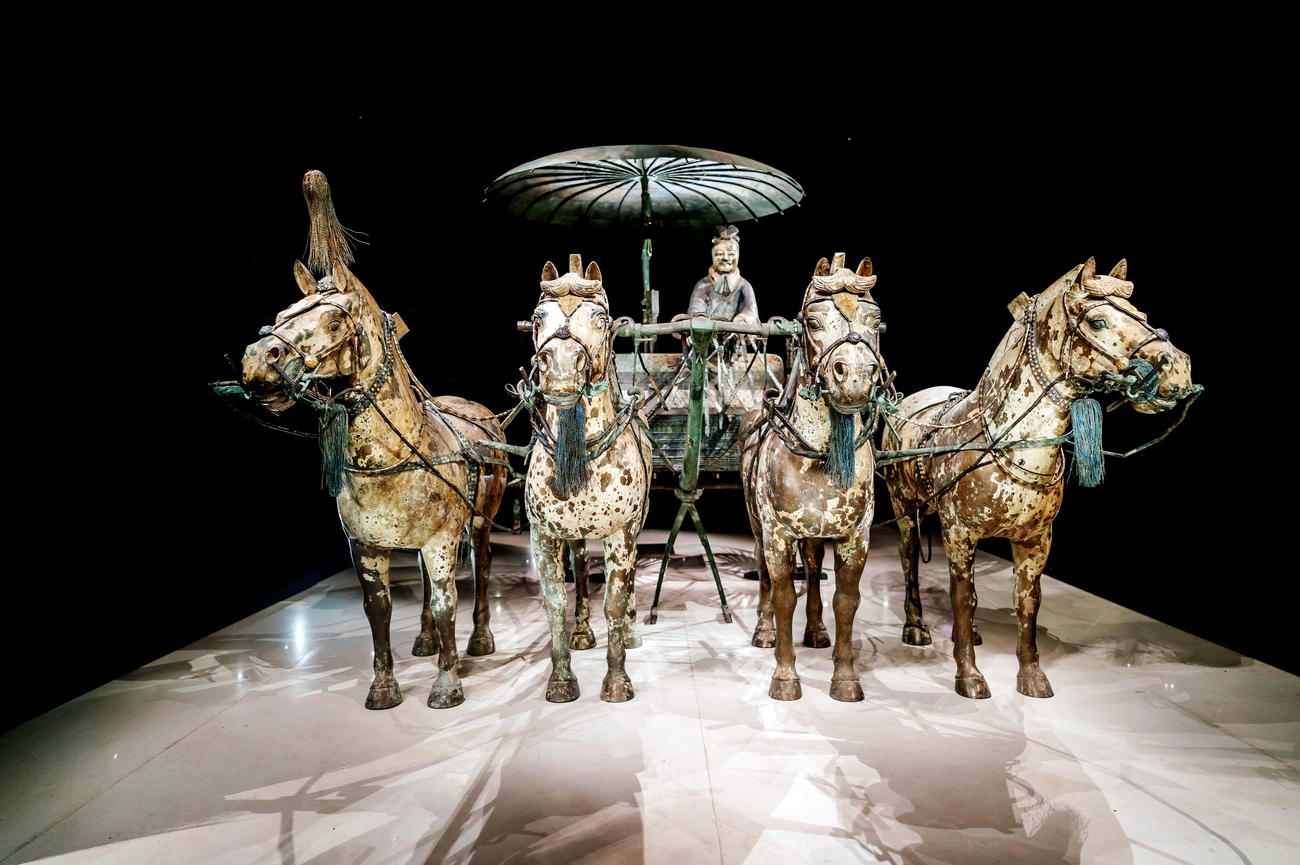
They were discovered in 1980, buried twenty metres west of the mausoleum mound itself. Each chariot was drawn by four bronze horses and built at roughly half the scale of the real imperial carriages used by Emperor Qin Shi Huang. Made from more than 3,000 components, the bronze chariots recreate the structure and detail of real imperial vehicles with extraordinary precision. Even after more than 2,000 years, parts of the carriage system remain movable, including the wheels, halter and reins.
The second of the two chariots, the enclosed carriage, is considered the finest bronze-casting achievement of the Qin period. The detail extends to a working canopy mechanism, articulated window screens, and harness straps rendered so precisely in bronze that they retain their flexibility. The artisans who built this were not making a model. They were making the emperor's vehicle for the afterlife, and they made it to the standard they would have applied to the real one.
Most visitors move through the bronze chariot hall quickly on the way to the main pits. The people who stop are the ones who understand what they are looking at.
The
Mausoleum and What Remains Underground
The burial mound of Qin Shi Huang stands 76 metres high in the landscape east of Xi'an, visible from the surrounding site as a forested hill that looks, from a distance, like a natural feature of the terrain. It is not natural. It is man-made. And it has not been opened.
Emperor Qin Shi Huang's actual tomb remains a mystery to archaeologists and historians as it is still sealed up. There have been geophysical surveys of the tomb mound, but the mausoleum itself has not been excavated. The tomb was written about by Han dynasty historian Sima Qian, who describes "palaces and scenic towers for a hundred officials", as well as many rare artefacts and treasures. In addition, the two major rivers of China, the Yangtze and the Yellow River, were simulated in the tomb using mercury and the tomb ceiling was decorated with the heavenly constellations.
Modern soil surveys conducted around the mound have confirmed mercury concentrations in the earth consistent with the ancient texts. The emperor buried rivers of mercury in his tomb. They are still there.
The decision not to excavate is not bureaucratic. It is scientific. The conservation technology required to stabilise whatever might be exposed does not yet exist at the scale required. The ongoing preservation work at the Forbidden City offers a useful comparison, showing how long conservation can take when a site has already been exposed to centuries of weather, restoration and human use. Qin Shi Huang’s mausoleum is a larger, more complex and more fragile proposition.
The Terracotta Army captures Qin Shi Huang's dual nature: brutal authoritarian and visionary unifier. The warriors' standardising of weights, measurements, money and even written characters across the newly united empire reflects his more general policies. The man who built this complex also built China's first connected road network, extended what would eventually become the Great Wall, and created the template for centralised imperial administration that every subsequent dynasty inherited and refined. The Forbidden City in Beijing, which the Ming Dynasty completed fourteen centuries later, is, in significant ways, a direct descendant of the administrative logic the Qin invented. The Terracotta Warriors Xi'an and the Great Wall at Mutianyu are the two most physically dramatic expressions of what Qin ambition put into the world.
The Qin Shi Huang mausoleum was inscribed as a Xi'an UNESCO heritage site in 1987. The recognition was not difficult to justify.
Xi'an
Beyond the Pits
The Terracotta Warriors Xi'an occupies most of a full day, and it should. But Xi'an itself is a city with its own deep Xi'an ancient history that the warriors represent only partially.
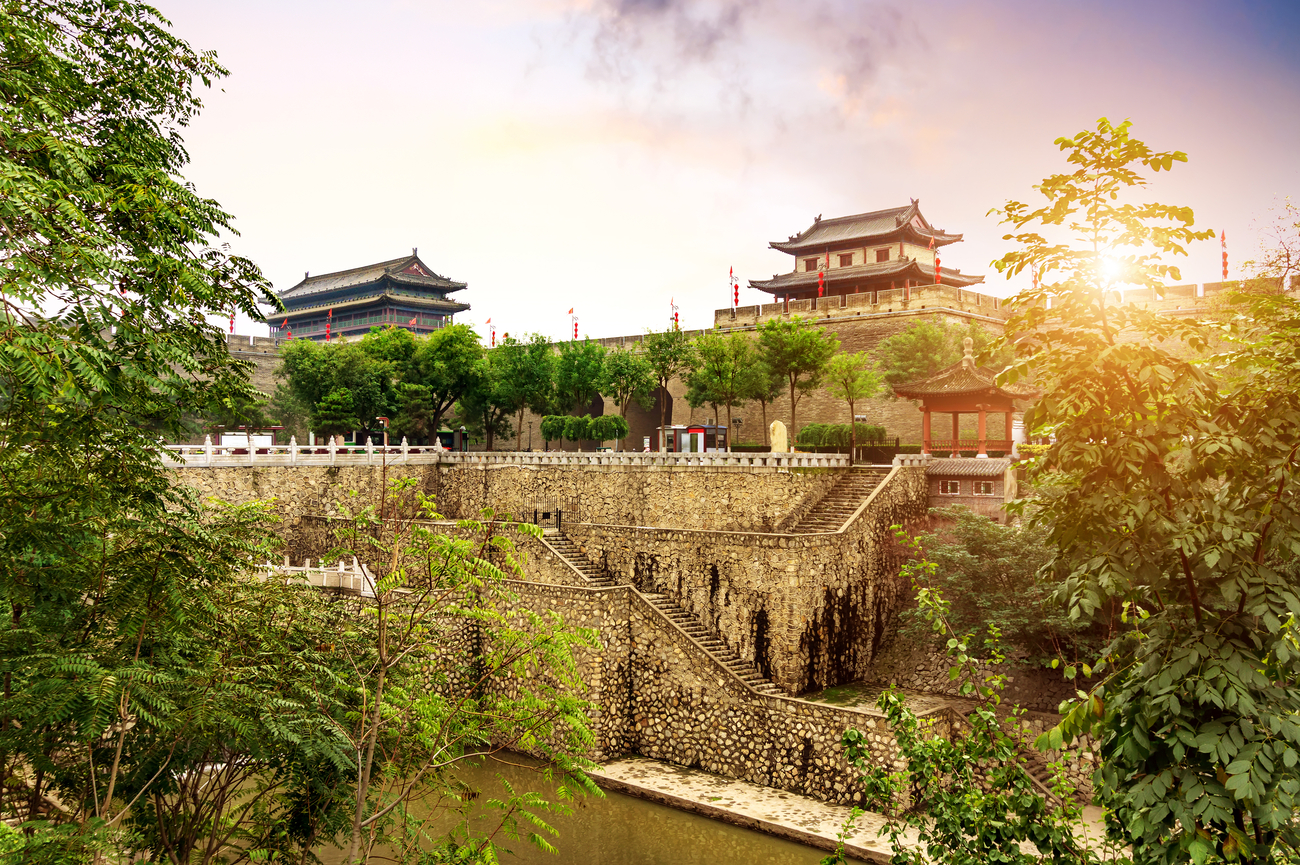
The ancient City Wall encircles the historic centre in 8.7 miles of intact Ming-era fortification, built on Tang foundations, still walkable at the top. The Giant Wild Goose Pagoda, built in 652 AD to house Buddhist scriptures brought back from India by the monk Xuanzang after a seventeen-year journey along the Silk Road, rises above the city's southern district in sixty-four metres of Tang-era brick. The Muslim Quarter, eight blocks of Hui culture layered over a thousand years of settlement, fills the streets around the Great Mosque on Huajue Lane with the particular density of a neighbourhood that has been doing the same things for a very long time.
Xi'an was the imperial capital of eleven Chinese dynasties and the eastern terminus of the Silk Road. The Terracotta Warriors Xi'an are the city's most famous export to world consciousness. They are not its whole story, and a visit arranged to include both the warriors and the city proper is considerably richer than one that treats the pits as the destination and Xi'an as the stop before the train.
What Xi'an does to a traveller who arrives properly prepared for it, who has the context to read the Silk Road's cultural residue in the Muslim Quarter's architecture and the Buddhist monumentality of the pagoda and the military logic of the warriors, is different from what it does to a traveller who arrives and works it out on the fly. The city rewards preparation. It rewards context. It rewards having someone alongside you who knows it.
The Army Was Only the Beginning
The Terracotta Warriors Xi'an site currently has more than 2,000 figures excavated from an estimated total of over 8,000. The three main pits represent approximately 5 percent of the total mausoleum complex. Over 600 distinct pits have been found in the complex according to archaeological studies; most of them still remain unexcavated. Archaeologists have found terracotta acrobats, terracotta strongmen, bronze water birds, musicians, civil officials, and stable pits containing actual horse skeletons.
The emperor built a complete world underground. The warriors are the army of that world. The acrobats were its entertainment. The civil officials were its bureaucracy. The rivers of mercury were its geography. The stars on the ceiling of the unexcavated tomb were its sky.
The facts about the Terracotta Army China that circulate most widely, the 8,000 soldiers, the individual faces, the chromium weapons, the famous pits, are the facts of the outer edge. What they point toward, the unexcavated mound and everything described in the ancient texts as lying beneath it, remains one of the most significant unsolved questions in world archaeology.
Standing in Pit 1, at the far end of the elevated walkway, looking back along the full length of the formation, that question is present in the air. You are looking at the guards. Whatever they are guarding is two kilometres away and still underground.
Experience
Ancient History
Some mornings in travel produce facts. Some produce understanding. The Terracotta Warriors Xi’an produces something closer to vertigo, the particular disorientation of standing in front of something 2,200 years old and finding it more coherent, more purposeful and more present than almost anything in the modern world around it.
The Xi’an UNESCO heritage designation confirms the site’s importance to human history in official terms. The experience of standing inside Pit 1 confirms it in terms that stay with you considerably longer than any designation.
Revigorate’s First-Time China vacation spends two full days in Xi’an, with the Ritz-Carlton Xi’an as its base in the historic centre. The warriors, the City Wall, the Muslim Quarter and the Giant Wild Goose Pagoda are all arranged with the right timing, private guidance and historical context, so the city becomes more than a stop between Beijing and Shanghai.
For anyone moving through China for the first time, the Terracotta Warriors are where the country’s deepest claim on the imagination becomes impossible to ignore. Speak to our team about creating your tailor-made China vacation.


Let us know what you love, where you want to go, and we’ll design a one-of-a-kind adventure you’ll never forget.
Get in touch
Miriam
Travel Specialist

Nina
Travel Specialist

Abigail
Travel Specialist
Our offices:



Revigorate, Iberian Escapes and Algarve Lifestyle are the registered brand names of APCS Lda . We are a fully authorised travel agency licensed by Turismo de Portugal RNAVT/6867.
In the event of a dispute, the consumer may refer to: RAL - Centros de Arbitragem
Avª. 5 de Outubro, nº. 55, R/C Dtº. 8000-075 Faro, Portugal | Tel: +351 289 823 135 *
* national landline call
E-mail: info@consumoalgarve.pt| www.consumidoronline.pt | Mon to Fri: 9:00 - 13:00 / 14:00 - 17:00