China’s Riverlands: Guilin, Yangshuo and the Terraced Mountains of Guangxi
China’s Riverlands route through Guilin, Yangshuo and the Longji Rice Terraces reveals Guangxi’s most iconic landscapes, from Li River karst peaks to hand-carved mountain terraces and traditional villages.
Pull out a 20 RMB note. The green hills reflected in the river on its reverse side have appeared on the banknote since 1999, capturing one of the most recognisable landscapes in China. The route between Guilin and Yangshuo exists to place travellers inside that image rather than simply looking at it.
Around Guilin, limestone towers rise from a landscape shaped over millions of years by water and erosion. Further north, the terraced mountains of Longsheng, known as the Longji Rice Terraces, are still farmed by local communities. Our carefully crafted China Rivers and Terraces itinerary places you on that river, above those terraces and inside the landscape that has defined Guangxi for centuries.

Beijing
and Xi'an: China's Imperial Heartland
China's imperial story belongs to the north. Beijing's Forbidden City, the Great Wall at Mutianyu, the hutong quarter with its courtyard houses and narrow lanes: the capital layers its history visibly, making its argument about power through architecture and the geometry of how it arranges its most significant buildings relative to the cardinal directions. The full depth of what Beijing holds is explored in our guide to Things to Do in Beijing for travellers who want the imperial story in full.
Xi'an follows: the ancient capital of eleven dynasties, the Silk Road's eastern terminus, the city beneath whose fields Qin Shi Huang buried an army of more than 8,000 individually rendered Terracotta Warriors in 210 BCE. The full story of China's former dynastic capital is explored in our guide to Things to Do in Xi'an.
The flight south from Xi'an to Guilin covers approximately 1,200 kilometres. What changes is not just the scenery but the fundamental character of the landscape. The loess plateau and the North China Plain, which are the terrain of the imperial story, give way to subtropical Guangxi, where the geology has been doing something entirely different for a very long time.

Guilin:
The City That Karst Built
The karst landscape China is most associated with, exists because of the specific geological conditions Guangxi has provided for more than 300 million years. The process is straightforward in principle but extraordinary in scale. Limestone, deposited as marine sediment when this region was covered by a shallow tropical sea, was exposed when the sea retreated. Slightly acidic rainwater, carbonic acid formed when rainwater dissolves atmospheric carbon dioxide, contacted the soluble limestone and began dissolving it along fracture lines. Underground caverns formed, collapsed, and the towers that stood between the dissolved sections were left standing in isolation.
The peaks of Guilin are not mountains in the conventional sense. They are what survived subtraction. The landscape is defined by what was removed rather than by what was built. The towers that remain, each one isolated and shaped differently from every other, are the remnants of a geological process that has been running for 65 million years and is technically still ongoing. The Li River is still dissolving the limestone beneath Guilin's streets. The city stands above an extensive cave system.
This is the fact that changes how the Guilin landscape reads once you know it. Every peak visible from the river is a survivor. Every valley between them is an absence. The landscape is a record of geological patience and the particular chemistry of rain.

Elephant Trunk Hill and
the City's Vertical Character
Within the city itself, the karst peaks are not background elements but active presences in the urban fabric. They rise from neighbourhoods, from river bends, from the centres of parks, each one a geological event that the city has arranged itself around rather than relocated.
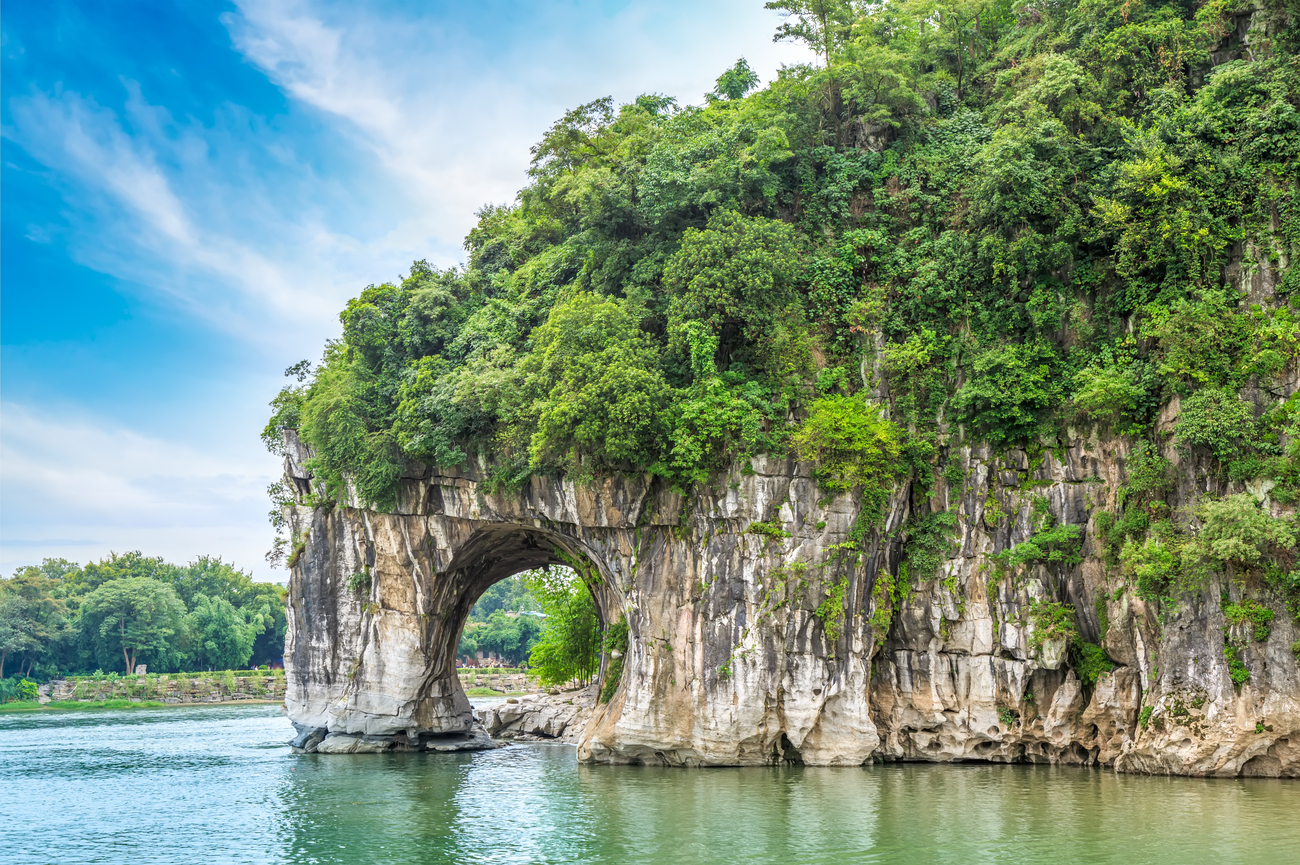
Elephant Trunk Hill, at the confluence of the Li and Peach Blossom rivers, is Guilin's most recognisable formation and has been since the Tang Dynasty. A natural arch at water level, eroded completely through the tower, creates the illusion of an elephant drinking from the river. The arch is not architectural. It is the result of the same process that formed the surrounding landscape: water dissolving limestone along a fracture line until the fracture became a passage. At night, the arch frames its own reflection in the river below, creating what Tang Dynasty poets described as a moon on the water.
The peak has been depicted in Chinese ink-wash painting for more than a thousand years. More than 200 surviving Tang and Song poems reference it specifically. The hill's interior holds inscriptions from several dynasties, and a small Ming Dynasty pagoda still stands on its summit. Guilin's name, meaning Forest of Sweet Osmanthus, refers to the fragrant osmanthus trees that have grown along its riverbanks since antiquity, not the karst peaks that define it. The city arrived here because the river did. The river arrived here because the limestone permitted it.
Solitary Beauty Peak, Duxiu, rises 152 metres from the centre of what was once the Jingjiang Prince's Palace during the Ming Dynasty, the best-preserved Ming imperial palace complex outside Beijing. Three hundred and six stone steps carved into the cliff face lead to a summit from which the full karst panorama surrounding Guilin is visible in every direction. Guilin's urban density and its geological drama exist in the same frame from this summit, and the relationship between them, a modern city arranged around geological formations it could not move and did not try to, is one of the clearest arguments the city makes about its own character.
Reed Flute Cave
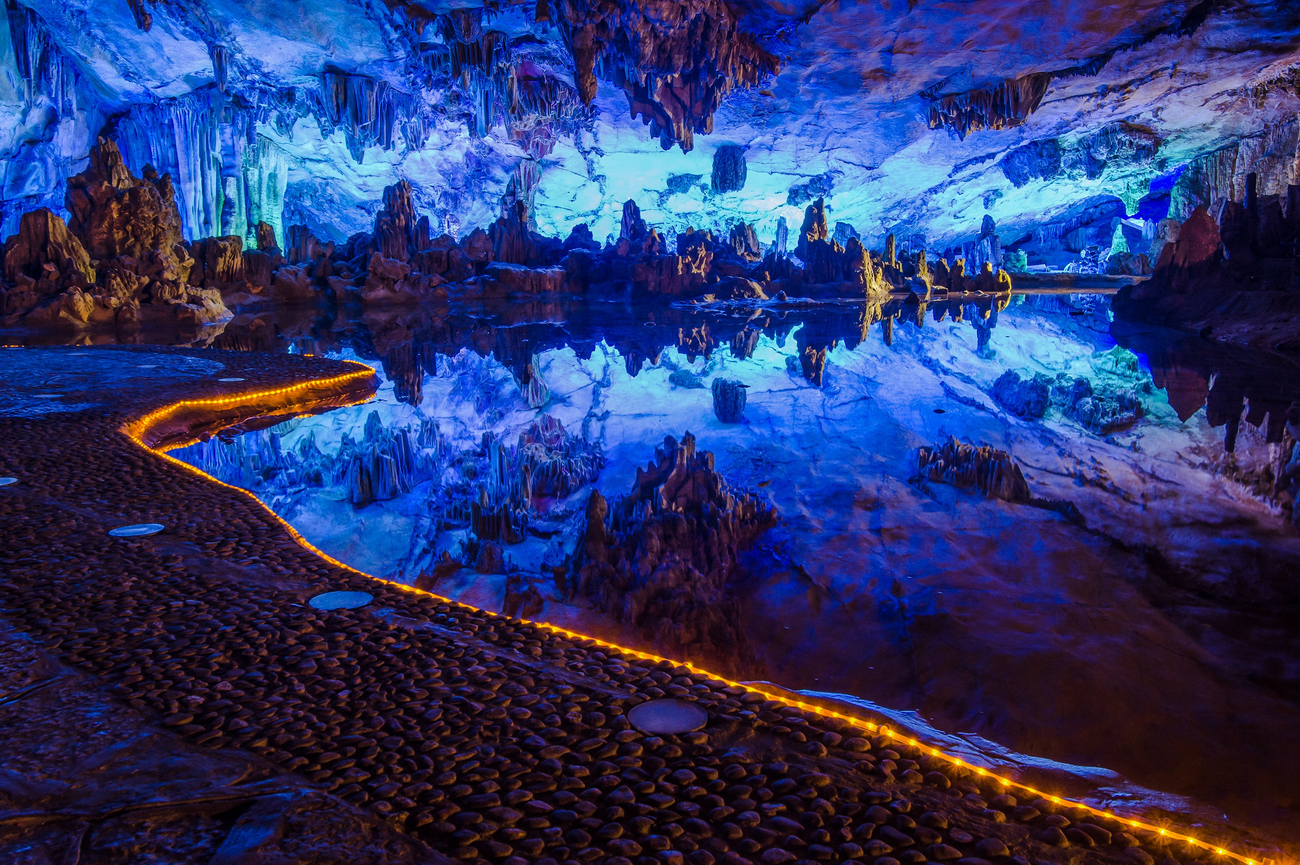
Five kilometres northwest of the city centre, Reed Flute Cave is a 180-metre limestone cave system formed over 180 million years. The cave takes its name from the reeds that once grew at its entrance and were used to make flutes. The practice ended. The cave remained.
Its interior holds stalactites and stalagmites that are still accumulating at approximately one centimetre per century. The Crystal Palace chamber is large enough to hold 1,000 people and contains formations that required 180 million years to reach their current dimensions. The cave was used as a shelter during the Second World War. More significantly, it holds ink inscriptions left by Tang Dynasty travellers, the oldest dating to 792 AD, that remain legible on its walls.
Those inscriptions are not graffiti. They are literary compositions, written by scholars who came specifically for the aesthetic experience of the cave's formations. More than 70 inscriptions survive. They are evidence that the Chinese relationship with this landscape is not a modern tourist phenomenon but a fourteen-hundred-year engagement between an extraordinary natural environment and the people who recognised it as such.
The geological story behind Guilin's peaks, the specific process that produced each formation and what it reveals about 300 million years of Guangxi's history, goes considerably deeper than any pillar post can explore. Our guide to Guilin's karst peaks does what this one cannot.
The
Li River: What Water Does When Given Enough Time
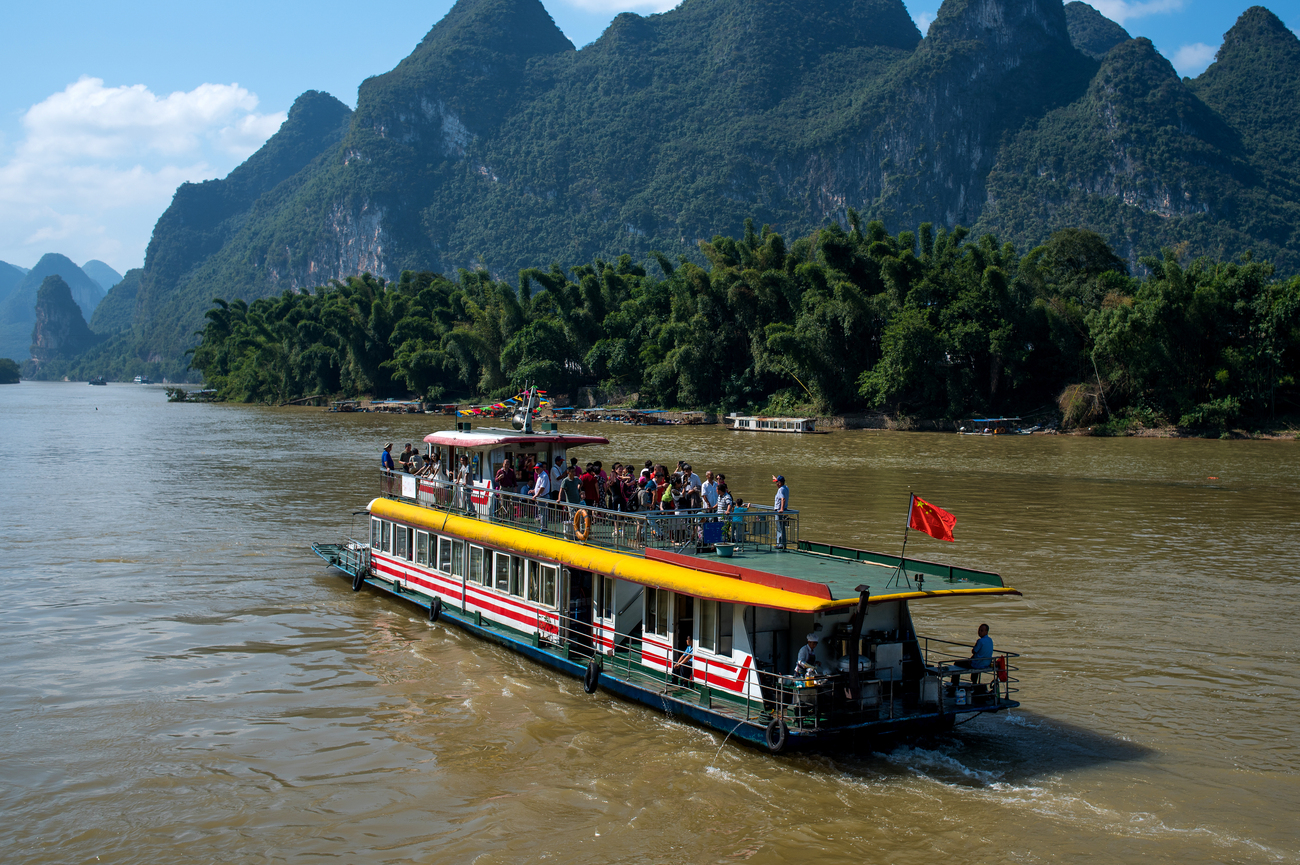
The Li River cruise from Guilin to Yangshuo covers 83 kilometres over approximately four and a half hours. That ratio, four and a half hours of experience against sixty-five million years of formation, is the most honest way to frame what the cruise actually is: a very brief opportunity to witness something that required an extraordinary amount of time to produce.
The poet Han Yu, writing during the Tang Dynasty, described the Li as a blue silk ribbon with emerald hairpins for mountains. The image is precise. The river runs through the peaks rather than alongside them. It moves between geological events, each bend revealing a new configuration of limestone tower and reflected sky that will not be visible again from this angle, at this water level, in this quality of light.
Han Yu was not stylising. He was being accurate.
CNN named the Li River one of the world's fifteen most beautiful rivers and the only Chinese waterway on the list. The recognition is earned by the specific combination that makes this stretch singular: the concentration of karst peaks on both banks, the clarity of the water, the working agricultural landscape that continues alongside the spectacle, and the particular quality of morning mist in the valley between the peaks that makes the landscape feel painted rather than geological.
The Route and Its
Landmarks
The cruise departs from Zhujiang Pier south of Guilin and moves through the city's outskirts before the landscape's full rural character establishes itself. The essential stretch, where the Guilin-Yangshuo landscape reaches its most concentrated expression, runs between Yangdi Village and Xingping Town.
The Yellow Cloth Shoal is a stretch of shallow river over a pale limestone shelf where the water is so clear and shallow that the surrounding peaks reflect in it with remarkable precision. The reflection here is more distinct than anywhere else on the route because the depth is minimal and the current is slow. In the right light, before the morning tour boats arrive, the surface becomes a mirror. The peaks above and the peaks below occupy the same frame.
Nine Horse Fresco Hill is a 100-metre cliff face where natural rock textures and colour variations in the limestone are said to depict nine horses in different postures. The Tang Dynasty poet Han Yu wrote about this cliff specifically. The count of nine horses depends on the observer's patience and imagination. Most people find fewer. The game has been played by river travellers for more than a thousand years.
The cormorant fishermen represent a practice confirmed in Chinese historical records by the Song Dynasty, though its origins may be earlier. Trained cormorants, fitted with a loose ring at the base of the neck to prevent them swallowing larger fish while allowing smaller ones through, dive from bamboo rafts on command. The first written mention of trained cormorants being used to catch fish appears in the Book of Sui, describing a practice in Japan. Cormorant fishing was certainly taking place in China by the Song Dynasty and was widespread during the Ming. The fishermen on the Li River are among the last practitioners of this technique anywhere. The ring, the raft, the bird's particular patience: the mechanics have not changed across a thousand years of recorded practice.

Xingping and the Banknote
Xingping Town, where the Li River curves around Huangbu Shoal, is where the image on China's 20 RMB banknote was captured. The reverse side of the note depicts a fisherman on a bamboo raft drifting through the karst landscape of the Li River. Ask people in Guilin where the scene can be found and most will point to the stretch of river between Xingping and Yucun, widely regarded as the highlight of the Li River cruise.
Laozhai Mountain above Xingping offers the elevated version of this view: the river's curve, the cluster of peaks around the bend, the village at the water's edge, the entire composition visible in a single frame from the summit after a thirty-minute ascent from the riverbank. The cruise passes the viewpoint at water level. The two perspectives are complementary. One is the image the currency chose. The other is the landscape that surrounds it.
Xingping itself is a Sui Dynasty settlement more than 1,400 years old, with preserved Huizhou-style merchant buildings lining its riverside streets. The town has seen increasing tourist traffic in recent years and the main street reflects this. Twenty minutes in almost any direction from the ancient quarter returns you to the river, the peaks, and the particular tranquillity that defines this part of Guangxi.
The specific landmarks of the cruise, the Nine Horse Fresco Hill, the Yellow Cloth Shoal's perfect reflections, the cormorant fishermen at dawn, and the approach to Xingping, are covered in full in our guide to the Li River cruise through Guilin and Yangshuo, including the practical case for timing the journey's most significant section correctly.

Yangshuo:
Where the River Delivers You
The Li River cruise ends at Longtoushan Pier in Yangshuo, where the boat docks and the karst peaks continue in every direction. The town has been receiving travellers since the 1980s, when it became one of the first places in China to develop an international tourism identity, and West Street, its primary commercial lane, reflects this history in its current character: lantern-lit, lively in the evenings, and lined with restaurants and shops that have served visitors for decades.
Step three blocks off West Street in almost any direction and the landscape resumes. Rice paddies between karst towers. Bamboo groves above village lanes. The Yulong River, a quieter counterpart to the Li, runs through countryside that the scale of the Li River cruise cannot fully reveal: smaller, slower, navigable by hand-punted bamboo raft through villages and across ancient stone bridges. The Yulong is what the Li River becomes at a more intimate scale, and it is the correct complement to the cruise rather than a substitute for it.

The Ten-Mile Gallery and
the Cycling Routes
The scenic corridor between Yangshuo and the surrounding countryside, known as the Ten-Mile Gallery, runs parallel to the karst peaks for approximately nineteen kilometres. By bicycle or e-bike, the route passes through Chaoyang Village, follows the Yulong River, and ends at Gongnong Bridge, where bamboo rafts move between the peaks at water level. The cycling here is not sport but geography: a moving engagement with the landscape at the pace that allows it to be properly seen rather than merely registered.
Moon Hill, a karst formation south of Yangshuo with a natural arch at its summit large enough to walk through, offers the landscape from above rather than within it. The ascent takes approximately forty-five minutes. The view from the arch, across rice paddies and karst towers in every direction, is the version of Yangshuo most closely resembling the ink-wash paintings that this landscape has inspired for more than a thousand years.

Impression Liu Sanjie
Every evening on the Li River, two kilometres from West Street, a different relationship between landscape and performance is offered.
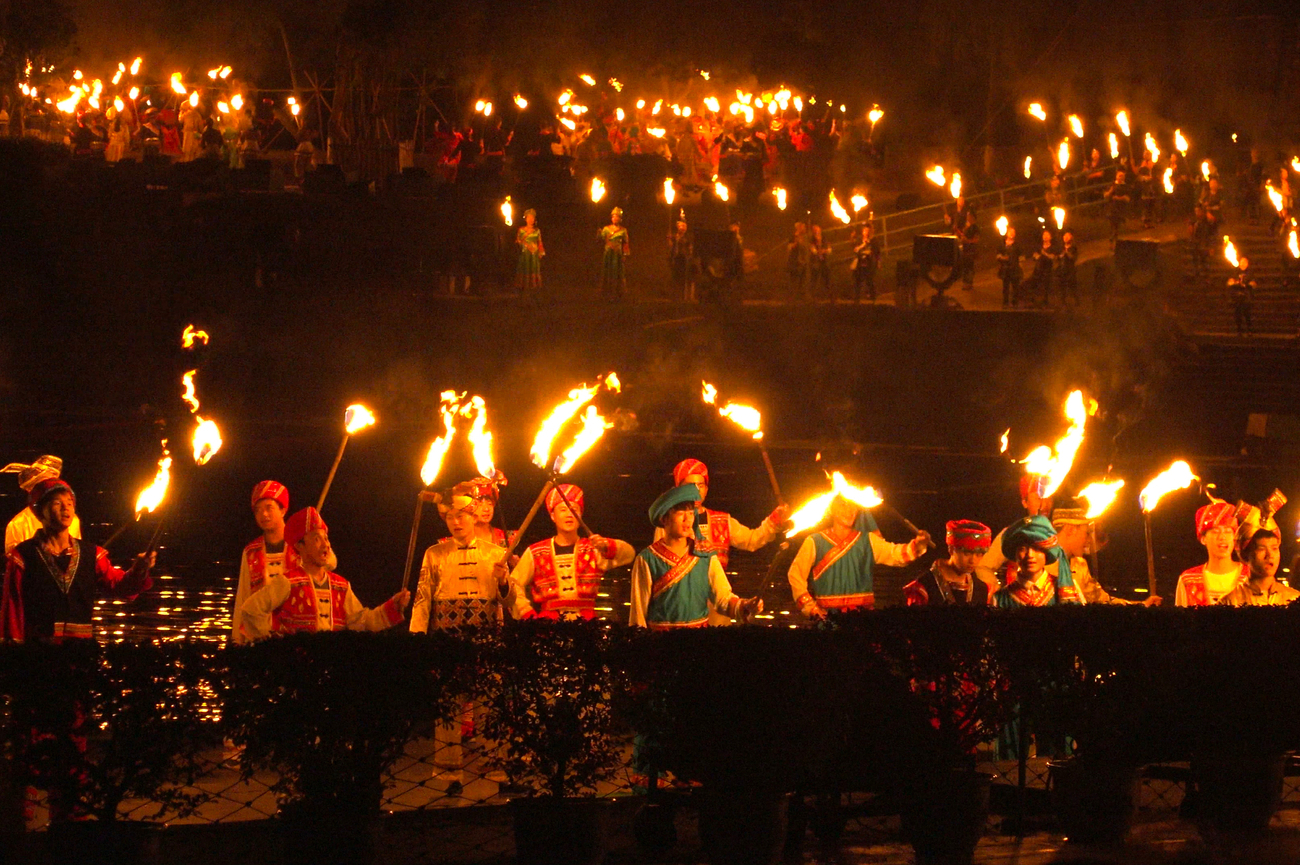
Impression Liu Sanjie was created by director Zhang Yimou, who also directed the opening and closing ceremonies of the 2008 Beijing Olympic Games. The production uses the Li River itself as a stage, with twelve illuminated karst peaks forming the backdrop.
More than 600 performers, including local farmers, fishermen, and villagers from communities along the Li River, present the folklore of Liu Sanjie, a legendary Zhuang girl celebrated for her skill in folk singing. The river itself becomes the stage. The peaks become the set. Mist, when present, becomes part of the production. Light rain does not stop the performance. Moonlight changes the character of the entire spectacle.
The best season to attend the show is autumn, from September to November, when rainfall is lower and evenings are cooler. The performance lasts approximately one hour. Seating is divided into zones based on distance from the water. The closest positions place performers almost at eye level with the river's surface, the illuminated peaks rising directly behind them, allowing the audience to experience both the music and the landscape with equal intensity.
It is, practically speaking, one of the more unusual experiences in China and one of the hardest to describe afterwards. The landscape that spent the day being admired from a boat is now illuminated from within, its limestone surfaces catching the production lighting and returning it in colours that have nothing to do with daylight and everything to do with the specific texture of this rock at this hour.
The
Longji Rice Terraces: The Route's Oldest Layer
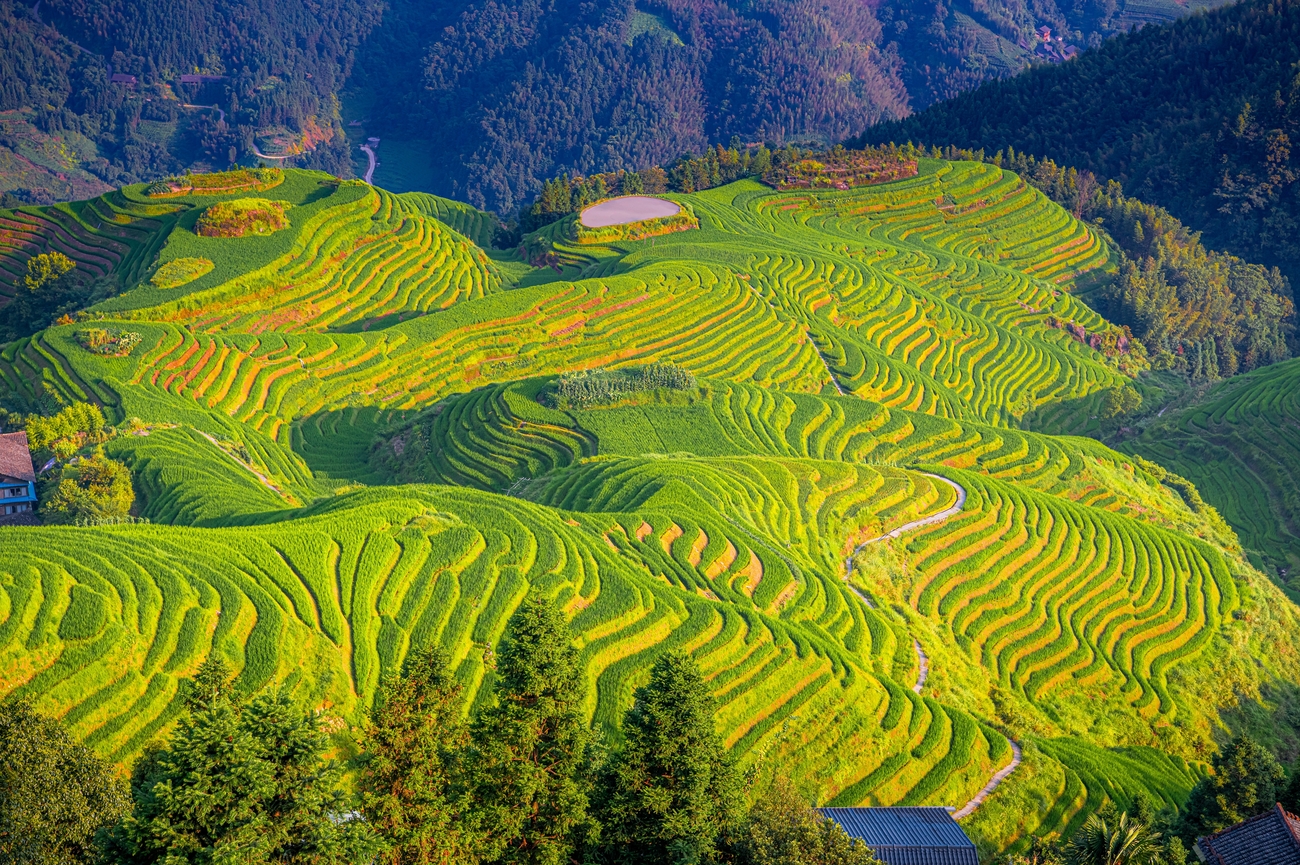
Eighty kilometres north of Guilin, Longsheng County holds 66 square kilometres of terraced rice fields distributed between 300 and 1,100 metres above sea level. Their name, Dragon's Backbone, describes the mountain ridgeline the terraces follow and the appearance of the fields cascading down it in overlapping curves like scales.
Construction began during the Yuan Dynasty, between 1271 and 1368, and reached its current scale by the early Qing Dynasty. The people who built these terraces were the Zhuang and Yao ethnic minority groups, communities that moved into the mountains during periods of political upheaval and needed to continue growing rice in terrain where flat ground did not exist. The engineering solution they developed, terraced paddy fields supported by a self-sustaining irrigation system fed by mountain springs, has remained in continuous use for more than 650 years.
The Zhuang are China's largest ethnic minority group, with approximately 18 million members, most living in Guangxi and neighbouring Yunnan. The Yao communities in Jinkeng Dazhai, the highest of the three principal terrace areas, are known internationally for the Red Yao women's practice of growing their hair throughout their lives and winding it into elaborate headdresses. The tradition is specific to this community and has been maintained without interruption for generations. Jinkeng's three numbered viewpoints are where the Longji Rice Terraces are most fully appreciated from above, the terrace system cascading across the mountain face in a single frame.
The terraces change across the four seasons in ways that make the choice of when to visit a genuine decision rather than a logistical one. Spring floods the terraces for planting, filling each level with water that reflects the sky. The mountains become silver in the morning light, each terrace a mirror. Summer turns the rice emerald green, creating the signature image of Longsheng at its most vibrant. Autumn transforms the fields to gold and brings the entire community onto the terraces for harvest, the rice still cut by hand because the slopes are too steep for mechanisation. Winter strips the earth bare and reveals the engineering itself: the stone walls, hand-laid without mortar, and the full extent of the terrace system visible only when the rice is absent.
Built more than 650 years ago by local ethnic minority communities, these step-like fields wind their way up the mountainsides like ribbons of green, gold, or glassy mirrors depending on the season.
The terraces were selected as a UN World Tourism Organisation Best Tourism Village in 2022 and are recognised as a Globally Important Agricultural Heritage System by the FAO. Both designations acknowledge something the terraces have demonstrated for centuries: an agricultural engineering achievement created in the 14th century, maintained entirely by the communities that built it, and still producing rice today, is one of the most remarkable examples of continuity in human history.
The depth of what Longsheng holds, the villages within the scenic area, the Yao cultural traditions, the irrigation system's engineering, and the practical question of which season and which viewpoint to prioritise, are explored in our guide to the Longji Rice Terraces. It is the route's most historically layered stop, and it earns its own reading.
Where
You Stay
The Guilin-Yangshuo route places five-star accommodation inside the landscape rather than adjacent to it.
Guilin
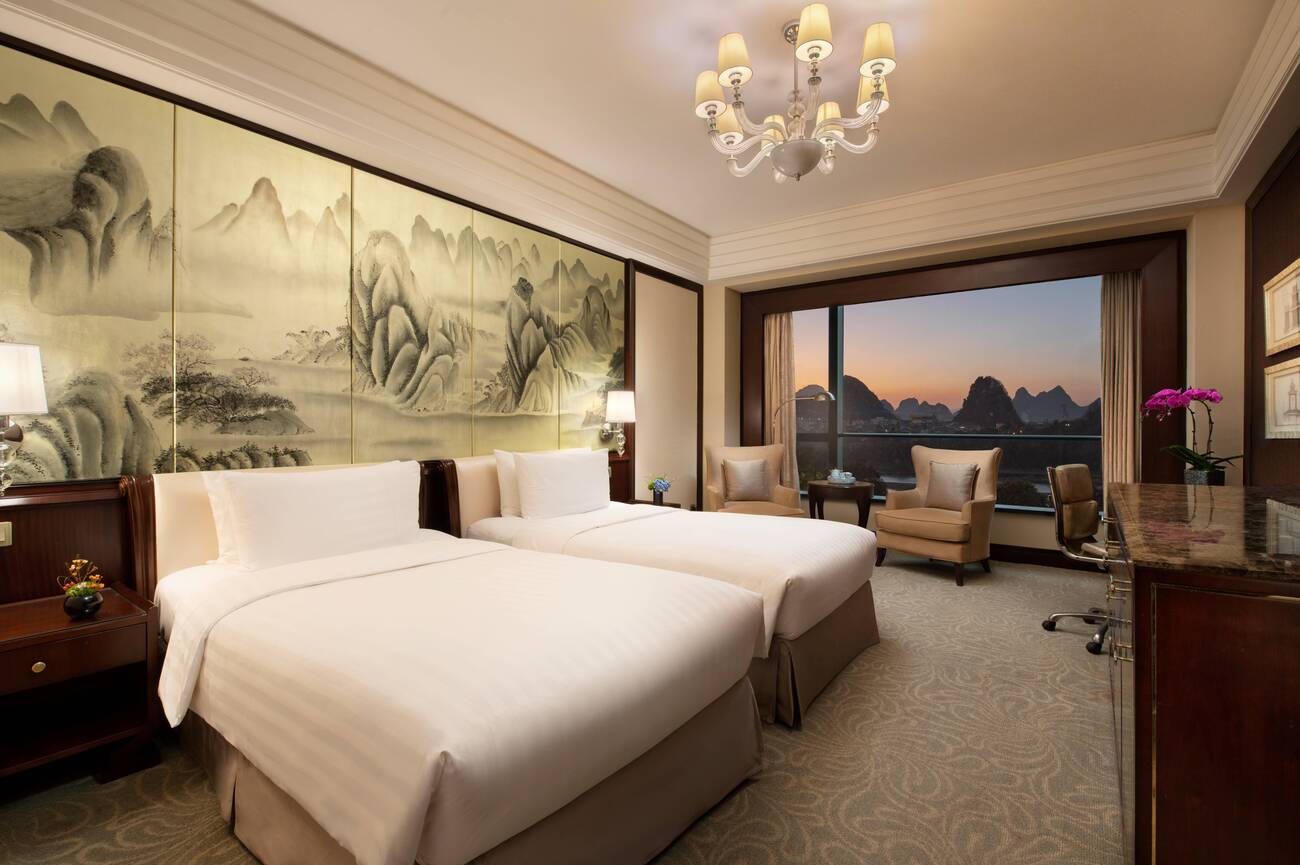
In Guilin, the properties on this itinerary are positioned for karst mountain views and convenient access to the Li River pier. This matters when the cruise departure is at 9 AM and the alternative is a predawn transfer. Shangri-La Guilin is included for this reason, offering a comfortable riverside base where the city’s karst peaks are visible from the hotel. The landscape that makes Guilin worth visiting is not something you travel to from the accommodation. It is the accommodation’s context.
Yangshuo
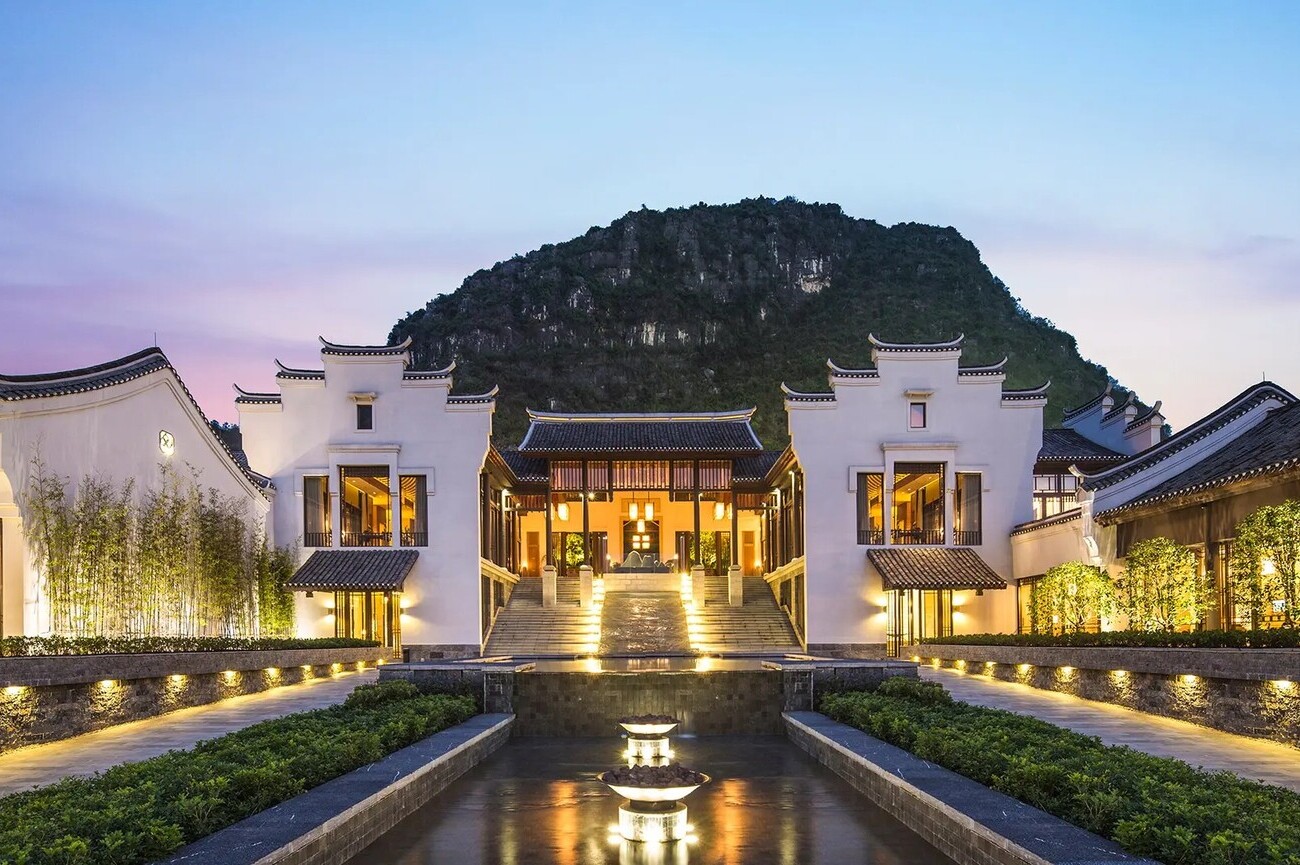
In Yangshuo, the approach is different in character. Boutique five-star properties in the surrounding countryside, such as Banyan Tree Yangshuo, place guests within the karst landscape rather than in the town that the landscape surrounds. The peaks are not a view from the window. They are the horizon in every direction.
Longsheng
At Longsheng, the overnight option at Baike Boutique Hotel in Ping’an Village changes the Longji Rice Terraces from a day trip into an experience with a different temporal quality. The No. 1 Viewpoint at sunrise, before the morning’s visitors arrive from Guilin, is available only to guests who stayed the night on the mountain. The terraces at that hour, in that light, without the day’s commerce around them, are a different place from the one accessible to day visitors.
Revigorate's China Rivers and Terraces itinerary holds the full accommodation thread across all cities, with the Guilin, Yangshuo and Longsheng properties chosen for their relationship to the landscape the journey is built around. The logistics, the transfers, the access to the Li River cruise and the Longji viewpoints at the right hours of the right days: all of it arranged before departure so the trip can be the experience rather than the coordination.

The
Route's Full Shape
The Beijing-to-Shanghai thread that runs through this journey carries both the imperial story and the contemporary one. Beijing's Forbidden City and the Great Wall at Mutianyu represent the dynasty's physical ambition at its most sustained. Shanghai's Bund and the Pudong skyline facing each other across the Huangpu represent China's engagement with the global economy at its most visually concentrated.
What the China Rivers and Terraces itinerary adds, the Guilin and Yangshuo leg between Xi'an and Shanghai, is a third register entirely. Not imperial and not contemporary, but geological and agricultural: the landscape that Chinese painters have been responding to for fourteen centuries and the mountain terraces that Chinese farmers have been maintaining for more than 650 years. The natural world and the human world exist here in a relationship that predates both the Great Wall and the Forbidden City.
The Guangxi travel experience of moving through the karst landscape by river, spending a morning above the cloud line at a viewpoint where the Longji Rice Terraces turn gold in October light, and arriving in Yangshuo by boat rather than by road, gives this route what no imperial city or contemporary waterfront can provide. These landscapes exist here, in the specific geology and culture of Guangxi, because the river has been doing its work for an extremely long time.

On
the River, Looking Up at the Peaks
The Li River cruise ends in Yangshuo in the early afternoon. The karst peaks are still there in every direction. The Longji Rice Terraces at Longsheng are still turning through their season. The cormorant fishermen are still on the river at dawn, their birds still fitted with the same rings their Tang Dynasty predecessors used.
The landscape does not hurry. It has not hurried for sixty-five million years. The journey through it, properly arranged, can adopt the same quality.
For travellers who want the Guilin-Yangshuo route at its most complete, with the karst peaks, the Li River, and the terraced mountains of Guangxi held within a ten-day itinerary that also moves through Beijing's imperial core and Xi'an's Silk Road layer before arriving at Shanghai's waterfront, the China Rivers and Terraces journey is where to begin the conversation.
The route is built. The river is running. The only question is the season. Let's talk about it.



Let us know what you love, where you want to go, and we’ll design a one-of-a-kind adventure you’ll never forget.
Get in touch
Miriam
Travel Specialist

Nina
Travel Specialist

Abigail
Travel Specialist
Frequently Asked Questions
- How many days should travellers allow for Guilin, Yangshuo and Longsheng?
A well-paced journey through Guilin, Yangshuo and Longsheng usually needs at least four to five days. This allows time for the Li River cruise, Yangshuo’s countryside, the Longji Rice Terraces and one overnight stay in the mountains without turning the route into a rushed sequence of transfers.
- Is this part of China suitable for first-time visitors?
Yes. Guilin, Yangshuo and Longsheng work particularly well for travellers who want to balance China’s imperial cities with landscapes, river journeys and rural culture. The region adds a completely different rhythm to a classic China itinerary that includes Beijing, Xi’an and Shanghai.
- When is the best month to visit the Guilin, Yangshuo and Longji route?
October is one of the strongest months for this journey. The weather is generally comfortable, the Longji Rice Terraces are often golden before harvest, and the Li River landscape has excellent visibility. Spring is also beautiful, especially when the terraces are filled with water.
- Is the Li River cruise better than travelling by road from Guilin to Yangshuo?
Yes, for travellers who want to experience the landscape properly. The road transfer is quicker, but the Li River cruise is the journey’s defining experience. It reveals the karst peaks, river bends, villages and reflections in a way that cannot be replicated from a car.
- Do you need to stay overnight at the Longji Rice Terraces?
An overnight stay is highly recommended. Day visitors usually arrive after the best early morning light has passed. Staying in Ping’an Village allows travellers to experience the terraces at sunrise, before the viewpoints become busier.
- Is Yangshuo too touristy to include?
Yangshuo town can be lively, especially around West Street, but the surrounding countryside remains the reason to stay. With the right hotel location and privately arranged activities, Yangshuo becomes a base for rivers, villages, cycling routes and karst scenery rather than a standard tourist stop.
- Can this itinerary be arranged privately?
Yes. The route works best as a privately arranged journey, with transfers, cruise timing, hotel selection, guides and viewpoint access coordinated in advance. This is especially important when combining Guilin, Yangshuo and Longsheng with Beijing, Xi’an and Shanghai.
- Is this itinerary suitable for families?
Yes, depending on the children’s ages and travel style. The river cruise, caves, bamboo rafting, cycling routes and rice terraces can work very well for families, provided the pace is carefully planned and long transfer days are avoided.
- How physically demanding is the Longji Rice Terraces visit?
The terraces involve uneven paths, stone steps and uphill walking, especially around the viewpoints. The experience can be adapted, but travellers should expect some walking. Comfortable shoes are essential.
- Why book the China Rivers and Terraces itinerary with Revigorate?
Revigorate combines China’s most important cultural and historical destinations with the extraordinary landscapes of Guangxi in a single, seamless journey. From selecting the right hotels in Guilin, Yangshuo and Longsheng to arranging private transfers, guides, flights and Li River cruise logistics, every detail is coordinated in advance. The result is a tailor-made travel experience that allows you to focus on the landscape, culture and experiences rather than the planning.
Our offices:



Revigorate, Iberian Escapes and Algarve Lifestyle are the registered brand names of APCS Lda . We are a fully authorised travel agency licensed by Turismo de Portugal RNAVT/6867.
In the event of a dispute, the consumer may refer to: RAL - Centros de Arbitragem
Avª. 5 de Outubro, nº. 55, R/C Dtº. 8000-075 Faro, Portugal | Tel: +351 289 823 135 *
* national landline call
E-mail: info@consumoalgarve.pt| www.consumidoronline.pt | Mon to Fri: 9:00 - 13:00 / 14:00 - 17:00