Li River Cruise from Guilin to Yangshuo: China’s Most Recognisable River Passage
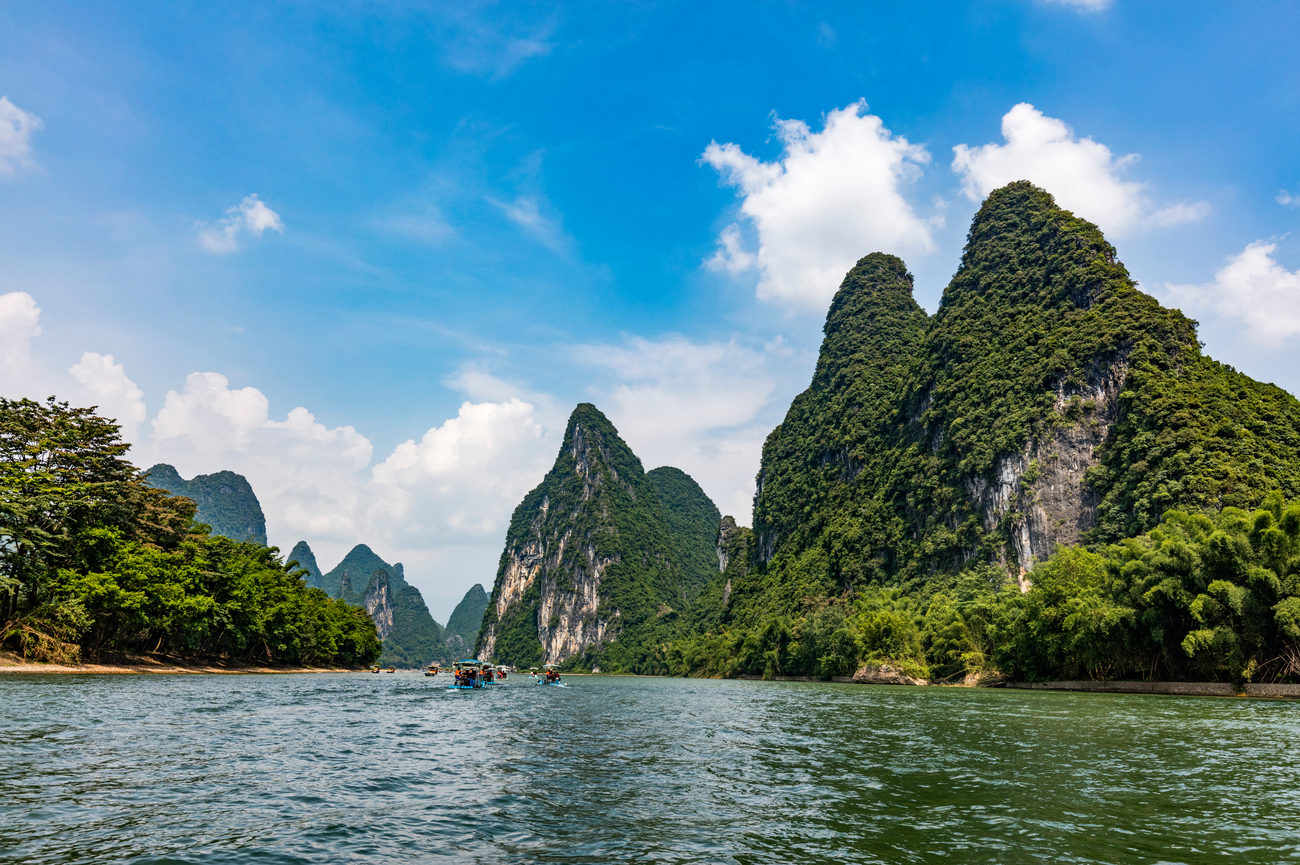
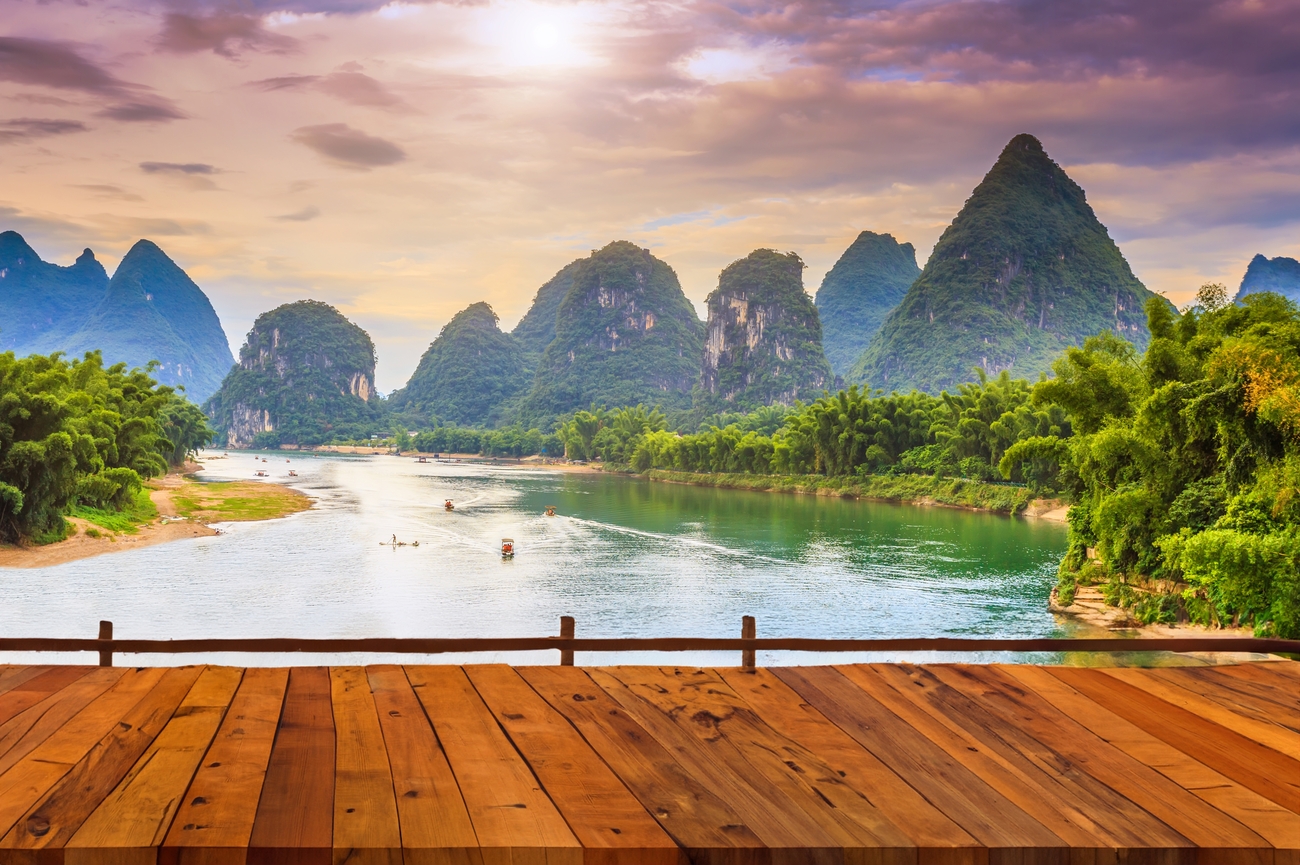
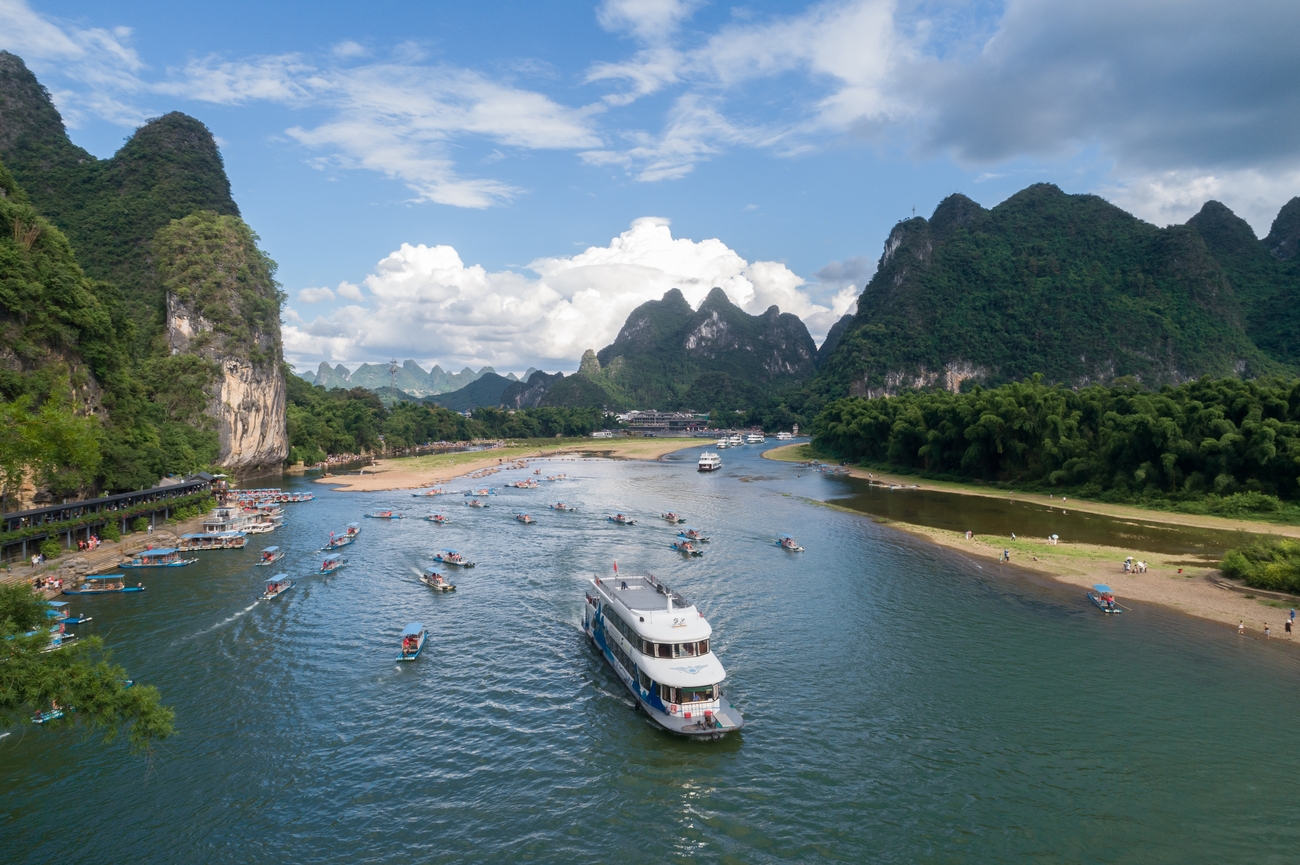
The Li River Cruise from Guilin to Yangshuo is one of China’s most iconic river journeys, passing through the karst peaks, bamboo groves and misty limestone landscapes that have shaped the image of Guangxi for centuries.
The route follows the Li River south from Guilin towards Yangshuo, where steep green peaks rise almost vertically from the water and villages appear between bends in the river. Along the way, Yellow Cloth Shoal and Xingping reveal the scenery made famous by China’s 20 yuan banknote, turning a familiar national image into a real landscape moving slowly past the boat.
This is the gentler side of a China itinerary: not imperial palaces or skyline cities, but river light, limestone towers and countryside shaped by water. The China Rivers and Terraces itinerary places this cruise within a wider Guangxi journey, connecting Guilin, Yangshuo and the region’s most recognisable natural scenery in a single, memorable passage.
The
River Before the Cruise Begins
Understanding what the Li River cruise is taking you through requires knowing what the Li River actually is before you board.
The river originates in the Cat Mountain range at Xing'an County, northeast of Guilin, and runs south for 164 kilometres. The 83-kilometre section from Guilin to Yangshuo is where China's karst landscape reaches its most concentrated expression: the limestone towers are most densely placed on both banks, the valley is at its most open, and the water is at its clearest. The entire length of this section is protected within the Li River National Scenic Reserve, one of China's first protected scenic zones, established in 1982.
The river's clarity is a direct consequence of its geology. The Li River is suitable for travel throughout the year, especially from April to October. During occasional low-water periods in December, January, and February, the government opens the sluice gates of the upriver reservoir to ensure cruise ships can operate. The karst limestone through which the river flows is porous. Water filters through the rock system before reaching the surface, emerging cleaner than a river moving through typical alluvial sediment. In the dry season, between October and April, the Li runs at its most transparent, with the limestone riverbed visible in sections where the water is only a metre or two deep.
The water level matters more than most visitors realise before they arrive. The cruise from Zhujiang Pier in Guilin operates on larger vessels that require a minimum river depth for the most scenic sections. In very dry periods, boats may change or routes may adjust. The section between Yangdi Village and Xingping Town, the most visually concentrated 18 kilometres of the full route, depends on conditions. Coming in the right season is not a minor detail. It is the difference between two versions of the same river.
The karst peaks that line both banks, and the specific geology that produced these precise shapes in this precise valley, are covered in full in our guide to Guilin's karst peaks. The river is where you experience the landscape the geology produced.

The
Route, Landmark by Landmark
The cruise departs from Zhujiang Pier, south of Guilin's city centre, for vessels in the 4 and 5-star category, or Mopanshan Pier for the 3-star fleet. The route moves south through the city's outer areas before the rural character of the Li valley fully establishes itself. The landscape builds gradually. By the time the boat reaches Yangdi Village, the city has completely disappeared and the peaks are pressing in on both sides.
The section between Yangdi Village and Xingping Town is where the Li River cruise earns its reputation.
Crown Cave and
the Underground River
Before Yangdi, the boat passes Crown Cave, Guanyan, on the eastern bank. The cave entrance is visible from the river: an opening in the cliff face where a Li River tributary disappears underground before re-emerging downstream. The cave system within extends considerably further than the visible entrance.
Crown Cave was formed by the same dissolution process that created the karst peaks above ground: the same carbonic acid, the same limestone, the same millions of years. The surface landscape and the underground landscape of Guilin are different expressions of one geological event.
Nine Horse
Fresco Hill
Nine Horse Fresco Hill is 400 metres high and 200 metres wide. The cliff facing the Li River appears to contain the images of nine horses: some standing, some lying, some with heads raised high, some running, some turning their heads, and some seemingly grazing at leisure.
The game of counting the nine horses has been played by river travellers since the Tang Dynasty. In the past, those who could identify all nine were believed to be destined for success in the imperial examinations. The Qing Dynasty poet Yuan Mei wrote specifically about this cliff. Most observers find fewer than nine. A few find more. The debate has continued for more than twelve centuries without resolution and shows no sign of ending.
What the hill actually demonstrates, beyond the horses, is the character of limestone weathering in this section of the Li valley. The mineral deposits in the cliff face, principally iron oxides and manganese compounds, weather at different rates. The surface is genuinely patterned rather than smooth. The patterns are real. Whether any of them are horses is a question the rock face has declined to answer definitively.

Yellow Cloth
Shoal
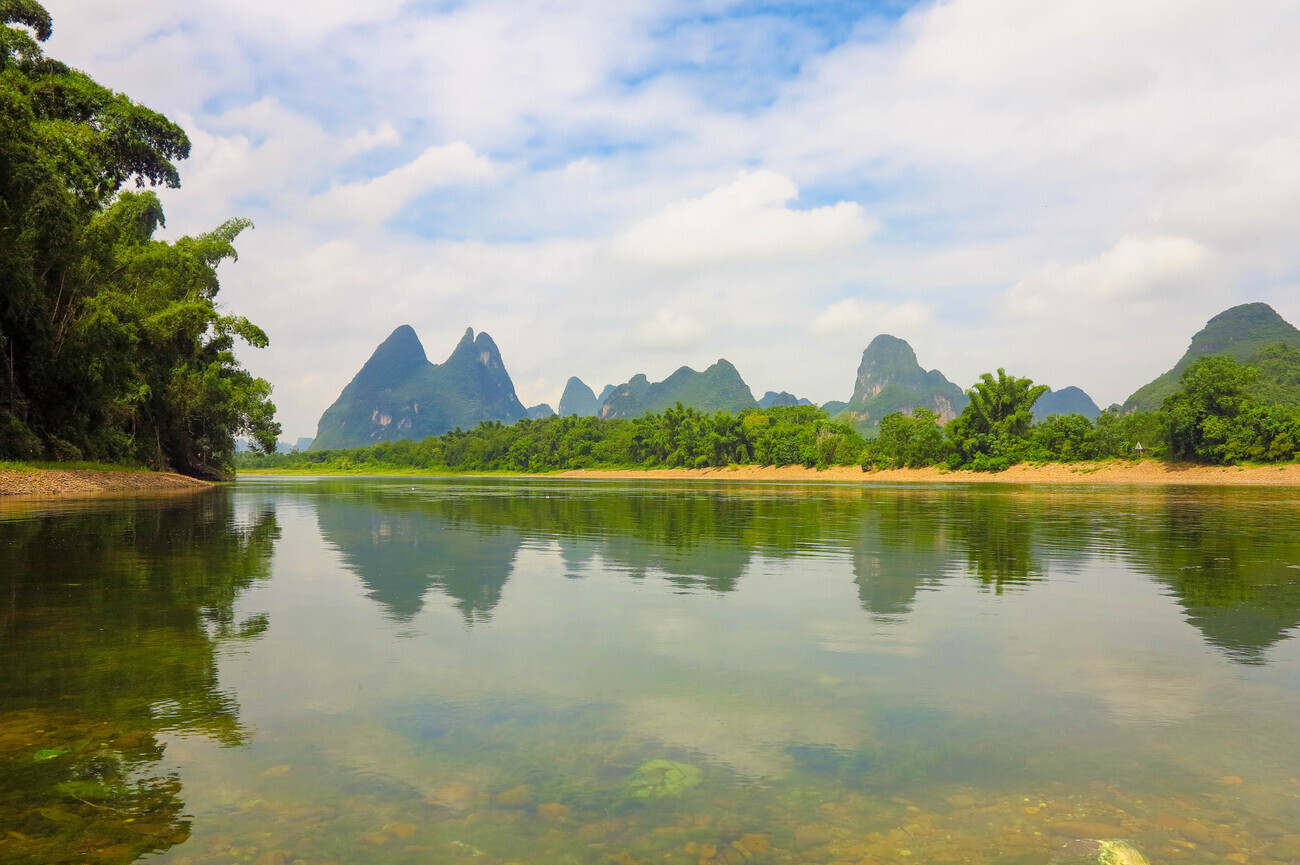
Yellow Cloth Shoal lies in the upper reaches of Xingping. Here, the water is calm and clear, with a large beige limestone shelf visible at the bottom of the river, like a yellow cloth laid flat on the riverbed. That is where the name comes from. The beauty of the Li River's mountains lies partly in their reflections, and the reflections at Yellow Cloth Shoal are the most celebrated of all.
The shoal's specific character comes from three factors that happen to coincide in this section: the pale limestone shelf lightens the water's colour from below, the surrounding peaks channel wind away from this stretch, keeping the surface still, and the bend in the river immediately upstream slows the current to its minimum. The combination produces a mirror that no other section of the river replicates.
The shoal's reflection appears on the 20 yuan note of China's fifth currency series and was selected as the background for the Chinese embassy's large landscape painting. The Chinese government has used this specific view, this precise configuration of reflected peak and still water, to represent the country in formal diplomatic contexts. Passing through it on a boat, the image already somewhere in memory, is the particular experience of arriving inside something you have seen reproduced many times and finding the original different in a way you cannot immediately explain.
Xingping Town
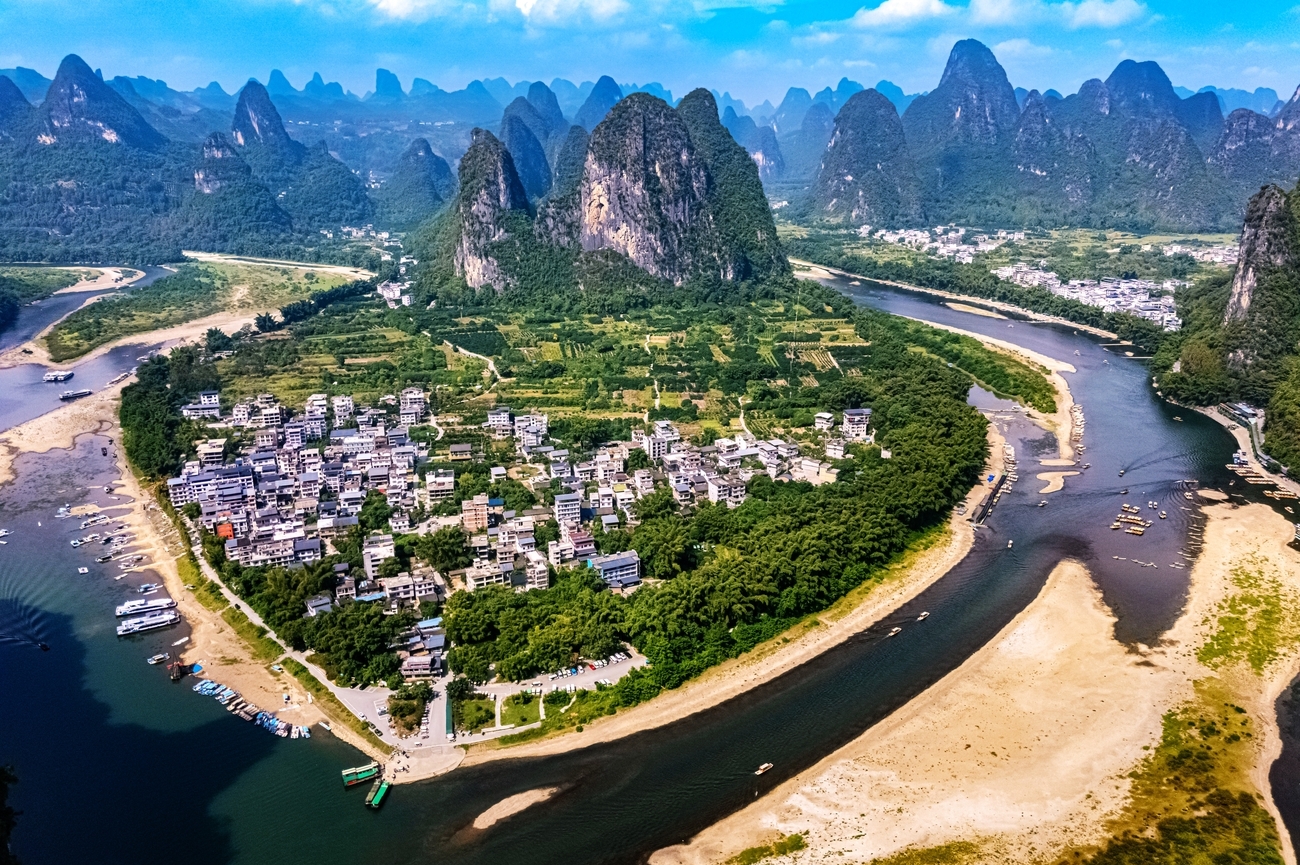
Xingping Ancient Town, on the western bank of the Li River between Nine Horse Fresco Hill and the final approach to Yangshuo, is the most historically significant landing point on the Li River cruise route.
Xingping features many well-preserved Ming and Qing-era structures, including historic streets, bridges, temples, and an opera stage. The town gained international attention when President Bill Clinton visited in 1998, following the same river route local fishermen had used for generations.
The old street of Xingping, a Sui Dynasty settlement with a history spanning more than 1,400 years, is a five-minute walk from the river landing. The Ming and Qing merchant buildings lining the main street remain intact enough that the town's original character is legible rather than reconstructed. Xingping existed on this bend of the river because the bend itself, where the current slowed and the surrounding karst peaks created the valley's most dramatic setting, made it a natural centre of exchange for the communities working along the Li.
Laozhai Mountain above Xingping, a thirty-minute ascent from the riverbank, offers the elevated view that produced the 20 RMB banknote image. The summit frame shows the Li River curving around Huangbu Shoal, the village at the water's edge in the middle distance, and a cluster of karst peaks completing the composition behind it. The cruise passes this landscape at water level. The mountain gives you the photographer's viewpoint. Both perspectives are worth having. Neither replaces the other.
The
Cormorant Fishermen
They are on the water at dawn, sometimes at dusk, and occasionally visible from the cruise deck during the journey's middle section.
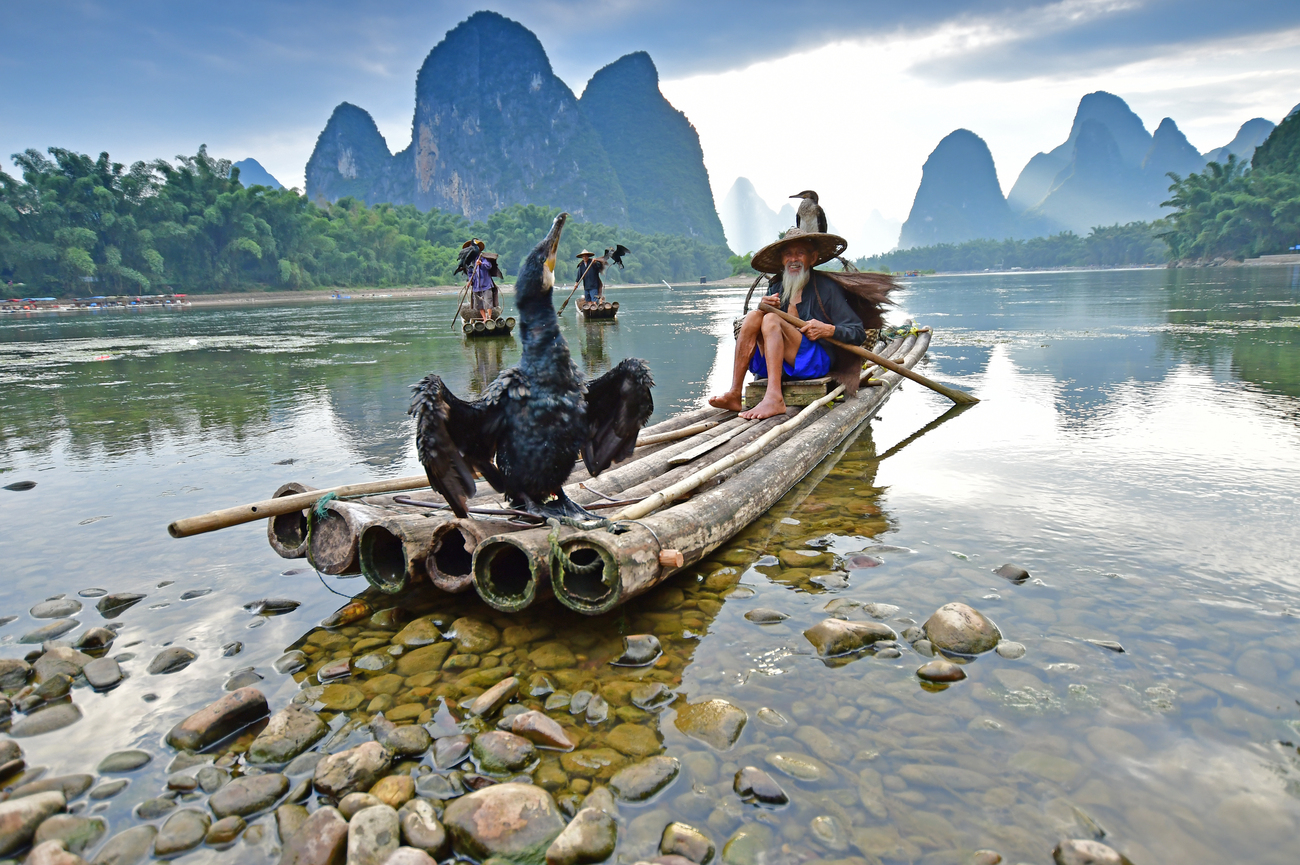
The Li River fishermen are known for the traditional practice of cormorant fishing, which has been recorded on the river for more than a thousand years. The fishermen train cormorants to catch fish, using a loose ring around the bird's throat to prevent it swallowing larger catches while allowing smaller fish through.
Some fishermen still work after dark. An oil lamp is hung from one end of the bamboo raft, illuminating the river below so the cormorants can see and pursue fish beneath the surface. The image of a lantern-lit raft in the darkness, with the silhouette of a cormorant set against a reflection of the karst peaks, is the Li River reduced to its essential elements: the bird, the fisherman, the bamboo, the water, the mountains behind them, and a practice that has changed remarkably little over the centuries.
The fishermen around Xingping are among the last working practitioners of this technique in China. Cormorant fishing has been replaced by modern methods almost everywhere else. On this section of the river, it survives partly as a livelihood and partly as the continuation of knowledge passed through families for generations. They are not recreating a tradition for visitors. They are the tradition, and the bamboo raft beneath them is recognisably the same craft their grandfathers used.
The mist that settles over the Li River at dawn, before the cruise boats leave Guilin, is when the fishermen and the landscape around them most closely resemble the ink-wash paintings that this river inspired. At dawn or dusk, when mist hangs over the water, the scene becomes a living Chinese painting: the fisherman, his cormorants, the bamboo raft, the still river, and the karst peaks fading into the distance.
Yangshuo:
What the River Delivers You To
The Li River cruise ends at Longtoushan Pier in Yangshuo. The karst peaks continue in every direction.
Yangshuo has been attracting international attention since the early 1980s, when it became one of the first towns in China to develop an international tourism identity. West Street, its primary commercial lane, is genuinely good for food and lively in the evenings. Step three blocks away and the paddies and karst towers resume, as if the town were a brief interruption in a landscape that is otherwise uninterrupted.
The Yulong
River
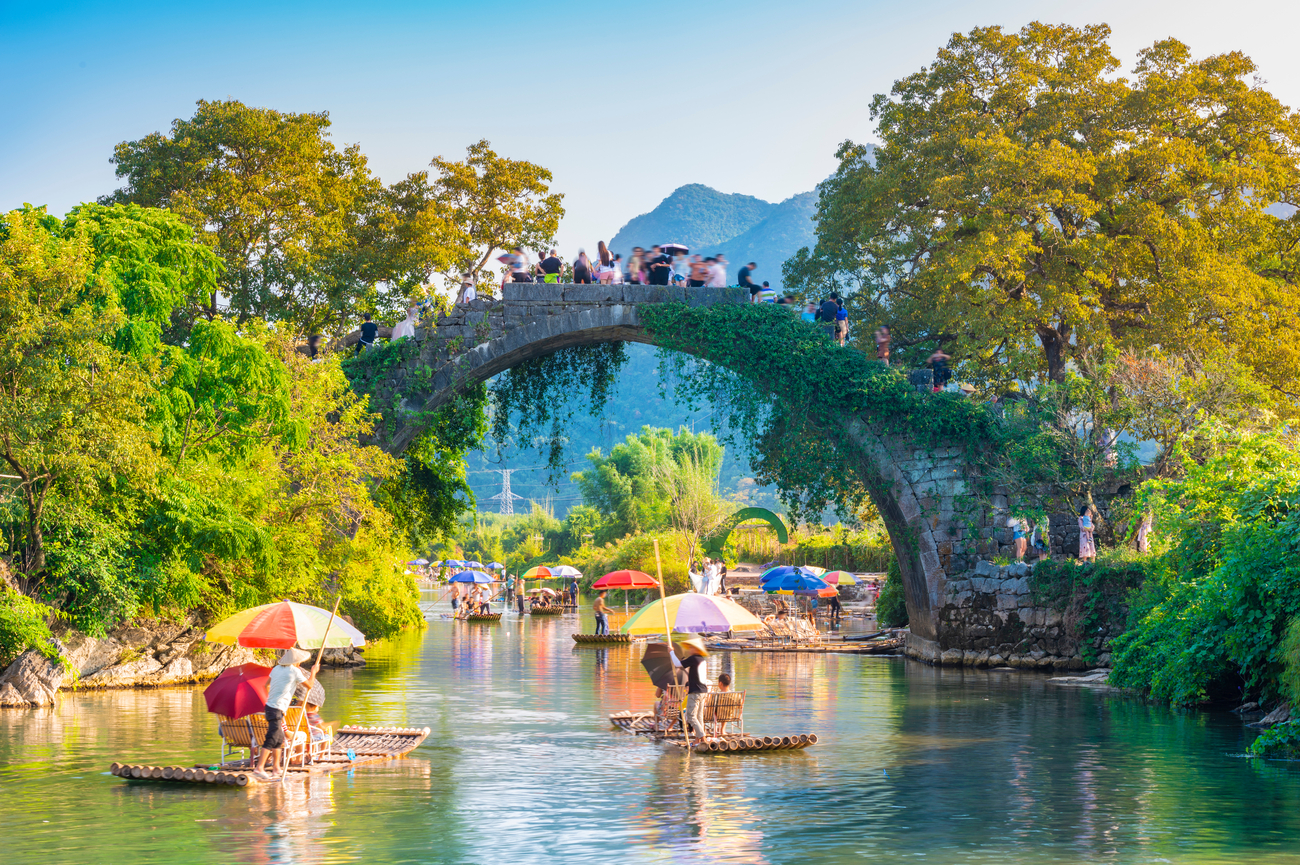
The Yulong is the Li River's quieter counterpart: a tributary that runs through rice paddies and past ancient stone bridges at a pace that allows the countryside to be absorbed rather than watched from a moving deck. Hand-punted bamboo rafts carry two or three passengers downstream through a landscape the larger cruise boats on the Li cannot access.
The Yulong River winds past ancient stone bridges, rice paddies, and grazing water buffalo. Its stillness captures the pastoral heart of Yangshuo. Gongnong Bridge, a Song Dynasty stone arch still in daily use by foot traffic, crosses the Yulong at the point where the raft route opens to one of its broadest views of the surrounding karst. The bridge has been here for nine hundred years. The river has been running beneath it for considerably longer.
The Yulong and the Li are the Guilin-Yangshuo landscape at different scales. The Li is the argument. The Yulong is the evidence.
The Ten-Mile
Gallery
The scenic road corridor between Yangshuo and the surrounding countryside, nineteen kilometres of karst peaks and Yulong River banks, is the correct way to spend an afternoon after the morning's cruise. By bicycle or e-bike, the route passes through Chaoyang Village, follows the river, and ends at Gongnong Bridge, where bamboo rafts move between the peaks at water level. Cycling here is not a sport. It is geography at the pace that allows it to be felt rather than merely registered.
Moon Hill, a karst peak south of Yangshuo with a natural arch at its summit large enough to walk through, offers the landscape from above. The forty-five-minute ascent leads to a view across rice paddies and karst towers that is the closest available equivalent to the ink-wash painting tradition the Li River produced: isolated peaks, cultivated valleys, and mist if the hour is right.
Impression Liu
Sanjie
Every evening on the Li River, two kilometres from West Street, landscape and performance meet.
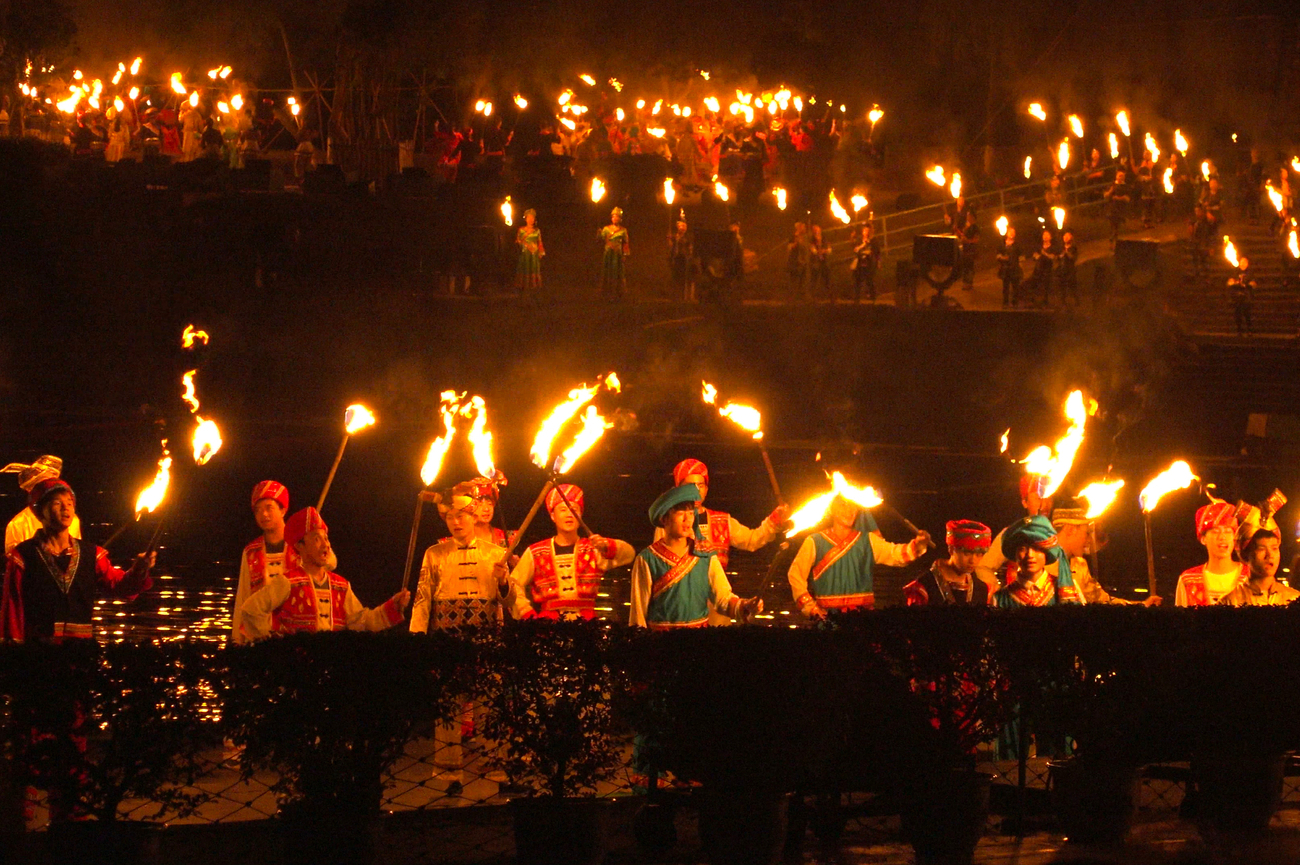
Impression Liu Sanjie is the first of the Impression Shows by director Zhang Yimou, who also directed the opening and closing ceremonies of the 2008 Beijing Olympic Games. Zhang designed the performance around the Li River itself, using the water as the stage and twelve karst mountains as the backdrop. More than 600 performers, many of them local farmers and fishermen from riverside communities, take part in the show, which lasts approximately 70 minutes.
The production stages the folklore of Liu Sanjie, a legendary Zhuang girl celebrated for her folk singing, against the illuminated karst peaks. The river itself is the stage. The mountains are the set. Mist becomes part of the design. Fishermen in straw rain capes, with cormorants on bamboo rafts, appear in the opening sequence on the water they have always worked.
The best season to attend is autumn, from September to November, when rainfall is lower and evenings are cooler. There are usually two performances each night, and tickets can sell out quickly.
The Longji Rice Terraces above Guilin, 80 kilometres north of the city and accessed on a separate day from the cruise, are the other half of what makes this Guangxi itinerary complete. Where the Li River shows you what water built over geological time, the terraces show you what human hands built over more than six centuries on the mountains above.
Where the cruise ends and the terraces begin, and how the ten days between Beijing and Shanghai hold both, is mapped in the China's Riverlands guide.
On
the Water: What the Four and a Half Hours Actually Contains
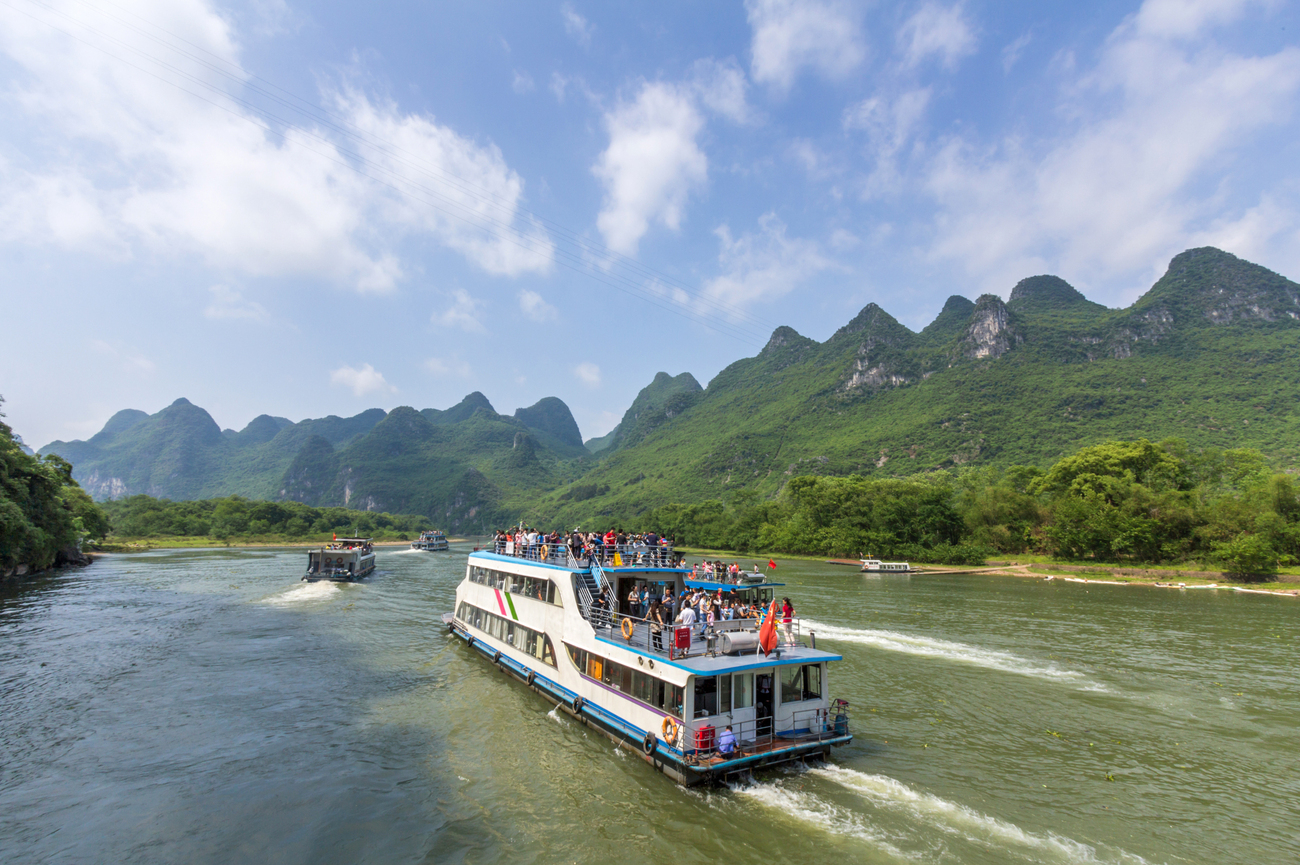
The full Li River cruise from Zhujiang Pier to Longtoushan Pier covers 83 kilometres over approximately four and a half hours. The first section, from Guilin through the city's outskirts to Yangdi, takes roughly ninety minutes and acts as the journey's opening movement: the peaks begin to appear, the valley opens, and the urban fabric drops away. The essential section between Yangdi and Xingping contains Nine Horse Fresco Hill, Yellow Cloth Shoal, the 20 RMB viewpoint, and the cormorant fishermen in approximately ninety minutes of sustained concentration. The final section from Xingping to Yangshuo is the unwinding: the peaks continue, the valley widens, and the boat arrives at the town pier with the afternoon still available.
The cruise boats themselves vary considerably. Prices range from CNY 200 to more than CNY 2,000, from 3-star vessels to luxury boats. 4 and 5-star boats depart from Zhujiang Pier, while 3-star boats depart from Mopanshan Pier. The difference between vessel categories is meaningful on a journey of this length: the upper deck viewing areas on 4 and 5-star boats are considerably less crowded during the essential central section, when the landscape most rewards sustained attention.
The practical case for arranging the cruise in advance rather than purchasing it on arrival in Guilin comes down to three specific issues. Peak season demand, particularly during Golden Week in the first week of October, when the Longji Rice Terraces are in full harvest gold and the Li River cruise is simultaneously at its most popular, fills the better vessels quickly. The departure transfer requires knowing which pier serves which vessel category and arriving at the correct time. And the question of which sections of the boat offer the right vantage point at the right hour is information that a guide carries and a first-time visitor on a self-arranged cruise may not.
Revigorate's China Rivers and Terraces itinerary includes the Li River cruise within a ten-day journey that also gives the Longji Rice Terraces and Guilin's karst peaks the time each deserves. The cruise is booked, the pier is arranged, and the vessel is the right one for the route. What remains is being on the water.
Practical
Notes
- Departure piers: Zhujiang Pier for 4 and 5-star vessels. Mopanshan Pier for 3-star vessels.
- Duration: Approximately 4.5 hours from Guilin to Yangshuo.
- Best season: April to October for the highest water level and most consistent cruising conditions. October for the combination of harvest gold at Longji and the clearest autumn river conditions.
- The essential section: Yangdi Village to Xingping Town, approximately 18 kilometres and ninety minutes of the cruise, contains Nine Horse Fresco Hill, Yellow Cloth Shoal, and the Xingping 20 RMB viewpoint. This is the section most affected by water level conditions.
- Advance booking: Required during Chinese national holidays and Golden Week. The premium and 5-star vessels sell out first.
- Impression Liu Sanjie: Two performances nightly, showtimes vary by season. Autumn performances benefit from clearer weather and cooler air. Tickets sell out in peak season.
- Cormorant fishing: The fishermen at Xingping are most reliably seen at dawn and dusk. The main cruise passes the Xingping section around midday. Dawn or sunset photography of the cormorant fishermen typically requires a separate early morning or late afternoon excursion.
What
the River Reveals That Land Travel Cannot
The peaks along the Li River cruise route are visible from the road that runs parallel to the river. Photographs taken from the road and photographs taken from the water look different in ways that go beyond angle. The road positions you at the base of the peaks, looking up. The boat positions you in the valley between them, with towers on both sides, the river running ahead and behind, and the landscape enclosing rather than facing you.
This is the distinction that makes the Li River cruise the most revealing way to experience the Guilin-Yangshuo landscape rather than simply an alternative to driving through it. The karst peaks of this valley were formed by the river that runs between them. Their relationship with the water that shaped them is only fully visible from the water itself. Standing on the bank, you see the face of the landscape. On the river, you see what it is.
The Tang Dynasty poet Han Yu wrote that the Li ran like a blue silk ribbon and the mountains rose like emerald hairpins along its banks. He was writing from a boat. He was not reaching for a metaphor. He was trying to describe accurately what he was looking at, from the only position that makes the description possible.
Sixty-Five
Million Years Is a Long Time to Wait for a Visitor
China's karst landscape along the Li River valley was sixty-five million years in the making. The four and a half hours the cruise takes to move through 83 kilometres of it is, by any measurement, a brief appointment. The peaks were here before there was a language to name them. The cormorant fishermen and their ancestors have been on this water for thirteen centuries. The paintings Tang Dynasty poets produced from this landscape are still held in museum collections across China and the world.
The river is still running at the same speed. The peaks have not moved. The Yellow Cloth Shoal is still reflecting whatever is above it with the same precision that produced the image on the 20 RMB note.
The only variable is who is on the water to see it.
The China Rivers and Terraces itinerary arranges the Li River cruise within a ten-day journey through Beijing, Xi'an, Guangxi and Shanghai.
Are you ready to see it?


Let us know what you love, where you want to go, and we’ll design a one-of-a-kind adventure you’ll never forget.
Get in touch
Miriam
Travel Specialist

Nina
Travel Specialist

Abigail
Travel Specialist
Our offices:



Revigorate, Iberian Escapes and Algarve Lifestyle are the registered brand names of APCS Lda . We are a fully authorised travel agency licensed by Turismo de Portugal RNAVT/6867.
In the event of a dispute, the consumer may refer to: RAL - Centros de Arbitragem
Avª. 5 de Outubro, nº. 55, R/C Dtº. 8000-075 Faro, Portugal | Tel: +351 289 823 135 *
* national landline call
E-mail: info@consumoalgarve.pt| www.consumidoronline.pt | Mon to Fri: 9:00 - 13:00 / 14:00 - 17:00