Bordeaux to Toulouse: Southwest France Wine Country, Carcassonne and the Languedoc

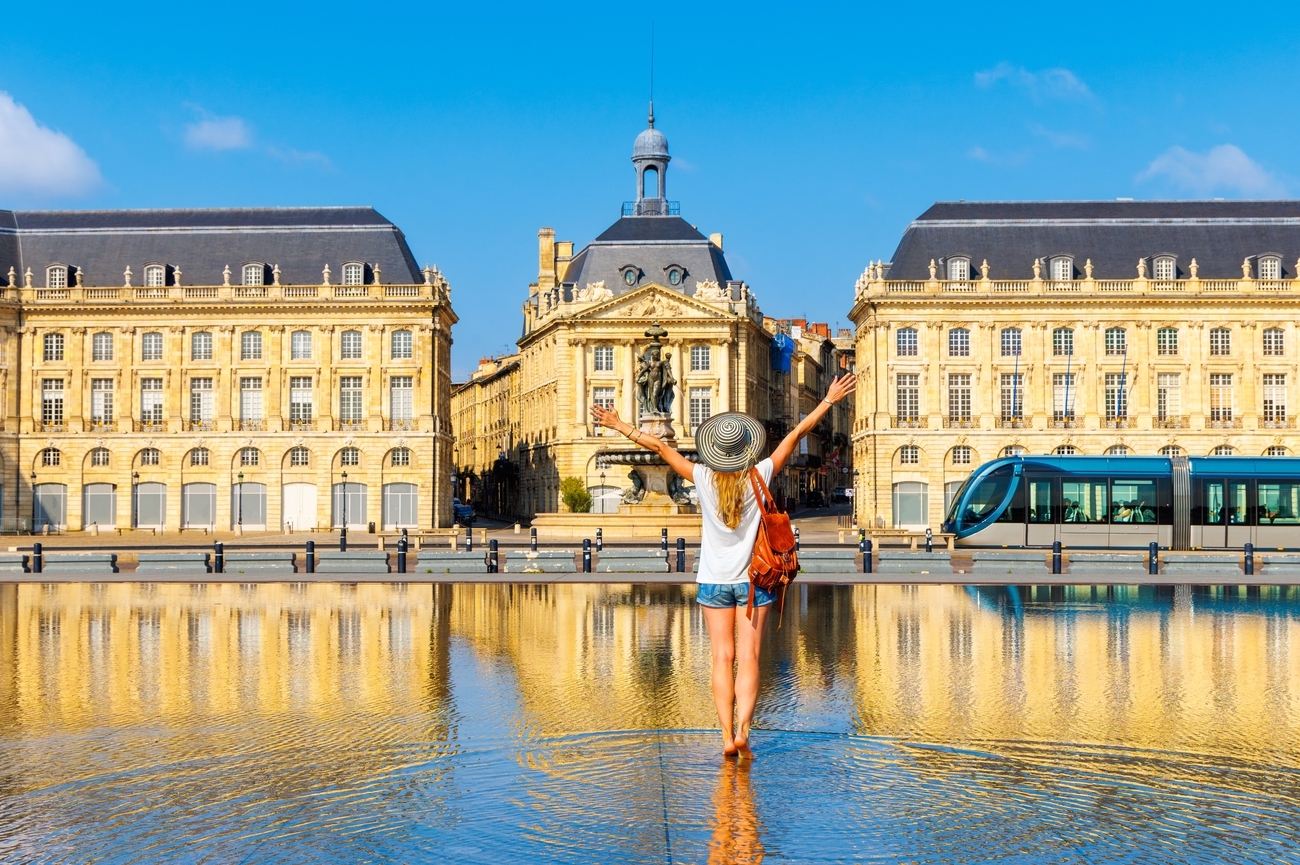
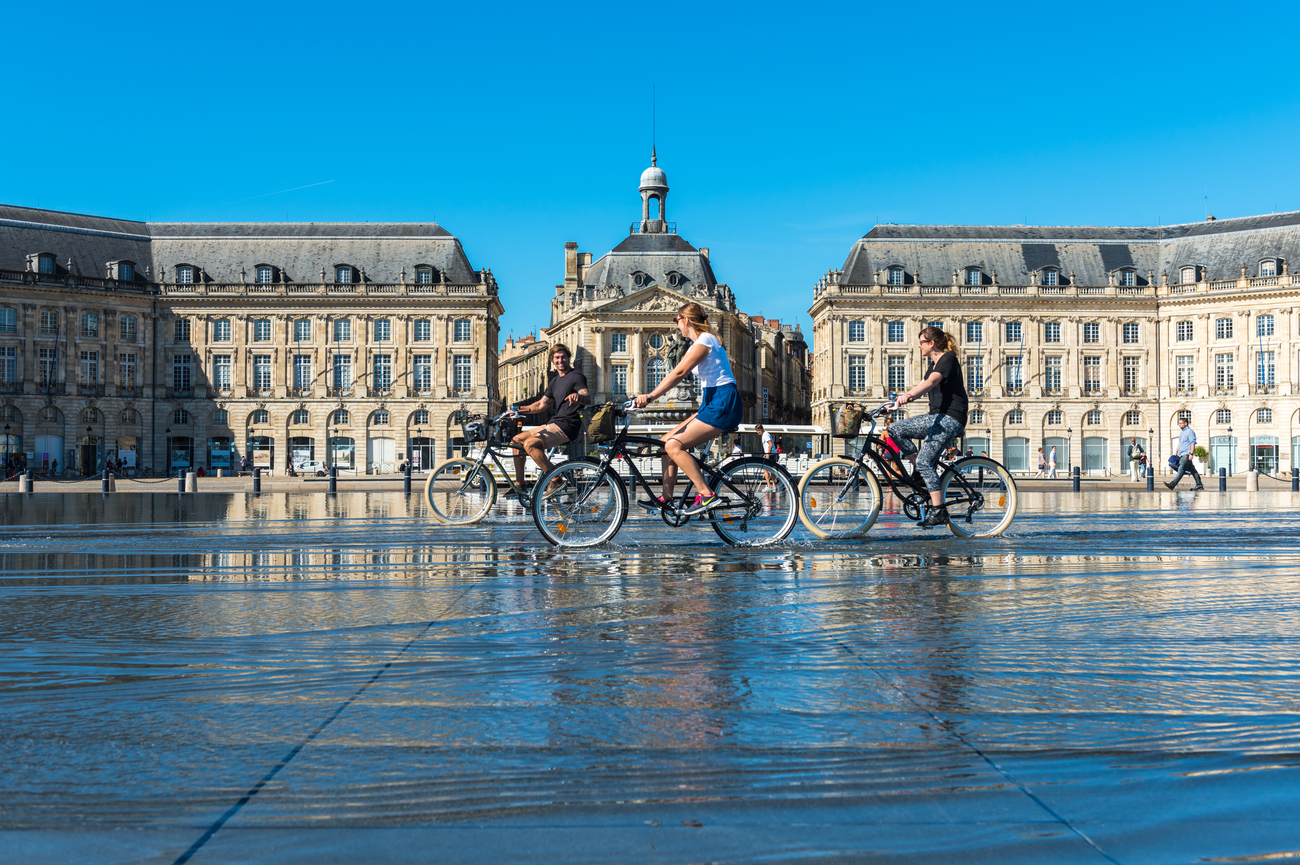
At about six in the evening the Miroir d'Eau starts breathing. It is a slab of black granite the size of a city block laid along the Bordeaux quayside, and every so often a film of water two centimetres deep slides across it and goes perfectly still, so that the Place de la Bourse doubles itself, eighteenth-century stone standing upside down in the reflection with the sky underneath. Children who have been waiting for this run straight into it. Then the water drains away and the whole surface exhales a low fog through the granite, ankle deep, and for half a minute the grandest square in the city floats on a cloud while several hundred people stand around grinning at a puddle.
Four hours ago you were eating anchovies at a bar counter where the language had no relatives. Southwest France arrives that fast. One border, no ceremony, and the entire register changes: the buildings go from granite to pale limestone, the wine goes from a pale coastal white poured from a height to some of the most collected reds on earth, and the pace of the evening slides an hour later.
Our Exploring the Basque Country journey is built on that hinge: five nights in the Basque Country followed by five in southwest France, travelling through Biarritz and Bordeaux to Toulouse, with Carcassonne and the Languedoc wine country along the way.
Is
Biarritz Worth a Stop Between the Basque Country and Bordeaux?
The border between the Spanish Basque coast and France is one of the least dramatic in Europe. The road simply follows the Atlantic, the language on the signs changes, and before long you are in the French Basque Country. Shortly afterwards you arrive at Biarritz, where the journey pauses on its way north.
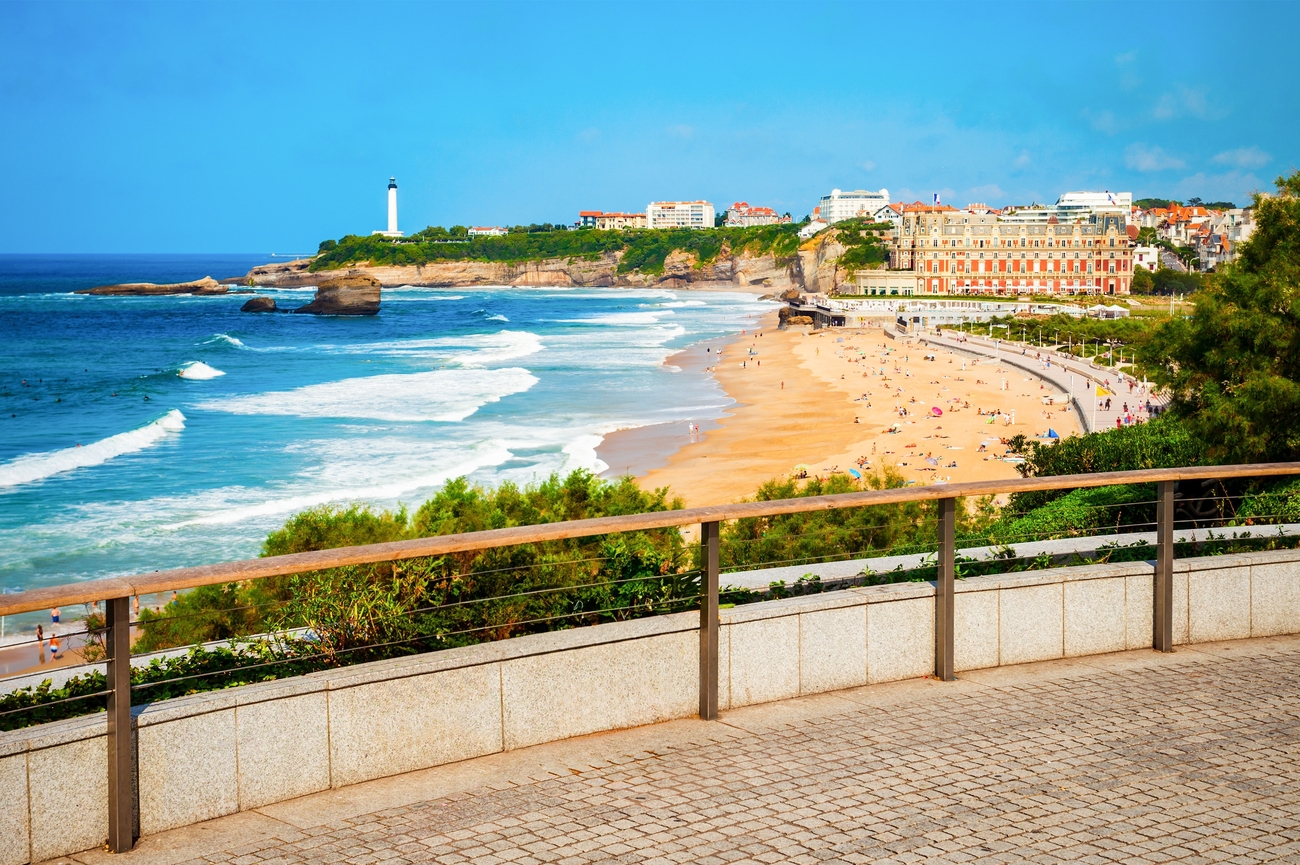
Biarritz earns the stop. It was a whaling village until the nineteenth century, when Empress Eugénie built a summer palace on the beach and the European aristocracy followed, turning a fishing town into a resort of grand hotels, casinos and cliff walks above a wild Atlantic. The waves that once made the coast dangerous have made Biarritz one of Europe’s great surfing destinations, particularly around the Côte des Basques. The two identities sit on the same seafront without embarrassment: elderly couples taking the sea air on the promenade while twenty-year-olds carry boards past them to the beach. The pastry shops are French. The place names are still Basque. For about an hour, on the drive north, you get to watch one culture hand over to another in real time.
It also settles something the map already suggested. The wider Basque Country does not stop at the Spanish border. It extends into southwest France, and this stretch of Atlantic coast is where the two sides of the region meet most visibly.
Why
Is Bordeaux One of the World’s Great Wine Cities?
Bordeaux is worth the stop because it is not simply a city with vineyards nearby. Bordeaux is a wine city in the way that Detroit was a car city, built on the trade, shaped by it, and rich because of it. The vineyards around Bordeaux form France’s largest AOC wine region, with names on the map that read like an auction catalogue: Médoc, Saint-Émilion, Pomerol, Sauternes, Margaux. The eighteenth-century merchants who made the money built the city you walk through, a long crescent of pale stone along the Garonne so unified in style that UNESCO listed the historic centre as an outstanding urban and architectural ensemble.
The way to take it in is the way our journey does: on two wheels, with a guide, along the river. An e-bike tour turns a city built for eighteenth-century merchants into a morning rather than a route march, and it strings the highlights together in the order the river laid them out. The Place de la Bourse and its mirror. The Grosse Cloche, the great bell gate above the old town. The Basilique Saint-Michel with its separate bell tower standing apart from the church like a chaperone. The Esplanade des Quinconces, one of the largest city squares in Europe, big enough that Bordeaux has never quite worked out what to do with all of it. And Rue Sainte-Catherine, one of Europe’s longest pedestrian shopping streets, which is either a highlight or a warning depending on who you are travelling with.
What the ride gives you that a walking tour cannot is the riverbank itself, kilometres of it, quays that were working docks within living memory and are now the city's front garden. Bordeaux spent twenty years scrubbing the soot off its own facades and discovered a golden city underneath. Locals still talk about the before and after the way Bilbao talks about the Guggenheim, which is one of several quiet rhymes between the two halves of this journey. We tell the Bilbao half of that story in How Bilbao Reinvented Itself: The Guggenheim Effect and Beyond.
A word on the wine, since you are standing in the capital of it. Bordeaux drinks red, overwhelmingly, and its reds are typically blends built around Merlot and Cabernet Sauvignon, a marked contrast with the Tempranillo-led wines of Rioja Alavesa. The châteaux of the Médoc run north from the city along the left bank of the Gironde estuary; Saint-Émilion, a UNESCO-listed wine town of limestone buildings and a monolithic church carved down into the rock, sits an easy run east. Neither is on the fixed itinerary, and both are the kind of afternoon our team will build in on request, which is the honest position: the journey gives you the wine city, and the châteaux are yours to add.
Why
Is Toulouse Known as La Ville Rose?
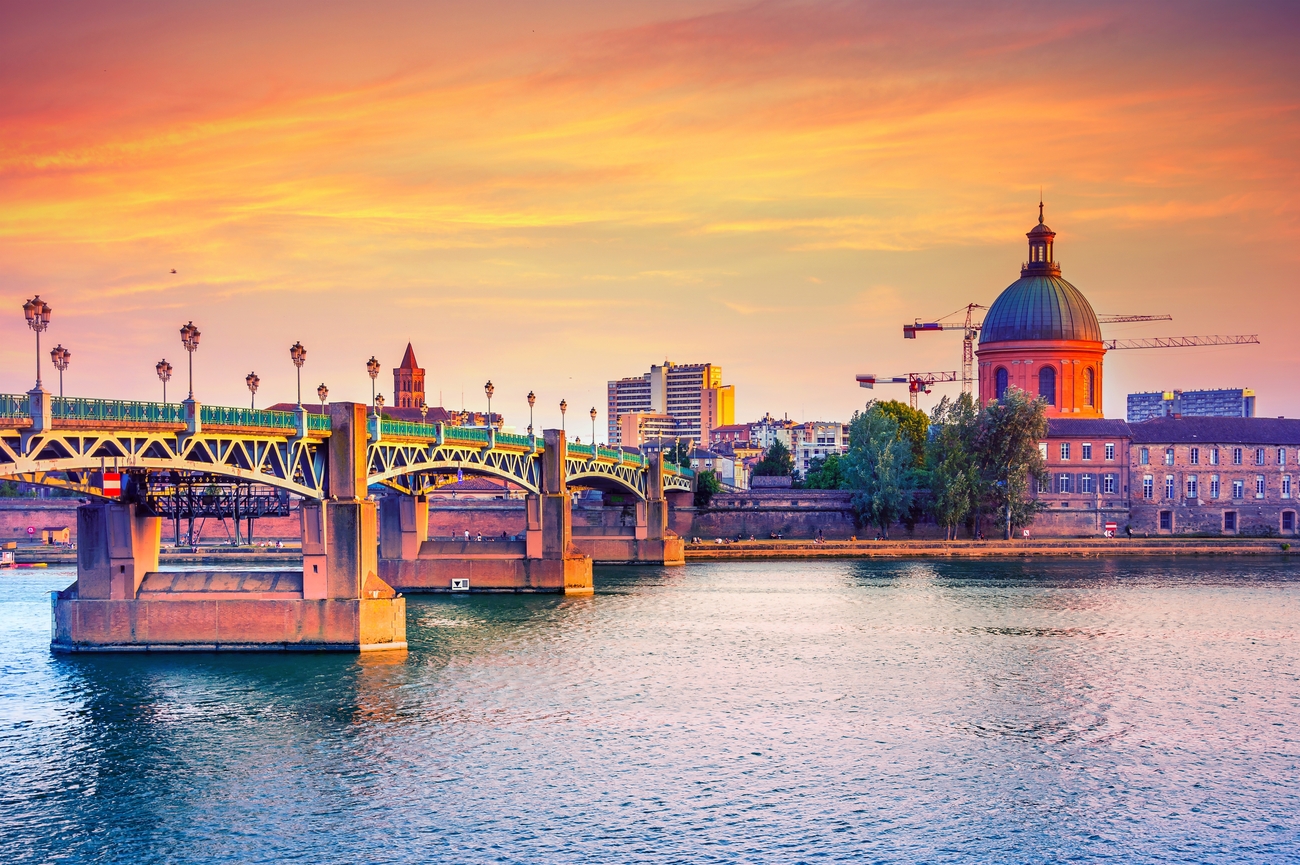
Toulouse is known as La Ville Rose, the Pink City, because so much of its historic centre is built from brick fired from the clay of the Garonne plain. In flat midday light it reads as ordinary terracotta. In the last hour before dark it goes the colour of a peach and the entire city seems lit from inside its own walls, which is why any guide worth having takes you out at the right hour.
Three nights here is the journey's longest stay anywhere, and the base is the grandest: a five-star hotel set inside two restored eighteenth-century mansions in the historic heart, the kind of building with a courtyard, a stone staircase and ceilings that tell you what the merchants of this city were worth.
The guided walking tour covers the city's spine. The Place du Capitole is the great square, its town hall front running the length of one whole side in pink brick and white stone, its floor inlaid with the Occitan cross. The UNESCO-listed Basilique Saint-Sernin is one of the largest surviving Romanesque churches in Europe and was built to receive pilgrims travelling to Santiago de Compostela, which means the road you have been travelling in reverse all week runs through this building too. The Pont Neuf, despite the name, is the oldest bridge in the city; construction began in the sixteenth century and it was completed in 1632, built to withstand the Garonne's floods. And the Canal du Midi, also UNESCO-listed, leaves from the edge of the centre under an avenue of plane trees, a seventeenth-century feat of engineering that connected the Atlantic to the Mediterranean and remains, three and a half centuries later, one of the loveliest places in southwest France to walk slowly with nowhere to be.
Toulouse eats seriously and unpretentiously. Cassoulet is the local monument, a slow bean and confit stew argued over by three towns, none of which will concede. The morning pastry here is called a chocolatine and calling it a pain au chocolat in public is a mistake you make once. The Victor Hugo market is the city's belly, its upper floor given over to small restaurants that cook what the stalls below are selling. And the violet, of all things, is the city's emblem, candied and sold in tins and folded into everything from liqueur to ice cream.
Is
Carcassonne Worth a Day Trip from Toulouse?
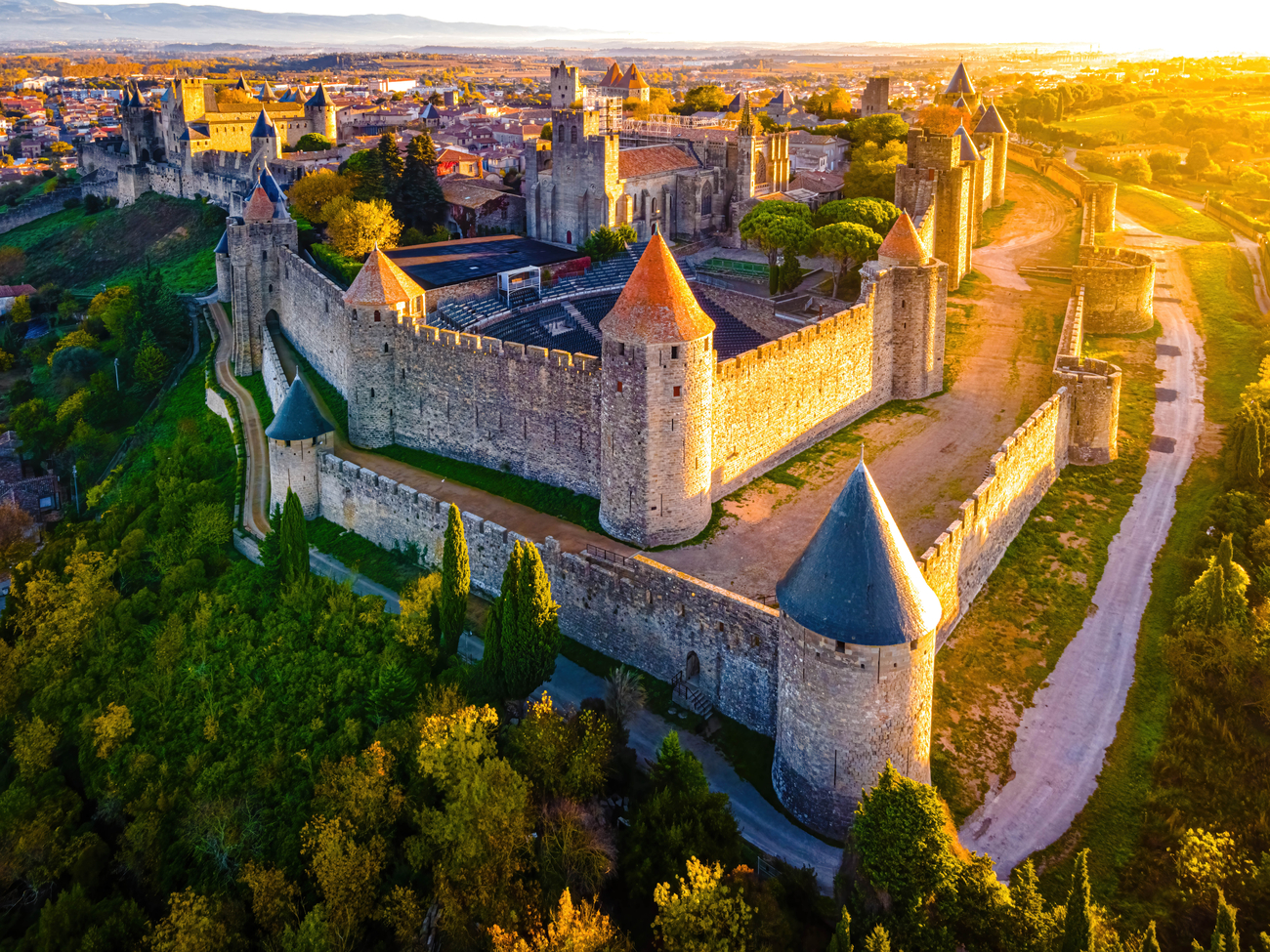
Carcassonne is worth the day trip from Toulouse for the sheer spectacle of its medieval citadel. There is no gentle way to arrive at it. The Cité de Carcassonne appears from the road all at once: a walled city on a hill with fifty-two towers and a double ring of ramparts, conical slate roofs, gates, drawbridges and battlements, looking less like a historic site than something built to illustrate the concept of a castle.
The history underneath is real and long. There has been a fortress on this hill since Roman times; the double walls were developed over centuries, and Carcassonne became an important frontier stronghold between France and the Crown of Aragon. When the border moved south, the citadel gradually lost its military importance and began to crumble. In the nineteenth century it was threatened with demolition and rescued instead by the architect Eugène Viollet-le-Duc, who restored it with enormous energy and a certain amount of invention, which is why purists occasionally sniff at the roofline and everybody else simply stares. UNESCO listed the fortified city in 1997.
Inside the walls the Cité holds a working neighbourhood of narrow lanes, the Château Comtal at its heart, and the Basilique Saint-Nazaire with some of the finest stained glass in southern France. It also carries the shadow of the Cathars, the dissenting Christian movement targeted during the thirteenth-century Albigensian Crusade. Carcassonne fell early in that conflict, while the ruined castles associated with the Cathars still stand on crags across the wider region.
Go early or go late. Carcassonne draws large crowds, and the middle of a summer day belongs to the coaches, while a morning arrival or an evening one gives you the ramparts with the light low across them and the lanes half empty. On our journey the day is guided and timed with exactly that in mind.
Why
Visit Domaine de Baronarques in the Languedoc?
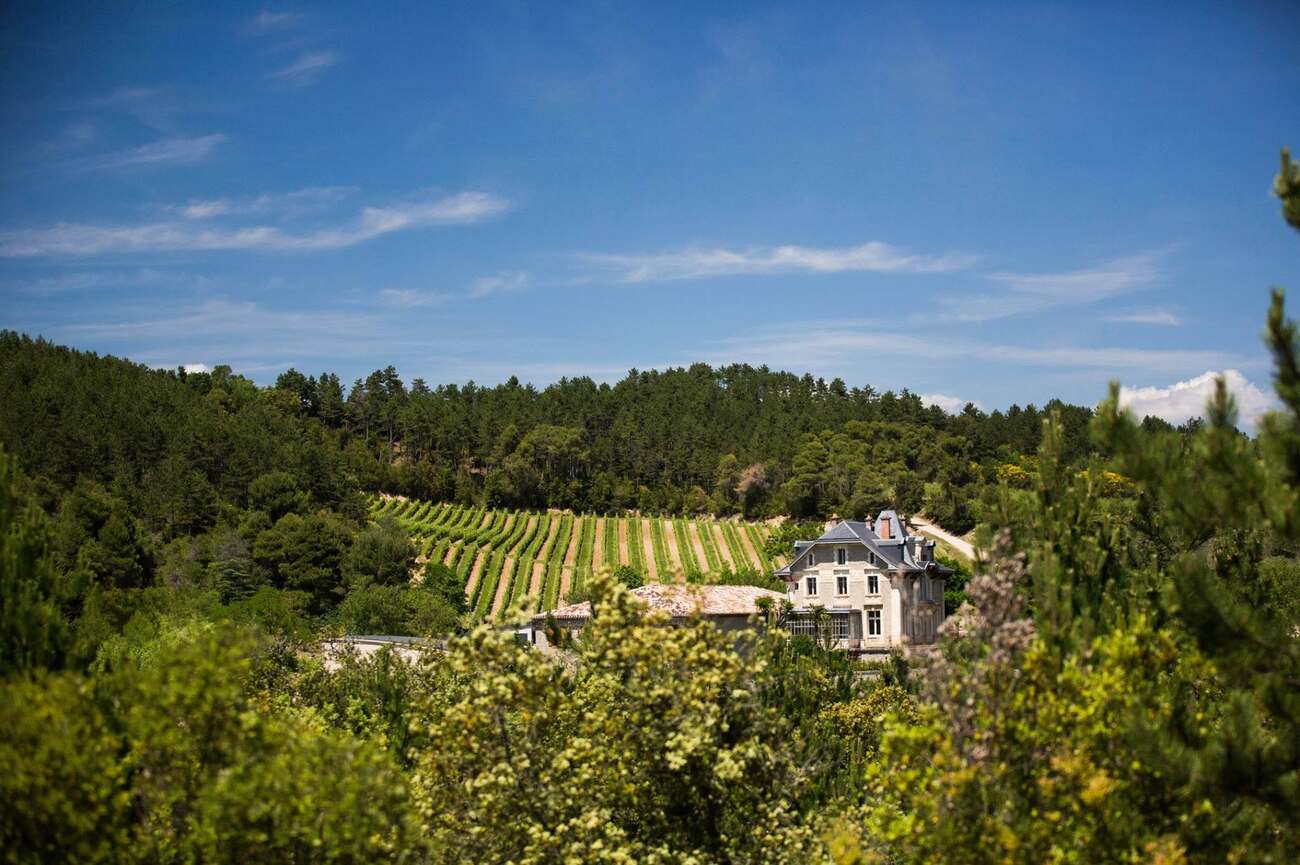
Domaine de Baronarques makes a fitting final vineyard stop because it tells one of the most interesting stories in modern French wine. The estate sits in Saint-Polycarpe near Limoux, in the Languedoc, covering about 110 hectares, with around 43 hectares under vine. Its history reaches back to at least the seventeenth century, when it was known as Domaine de Lambert, and today it is one of the region's serious modern wine estates.
The Languedoc is one of the world's largest wine-producing regions and spent much of the twentieth century making a great deal of wine that nobody wrote about. What has happened here since the 1990s is one of the genuine stories of European wine: growers and investors identified the best ground, replaced high-yielding vines, improved viticulture and turned a region once associated with bulk production into one capable of producing ambitious wines at prices that can still make Bordeaux look expensive. Tasting at Baronarques with that context in your head is a different experience from tasting blind. You are drinking the proof that terroir can be rediscovered.
There is a local footnote worth carrying to the table. Limoux, a few minutes away, produces Blanquette de Limoux, a sparkling wine with a history that predates Champagne. Local tradition holds that monks at the nearby Abbey of Saint-Hilaire were producing sparkling wine in the sixteenth century. The claim is still debated with great courtesy by people farther north. Raise it at lunch and see what happens.
The tasting is guided, the wines are paired with local delicacies, and it lands on the second-to-last day of the trip, which is exactly right. By then you have drunk txakoli poured from a height on a Basque counter, whatever Bordeaux put in front of you, and now a Languedoc red from a valley most travellers cannot place on a map. The Spanish side of that story — from Euskara and txakoli to the private txokos behind Basque food culture — is explored in our guide to Basque Culture and Identity: Euskara, Txokos and Txakoli.
Combine
the Basque Country and Southwest France?
The Basque Country and southwest France work particularly well in one journey because their histories, food cultures, pilgrim routes and wine traditions have been intertwined for centuries. These two regions have been trading, marrying and quarrelling with each other for a thousand years. The pilgrim roads to Santiago run through both. Euskara and Occitan have both survived long periods of pressure from centralising states with a stubbornness that would be recognisable on either side of the mountains. Even the food rhymes: duck and beans here, beans and pork there, and a shared conviction that lunch is not a break from the day.
What differs is the register, and the difference is the point. Spain gives you the counter, the standing crowd, the small glass refilled, the evening that starts late and stays loud. France gives you the table, the sitting down, the courses in order, the bottle chosen with ceremony. Doing one after the other in a single journey sharpens both, and by the second week you catch yourself comparing them with something close to expertise, which is a thing very few trips manage to teach in ten nights.
The Spanish half of this journey — Bilbao's titanium, the Gernika oak and the coast at Gaztelugatxe — is mapped in full in our Basque Country Wine and Culture Tour. Read them together and the shape of the whole journey becomes obvious: one long line from the Bay of Biscay through the Basque Country and across southwest France, drawn through distinct languages, landscapes and wine regions.
What
Makes This Basque Country and Southwest France Journey So Memorable?
Here is what happens about three months after this trip: somebody at a dinner party asks about it, and you begin describing a particular lunch, the long one, the one where the light came through the window a certain way and nobody wanted to leave. Halfway through the description you stop, because you cannot immediately remember whether it happened in Spain or in France.
That is not a failure of memory. It is what a well-drawn border crossing does to a holiday. The line on the map is real, Euskara and French are unrelated, and the wines could hardly be more different, yet the trip files itself in your head as one continuous stretch of good tables in good light, running from a counter in Bilbao to a cellar in the Languedoc without a seam anywhere in it.
Ten nights, two countries, four wine regions and one long thread of arranged road between them. Our Exploring the Basque Country journey is that thread, drawn and booked before you land.
Cross the border. See how long you can keep track.


Let us know what you love, where you want to go, and we’ll design a one-of-a-kind adventure you’ll never forget.
Get in touch
Miriam
Travel Specialist

Romina
Travel Specialist

Laura
Travel Specialist
Our offices:



Revigorate, Iberian Escapes and Algarve Lifestyle are the registered brand names of APCS Lda . We are a fully authorised travel agency licensed by Turismo de Portugal RNAVT/6867.
In the event of a dispute, the consumer may refer to: RAL - Centros de Arbitragem
Avª. 5 de Outubro, nº. 55, R/C Dtº. 8000-075 Faro, Portugal | Tel: +351 289 823 135 *
* national landline call
E-mail: info@consumoalgarve.pt| www.consumidoronline.pt | Mon to Fri: 9:00 - 13:00 / 14:00 - 17:00