Basque Culture and Identity: Euskara, Txokos and Txakoli

Basque culture and identity are shaped by a language unlike any other in Western Europe, distinctive food and wine traditions, communal institutions, music, mythology, rural sports and forms of oral performance that remain part of everyday life rather than museum pieces.
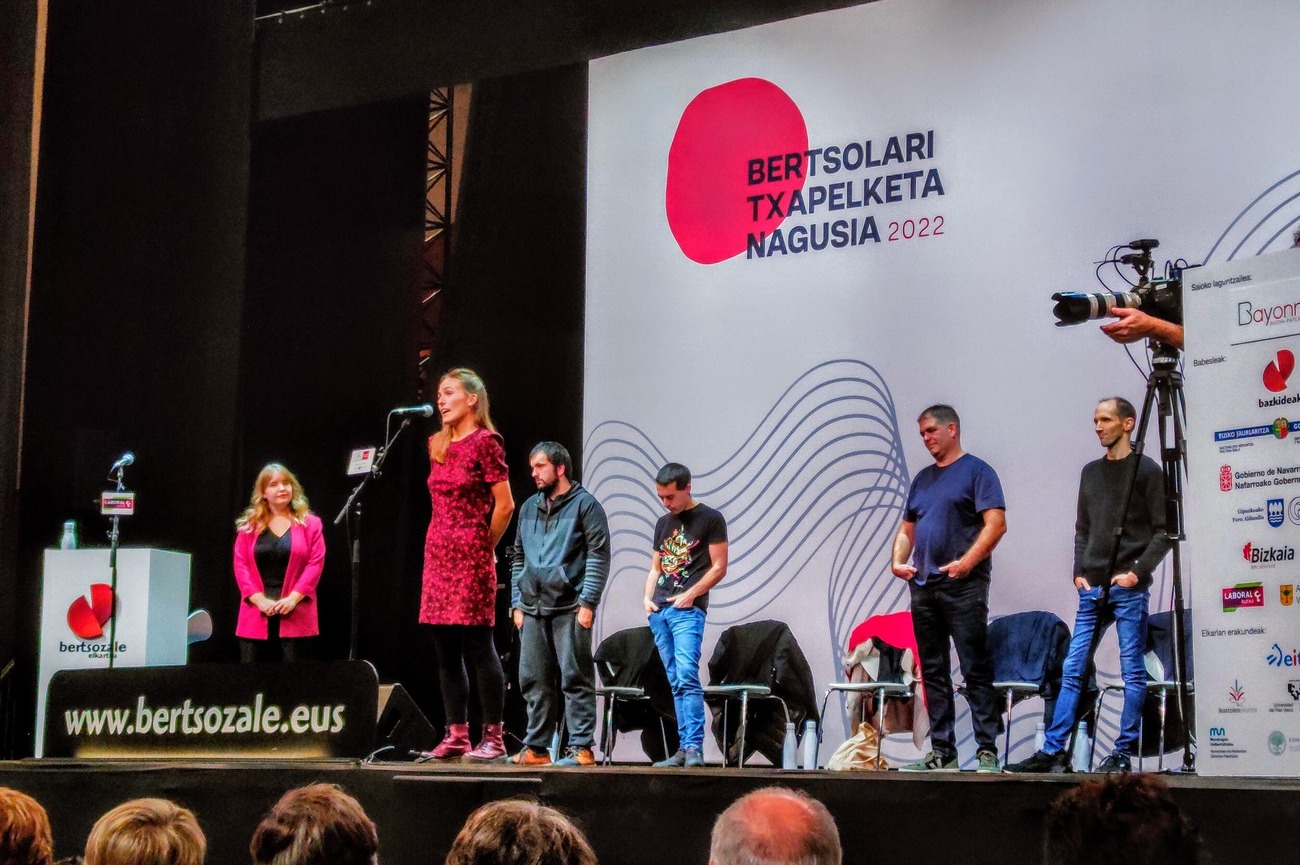
One of the clearest examples is bertsolaritza, the Basque tradition of improvised sung verse. Every four years, thousands of spectators gather for the national championship final, where bertsolaris are given themes they have not seen in advance and compose rhymed, metrical verses as they perform. The winner is crowned, with complete seriousness, with a beret.
At the centre of Basque identity is Euskara, the Basque language, spoken by hundreds of thousands of people across the Basque Country. It is unrelated to the Indo-European language family that includes Spanish, French, English and most other European languages, and its origins remain unresolved. Its survival and revival have made it one of the strongest symbols of Basque cultural continuity.
That identity is also expressed through txokos, private gastronomic societies built around communal cooking and dining, and through txakoli, the lightly sparkling, high-acid white wine traditionally produced in parts of the Basque Country. Both are closely connected to the region’s social life and to the importance placed on food, hospitality and shared ritual.
Beyond language and gastronomy, Basque culture includes herri kirolak, traditional rural sports derived from farming and maritime labour, along with distinctive music, dance and mythology. These traditions continue to be performed, watched and taught, helping explain why Basque identity feels unusually visible in daily life.
The famous exterior of the region, Bilbao, the coast and the vineyards, is mapped in our Basque Country Wine and Culture Tour. This guide looks inward instead, at the language, dining societies, wine, poetry, sport, music and mythology through which Basque culture continues to be lived rather than simply remembered.
Euskara,
the Language With No Known Relatives
Begin with the sound in the air, because everything else grows from it.
Euskara, the Basque language, is what linguists call a language isolate: no relationship has been established between it and any other surviving language.
Not Spanish or French, which surround it. Not any other known language family.
Most of the languages spoken around it belong to the great Indo-European family that spread across Europe thousands of years ago. Euskara was present in the western Pyrenees before Latin developed into the Romance languages heard there today, which is why it is so often described as the oldest living language in Europe.
That phrase is evocative rather than scientifically exact. Nobody can assign a birth date to a language, and nobody knows precisely how far back Euskara reaches. What can be said is that it represents the deepest surviving linguistic continuity in Western Europe.
When you hear Euskara spoken over a bar counter, you are hearing a language that survived while almost every language around it changed family, form and name.
Survival is the correct word, because the language nearly did not.
Under Franco’s dictatorship, Euskara was pushed out of schools, administration and much of public life. Publishing and broadcasting were heavily restricted, and Basque personal names were often required to appear in officially approved Spanish forms.
What sustained the language was stubbornness organised into institutions: families who continued speaking it at home, teachers who taught children quietly around kitchen tables and the clandestine Basque-language schools known as ikastolas.
Some had roots reaching back before the Spanish Civil War. After their closure, teachers such as Elbira Zipitria began teaching children privately in the 1940s. From the 1960s, parent-led ikastolas spread across the region and became one of the foundations of Euskara’s revival.
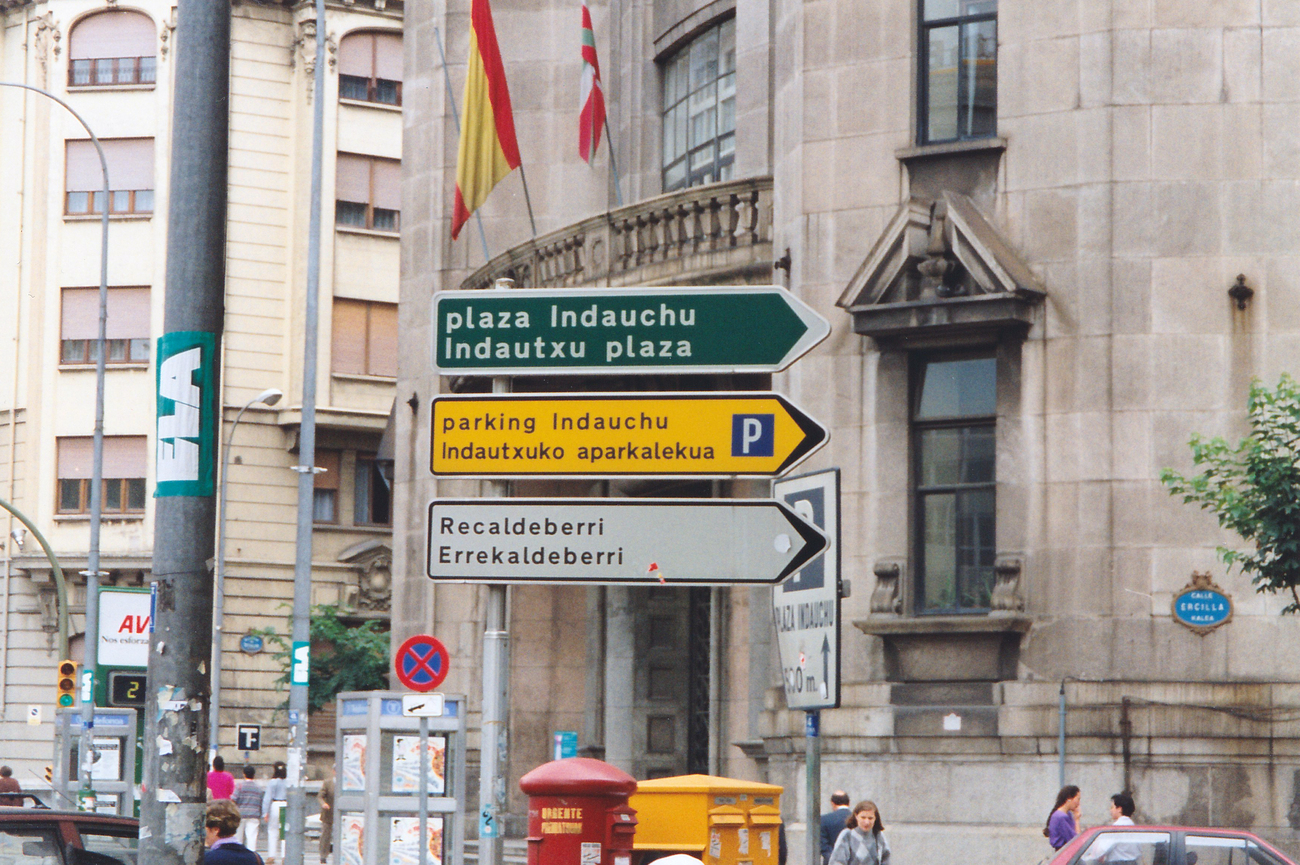
Today, Euskara is co-official with Spanish in the Basque Autonomous Community and in the Basque-speaking zone of Navarre. It is taught through public schools, private schools and the continuing ikastola network, although its legal status and everyday use differ across the wider Basque territories.
The result is one of Europe’s most striking examples of language recovery. The proportion of speakers is now considerably higher among younger generations than among the population as a whole, even if fluency and daily use remain uneven from one town to another.
Bertsolaritza, the improvised poetry that fills that arena, has played its part. It is taught in schools and in dedicated bertso-eskolak, where children learn metre, rhyme and improvisation before taking those skills onto a stage.
Maialen Lujanbio belonged to a generation shaped by that revival. In 2009, she became the first woman to win the national bertsolari championship. She won the txapela again in 2017 and for a third time in 2022.
You do not need a word of Euskara to travel here, but three will repay you a hundredfold: kaixo for hello, eskerrik asko for thank you and agur for goodbye.
Use them and watch faces change.
Small languages keep accounts.
The language travelled too. Basque whalers, miners, farmers and shepherds carried it across the Atlantic, and communities throughout the western United States still gather for festivals, dancing, food and improvised verse.
In Nevada, a bertsolari gathering first held as a competition in 1988 developed into a continuing celebration of Basque song and improvisation, connecting communities thousands of miles from the language’s European homeland.
A culture this portable, this durable, in a language spoken by comparatively few people, is its own kind of wonder.
The
Txoko: Dinner Behind a Private Door
Now to the tables, because Basque culture does much of its living around food, and its most distinctive institution is one that most visitors never see.
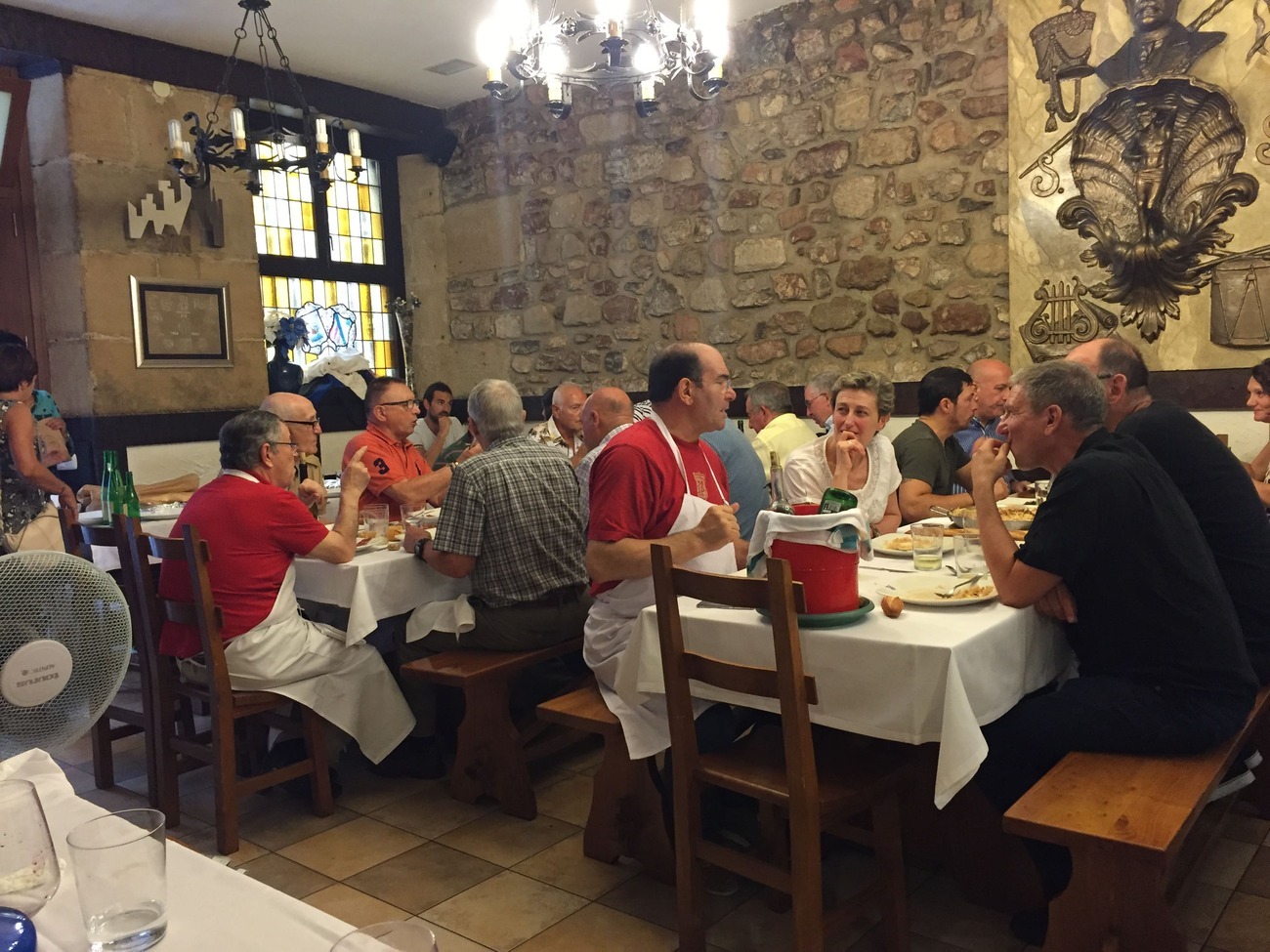
A txoko, or gastronomic society, is a private members’ club with its own premises, a serious communal kitchen and a well-stocked pantry and cellar, where friends gather to cook for one another.
The members shop, cook, eat, argue and sing. What is taken from the pantry or cellar is recorded, and the cost of the meal is divided among those around the table. The system runs largely on trust and self-management, which gives these societies the feeling of somewhere halfway between a private home and a restaurant.
There are hundreds across the Basque Country, with an especially dense concentration in Gipuzkoa and San Sebastián. The oldest date from the nineteenth century. For generations many were male-only kitchens, a rule that has gradually relaxed, society by society, in the Basque way—which is to say slowly and on their own terms. Some restrictions remain, but women now participate fully in many societies.
The txoko explains something essential: in the Basque Country, cooking is not merely a service someone performs for you. It is a social act performed among equals, and prestige flows towards the person at the stove.
The same communal instinct fills the sagardotegiak, the cider houses in the hills around San Sebastián. During the traditional cider season, generally from January into April, whole tables rise at the cry of “txotx!” and file towards the barrels to catch the new cider as it streams from the wood.
They return to a menu whose essentials have changed remarkably little: salt-cod omelette, cod with peppers, grilled txuleta and Idiazabal cheese with walnuts and quince paste.
That instinct—to eat communally, to move between tables and bars, and to treat food as a form of participation rather than performance—also animates the pintxo counters, the txikiteo and poteo bar rounds, and the extraordinary concentration of celebrated restaurants around San Sebastián. We map four days of it in our luxury culinary itinerary in San Sebastián.
The amateurs came first.
The Michelin stars are the visible tip of a culture that cooks for love, and the meal you remember longest may be the one prepared by someone who has never charged for it.
Traditionally, a place at such a table depends on an invitation from a member. It is not simply a restaurant reservation but an introduction into a private social world, and arranging that introduction is precisely the kind of door our Exploring the Basque Country journey exists to open.
Txakoli
and What the Basques Drink
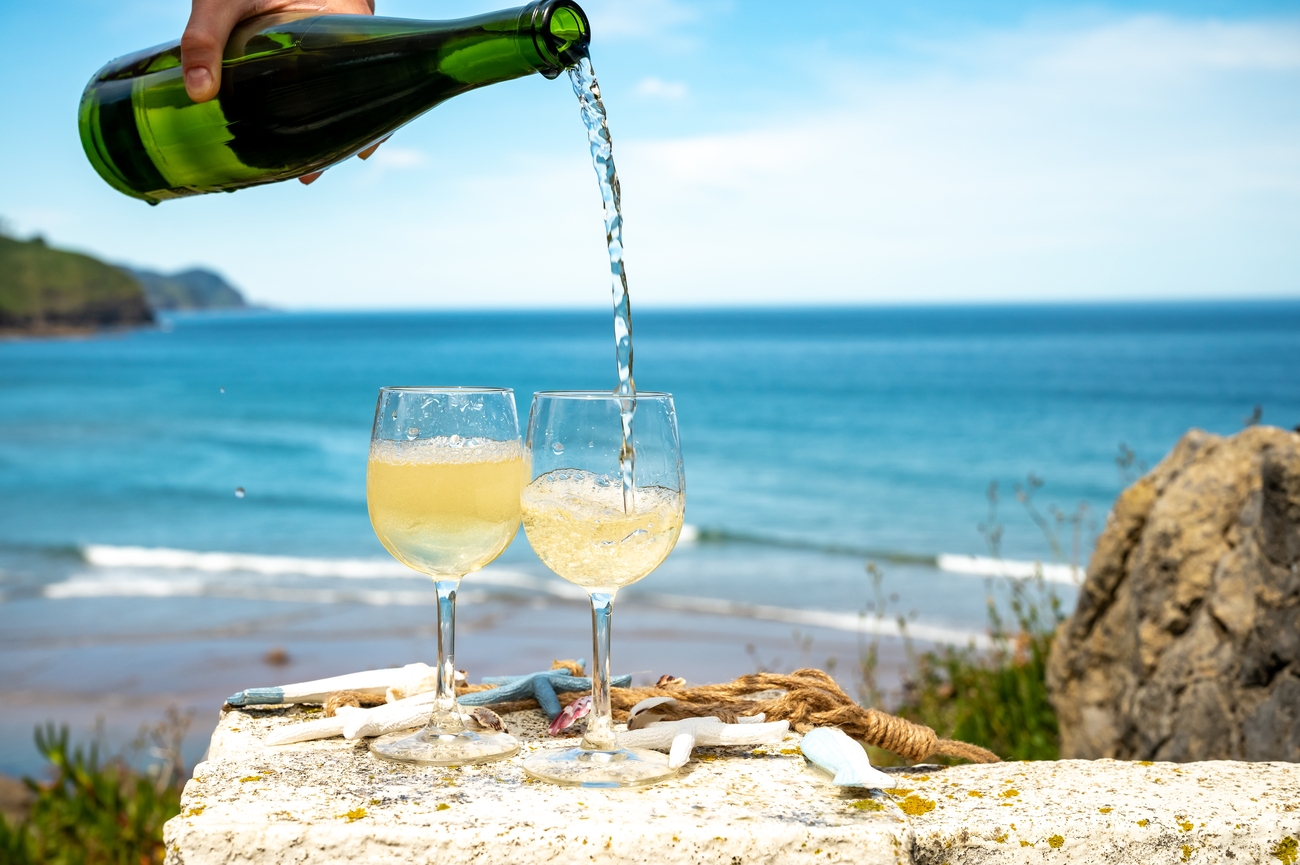
Every culture keeps a drink that tastes like itself, and the Basque coast keeps txakoli: a pale, crisp white wine, generally moderate in alcohol and bright with acidity, made principally from the Hondarrabi Zuri grape on Atlantic-influenced hillsides and in sheltered valleys near the sea.
For much of its history, it was a farmhouse wine, made for local consumption in villages such as Getaria and Bakio and drunk within sight of the vines. From the 1980s onwards, its vineyards and winemaking traditions were revived under three protected denominations of origin, transforming what had nearly disappeared into one of Spain’s most distinctive white wines.
Traditional Getaria txakoli may retain a delicate natural spritz and is sometimes poured from a height, the bottle raised and the glass held low so that the wine breaks against its side. The gesture belongs particularly to the coastal style and can enliven a young wine, although many modern txakolis are simply served chilled in a wine glass.
Either way, txakoli is made for the table: young, cold and poured alongside anchovies, grilled fish and whatever else the pintxo counter is offering.
The pleasure deepens when you know the other half of the story.
South of the Sierra de Cantabria, the same culture produces wines of an almost opposite character: the Tempranillo-led reds of Rioja Alavesa, including structured wines capable of long ageing, made around medieval villages and vineyards protected from the wetter Atlantic weather by the mountains.
At the centre is Laguardia, a walled town standing above hundreds of underground cellars.
One people, two wine traditions at opposite ends of the spectrum, both pursued with extraordinary seriousness.
We explore the southern half of that story—the bodegas, Gehry’s titanium architecture and the cellars beneath Laguardia—in our guide to the Rioja Alavesa Wine Tour.
Drink both in one journey and you begin to understand the Basque relationship with craft: whatever is worth doing is worth doing completely.
Gernika,
the Oak and the Symbols
Basque identity also lives in objects, and the most sacred of them is a tree.
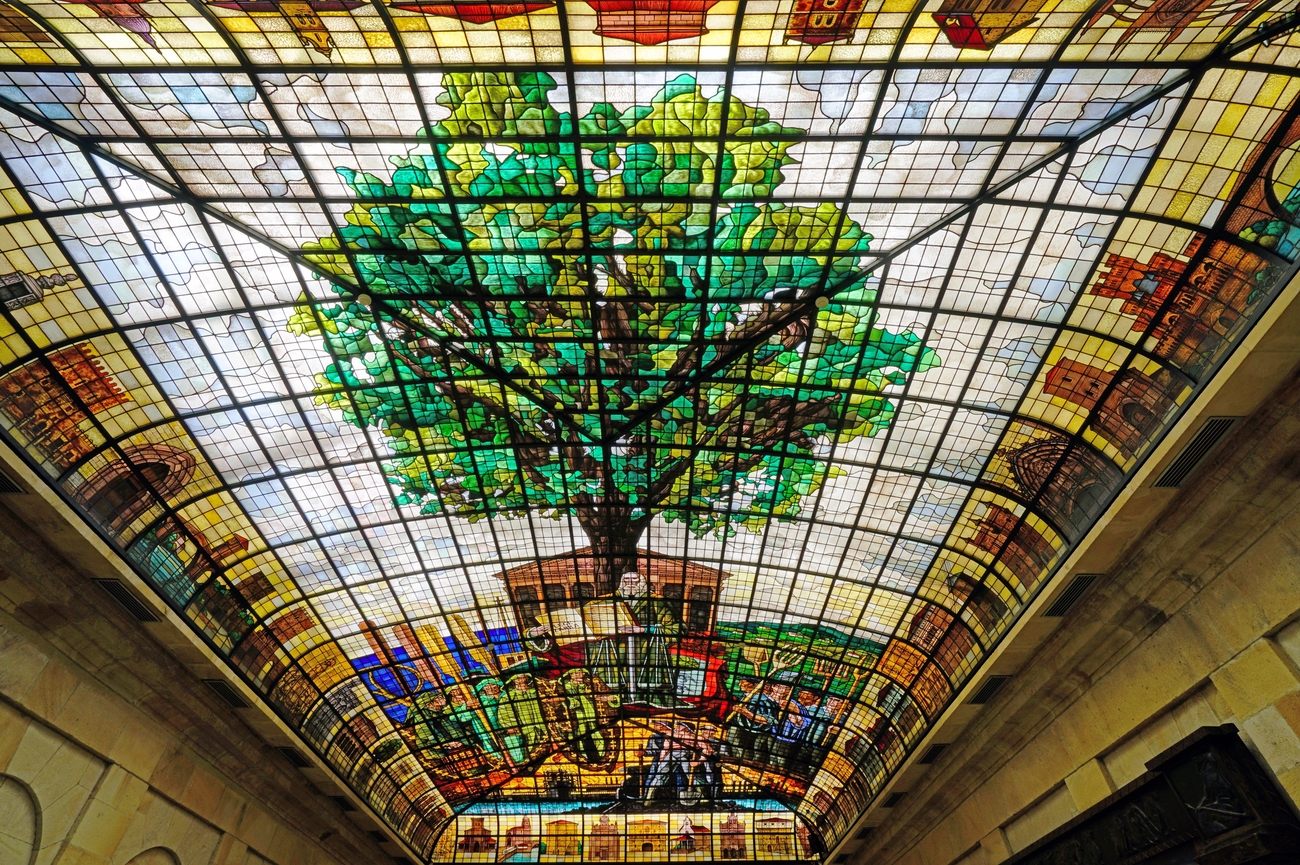
In Gernika stands an oak beneath which the representatives of Bizkaia gathered for centuries. Here, the lords of Bizkaia swore to respect the territory’s liberties, customs and privileges: the body of local law known as the fueros.
The Casa de Juntas, the parliament of Bizkaia, still stands beside it. Its main chamber occupies a building that is part parliament and part former church, while a neighbouring institutional hall is covered by an enormous stained-glass roof depicting the oak as the meeting point of Bizkaia’s towns.
The tree itself is renewed generation after generation. The present oak, planted in 2015, descends from earlier Trees of Gernika and continues a living line rather than replacing a dead symbol.
On Monday, 26 April 1937, German and Italian aircraft supporting Franco’s forces bombed Gernika. It was market day, and the town was crowded with residents, traders, refugees and people arriving from the surrounding countryside.
Much of the centre was reduced to rubble in the attack that Picasso fixed forever in Guernica.
The oak and the Casa de Juntas survived. Their endurance became inseparable from the meaning of the town itself: institutions and identity still standing amid the destruction.
The Monday market still runs.
Visit Gernika at the beginning of the week and you walk through the town’s answer to its own history: stalls, produce, noise, life.
Around the tree gather other symbols that begin appearing everywhere once you know how to recognise them.
The ikurrina, the red, green and white flag created in Bilbao by the Arana brothers in the 1890s, hangs from balconies, town halls and fishing boats.
The lauburu, a curved cross with four comma-shaped heads, appears on doorways, gravestones, jewellery and signs. Its precise origins are uncertain, but it has become one of the most recognisable emblems of Basque identity.
And then there is the etxe, the house itself.
Traditional Basque farmhouses carry names, and many family names developed from ancestral houses, villages or features of the surrounding landscape. For centuries, identity was rooted not only in the family you belonged to, but in the place from which that family came.
Ask about a long Basque surname and you may find that you are also being told about a house.
Strong
Games: Stone, Wood and the “Fastest Ball” on Earth
Then there are the sports, which are the culture with its sleeves rolled up.
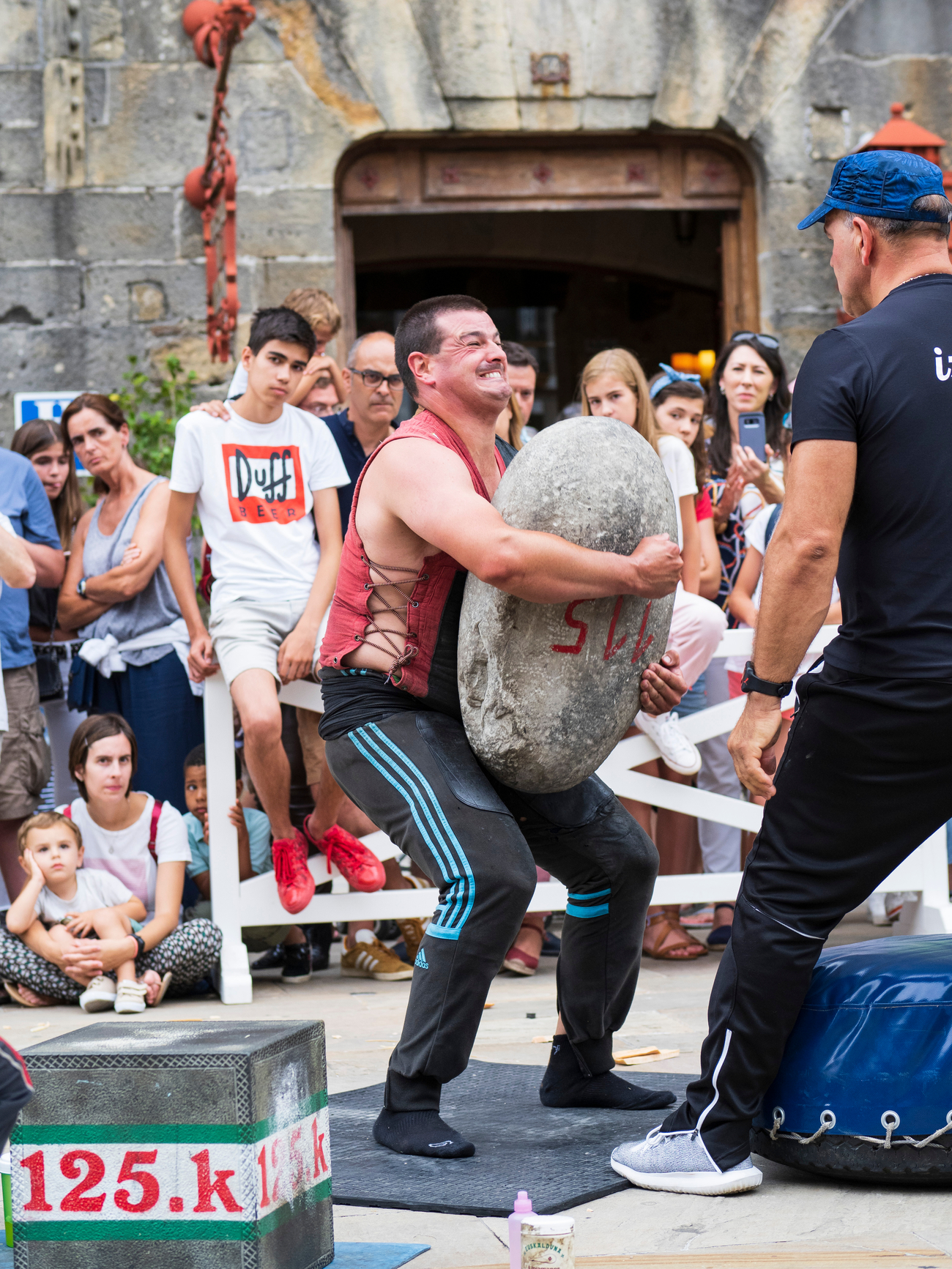
Herri kirolak, the rural games, grew largely from farm, forest, quarry and harbour work turned competitive: harrijasotzaileak, the stone-lifters, raising blocks that can weigh well over a hundred kilograms; aizkolariak, the wood-choppers, racing through great beech trunks with axes; scythe mowing, weight carrying and tug-of-war.
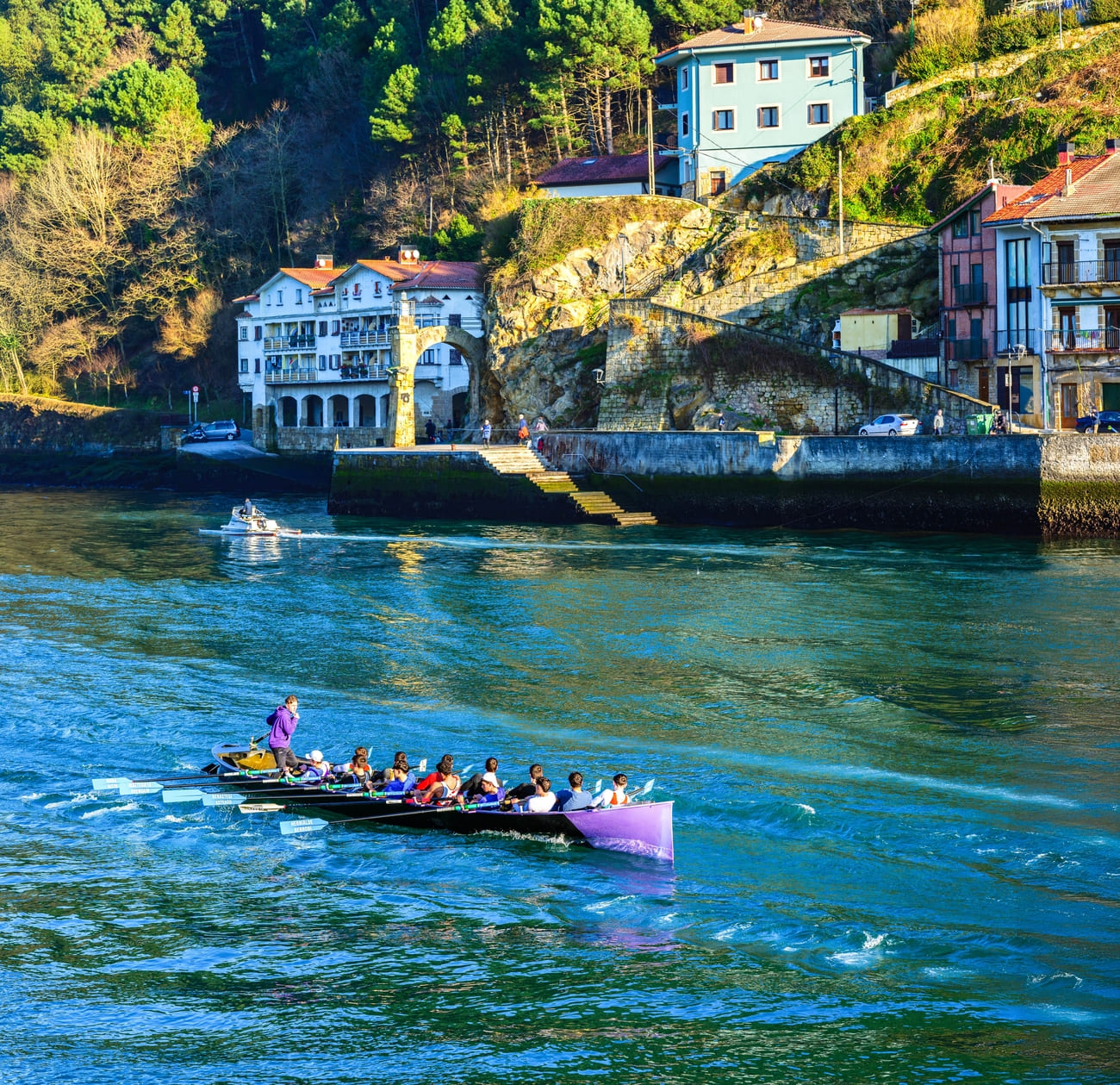
Along the coast come the trainera regattas. Their origins lie in the fishing crews who once raced one another back to harbour, but today’s boats are purpose-built competition craft, rowed by thirteen athletes and steered by a cox. Entire coastal towns follow the summer season with something close to religious intensity.
The bets are real, the rivalries are old and these remain living sports rather than performances preserved only for visitors. Walk into a village fiesta at the right hour and you may find a crowd roaring at a stone-lifter or wood-chopper much as earlier generations did.
Then there is pelota, the family of wall-and-ball games played on the frontón court found in towns and villages across the Basque Country. The court is so central to community life that it often stands beside the church or town hall.
Its forms range from bare-hand pelota to games played with wooden bats, gloves and wicker baskets. In the fastest and most internationally famous version, cesta punta or jai alai, the player catches and releases the ball with a long curved cesta, sending it towards the front wall at extraordinary speed.
The game is often described as the fastest ball sport on earth, a reputation that helped make jai alai famous far beyond the Basque Country.
In Bilbao, identity takes its most celebrated modern sporting form in Athletic Club. The team has played in every season of Spain’s top division and has never been relegated, while maintaining a policy unlike that of any other major European football club: its players must have been born in the Basque territories or developed through football academies there.
We explore Athletic Club’s story alongside the rest of the city in How Bilbao Reinvented Itself: The Guggenheim Effect and Beyond.
The common thread through all of it is the same: the game matters because of who is playing, and who they are playing for.
Music,
Dance and the Old Gods
Listen closely at a fiesta and you will hear instruments whose sound belongs unmistakably to the Basque Country.
The txistu, a three-holed flute played with one hand while the other beats a small drum, has accompanied Basque dances and public ceremonies for centuries.
The trikitixa, a small diatonic accordion generally paired with a tambourine, drives village romerías and dances with a joy that earlier religious and social authorities sometimes regarded with suspicion. The instrument arrived in the Basque Country during the nineteenth century, but it settled so completely into rural life that it now sounds inseparable from it.
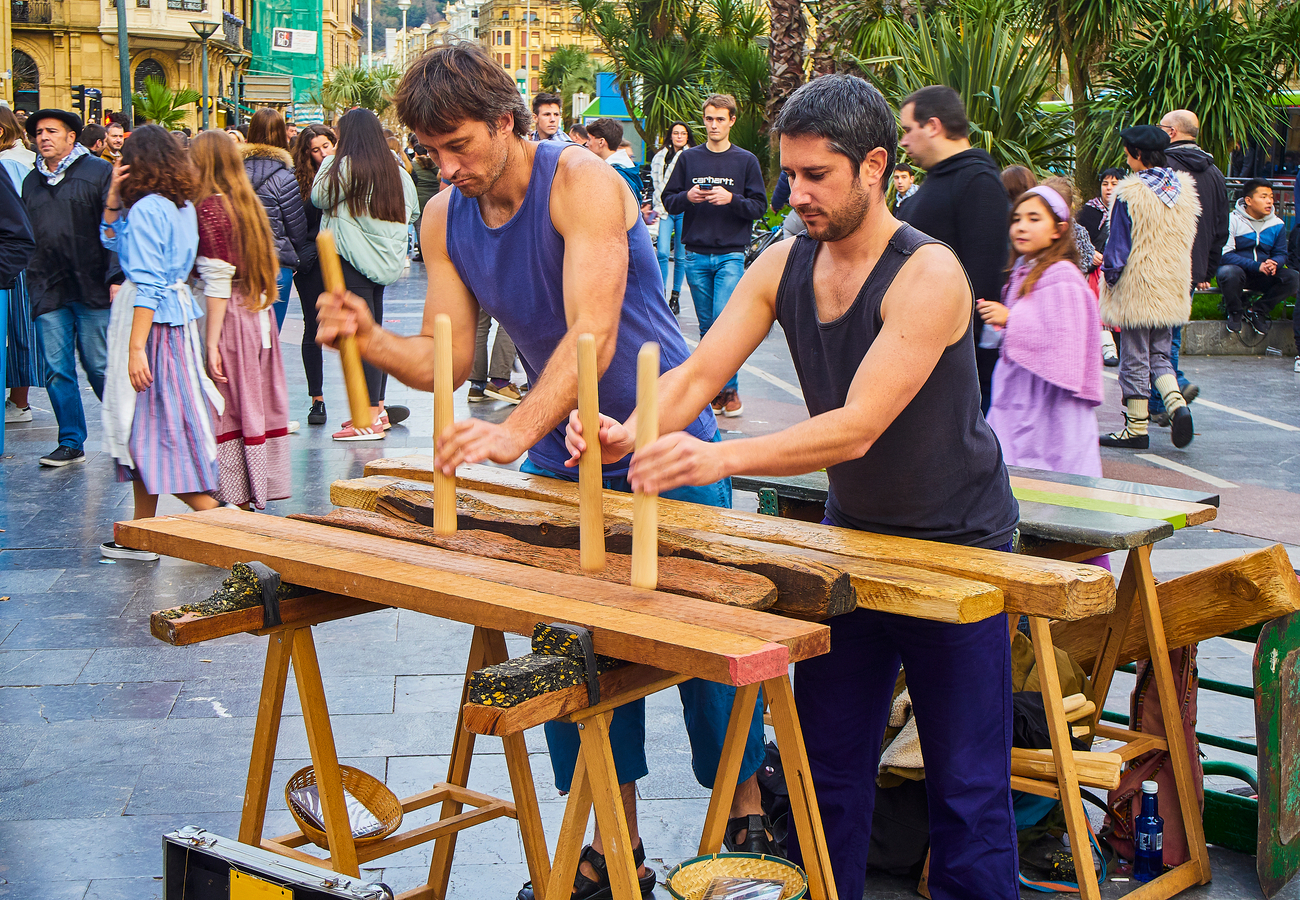
Strangest of all is the txalaparta: two players standing over a set of wooden planks, striking them with long beaters in an interlocking rhythm that is half music, half conversation.
The instrument is often connected with communal work, particularly the rhythms once used around cider making, although its exact origins remain uncertain. What matters in performance is the exchange. One player establishes a pattern; the other answers, interrupts and reshapes it. Both must listen or the whole thing collapses.
As a metaphor for the culture, it could hardly be improved.
The dances carry the same weight.
The aurresku, which developed from the traditional soka-dantza, is now often performed alone as a ceremonial expression of respect. With its controlled leaps, raised legs and measured formality, it honours newly married couples, distinguished guests and people being welcomed or remembered.
To have an aurresku danced in your honour remains one of the highest compliments the culture can offer.
Beneath the Christian calendar, meanwhile, older figures continue to inhabit the stories.
There is Mari, the great lady of Basque mythology, associated with mountains, caves, storms and the forces of nature. Legends place her in different highland dwellings and describe her moving through the sky between them.
There is Basajaun, the shaggy lord of the forest, who in some tales possesses the knowledge of farming, ironworking and the secrets of the natural world before humans acquire them.
And there is Olentzero, the charcoal burner who descends from the hills at Christmas bearing gifts, now often accompanied by Mari Domingi. He is sometimes described as the Basque answer to Santa Claus, although he arrives with older, earthier stories of his own.
Nobody exactly believes, and nobody exactly stopped believing.
That is often the Basque arrangement with the past: keep it close, and keep it working.
Where a Traveller Truly Feels Basque Culture
Here is the honest difficulty with everything described above.
Basque culture does not exist primarily for visitors. Its music, games and traditions may appear at festivals and public celebrations, but much of the culture is simply happening, all the time, in its own spaces. The traveller’s problem is that its best rooms have no ticket booth.
The bertso-afariak, where poets improvise across a long table of food. The txoko that welcomes guests on the right night. The village fiesta you would never have known to look for. The sagardotegi in full cry, the frontón on a Sunday, the trainera regatta watched from the harbour wall with the town around you losing its collective mind.
Reaching those moments is a matter of relationships, timing and a little local radar. That is precisely the layer our Exploring the Basque Country journey adds beneath the visible itinerary.
The Guggenheim and Gaztelugatxe will still be there on the day you arrive. The guide who knows that a village further up the valley crowns its stone-lifting champion this Saturday is the difference between visiting the Basque Country and briefly living in it.
One version you photograph.
The other follows you home. Years later, at the sound of an accordion or the sight of a stone church wall with a ball court beside it, you may realise that it never entirely left.
The
Culture Will Outlast Your Visit. Join It Anyway
Empires came and went. The dictatorship came and went. The language that survived them is being sung, right now, by schoolchildren who may one day fill an arena with it.
Standing inside a culture that has made that kind of decision about itself is one of the rarest experiences travel can offer, and it cannot be had through glass.
It is held at a counter over a cold txakoli, at a long table where someone’s friend is cooking, on a harbour wall while the boats race, and in the half-second of silence before a poet begins.
Our Exploring the Basque Country journey is designed to bring you inside those moments, with the introductions made, the timing carefully judged and the right doors already ajar.
Come and learn three words of Euskara, one of Europe’s oldest surviving languages, and use them among people who will notice.
The Basques have carried their language and culture through centuries of profound change.
The least you can do is come and see why.


Let us know what you love, where you want to go, and we’ll design a one-of-a-kind adventure you’ll never forget.
Get in touch
Miriam
Travel Specialist

Romina
Travel Specialist

Laura
Travel Specialist
Our offices:



Revigorate, Iberian Escapes and Algarve Lifestyle are the registered brand names of APCS Lda . We are a fully authorised travel agency licensed by Turismo de Portugal RNAVT/6867.
In the event of a dispute, the consumer may refer to: RAL - Centros de Arbitragem
Avª. 5 de Outubro, nº. 55, R/C Dtº. 8000-075 Faro, Portugal | Tel: +351 289 823 135 *
* national landline call
E-mail: info@consumoalgarve.pt| www.consumidoronline.pt | Mon to Fri: 9:00 - 13:00 / 14:00 - 17:00