Zhangjiajie and the Floating Forests: China’s Most Surreal Landscape

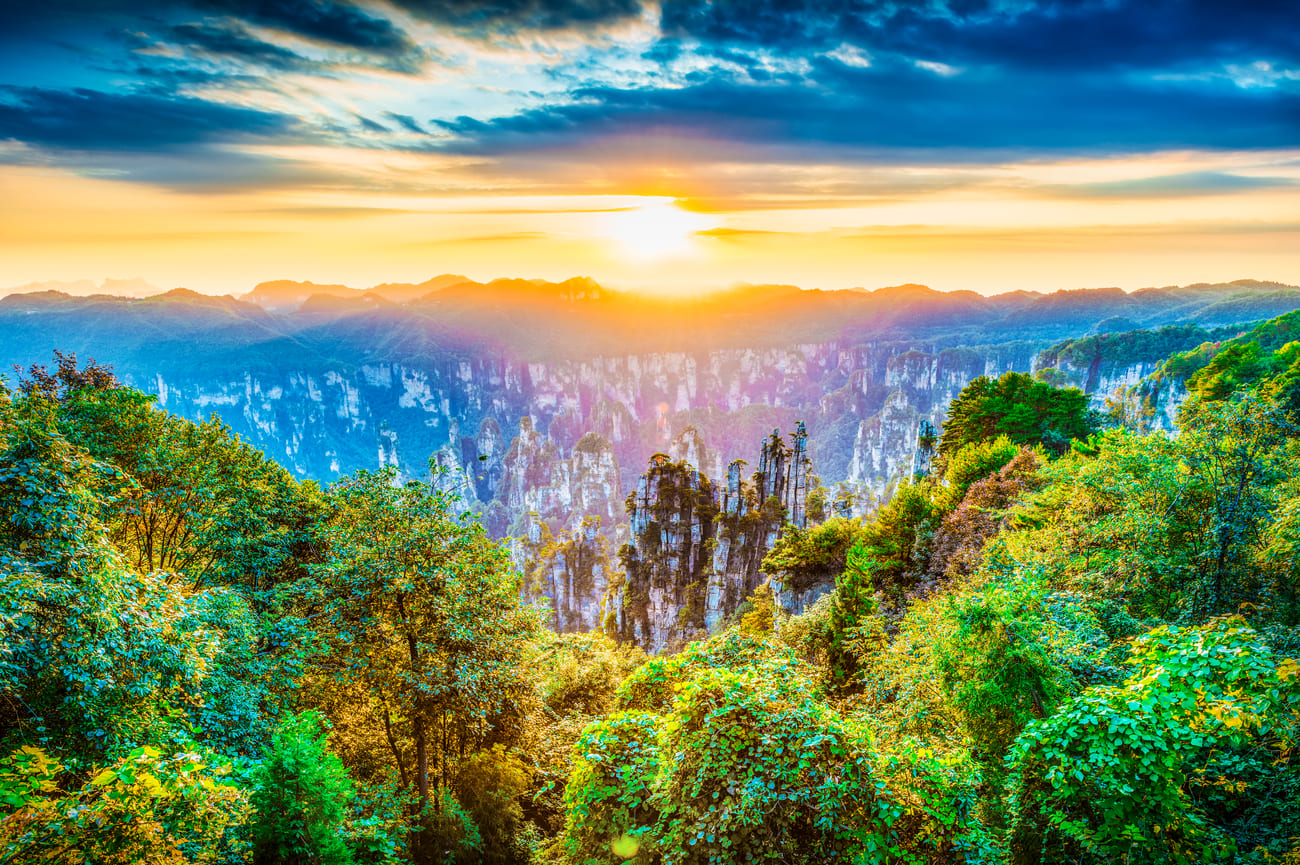
Zhangjiajie is one of China’s most extraordinary natural landscapes, where towering sandstone pillars, mist-filled valleys and ancient forests create a world that appears almost unreal.
In Hunan Province, the stone pillars rise through the morning fog as though they have been waiting centuries to be discovered. The gorges between them fill with clouds before the sun reaches the valley floor, while sandstone faces catch the first light in shades of amber and gold. Ancient trees cling to cliff edges and fissures, their roots woven into rock shaped over millions of years.
Below the Yuanjiajie plateau, valleys disappear beneath a sea of white, while thousands of sandstone towers emerge from the mist. This landscape feels imagined, yet every pillar and gorge is the result of hundreds of millions of years of geological change.
Zhangjiajie National Forest Park is one of China’s greatest natural wonders. Long before it inspired the floating mountains of Avatar, it inspired generations of travellers who struggled to find words for its scale and beauty. The landscapes of this region form the centrepiece of our China Floating Forests journey, which combines Zhangjiajie’s extraordinary scenery with a carefully designed route through China.

Beijing:
Where the Route Begins
China's imperial story belongs to Beijing, and the capital deserves three full days.
The Forbidden City, completed in 1420 under the Yongle Emperor, still communicates power through scale, symmetry and ceremony. Its 180 acres, 980 surviving buildings and 1.86 million artefacts are arranged along a precise north-south axis that runs from Tiananmen Gate to the Imperial Garden. North of the city, the Great Wall at Mutianyu follows a forested ridgeline 73 kilometres from Beijing, with 22 watchtowers and the distinctive double-sided battlements rebuilt by General Qi Jiguang in 1569. In the hutongs, Beijing becomes more intimate, shifting from imperial geometry to courtyards, alleyways and the quieter rhythms of daily life.
The full depth of the capital belongs to the Golden Triangle guide, where Beijing's imperial story is explored in greater detail. On this route, Beijing sets the human scale before Zhangjiajie changes it completely. The Forbidden City was built by 700,000 workers in fourteen years. The sandstone pillars of Zhangjiajie National Forest Park were shaped over 380 million years by rain, ice, roots and the resistance of quartz-rich rock.
Arriving in Zhangjiajie from Beijing, you feel that contrast before you fully understand it.

Zhangjiajie:
The Landscape Itself
The city of Zhangjiajie sits at the edge of a plateau in northwestern Hunan Province. The Wulingyuan Scenic Area lies 34 kilometres north, in the hills where the plateau has been dissected by rivers and time into the pillar forest that the rest of the world has spent the last fifteen years photographing.
Wulingyuan and
Its Four Zones
The Wulingyuan Scenic Area covers 397 square kilometres and is divided into four distinct zones. Zhangjiajie National Forest Park, China's first national park, established in 1982, covers 4,810 hectares of the zone's total area. Suoxi Valley Nature Reserve, Tianzi Mountain Nature Reserve, and Yangjiajie Scenic Area complete the broader Wulingyuan boundary. A single four day ticket covers all zones and includes the internal shuttle bus network.
The four zones are not interchangeable. Yuanjiajie, accessible via the Bailong Elevator within the national forest park, is the plateau zone where the cloud sea phenomenon is most reliably spectacular and where the Avatar Hallelujah Mountain occupies its viewing platform. Tianzi Mountain, at 1,262 metres, is the highest accessible point and the zone most associated with sunrise over the sea of clouds. Suoxi Valley and the Golden Whip Stream corridor are the forest floor experiences, the landscape read from within rather than from above. Yangjiajie, the least visited zone, offers the pillar formations at the greatest remove from the commercial infrastructure.
The Sandstone
Pillars: What Makes Zhangjiajie Unique
The formations that define Zhangjiajie are not limestone, but quartz-rich sandstone. This distinction explains why the landscape looks so different from the karst scenery of Guilin or Vietnam's Ha Long Bay.
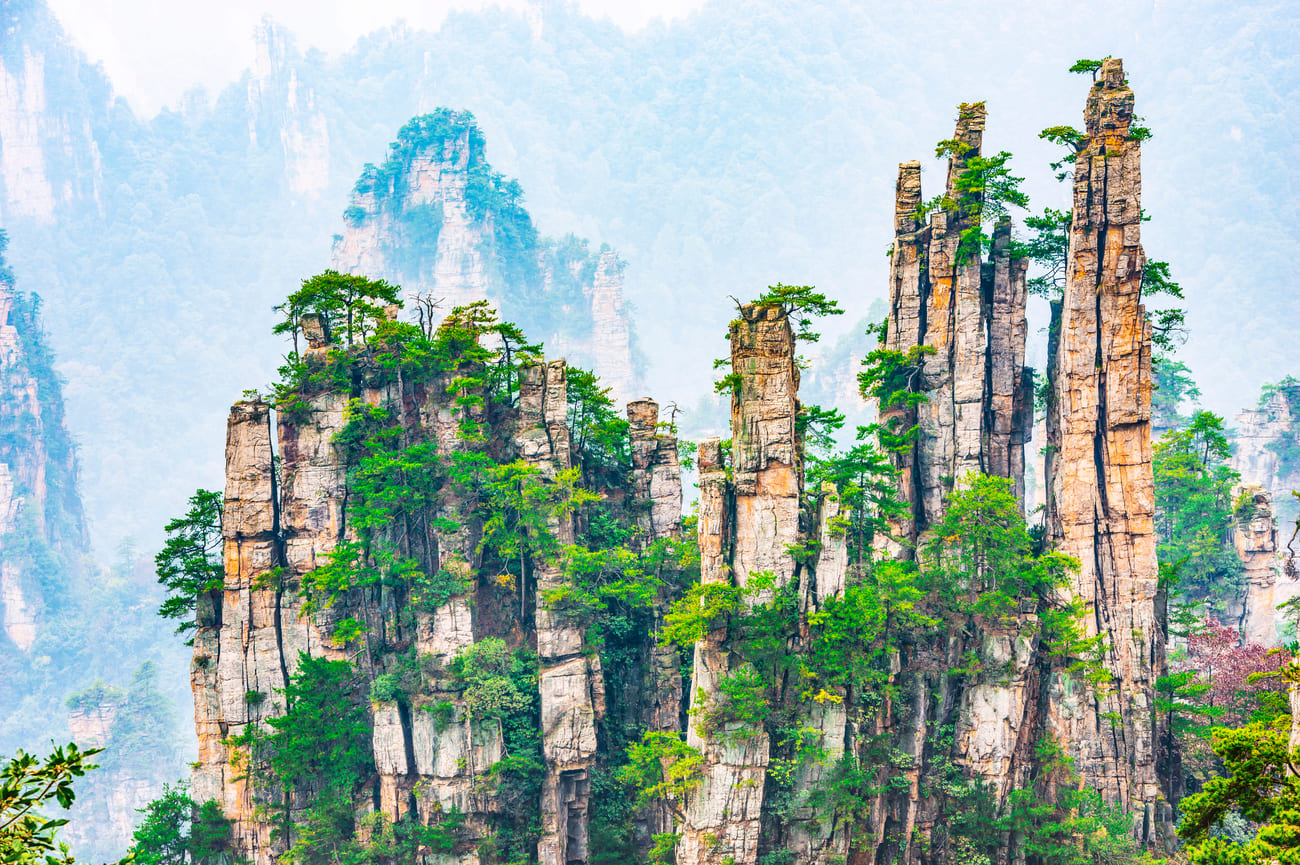
While karst landscapes are formed through the gradual chemical dissolution of limestone, Zhangjiajie's pillars were created through physical erosion. Over hundreds of millions of years, rainfall, seasonal freeze-thaw cycles and plant roots exploited natural fractures within the sandstone, gradually widening them and removing weaker sections of rock. What remained were the towering pillars, cliffs and plateaus that dominate the landscape today.
The process is surprisingly easy to see once you understand it. The deep gorges mark where heavily fractured rock was eroded away. The pillars remain where the sandstone proved more resistant. Together they create a landscape unlike any other on Earth, one that appears almost architectural in its verticality and scale.
Many of the tallest formations rise more than 1,000 metres above sea level, while ancient forests continue to cloak their surfaces. The vegetation is not simply decoration. Tree roots continue to widen fractures in the rock, participating in the same geological processes that have shaped the landscape for millions of years. Zhangjiajie is not a finished landscape. It is still evolving.
The remarkable geology behind the floating appearance of the pillars, the famous cloud sea and the landscape's connection to Avatar is explored in greater detail in our dedicated guide to Zhangjiajie's sandstone pillars and geology.

Yuanjiajie:
The Plateau Above the Gorges
Yuanjiajie is where the Wulingyuan landscape becomes most dramatic. Set high above the gorges, the plateau brings the sandstone pillar forest to eye level, allowing you to look across the formations rather than simply up at them from below.
Arriving by the Bailong Elevator is part of the experience. In less than two minutes, you rise from the valley floor to the upper landscape, where cliffs, forested pillars and cloud-filled ravines stretch in every direction.
The Bailong
Elevator
The Bailong Elevator is one of Zhangjiajie's most remarkable pieces of engineering. Built into the cliff face, it rises 326 metres in just 88 seconds, carrying visitors from the valley floor to the Yuanjiajie plateau in a transparent glass cabin.
Before it opened in 2002, reaching this part of the park required a demanding two to three-hour climb. Today, the ascent is part of the experience. The cliff face passes close beside the glass, the gorge opens beneath you, and the pillar forest begins to appear at the plateau rim. When the morning cloud sea fills the valleys, the elevator rises through white mist before emerging into clear air above it.

The Cloud Sea
The famous cloud sea is one of Zhangjiajie's defining sights. It forms when warm, moist air rises from the valley and meets cooler air above, causing clouds to settle in the gorges while the sandstone pillars remain visible above them.
The effect is extraordinary. Pillars appear and disappear as the cloud shifts, and the forested towers seem to float above a white ocean. This was the atmospheric quality that helped inspire the floating mountains of Avatar, giving the landscape a cinematic association that still draws travellers from around the world.
The cloud sea is most reliable in the early morning, especially between October and April after rain. The best window is usually within the first two hours after the park opens.
The Avatar
Hallelujah Mountain and the First Bridge Under Heaven
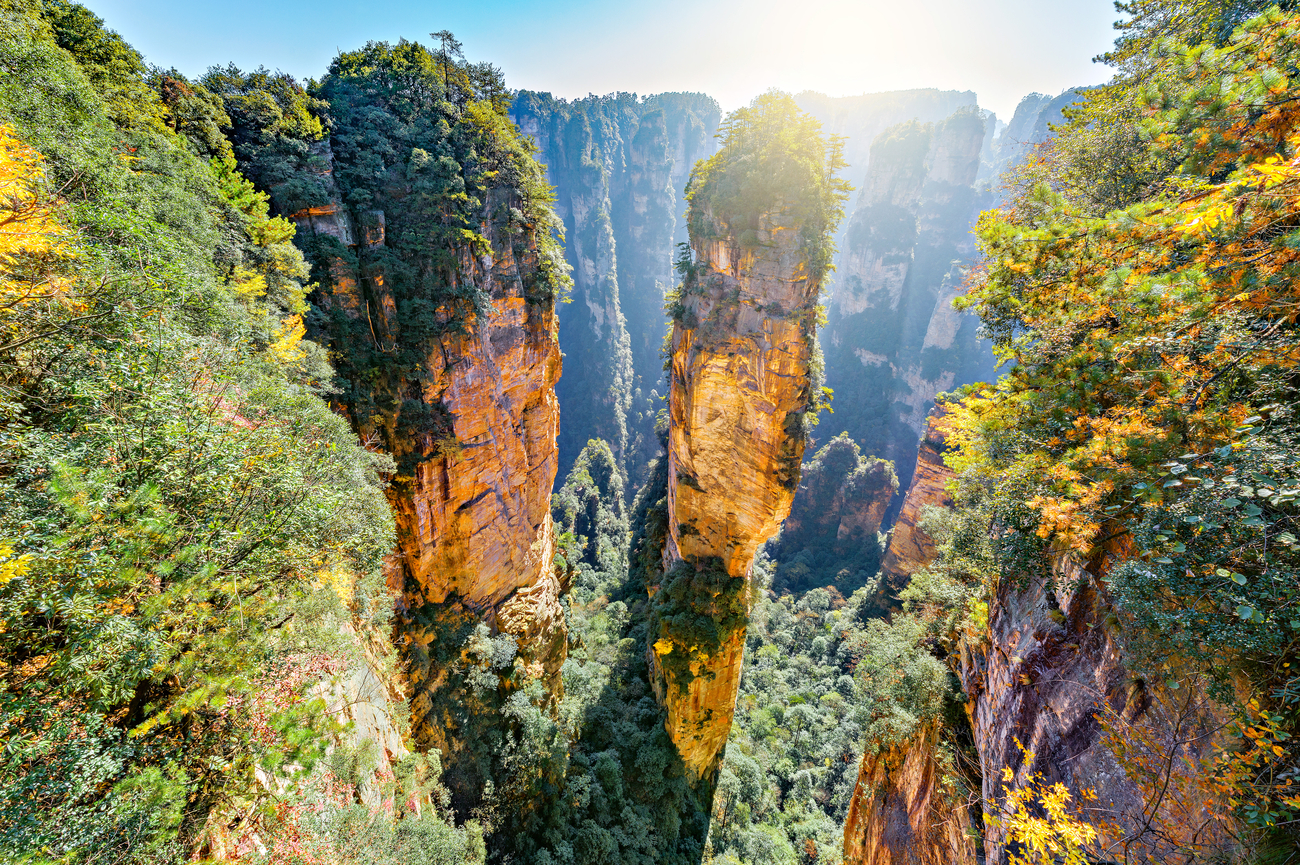
The Southern Sky Column, renamed Avatar Hallelujah Mountain in 2010, is one of the most recognisable formations in Yuanjiajie. Standing more than 1,000 metres above sea level, it is best seen from the No. 1 Scenic Bridge viewpoint, where its quartz-sandstone face rises against the gorge behind it.
Its connection to Avatar made it internationally famous, but the formation itself is far older and more interesting than its film association. The rock face, the fracture pattern and the ancient trees rooted into its upper fissures reveal the same geological forces that shaped the wider Wulingyuan landscape.
Nearby, the First Bridge Under Heaven, Tianxia Di Yi Qiao, forms a natural sandstone arch between two separate pillar formations. When the cloud sea fills the gorge below, crossing it becomes one of the park's most unforgettable experiences: a natural stone bridge suspended above a valley of white.
Tianzi
Mountain: The Emperor's Altitude
Tianzi Mountain is the highest accessible point in the Wulingyuan Scenic Area, rising to 1,262 metres. It offers some of the most expansive views in Zhangjiajie, with sandstone pillars, forested ridges and cloud-filled valleys stretching across the horizon.
The name honours Xiang Dakun, a Tujia chieftain who led a rebellion against Yuan Dynasty rule in the 14th century and declared himself Tianzi, or emperor. Although the uprising was eventually suppressed, the mountain kept his name. Many of the viewpoints still carry older poetic titles, including Imperial Writing Brush Peaks, Fairy Scattering Flowers, When the Armies Assembled and The Warrior Training Horses, names inspired by the shapes that local communities saw in the pillar formations long before modern tourism arrived.
The Sunrise
and the Sea of Clouds
Tianzi Mountain is especially powerful in the early morning. When the valleys below fill with cloud and the first light reaches the pillar tops, the landscape appears suspended between mountain and sky.
The Tianzi Mountain cable car begins operating around 7 AM and takes visitors up to the summit in approximately ten minutes. Arriving early gives the best chance of seeing the sea of clouds before the mist begins to lift. Later in the morning, the views often become clearer, revealing more of the sandstone geology, but the atmosphere is usually less dramatic.
Laowuchang, often described as the Fields in the Air, is one of the best viewpoints for seeing the Bailong Elevator in the distance against the pillar forest. From here, the elevator appears as a narrow vertical line on the cliff face, one of the few human structures in the park that can visually hold its place within such a vast natural setting.
The Shentang
Gulf
The Shentang Gulf offers a quieter and more mysterious side of Tianzi Mountain. Surrounded by cliffs, with a dark green pool far below, the gorge receives fewer visitors than the main summit viewpoints and still carries a sense of remoteness.
In a landscape where many viewpoints are named, signposted and carefully managed, Shentang Gulf feels different. It is a reminder that Wulingyuan still contains places where the scenery has not been fully domesticated by paths, platforms or crowds.
The
Tujia and Bai Communities
The Wulingyuan landscape was never empty. Long before UNESCO recognition or international tourism, Tujia and Bai communities lived in the surrounding valleys and mountain villages, giving the area a human history as layered as its geology.
The Tujia people helped shape the way the landscape is understood. Many of the names still used for the pillars, valleys and viewpoints came from generations of local observation. Imperial Writing Brush Peaks, When the Armies Assembled and Golden Whip Rock are not simply tourist labels. They reflect the shapes, stories and meanings that communities saw in the stone as the light changed across the seasons.
The Bai communities also left their mark on the region's old towns and architectural traditions. In and around the Wulingyuan district, wooden buildings, layered eaves and raised structures reveal the practical and cultural responses of communities living close to steep terrain, dense forest and mountain weather.
This cultural layer matters. Zhangjiajie is often described through geology, cloud seas and cinematic landscapes, but the park also belongs to the people who named it, lived around it and interpreted its forms long before the wider world arrived.
The
Golden Whip Stream: The Forest Floor
Yuanjiajie and Tianzi Mountain reveal Zhangjiajie from above. The Golden Whip Stream reveals it from within.
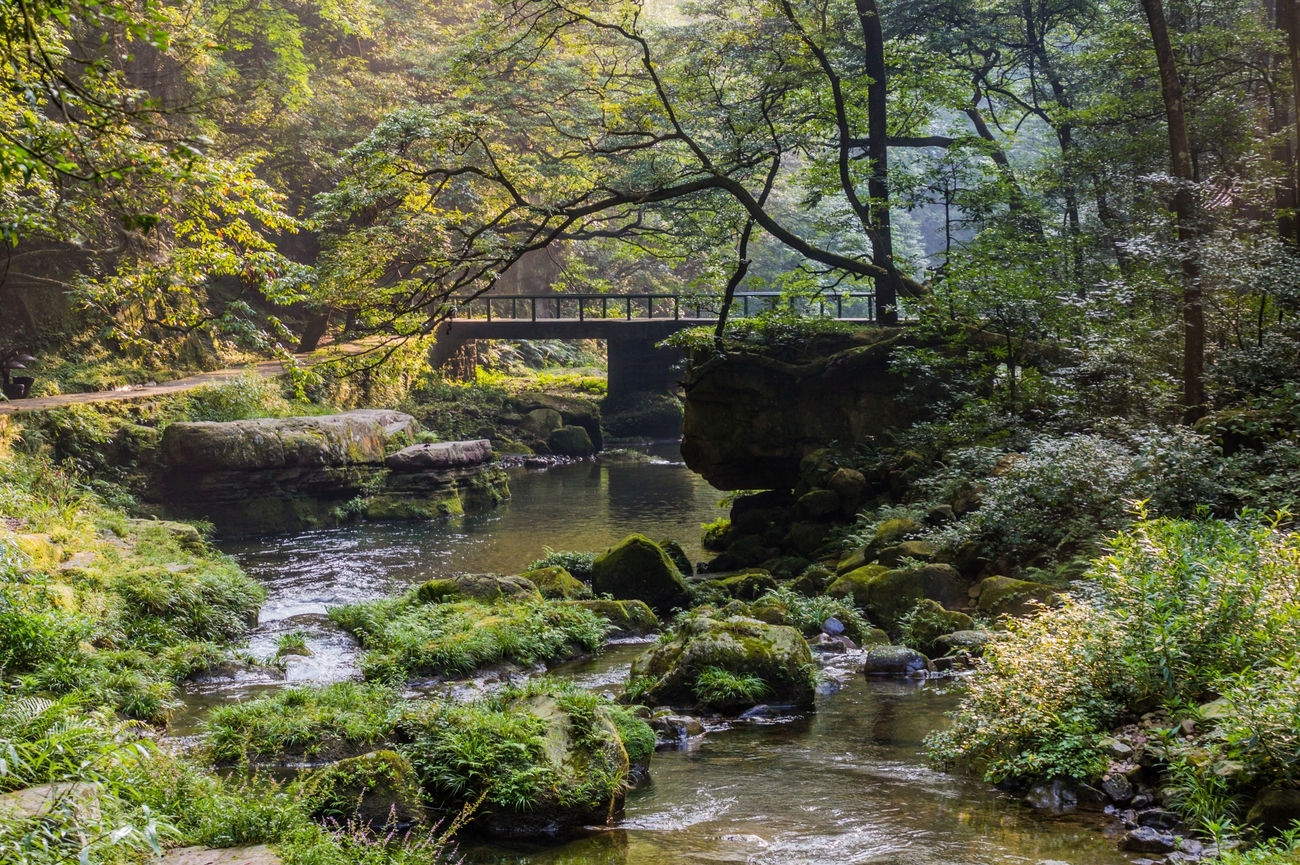
Running for 7.5 kilometres through the valley floor of Zhangjiajie National Forest Park, the stream follows a relatively gentle path between sandstone pillars that rise on both sides. It is one of the best places to experience the scale of the landscape at ground level, with the cliffs towering overhead and the forest closing in around the water.
The Golden Whip Rock, a 350-metre pillar near the valley entrance, is one of the route's most recognisable formations. In autumn light, its sandstone face takes on a warm amber tone, giving the impression of a ceremonial whip held upright against the sky.
The valley also reveals the ecological importance of Wulingyuan. Its shaded gorge environment supports ancient tree species, rare plants and endangered wildlife, including the Chinese giant salamander. This is part of why the area has often been described as a living natural archive, where difficult terrain helped protect habitats that more accessible landscapes lost.
Walking the Golden Whip Stream after seeing Yuanjiajie or Tianzi Mountain gives the park its full vertical range. Above, the pillars rise through cloud and light. Below, the same landscape becomes forest, water, stone and shadow.
Tianmen
Mountain: The City's Sacred Peak
Tianmen Mountain is separate from Zhangjiajie National Forest Park, sitting around 8 kilometres south of downtown Zhangjiajie City. It has its own entrance, ticket, cable car system and identity, and it should be treated as a separate day within the journey.
Where the national forest park is defined by sandstone pillars and forested gorges, Tianmen Mountain is centred on one dramatic peak, a vast natural arch, cliff-edge walkways and a long history of pilgrimage. The two landscapes belong together in the same itinerary, but they are not the same experience.
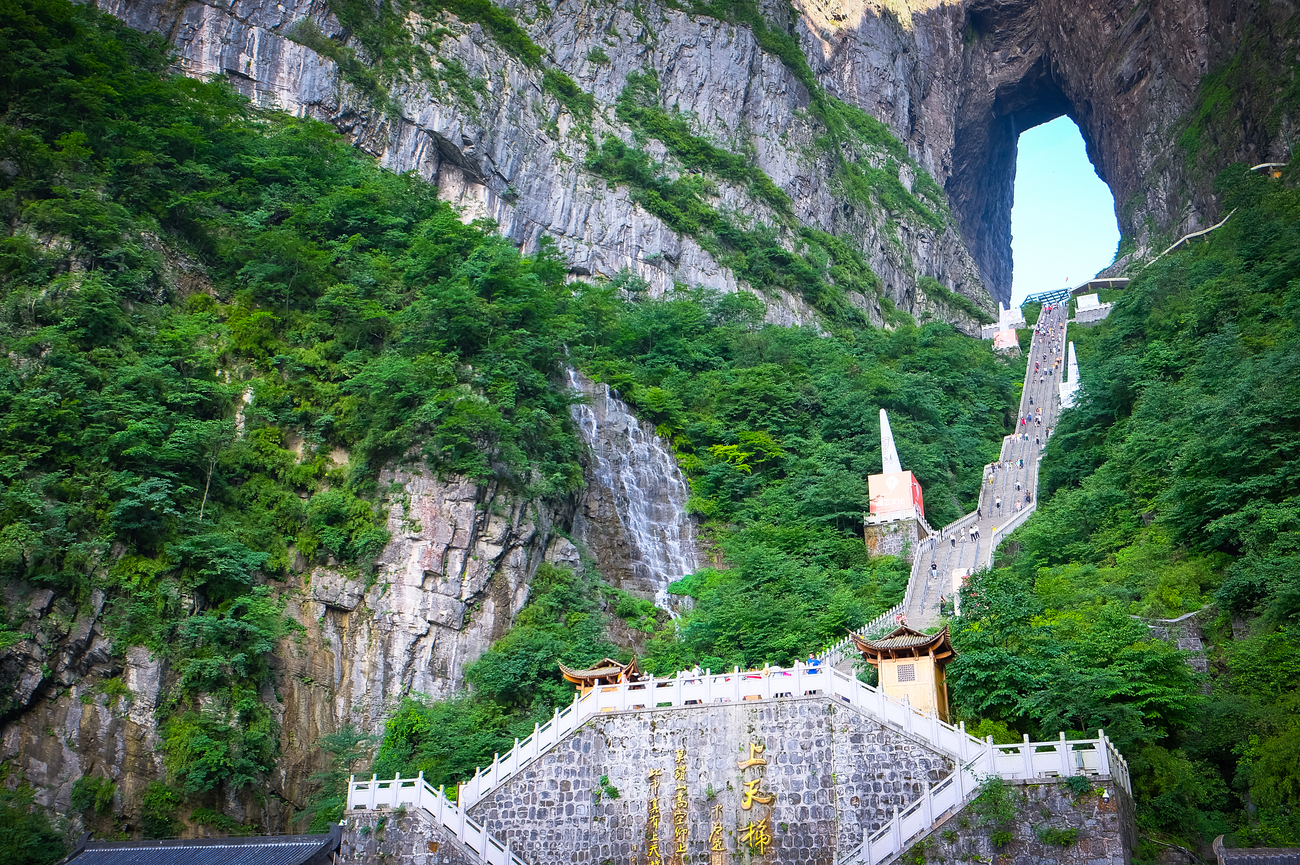
Tianmen Cave
Tianmen Cave is the mountain's defining feature. Set at around 1,300 metres above sea level, this natural karst arch rises 131.5 metres high and 57 metres wide, creating the opening that gave the mountain its name, Heaven's Gate.
According to local records, the cave opened in 263 AD during the Three Kingdoms period, when part of the cliff face collapsed and revealed the arch. The event gave Tianmen Mountain its sacred character, and surrounding Tujia and Han communities have treated it as a place of significance ever since.
Geologically, Tianmen Mountain is also distinct from Zhangjiajie National Forest Park. Its cave was formed in karst limestone, while the famous pillars of the national forest park are quartz-rich sandstone. The two places sit close to each other, but they tell very different geological stories.
The Glass
Walkway and the Ghost Valley Plank Road
The Coiled Dragon Cliff Glass Walkway is one of Tianmen Mountain's most memorable experiences. Suspended from the cliff face at around 1,430 metres above sea level, the glass path gives a direct view into the valley below and creates an immediate sense of exposure.
The Ghost Valley Plank Road offers a different kind of drama. Running for around 1,600 metres along the cliff face, it follows the mountain's natural profile, with rock on one side and open space on the other. The glass walkway asks you to pause and feel the altitude. The plank road lets that feeling unfold gradually as you move along the cliff.
When mist moves across the summit, the experience changes completely. The valley can disappear into white cloud, then return suddenly as the air clears. That shifting atmosphere is part of what makes Tianmen Mountain so powerful.
The full Tianmen Mountain experience, including the cave, glass walkway, Ghost Valley Plank Road, 999 steps and summit temple, is covered in greater detail in our dedicated guide to Tianmen Mountain and the Glass Walkway.

The
Avatar Story, In Its Correct Proportion
Zhangjiajie's connection with Avatar is real, but it is only one part of the story.
The landscape that helped inspire Pandora's floating Hallelujah Mountains was Zhangjiajie's Southern Sky Column, photographed and studied by James Cameron's production team during the film's research phase. Avatar was not filmed in Zhangjiajie National Forest Park, but the park's sandstone pillars, cloud seas and forested cliffs helped shape the visual language of the film.
After Avatar's release, the Southern Sky Column was renamed Avatar Hallelujah Mountain in 2010. The name brought international attention, but the landscape itself had already been recognised long before. Wulingyuan was inscribed as a UNESCO World Heritage Site in 1992 for its exceptional quartz-sandstone peak forest landform and its extraordinary concentration of more than 3,000 stone pillars.
The film association may explain why many travellers first hear about Zhangjiajie. It does not explain why the place matters. The geology, scale, biodiversity and atmosphere of the park are far older, richer and more compelling than any cinematic reference.
The full story of how Zhangjiajie inspired Avatar, what the film borrowed and what the real landscape offers beyond the screen, is explored in our dedicated guide to Avatar and Zhangjiajie.
Where
You Stay in Zhangjiajie
Where you stay in Zhangjiajie matters. The landscape rewards early starts, careful sequencing and proximity to the right entrance on the right day.
In Wulingyuan District, staying close to the national forest park's East Gate makes the morning experience far easier. Yuanjiajie's cloud sea is most powerful early in the day, before the mist lifts and before the main visitor flow builds. A short transfer can make the difference between reaching the Bailong Elevator in time for the first light and arriving once the landscape has already changed.
For Tianmen Mountain, the logic is different. Staying in Zhangjiajie City places you closer to the cable car station and the shuttle departure for the 99-bend road, both of which are important for a smooth day on the mountain. Summit conditions can shift quickly, especially around the glass walkway, so timing and access matter here too.
The ideal Zhangjiajie sequence is usually two nights in Wulingyuan for the national forest park, followed by one night in Zhangjiajie City for Tianmen Mountain. This allows each part of the region to be experienced properly, without rushing or treating two very different landscapes as one.
Our China Floating Forests itinerary is designed around this rhythm, combining Beijing, Zhangjiajie and Shanghai with the accommodation positioning, guiding and timing needed to experience the landscape at its best.
Shanghai:
The Route's Contemporary Close
The journey ends in Shanghai, where China's contemporary identity comes sharply into focus after the imperial scale of Beijing and the natural drama of Zhangjiajie.
The flight from Zhangjiajie to Shanghai moves from sandstone pillars and cloud-filled gorges to one of Asia's most recognisable skylines. Along the Bund, historic façades face the towers of Pudong across the Huangpu River, creating one of the clearest visual contrasts in modern China. The Shanghai Tower rises to 632 metres, while landmarks such as Yu Garden and Zhangyuan reveal older layers of the city behind its global image.
Two days in Shanghai give the route a different kind of ending. Beijing introduces China's imperial past. Zhangjiajie interrupts it with geology, forest and atmosphere. Shanghai closes the journey with architecture, energy and contemporary ambition.
For travellers who want to explore the city’s history and skyline in greater depth, our guide to things to do in Shanghai expands on the Bund, Pudong, Yu Garden and the city’s layered urban story, while this China Floating Forests journey keeps Shanghai as the contemporary close to a route shaped by Beijing, Zhangjiajie and the landscapes of Hunan.

Dawn
at Yuanjiajie
Dawn is the moment Yuanjiajie becomes unforgettable.
The cloud sea forms most reliably in autumn, especially in October, when cooler air strengthens the temperature difference between the gorges and the plateau above. After rain, clouds gather in the valleys before sunrise and often remain there as the first light reaches the sandstone pillars.
At this hour, Zhangjiajie feels suspended between earth and sky. The gorges disappear beneath a white sea, while the pillar tops rise above it in soft amber light. It is the landscape at its most atmospheric, and the version that explains both its UNESCO recognition and its later association with Avatar.
Standing on the Yuanjiajie plateau at 7 AM, above a complete cloud sea, you see what no photograph can fully hold: a forest of stone shaped over hundreds of millions of years, revealed for a short time before the morning changes it again. October dates at Yuanjiajie fill early. This is where the itinerary begins.


Let us know what you love, where you want to go, and we’ll design a one-of-a-kind adventure you’ll never forget.
Get in touch
Miriam
Travel Specialist

Nina
Travel Specialist

Abigail
Travel Specialist
Frequently Asked Questions
- How many days do you need in Zhangjiajie?
Most travellers should allow three days in Zhangjiajie. This gives time for Zhangjiajie National Forest Park, Yuanjiajie, Tianzi Mountain, the Golden Whip Stream and a separate day for Tianmen Mountain.
- What is the best month to visit Zhangjiajie?
October is one of the best months to visit Zhangjiajie. Cooler mornings, post-rain cloud formation and clearer afternoon light often create excellent conditions for seeing the cloud sea around Yuanjiajie and Tianzi Mountain.
- How do you get to Zhangjiajie from Beijing or Shanghai?
Zhangjiajie is usually reached by domestic flight from Beijing or Shanghai. The route works well as part of a wider China journey, beginning in Beijing, continuing to Zhangjiajie and ending in Shanghai.
- Is Zhangjiajie National Forest Park the same as Tianmen Mountain?
No. Zhangjiajie National Forest Park is part of the Wulingyuan Scenic Area and is known for its sandstone pillars, cloud seas and Avatar association. Tianmen Mountain is a separate mountain near Zhangjiajie City, known for Tianmen Cave, the glass walkway, the 999 steps and its summit temple.
- Can you visit Zhangjiajie without hiking?
Yes. Zhangjiajie can be experienced with limited hiking by using the Bailong Elevator, cable cars, shuttle buses and carefully planned viewpoints. Some walking is still needed, but the route can be adapted to suit different comfort levels.
- Where should you stay when visiting Zhangjiajie National Forest Park?
For Zhangjiajie National Forest Park, staying in Wulingyuan District near the East Gate is usually best. It reduces morning transfer time and helps travellers reach Yuanjiajie early, when the cloud sea is most likely to appear.
- Do you need a guide in Zhangjiajie?
A guide is strongly recommended in Zhangjiajie. The park is large, the zones are not interchangeable, and the best experience depends on timing, entrances, shuttle routes, weather conditions and knowing which viewpoints to prioritise.
- What is the difference between Yuanjiajie and Tianzi Mountain?
Yuanjiajie is the plateau area known for the Bailong Elevator, the Avatar Hallelujah Mountain and dramatic views across the pillar forest. Tianzi Mountain is the highest accessible zone in Wulingyuan and is especially known for sunrise, broad panoramas and the sea of clouds.
- When is the best time to see the cloud sea in Zhangjiajie?
The cloud sea is most reliable early in the morning, especially between October and April after rain. The first two hours after the park opens usually offer the strongest chance of seeing the pillars rise above the mist.
- Can Revigorate arrange a tailor-made luxury journey to Zhangjiajie and China's Floating Forests?
Yes. Revigorate can arrange a tailor-made luxury journey to Zhangjiajie and China's Floating Forests, combining Beijing, Zhangjiajie National Forest Park, Tianmen Mountain and Shanghai with private guiding, carefully chosen accommodation and the right timing for the landscape.
Our offices:



Revigorate, Iberian Escapes and Algarve Lifestyle are the registered brand names of APCS Lda . We are a fully authorised travel agency licensed by Turismo de Portugal RNAVT/6867.
In the event of a dispute, the consumer may refer to: RAL - Centros de Arbitragem
Avª. 5 de Outubro, nº. 55, R/C Dtº. 8000-075 Faro, Portugal | Tel: +351 289 823 135 *
* national landline call
E-mail: info@consumoalgarve.pt| www.consumidoronline.pt | Mon to Fri: 9:00 - 13:00 / 14:00 - 17:00