Tianmen Mountain: Heaven’s Gate and the Glass Walkways

In 263 AD, a cliff face on Tianmen Mountain in Zhangjiajie, China, split open.
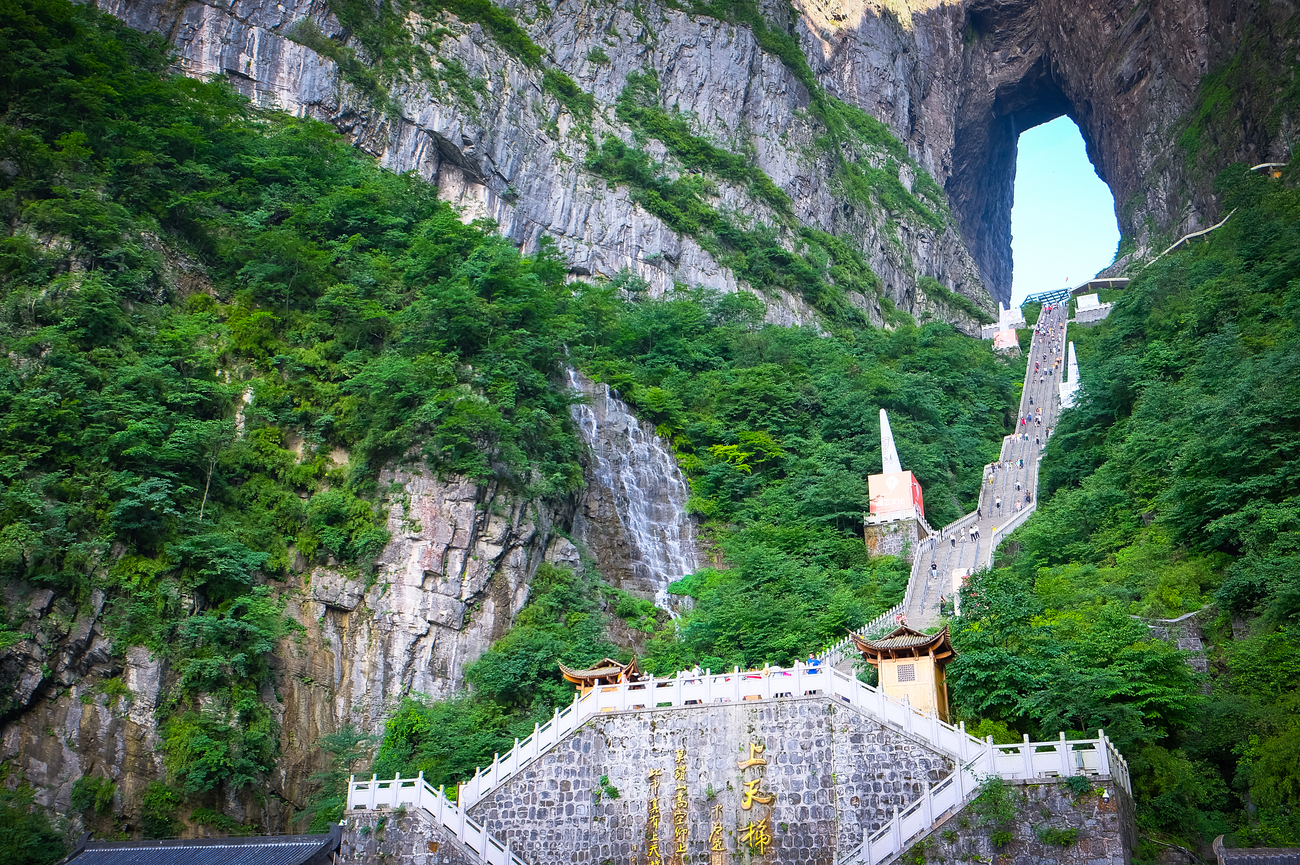
The fissure widened until it became an arch, 131.5 metres high and 57 metres wide, open to the sky at 1,300 metres above the valley. Local communities looked up at the opening and named it Heaven’s Gate. The mountain became Tianmen, the mountain of the celestial door, and pilgrims and travellers have climbed towards the arch for centuries.
The glass walkway came 1,752 years later. It extends from the cliff face at an elevation of approximately 1,430 metres, with the valley visible directly below through its transparent floor. Beneath Tianmen Cave, the 999 stone steps rise towards Heaven’s Gate. Higher on the mountain, the glass walkway and Ghost Valley Plank Road provide a different kind of exposure: modern, transparent and suspended above the same sacred landscape.
Tianmen Mountain is one full day within our China Floating Forests journey, and it earns every hour of it. Our China Floating Forests itinerary places Tianmen Mountain within a wider route through Beijing, Zhangjiajie and Shanghai, combining China’s historic cities with the dramatic landscapes of Hunan Province.
A
Mountain That Predates the Tourism
Tianmen Mountain was a place of meaning long before it became known for cable cars, glass walkways and cliff-edge paths.
The mountain appears in Chinese historical records from the Han Dynasty onward, giving it more than 2,000 years of documented human connection. Earlier names, including Yunmeng Mountain and Songliang Mountain, appear in texts that predate its Buddhist associations, showing that this peak had cultural significance long before modern tourism arrived.
Its sacred identity became closely linked to the appearance of Tianmen Cave in 263 AD. The vast opening in the cliff face was interpreted as Heaven's Gate, and the mountain gradually became associated with pilgrimage, ritual and the idea of a passage between earth and sky.
During the Tang Dynasty, Tianmen Mountain Temple was established at the summit, giving the mountain a lasting Buddhist presence. The temple became one of the most important religious sites in western Hunan, and its courtyards, halls and incense-filled spaces remain central to the mountain's character today.
This history matters because Tianmen Mountain is not an adventure attraction with a temple added for atmosphere. It is a sacred mountain that later acquired modern infrastructure. The cable car, glass walkway and plank roads are recent additions to a place that had already drawn pilgrims for centuries.
The sandstone pillar geology of Zhangjiajie National Forest Park, 8 kilometres to the north, is a completely different geological story from Tianmen Mountain's karst limestone cave. That contrast is explored in greater detail in our dedicated guide to Zhangjiajie's sandstone pillars and geology.

Tianmen
Cave: Heaven's Gate
Tianmen Cave is the mountain's centre of gravity. The cable car, glass walkways, temple, 99-bend road and 999 steps all lead, visually or physically, back to this vast opening in the cliff.
The Formation
Tianmen Cave is a natural karst arch set at around 1,300 metres above sea level. It measures 131.5 metres high and 57 metres wide, large enough to make the scale difficult to understand from below.
The cave appears in historical records from 263 AD, during the Three Kingdoms period, when part of the cliff face opened and revealed the arch. The geological explanation is limestone slowly dissolving along a fracture until the opening became large enough to transform the mountain's profile. The human response was different. Local communities saw a mountain opening itself to the sky and named it Heaven's Gate.
That name still defines the mountain today.

The Ascent to
the Cave
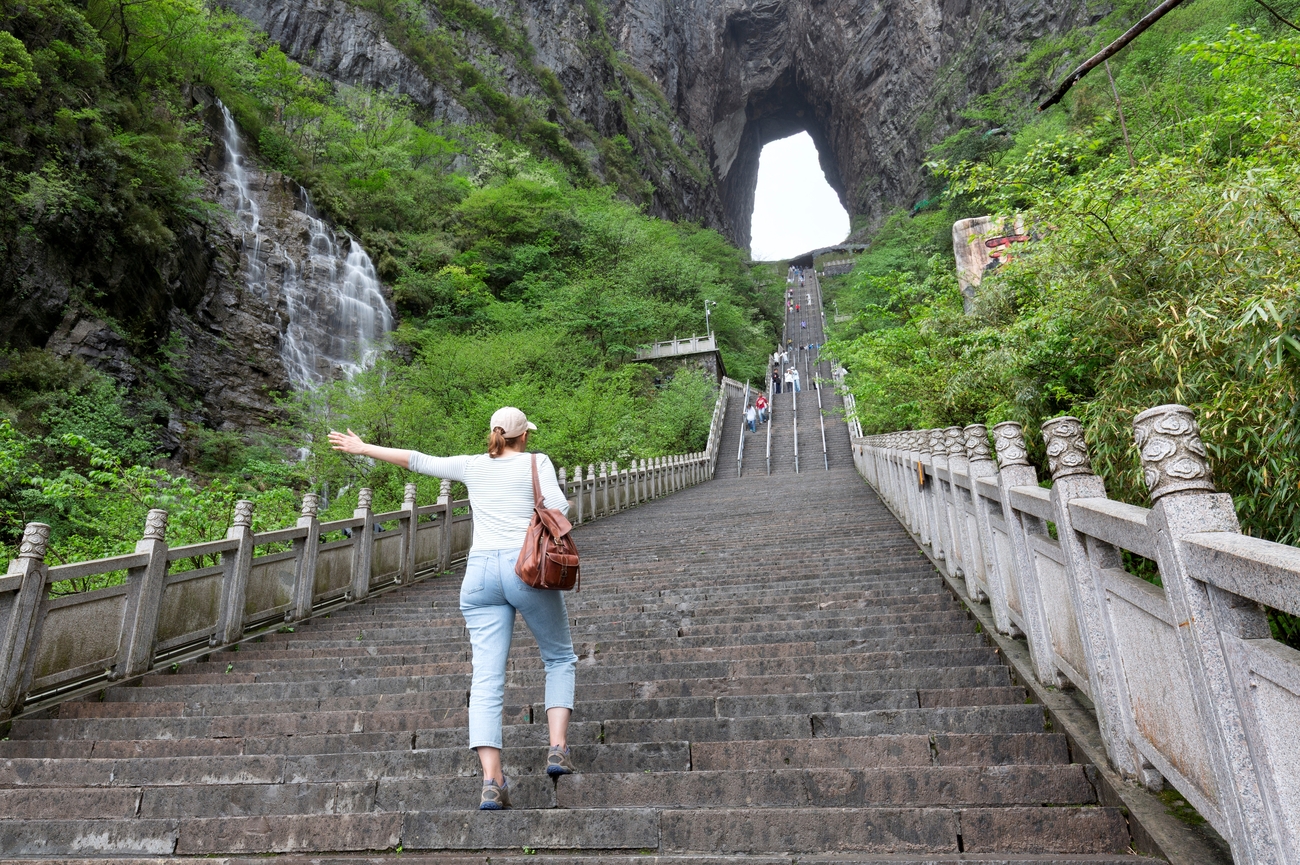
Tianmen Cave can be reached as part of the mountain's summit route, but the most symbolic approach remains the 999 steps. The number nine carries auspicious meaning in Chinese culture, associated with longevity and imperial symbolism, and the staircase gives the cave a ceremonial sense of arrival.
Descending or climbing the steps, the arch gradually expands in front of you. The valley appears through the opening below, the cliff rises around you, and the scale of the cave becomes physical rather than abstract.
For visitors who prefer a less demanding route, the express cable car between the summit and Tianmen Cave provides an alternative. It brings you close to the cave level without needing to use the full staircase, while still allowing time to stand within the arch itself.
From inside Tianmen Cave, the experience changes completely. The rock ceiling rises more than 130 metres above, the valley opens below, and the sky is framed through stone. It is the one perspective that no photograph from outside the cave can fully capture.
The Eastern
Glass Viewing Platform
The Eastern Glass Viewing Platform adds a more recent perspective to the cave experience. Suspended on the cliff face below Tianmen Cave, it allows visitors to look upward towards the arch while seeing the valley through the transparent floor beneath them.
It reverses the usual viewpoint. Instead of looking at the cave from the front or standing within it, you look up at the opening from below, with the mountain above and the drop below. The result is deliberately disorienting, combining the sacred scale of the cave with the exposed sensation of Tianmen's modern glass walkways.
The
Glass Walkway and the Plank Road
The summit plateau of Tianmen Mountain holds two cliff-edge experiences that feel very different from one another. They should not be treated as alternatives. Together, they show the mountain's modern, vertiginous side.
The Coiled
Dragon Cliff Glass Walkway
The Coiled Dragon Cliff Glass Walkway extends from the cliff face at around 1,430 metres above sea level. It is a short but unforgettable section of transparent glass, suspended above the valley with the drop visible directly beneath your feet.
Standing still on the glass is the point. The floor is solid, but your eyes register open air below. The surrounding cliff faces press close on either side, while the valley stretches far beneath you. For a moment, the body and the mind disagree about where you are standing.
Weather changes the experience completely. When mist moves across the summit, the valley disappears and the glass platform seems to float in white air. When the mist clears, the full depth returns all at once.

The Ghost
Valley Plank Road
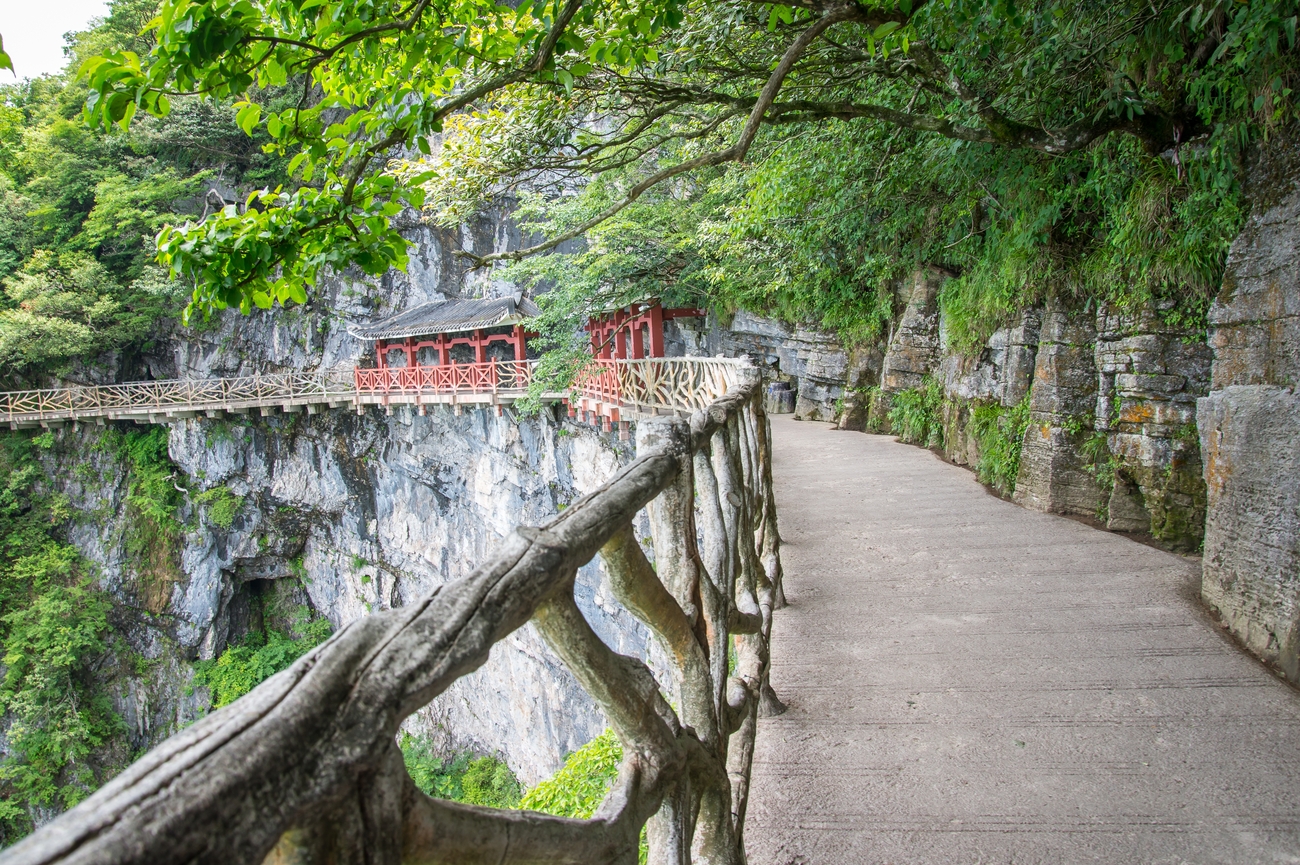
The Ghost Valley Plank Road offers a slower, more sustained form of exposure. Running for around 1,600 metres along the cliff face, it follows the natural profile of Tianmen Mountain, with rock on one side and open space on the other.
Unlike the glass walkway, which asks you to stop and feel the height, the plank road lets the sensation build gradually. In some sections, the path passes beneath overhanging rock. In others, the cliff recedes and the valley opens fully beside you. The exposure keeps changing, which prevents it from ever becoming routine.
Walking the route at a measured pace takes around 45 minutes. By the time the path returns towards the summit plateau, Tianmen feels less like a single viewpoint and more like a mountain experienced along an edge.
Tianmen
Mountain Temple
After the glass walkway and the cliff paths, Tianmen Mountain Temple changes the rhythm of the summit.
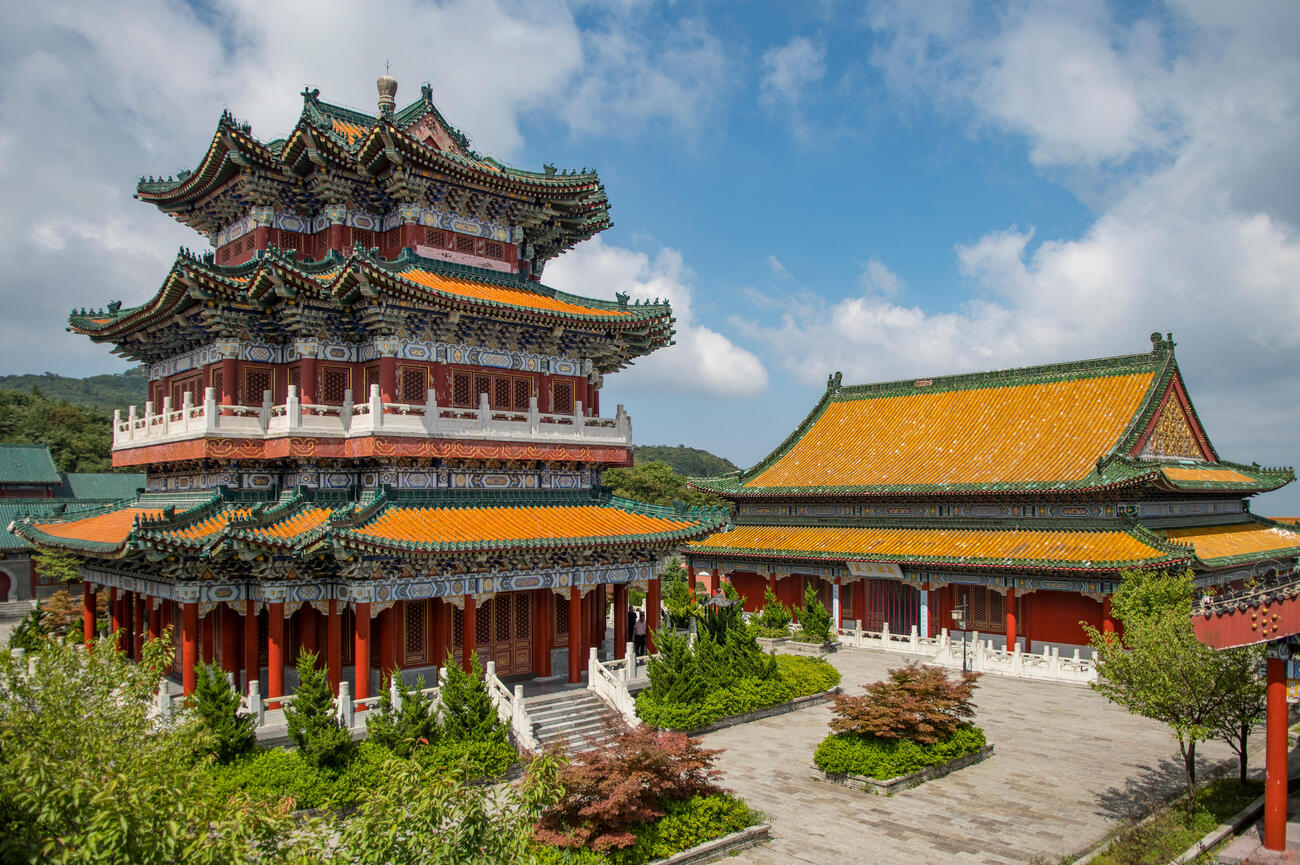
At the heart of the plateau sits the temple complex, built in the Tang Dynasty architectural style and surrounded by ancient trees. After the exposure of the glass walkway and the long edge of the Ghost Valley Plank Road, the shift is immediate. Incense smoke, temple halls, chanting and shaded courtyards create a quieter atmosphere, one that reminds visitors that Tianmen Mountain was sacred long before it became famous for altitude and glass.
The temple is one of the most important Buddhist sites in western Hunan. Its complex is arranged through a sequence of halls, including the Mountain Gate, Bell and Drum Tower, Heavenly King Hall, Main Shrine Hall, Avalokitesvara Pavilion and Scripture Pavilion. The progression gives the summit a ceremonial structure, moving visitors from open mountain air into a more contemplative space.
Its religious importance is linked to the presence of Buddhist relics associated with Sakyamuni Buddha and his disciples. This has helped sustain Tianmen Mountain's pilgrimage significance for centuries, drawing worshippers as well as travellers to the summit.
What makes the experience distinctive is the proximity of the sacred and the vertiginous. From parts of the summit, incense can drift towards the cliff paths, and the sound of chanting may carry across the plateau in still weather. Few places combine a high-altitude glass walkway, a natural cave known as Heaven's Gate and an active Buddhist temple within such a compressed mountain landscape.
The
99-Bend Road and the Approach
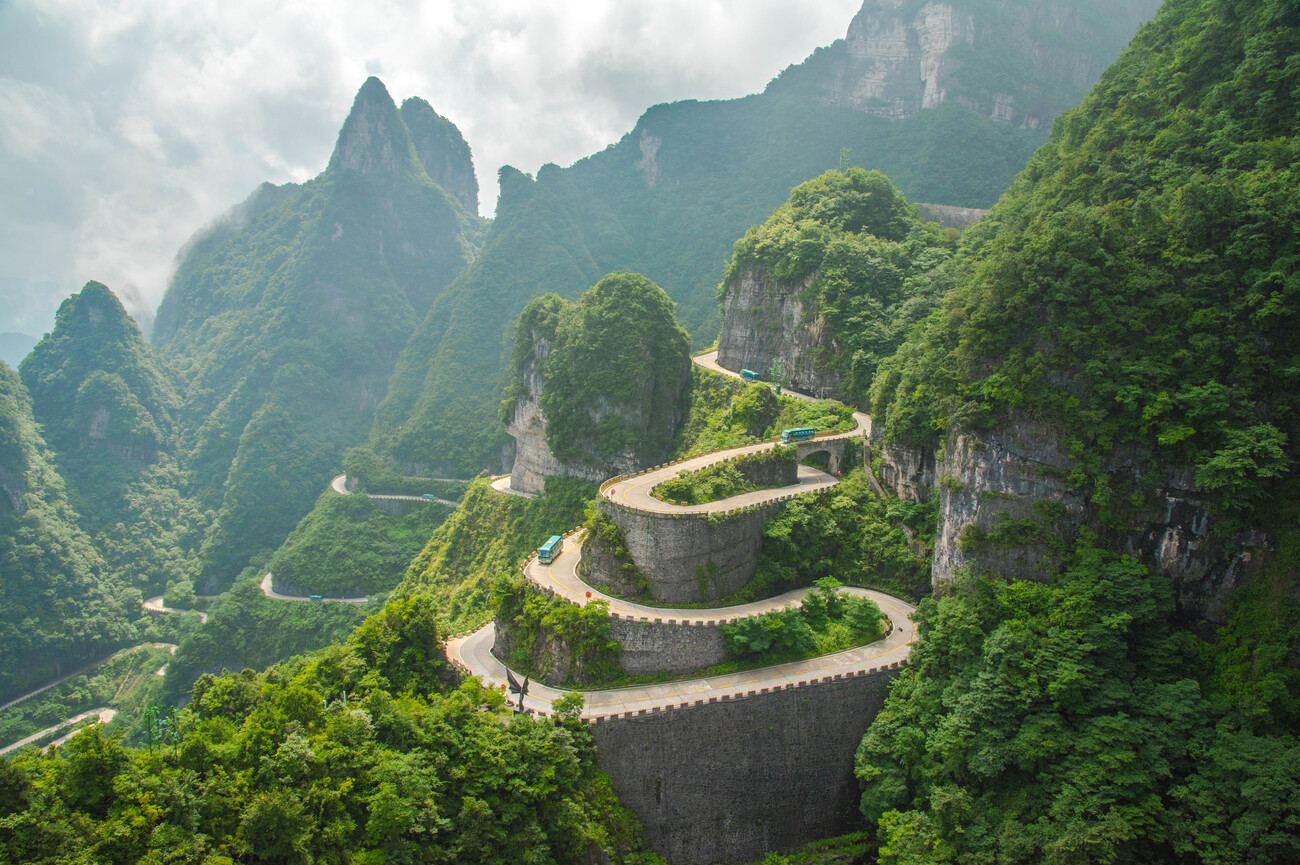
Tongtian Avenue is one of Tianmen Mountain's great visual set pieces. The road climbs from the valley towards Tianmen Cave over 10.77 kilometres, rising from around 200 metres to approximately 1,300 metres above sea level through 99 hairpin turns.
The number is symbolic as well as dramatic. In Chinese cosmology, nine is associated with heaven, longevity and imperial power, making the 99 turns part of the mountain's ceremonial language as much as its engineering.
Seen from above, the road appears almost impossible: a sequence of switchbacks cut into the mountainside, with shuttle buses moving across different levels of the cliff face. The drive itself takes around 25 minutes, but the visual impression lasts longer. It is the human-built counterpart to the natural drama of Tianmen Cave above it.
For travellers who want to approach the cave from below, the 99-bend road is especially rewarding. It delivers visitors to the lower entrance, from where the 999 steps rise towards the arch. This sequence, road first, then steps, then cave, gives the mountain a stronger sense of ascent than arriving from the summit alone.
Important operational note: access arrangements for Tianmen Mountain can change due to cable car maintenance, weather and seasonal conditions. The 99-bend road, shuttle system and express cable car are often used together to manage the route between the valley, Tianmen Cave and the summit. Current access should always be checked before travel.
What
Separates Tianmen From the Forest Park
The national forest park, 8 kilometres to the north, is defined by thousands of sandstone pillars rising from forested valleys, with cloud seas gathering around the Yuanjiajie plateau and Tianzi Mountain viewpoints. Tianmen Mountain is different: one dramatic peak, a vast natural arch, cliff-edge glass walkways, the 99-bend road and a summit temple with centuries of religious significance.
They do not compete with one another. They need separate days. Zhangjiajie National Forest Park is a landscape to move through slowly, with different zones revealing the pillars from above, below and within. Tianmen Mountain is a single mountain with a carefully sequenced day of ascent, exposure, pilgrimage and descent.
The Avatar connection belongs to the national forest park, especially the Yuanjiajie area and its floating pillar landscape. That story, and what the park offers beyond the film association, is explored in our dedicated guide to Avatar and Zhangjiajie.
Both landscapes belong in the same journey, but neither substitutes for the other. Our Zhangjiajie and the Floating Forests guide explains how the full route brings Beijing, Zhangjiajie National Forest Park, Tianmen Mountain and Shanghai together.
Practical
Notes
- Tianmen Mountain Cableway: The full cableway route is one of Tianmen Mountain's signature experiences, but access can change due to maintenance, weather or seasonal operations. Current routing should be checked before travel.
- The 99-Bend Road: Shuttle buses use Tongtian Avenue to reach the lower Tianmen Cave entrance. The journey takes around 25 minutes and includes sharp bends, so travellers prone to motion sensitivity should prepare accordingly.
- The 999 Steps: The steps between Tianmen Cave and the summit are steep and can be smooth in places. The route is not recommended for travellers with limited mobility.
- Glass Walkway: Shoe covers are usually provided at the entrance. The walkway may close during heavy rain, ice, snow or poor weather. Morning visits are often best before summit conditions change.
- Tianmen Mountain Temple: This is an active religious site. Visitors should dress respectfully and allow time to experience the temple at a slower pace after the cliff paths and glass walkways.
- Tickets and Access: Ticket types, routes and transport combinations can vary, so the best option should be confirmed close to travel.
The
Gate Has Been Open Since 263 AD
The mountain opened itself to the sky in 263 AD. Pilgrims reached the arch within living memory of that year. More than 1,700 years later, visitors now stand on glass walkways above the same valleys those early pilgrims crossed on foot.
That contrast defines Tianmen Mountain. On the same day, you can climb or descend the 999 steps to Heaven's Gate, walk along a cliff-edge glass walkway
at 1,430 metres, and enter a summit temple where incense still burns. The mountain moves between ancient and vertiginous, sacred and exposed, without ever feeling divided.
The Ghost Valley Plank Road brings you back towards the summit plateau after the glass walkway. Before the last overhang clears, the atmosphere begins to change again. Temple incense, mountain air and the sound of the plateau replace the exposed silence of the cliff edge.
Some days in travel are worth flying across the world for.


Let us know what you love, where you want to go, and we’ll design a one-of-a-kind adventure you’ll never forget.
Get in touch
Miriam
Travel Specialist

Nina
Travel Specialist

Abigail
Travel Specialist
Our offices:



Revigorate, Iberian Escapes and Algarve Lifestyle are the registered brand names of APCS Lda . We are a fully authorised travel agency licensed by Turismo de Portugal RNAVT/6867.
In the event of a dispute, the consumer may refer to: RAL - Centros de Arbitragem
Avª. 5 de Outubro, nº. 55, R/C Dtº. 8000-075 Faro, Portugal | Tel: +351 289 823 135 *
* national landline call
E-mail: info@consumoalgarve.pt| www.consumidoronline.pt | Mon to Fri: 9:00 - 13:00 / 14:00 - 17:00