Northern Spain by FEVE Narrow-Gauge Train: Bilbao to Santiago
Northern Spain’s narrow-gauge railway offers one of the slowest and most rewarding ways to explore Green Spain. The route runs from Bilbao through Cantabria and Asturias to Ferrol in Galicia, linking fishing towns, beaches, green valleys and historic cities before the journey continues to Santiago de Compostela.
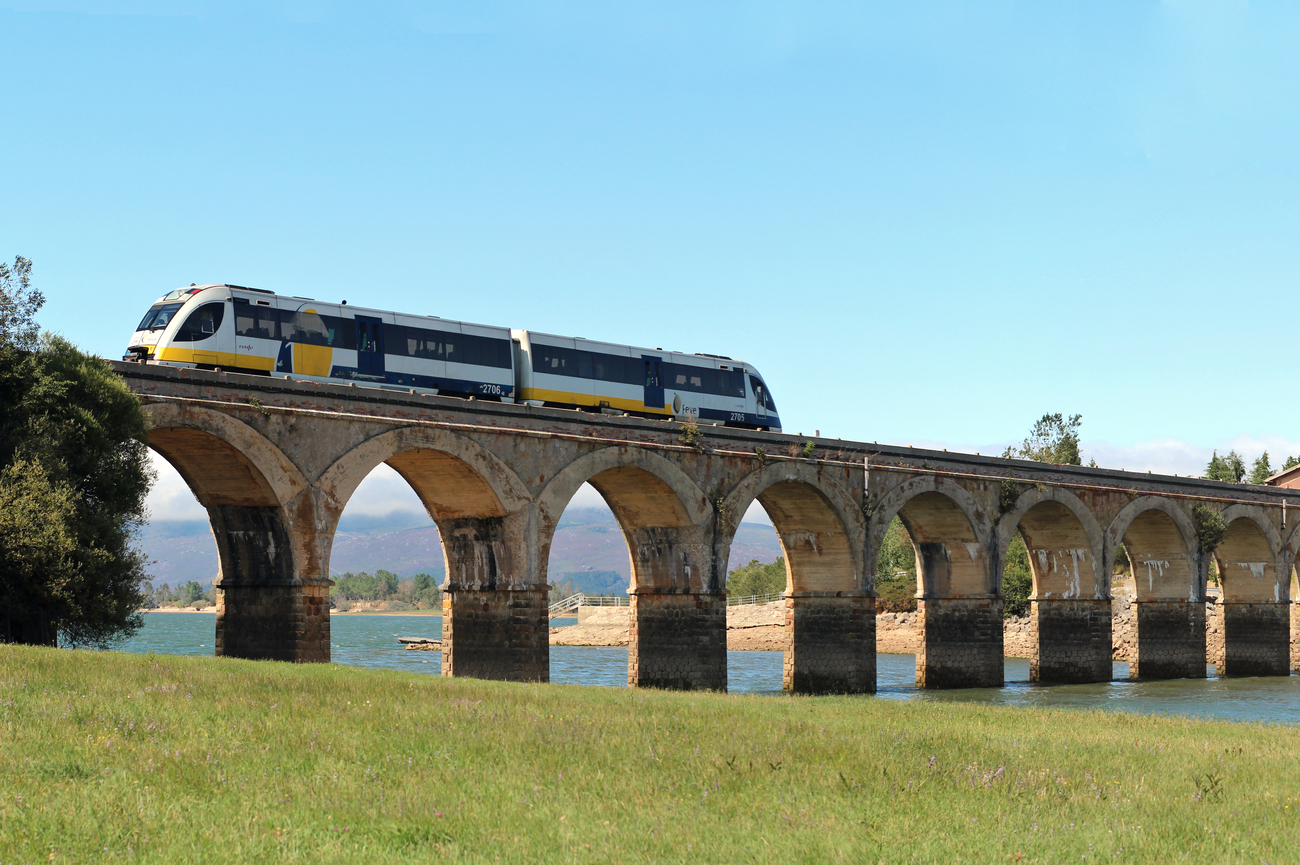
Still widely known as the FEVE railway, the former FEVE network now forms part of Renfe’s metric-gauge services. Its local trains travel at an unhurried pace through landscapes that faster routes often bypass, making the railway itself part of the experience rather than simply a way of getting from one city to another.
Somewhere west of Santander, the train may slow beside a tiny level crossing, a handful of houses and a passenger stepping onto the gravel with their shopping. Moments later, the landscape opens towards the Bay of Biscay before the railway turns inland again through the green countryside.
Nobody on board considers this remarkable. Here, it is simply how the railway works.
This nine-night journey follows the narrow-gauge route from Bilbao to Ferrol through the Basque Country, Cantabria, Asturias and Galicia, before continuing by train to Santiago de Compostela. Along the way are seaside towns, fishing communities and historic cities that many international visitors pass without seeing.
Our Exploring Northern Spain by Narrow-Gauge Railway journey follows the route one destination at a time, with rail travel and accommodation arranged before you arrive. Each stop includes time to explore independently, follow our recommendations or simply discover the town at your own pace.
A
Local Train Along the Bay of Biscay
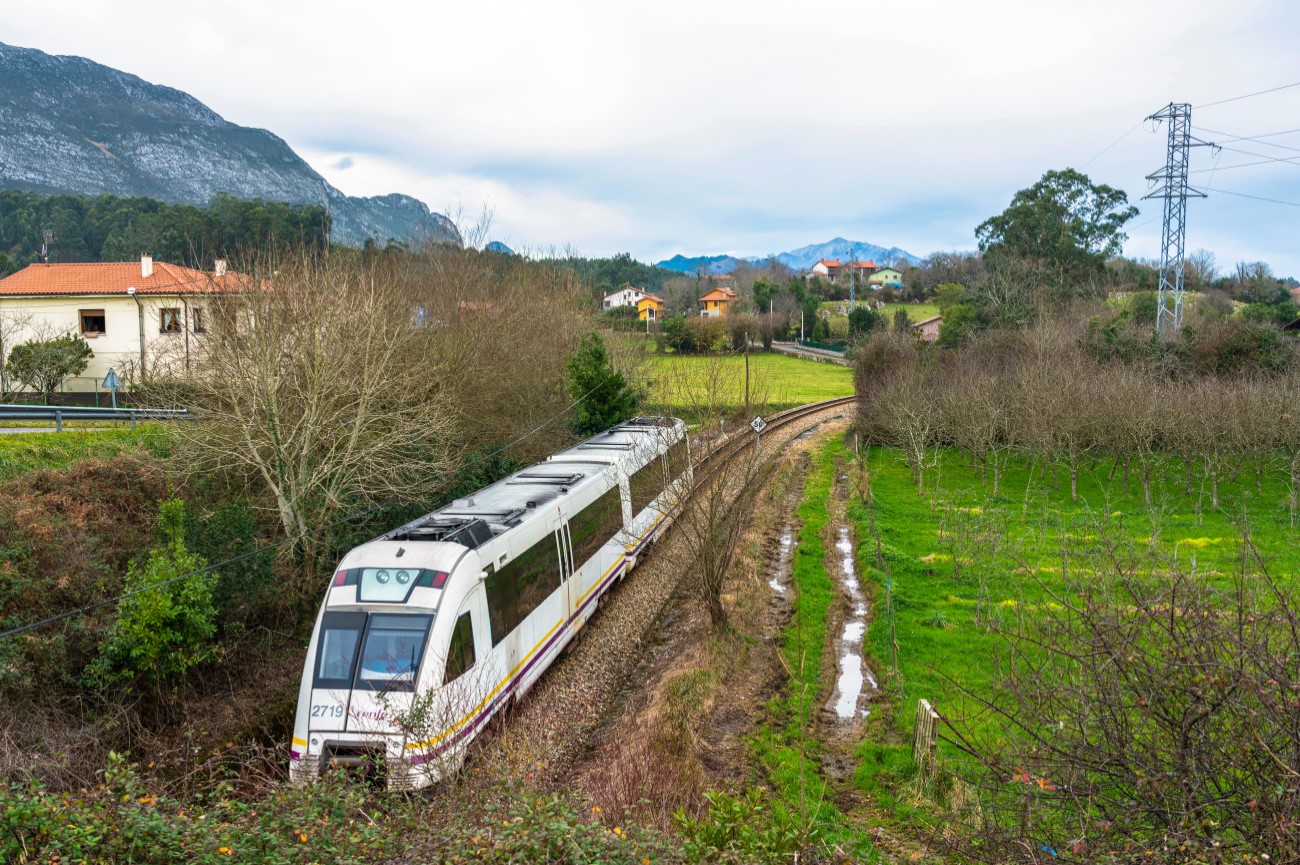
The FEVE railway is not a luxury sightseeing train. It is a working local railway used by commuters, schoolchildren and residents travelling between the towns and villages of northern Spain. Its small narrow-gauge trains cross Cantabria, Asturias and Galicia, passing through inland valleys, rural communities and occasional stretches of coastal scenery that Spain’s faster mainline services leave behind.
The first thing to understand about this railway is its size. The track is narrower than the mainline gauge used by Spain’s high-speed trains, and that single fact shapes the entire journey. A narrow-gauge line can take tighter bends, cling more closely to the coast and slip through places that a full-sized railway would have to bypass, tunnel beneath or ignore altogether.
Instead of the polished blur of the AVE, you get a train that threads through the landscape itself: crossing the mouths of rías where the tide is retreating and the mud shines, passing stone hórreos raised above the ground to keep their grain dry, and moving through eucalyptus woodland that perfumes the carriage when the windows are open.
This is España Verde, Green Spain, and it is green for an honest reason. The Atlantic sends its weather directly into these hills, and the rain that greys an afternoon in Asturias is the same rain that gives the valleys their deep, saturated colour. Cows graze on slopes that tilt towards the sea. Slate roofs darken with damp. When the sun breaks through, as it often does, the light returns sharp and washed clean, and the water changes from pewter to a blue that startles you.
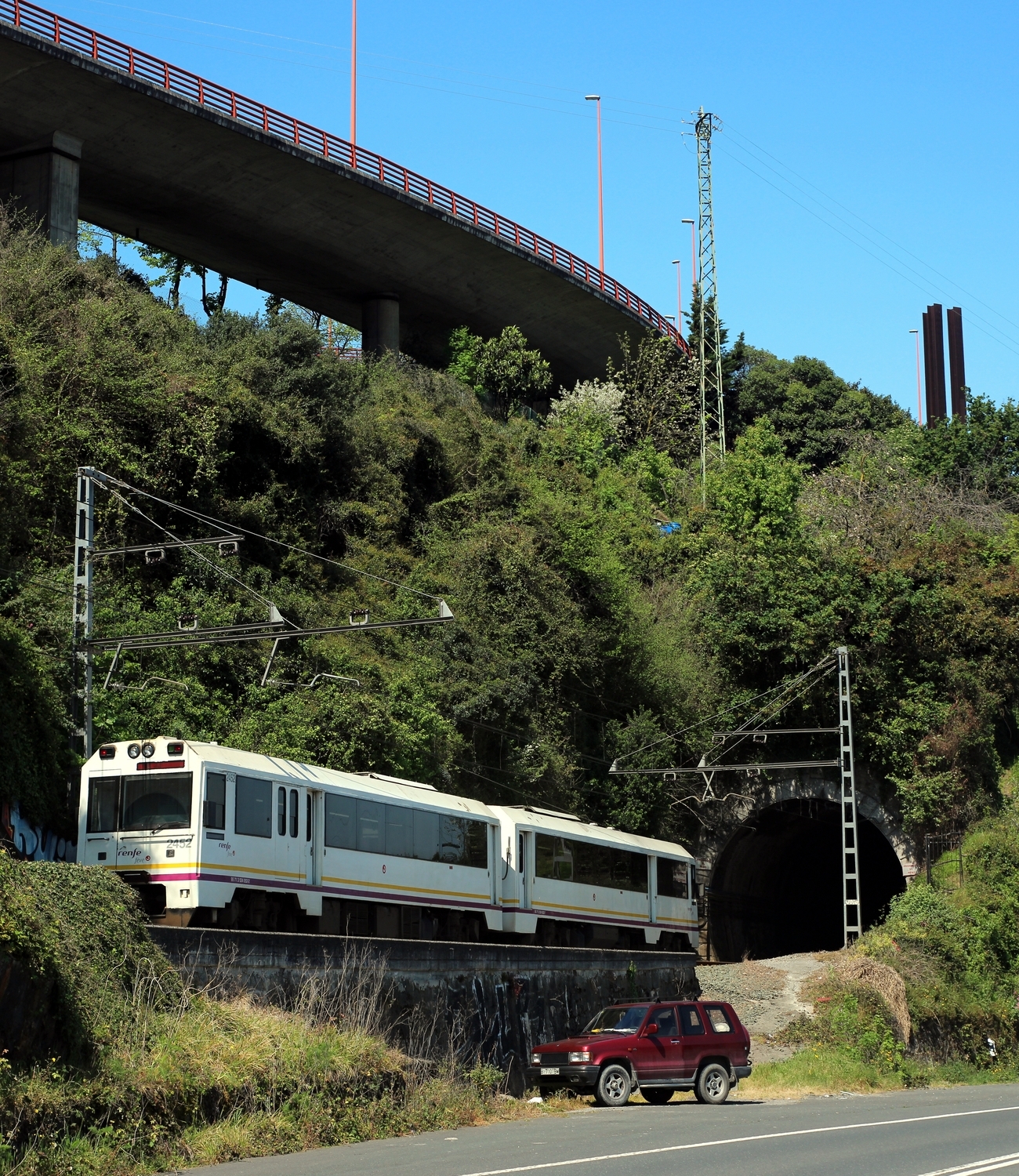
The carriages themselves are small and unpretentious, and that is a large part of the pleasure. At some of the smaller halts, the train stops only when someone wants to board or leave, and you soon learn to watch for villages where a single figure is waiting with a bag of shopping.
The conductor knows the regular passengers by name. Schoolchildren pile on at one station and disappear at the next. A farmer settles across from you with a crate beneath a cloth and nods once.
Because the train travels slowly and close to the ground, you see all of it: washing lines and vegetable plots, fishing boats drawn up beside the water and men repairing nets along the harbour wall. This is the ordinary business of a coast that fast roads and high-speed trains reduce to a green blur.
You are not simply watching northern Spain through glass. You are moving through it at the speed at which it actually lives.
It also helps to remember that this is not the version of Spain most commonly sold abroad. There are no flat golden plains here, little of the intense heat associated with the south and few of the familiar images found in traditional brochures.
Northern Spain looks and feels Atlantic, closer in spirit to Brittany or the west of Ireland than to Seville: a place of rain, rock and deep green, of bagpipes in Asturias and Galicia, grey seas that turn silver within an hour, and villages that have watched those seas for a thousand years.
Travellers who know only southern Spain are often caught off guard by it. The narrow-gauge railway is the gentlest way to allow that surprise to arrive gradually, one valley and estuary at a time.
The journey begins in Bilbao, where the titanium curves of the Guggenheim Museum and the city’s crowded pintxos counters set a high bar for the days ahead. We explore the wider region in our journey through the Basque Country, while the narrow-gauge railway carries us west from Bilbao towards the open coast.
From here, the FEVE line becomes the thread connecting the entire journey, and the map of northern Spain begins to reorganise itself around a slower centre of gravity.
The
Railway You Cannot Book Like a Normal Train
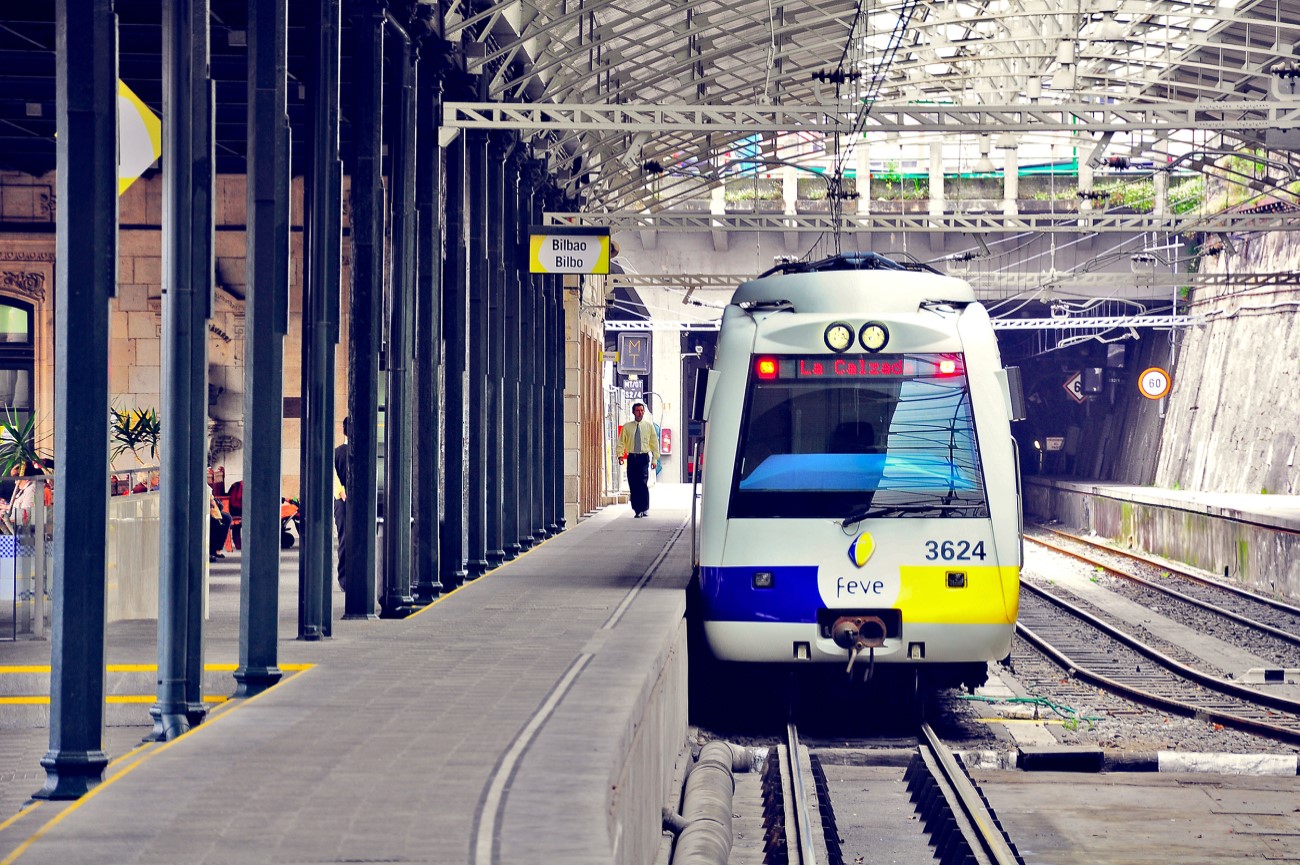
Here is the part that turns a beautiful idea into a genuinely difficult journey to organise. Renfe now operates the former FEVE network through a combination of Cercanías AM and Media Distancia narrow-gauge services. AM stands for Ancho Métrico, or metric gauge. The trains still run and the route is largely unchanged, but the rebrand did little to make the railway easier for international travellers to understand.
It does not appear as one continuous coastal journey from Bilbao towards Galicia. Instead, the route is divided across different regional services, with separate information for Bilbao, Cantabria, Asturias and Ferrol. The international booking sites most travellers open first do not sell these local coastal trains, and the journey cannot be planned or reserved in the same straightforward way as an AVE or other long-distance service.
There is no simple system of assigned seats that lets you book the entire route from home in a single transaction. Travellers need to understand which local services form part of the former FEVE network, where the changes take place and how the individual sections fit together.
What that means in practice is that one of the most charming rail journeys in Spain is also one of the hardest to assemble independently. A nine-night route lives or dies on its connections. One service misunderstood, one change overlooked or one hotel booked in the wrong sequence, and the careful progression of harbours, beaches and historic towns begins to come apart.
This is precisely the point at which many travellers abandon the railway and return to the rental car and the fast road. It is also the difficulty we remove.
On our Northern Spain by Narrow-Gauge Railway journey, the route, connections, accommodation and timing are handled entirely on your behalf. You are never asked to decode the network. You are only asked to board and enjoy the changing landscapes while the practical details are handled for you.
The
Shape of a Day on the Coast
The days on this line settle into a rhythm your body recognises within about forty-eight hours and then does not want to give up. Journey times vary considerably. Some stages are relatively short, while others take several hours as the trains follow indirect routes and stop frequently in small towns and villages.
By the time you have found your seat and the sea has appeared again through the window, it is almost time to arrive somewhere new.
That leaves the afternoons whole, and the afternoons are where the coast gets under your skin. There is time to climb to a castle and still come down for a long lunch. Time to sit in a market while a woman weighs percebes at the counter and tells you, without being asked, which ones are worth having. Time to walk along a beach until the town is a smudge behind you and then walk all the way back.
In northern Spain, the light does half the work of the holiday. It comes and goes with the weather, so that an ordinary square can become extraordinary in the ten minutes it takes a single cloud to cross the sun, and you find yourself stopping mid-sentence to watch it happen.
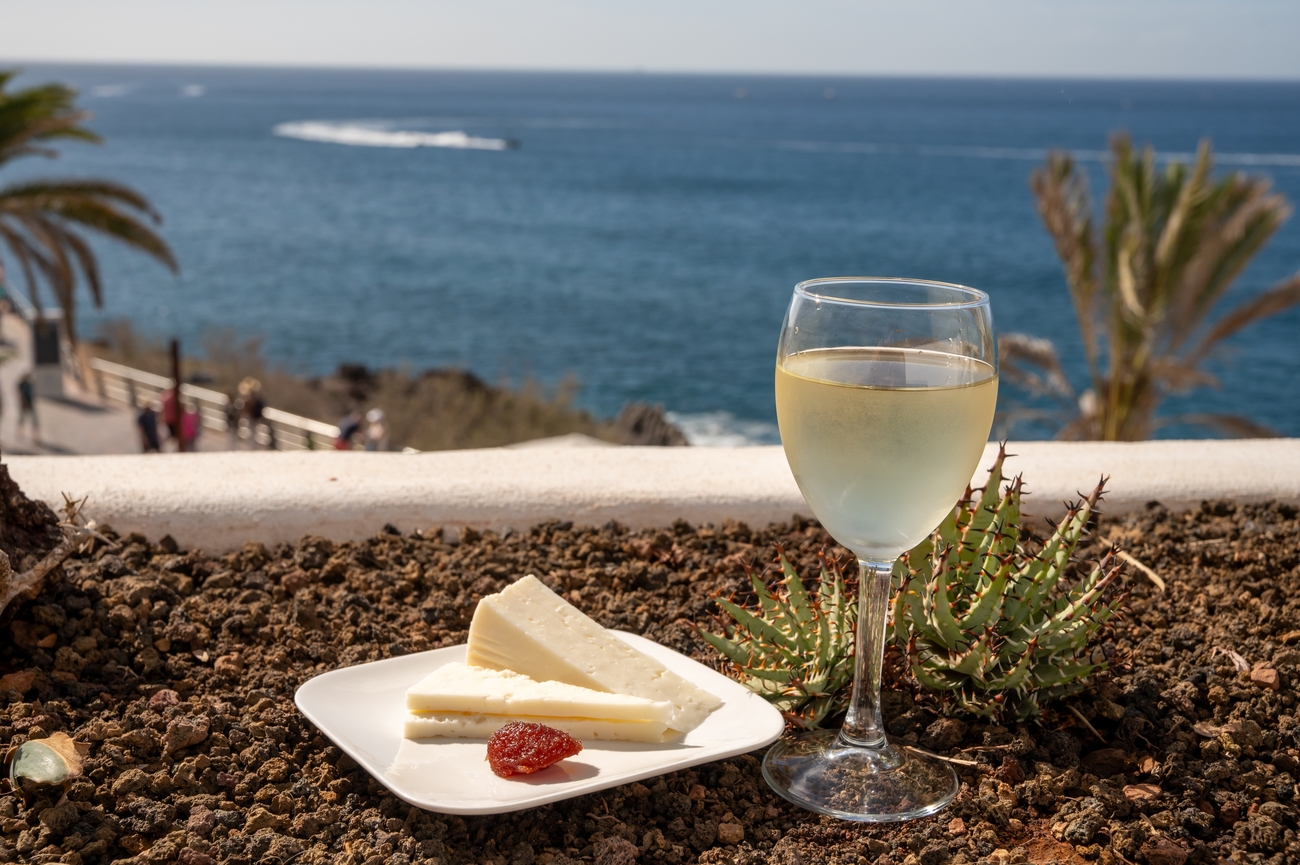
Evenings belong to the table and the street. In Cantabria, it is grilled fish and a cold, mineral white wine. In Asturias, it is a sidrería loud with the sound of cider being poured and plates of Cabrales cheese sharp enough to make you sit up straighter. In Galicia, it is an octopus stall and the smell of hot oil and pimentón drifting across a granite square.
Nowhere are you hurried towards the next thing, because there is no next thing until morning.
This is the quiet genius of crossing the coast by slow train. It gives you back the one luxury the modern holiday keeps quietly taking away: time that belongs entirely to you.
Cantabria:
Santander's Bay and the Harbours the Line Was Made For
Cantabria is the first region where the narrow-gauge railway reveals how closely northern Spain’s towns, estuaries and mountains are connected to the sea.
Its capital, Santander, curves around one of the great natural bays of Spain’s northern coast. The city’s grandest building occupies a peninsula of its own: the Palacio de la Magdalena, constructed in the early twentieth century as a summer residence for the Spanish royal family, with the sea on three sides and gardens where the city comes to walk on Sundays.
A short distance along the waterfront stands the Centro Botín, Renzo Piano’s contemporary art centre, appearing to hover above the harbour on slender supports. It is a piece of the present set gently against Santander’s Belle Époque architecture.
Much of the city centre was destroyed by fire in 1941, so the old town you walk through today feels younger and more compact than Santander’s long history suggests. It gathers around the cathedral and extends into streets filled with tapas bars. Order chorizo a la sidra, sausage cooked in cider until the sauce becomes dark and sweet, and allow the afternoon to stretch.
By evening, the city drifts towards El Sardinero, the broad sweep of beach beneath the old casino, for the paseo: a slow waterfront walk that is less exercise than ritual.
Santander has always faced the water, and the water rewards it. Ferries and fishing boats cross the bay, the Magdalena gardens descend towards small hidden coves, and on clear evenings the far shore takes on the colour of ripe peach. It is a city that asks for little more strenuous than a long walk and an even longer dinner, which is precisely the register of the journey as a whole.
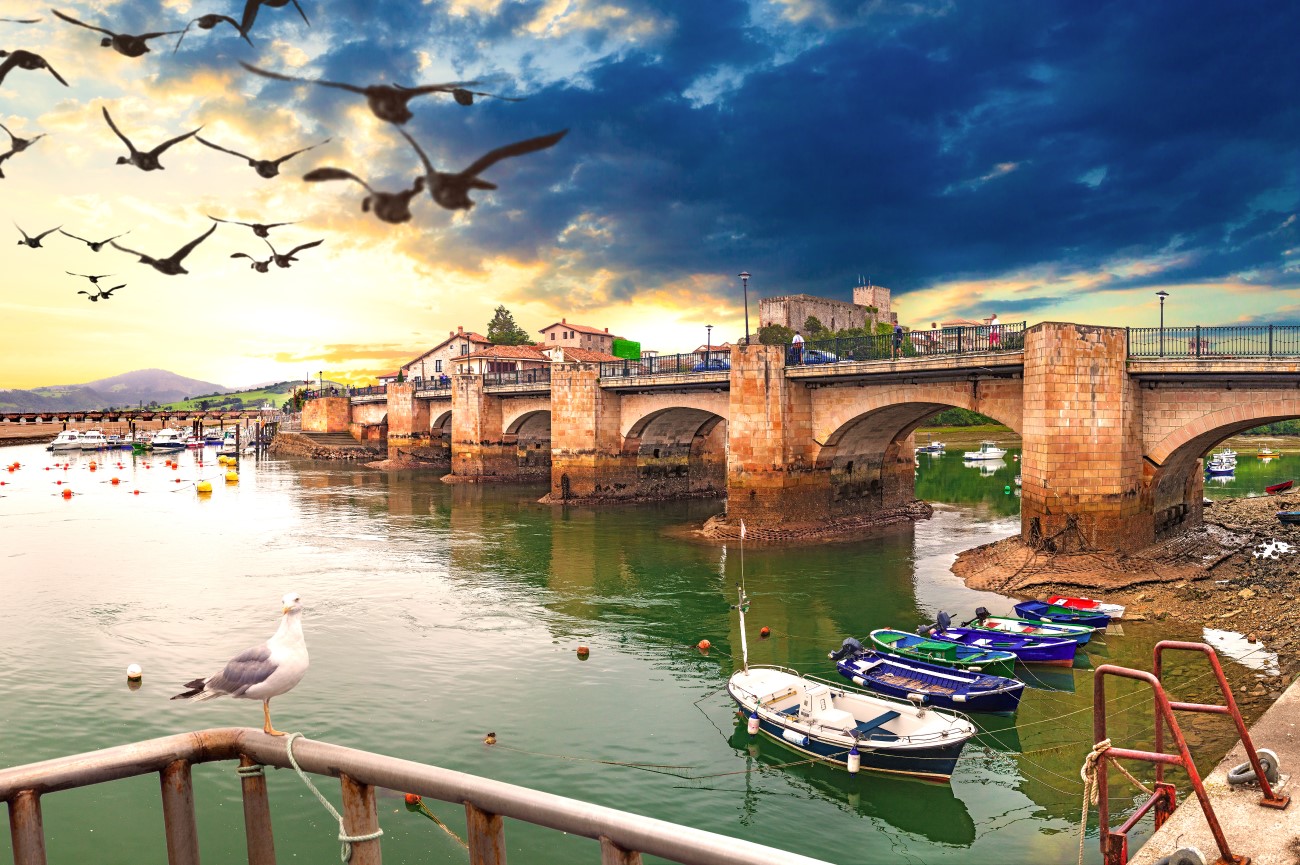
West of Santander, the railway reaches San Vicente de la Barquera, and this is where the line earns its reputation.
The town occupies an estuary crossed by a long medieval bridge, while its historic quarter climbs towards a thirteenth-century castle and a Gothic church. Behind it all, close enough to resemble a painted backdrop, rise the peaks of the Picos de Europa.
The fishing fleet still works from the harbour. When the boats return at dusk, the water turns copper and the mountains hold the final light of the day. At that moment, you understand why arriving at the right hour can matter more here than arriving in the right season.
There is an entire coastline of these harbours, and we explore it in greater depth in our guide to Santander and San Vicente de la Barquera , for travellers who want to linger over Cantabria before the railway continues west.
Behind the coast, the Picos de Europa rise so abruptly that the mountains feel like part of the shoreline rather than a separate landscape. On clear evenings, their limestone faces turn rose above San Vicente. For travellers who want to exchange the sea for the heights for a day, the mountain roads and glacial lakes of Covadonga can be incorporated into the wider journey.
Even when seen only from the carriage window, the peaks give the Cantabrian section its drama: sea on one side and mountains on the other, often held within the same frame.
Between Santander and San Vicente, the train pauses at Torrelavega, an old market town associated with merchant houses and regional trade. The essential stop is a bakery for a corbata, the almond-and-puff-pastry sweet Cantabria is quietly proud of, eaten warm before the next short journey west.
Asturias:
Ninth-Century Stone and the Long Pour of Cider
Cross into Asturias and the railway first reaches Ribadesella, an estuary town at the mouth of the River Sella where the sidrerías face the water.
Each August, the river hosts the Descenso Internacional del Sella, the famous canoe race from Arriondas to Ribadesella that turns the valley into one long festival. It is traditionally held on the first Saturday after 2 August.
Near the town lies the Cueva de Tito Bustillo, whose walls carry Palaeolithic art created more than ten thousand years ago. The cave forms part of the UNESCO-listed Cave of Altamira and Palaeolithic Cave Art of Northern Spain. Travellers wishing to visit should check opening dates and reserve in advance, as access is limited.
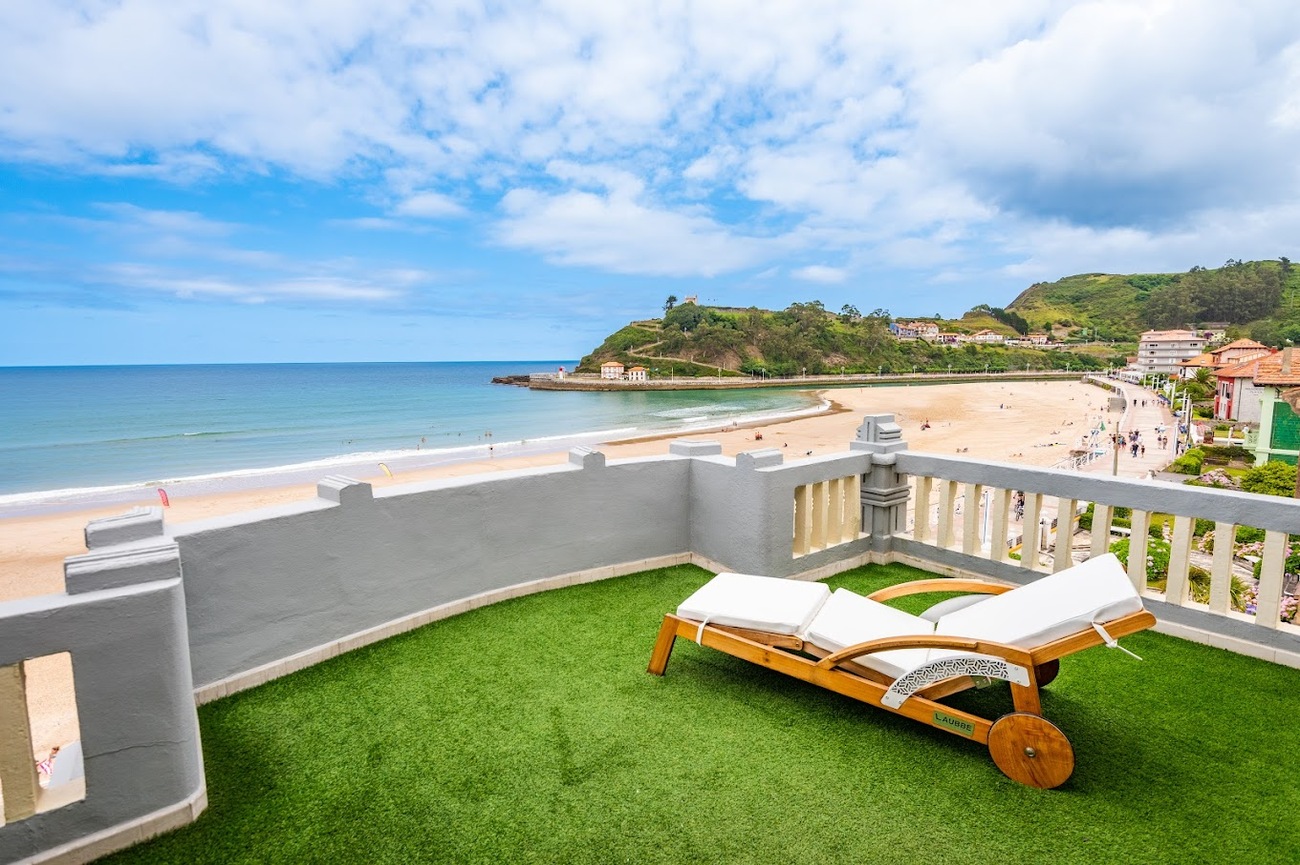
In Ribadesella, you stay in a seafront palacete built at the beginning of the twentieth century, overlooking the Bay of Biscay. The town offers time to walk beside the River Sella, visit a traditional cider house and experience the coastal side of Asturian culture.
From Ribadesella, the railway turns inland towards Oviedo, the regional capital and a city with a remarkable collection of architecture predating the Romanesque period.
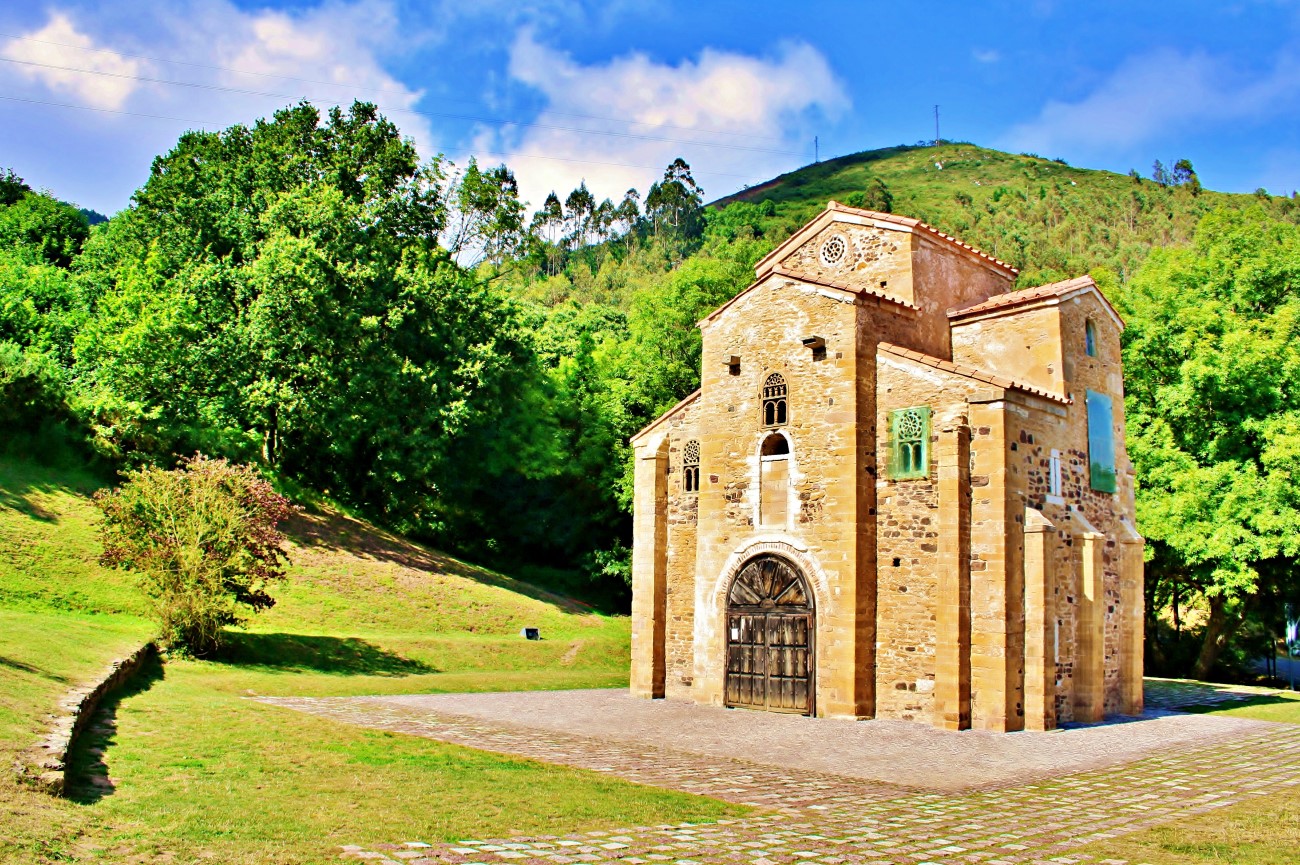
On the green slopes of Monte Naranco above the city stand two small, astonishing buildings, Santa María del Naranco and San Miguel de Lillo, built in the ninth century under King Ramiro I, when Asturias was a mountain kingdom resisting the forces controlling much of the Iberian Peninsula.
Santa María del Naranco began as a royal palace and was later converted into a church, while San Miguel de Lillo was built as a place of worship. Both form part of the UNESCO-listed Monuments of Oviedo and the Kingdom of Asturias. Standing beneath the tall, narrow arches of the Naranco, you feel the age of the place before a guidebook can fully explain it.
In the city centre, the Cathedral of San Salvador guards the Cámara Santa, which forms part of the same UNESCO World Heritage designation. Inside are the Cross of the Angels and the Victory Cross, twin emblems seen everywhere from the regional flag to the city’s manhole covers.
Oviedo is also associated with the beginning of the Camino Primitivo, the oldest of the recognised pilgrimage routes to Santiago de Compostela. According to tradition, King Alfonso II followed the route in the ninth century after travelling from Oviedo to the newly discovered tomb of Saint James.
The city knows its own worth and shows it. Its polished streets are scattered with sculptures, including a bronze of Woody Allen, who admired the city, and another of Ana Ozores, the heroine of La Regenta. This great nineteenth-century novel placed a fictionalised Oviedo at the centre of Spanish literature under the name Vetusta.
The old town is made for walking: polished stone, glass-fronted balconies and quiet civic grandeur, reflecting a place that has spent more than a thousand years as a centre of Asturian history.
Come evening, follow the noise to Calle Gascona, known locally as the Cider Boulevard, where sidrerías line the street and waiters pour Asturian cider in the traditional way, holding the bottle high above the head and the glass low at the hip so the sidra strikes the rim, aerates and comes to life.
Order a bowl of fabada while you are there, the rich stew of white beans, pork and smoked sausage that is Asturias rendered on a spoon, and you begin to understand why this green, rainy region cooks the way it does.
We give both destinations their proper time in our fuller guide to Oviedo and Ribadesella, the mountain capital and the cider coast.
Into
Galicia, Where the Atlantic Built a Cathedral
The final coastal stretch carries you across the Eo estuary into Galicia, and the change is immediate. The light softens, the place names turn Galician and the sea grows wilder.
The border town of Ribadeo made much of its wealth through emigrants who sailed to the Americas and returned prosperous, building the evidence into its streets. Their indiano mansions are ornate and confident, with the Torre de los Moreno rising above the main square as the grandest of them all.
At the mouth of the ría, the small lighthouse island of Illa Pancha keeps watch over the coast. Nearby, in the tiny fishing village of Rinlo, you can sit down to arroz con bogavante, the lobster rice people travel a considerable distance to eat.
A few kilometres farther along the shore lies the sight that draws most visitors to this corner of Spain, and rightly so.
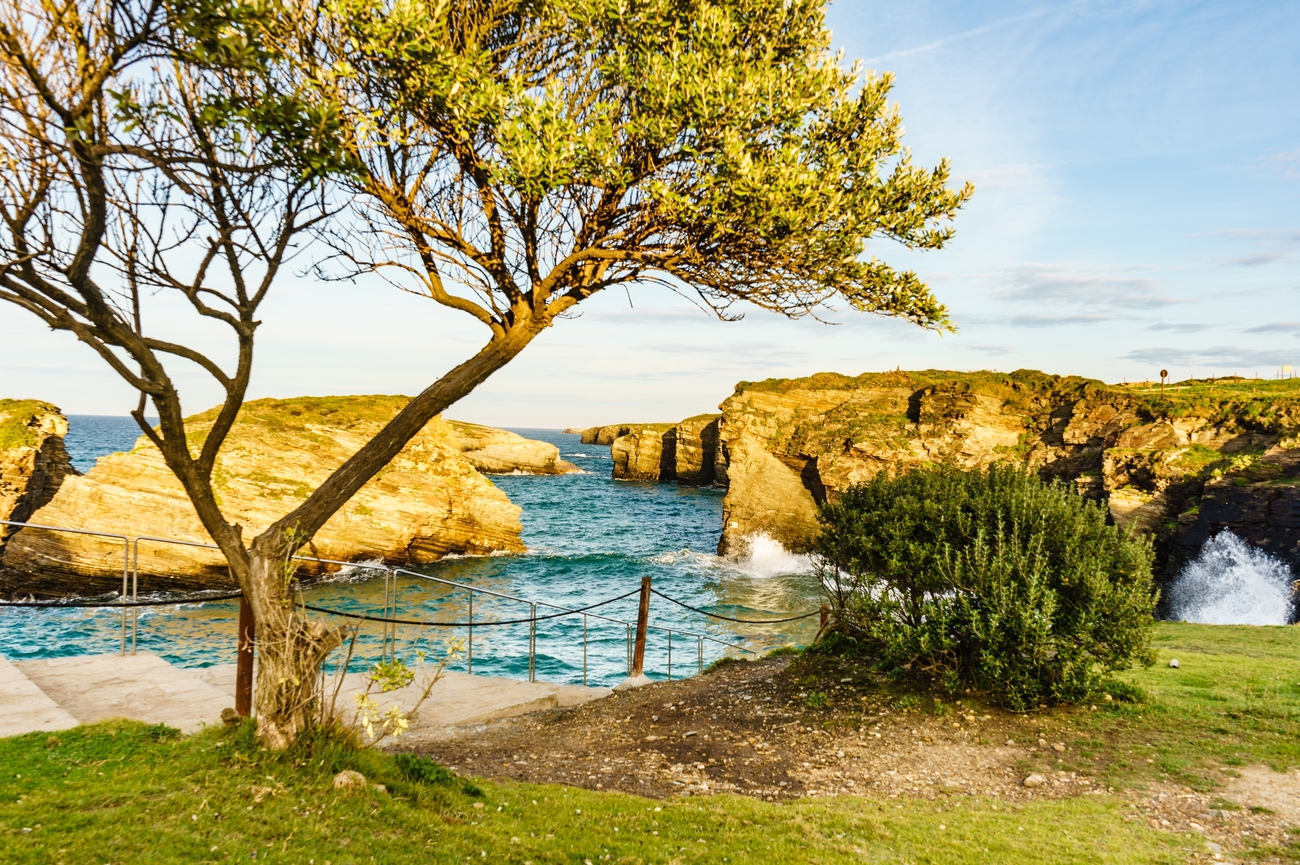
Praia das Catedrais, the Beach of the Cathedrals, is a stretch of coast where the Atlantic has carved the cliffs into soaring arches, buttresses and long, echoing corridors of stone. At high tide, much of it is simply a cove beneath the cliffs. At low tide, the sea retreats and reveals a cathedral you can walk through.
Light falls green and gold between the arches. The rock glows where the sun catches it, dark ropes of seaweed cling to the lower stone, and the surf reaches you softened, as though heard through the walls of a real cathedral.
People go quiet without deciding to.
The beach is protected, and rightly so. During Holy Week and from 1 July to 30 September, advance authorisation is required to access it. The visit must also be planned around the tide, because the great arches and corridors can only be explored safely when the water has withdrawn.
Left to chance, this is where a self-planned journey can easily stumble: a carefully arranged visit made at the wrong hour, when the Atlantic has covered the very landscape you came to see.
Travellers wishing to visit should reserve access where required and consult the tide times in advance, as the beach’s celebrated arches can only be explored safely at low tide. We explore the practicalities and the wider coastline in our guide to Praia das Catedrais, Ribadeo and Ferrol.
The narrow-gauge railway ends at Ferrol, a city the sea created and the navy shaped. In the eighteenth century, the Spanish Crown established one of Europe’s great naval arsenals here and laid out the Barrio de la Magdalena beside it on a strict Enlightenment grid, an unusually ordered and handsome piece of urban planning.
The Castillo de San Felipe still guards the narrow entrance to the ría, and from the headland at Cabo Prior, the Atlantic runs uninterrupted to the horizon.
Galicia carries different weather in its bones, softer, wetter and somehow older. You feel it in the granite crosses beside the road, the woodsmoke in the air and the way the Atlantic appears to lean its full weight against the land.
This was once the edge of the known world, the coast beyond which the medieval imagination saw only water and the setting sun. To reach it slowly, aboard a small train crossing the landscapes of northern Spain, is to feel something of the pull that drew pilgrims across an entire continent long before there was a modern road.
Here, the narrow-gauge section of the journey ends.
From Ferrol, the journey continues by conventional train towards its final destination, Santiago de Compostela, the end of the pilgrim roads and the beginning of a Galician feast explored more fully in our Galician gastronomy journey.
The cathedral, the seafood and the Albariño belong to the end of this railway journey and the beginning of another story. On certain religious occasions, visitors may also see the cathedral’s famous Botafumeiro swinging beneath the vaults.
Nine
Nights, and the Luxury of Not Hurrying
This nine-night journey combines a varied collection of well-located hotels and guesthouses with rail journeys of differing lengths and the freedom to experience northern Spain without planning every connection yourself.
A journey like this is only as good as the places where you close your eyes at night, and northern Spain has kept some fine ones. You begin in Bilbao at Hotel Carlton, a landmark of old-world grandeur in the centre of the city. In Santander, Hotel Bahía places you close to the waterfront and the historic centre. In Ribadesella, you stay in a seafront palacete from the beginning of the twentieth century, one of the most characterful properties on the route.
The journey also includes an intimate room in Torrelavega, a centrally located guesthouse in San Vicente de la Barquera and a peaceful country-style stay near Ribadeo. In Oviedo, your hotel is conveniently positioned near the railway station, while your central accommodation in Ferrol provides a practical base for exploring the city.
In Santiago de Compostela, the journey ends at an elegant boutique hotel only steps from the cathedral, close enough to hear the bells sounding across the old town.
What ties it all together is the planning you do not need to handle yourself.
Across nine nights and a succession of different hotels, the rail itinerary, accommodation and connections are arranged in advance. Journey times vary from short local stages to longer sections lasting several hours, but each one carries you towards another distinctive part of northern Spain.
This is the real luxury of travelling through northern Spain by narrow-gauge railway: not marble and gold, but the freedom to give your full attention to a fishing harbour at dusk because someone else has already studied the timetable.
By the final morning, something will have shifted in you. You will have stopped reaching for your phone to check how long the next journey takes because it no longer seems to matter. You will have learned to trust that the day will unfold, that lunch will be somewhere good and that the light will do something worth stopping for.
That trust is what people carry home from this journey, more durable than any photograph.
The route suits travellers who would rather experience one green corner of Europe deeply than rush through several, who read the word slow as a promise rather than a warning, and who understand that one of the finest things a holiday can offer is permission to stop rushing.
If that sounds like you, our Exploring Northern Spain by Narrow-Gauge Railway journey was created for you.
Let
the Coast Keep Its Secret, We Will Show You In.
A railway that barely appears on the maps most travellers use. Local trains that cannot be booked like ordinary long-distance services. A beach the Atlantic reveals for only a few hours and a coastline the fast roads were built to bypass.
The very things that make this journey difficult to organise are also what have kept it so beautifully overlooked.
Those difficulties disappear when the planning becomes ours instead of yours. What remains is the part you came for: the sea through the carriage window, eucalyptus in the air, fishing harbours at dusk, cider poured from a height and nine unhurried nights along the greenest coast in Spain.
Travellers returning from this journey rarely begin by listing what they saw. They talk instead about how it felt to move so slowly through somewhere so alive, and how quickly they began wondering when they could return.
The train is waiting, and so is the coast.
Your Exploring Northern Spain by Narrow-Gauge Railway journey begins here.


Let us know what you love, where you want to go, and we’ll design a one-of-a-kind adventure you’ll never forget.
Get in touch
Miriam
Travel Specialist

Romina
Travel Specialist

Laura
Travel Specialist
Frequently Asked Questions
- Can you buy FEVE train tickets on the day of travel?
Tickets for local narrow-gauge services can generally be purchased at staffed stations or from available ticket machines. However, planning the complete route is more complicated because it involves several regional services and connections.
- Are the FEVE trains suitable for travellers with reduced mobility?
Accessibility varies between trains and stations, particularly at smaller rural stops. Travellers with reduced mobility should confirm the accessibility of every stage before departure and arrange assistance where necessary.
- Can you take large suitcases on the FEVE trains?
Luggage can be carried aboard, but storage space is more limited than on long-distance trains. Compact luggage is considerably easier to manage, especially when changing trains or using smaller stations.
- Do FEVE trains have toilets and refreshments?
Facilities vary according to the train and service. Travellers should not assume that every local train has toilets, refreshments or onboard catering, so it is sensible to use station facilities and purchase food and drinks before travelling.
- Is Wi-Fi available on the narrow-gauge trains?
Wi-Fi should not be expected on these local services, and mobile coverage may be inconsistent in mountainous or rural areas. Download tickets, maps and essential travel information before boarding.
- What is the best time of year for this railway journey?
Late spring and early autumn generally provide a good balance of mild weather and fewer visitors. Northern Spain remains wetter and cooler than much of the country, so waterproof clothing is advisable in every season.
- Is this journey suitable for children?
Yes, particularly for families comfortable with slower travel and regular hotel changes. Journey times vary considerably, with some relatively short connections and other stages lasting several hours.
- Can dietary requirements be accommodated along the route?
Most hotels and restaurants can accommodate common dietary requirements when informed in advance. Smaller towns may offer fewer choices, so allergies and strict dietary needs should be communicated before the journey.
- Can Revigorate organise the complete narrow-gauge railway journey?
Yes. Revigorate arranges the rail itinerary, accommodation and connections from Bilbao to Ferrol, followed by onward travel to Santiago de Compostela, leaving you free to explore each destination independently.
Our offices:



Revigorate, Iberian Escapes and Algarve Lifestyle are the registered brand names of APCS Lda . We are a fully authorised travel agency licensed by Turismo de Portugal RNAVT/6867.
In the event of a dispute, the consumer may refer to: RAL - Centros de Arbitragem
Avª. 5 de Outubro, nº. 55, R/C Dtº. 8000-075 Faro, Portugal | Tel: +351 289 823 135 *
* national landline call
E-mail: info@consumoalgarve.pt| www.consumidoronline.pt | Mon to Fri: 9:00 - 13:00 / 14:00 - 17:00