Guizhou Miao and Dong Villages: Living Traditions

At the entrance to some of Guizhou’s Miao villages, a bowl of rice wine may be offered before you take another step.
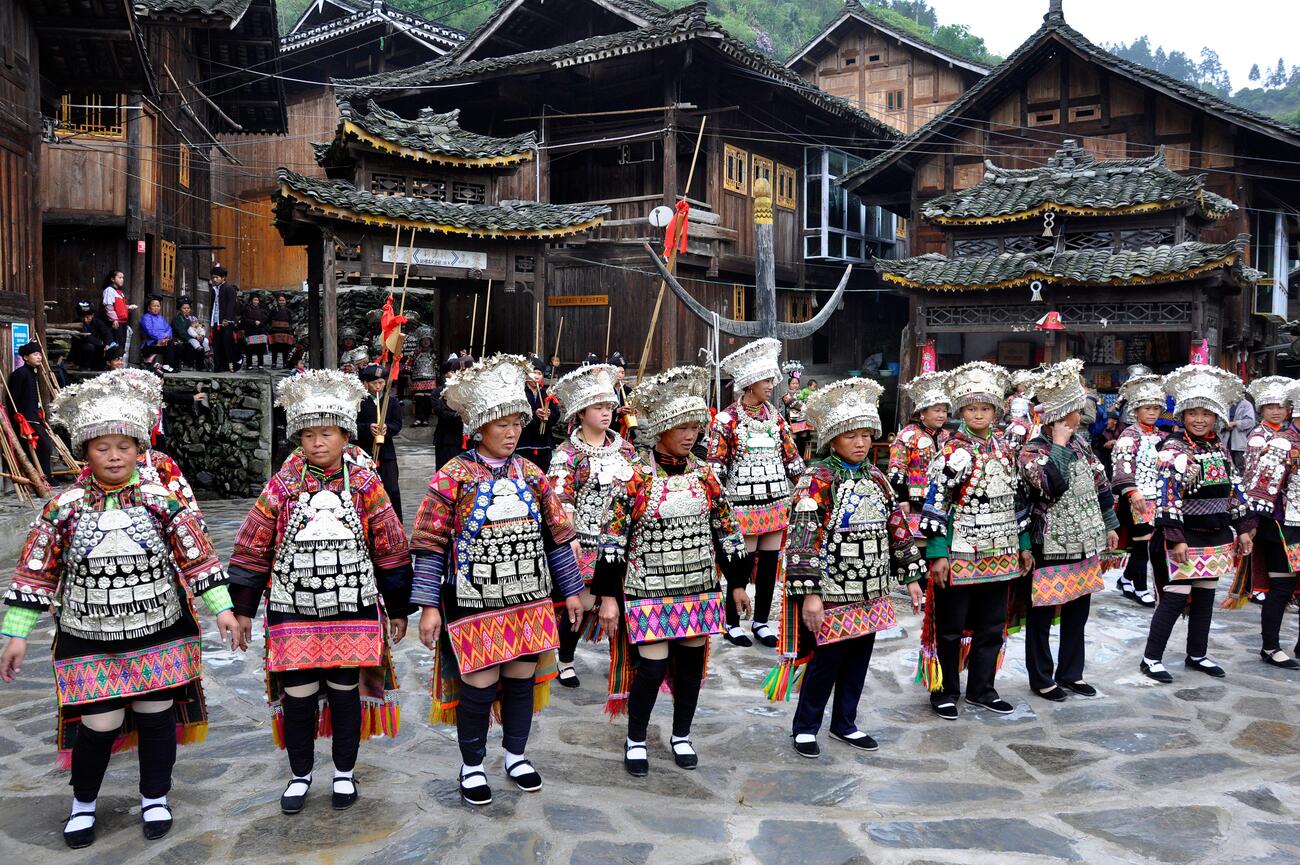
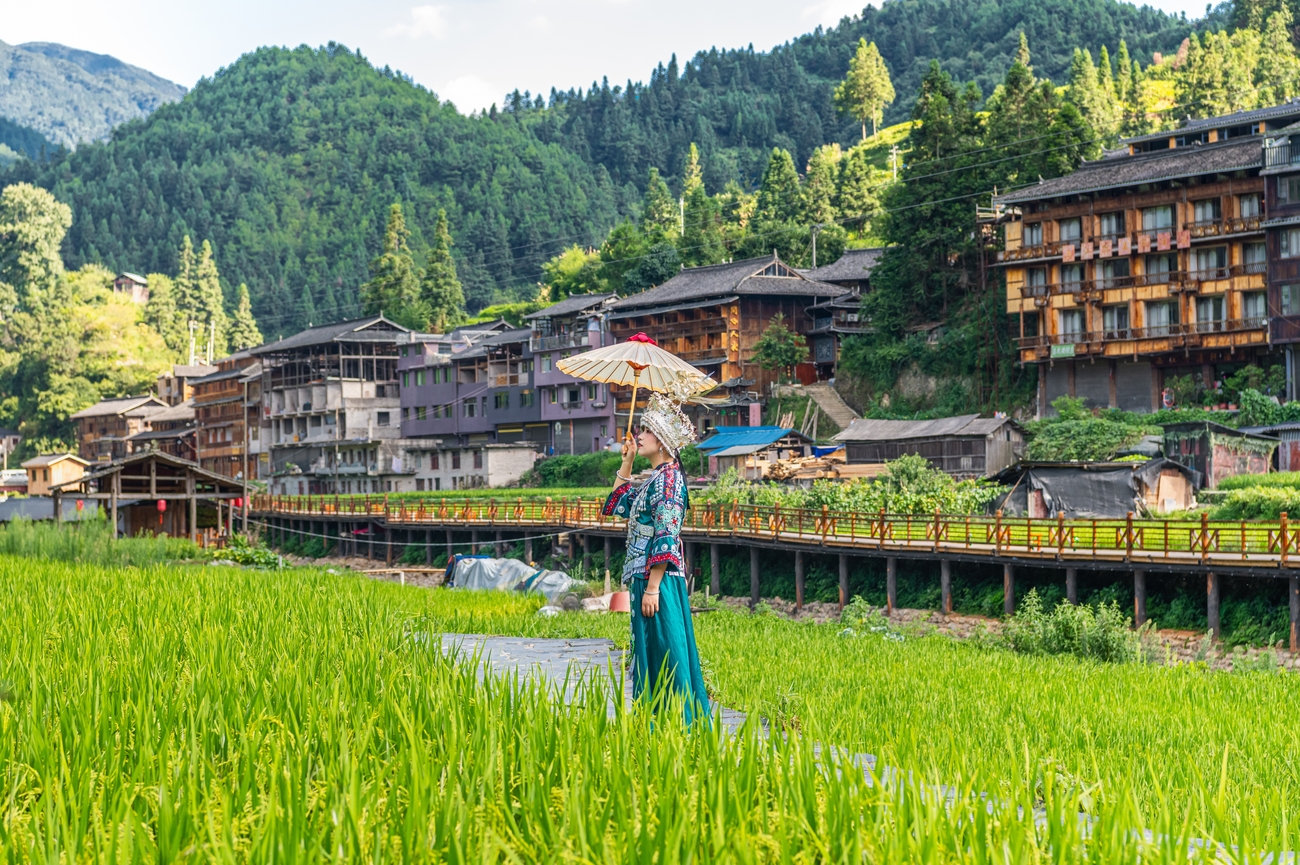
It is part of a traditional welcome shaped by music, ceremony and hospitality. During festivals and special occasions, women may wear elaborate silver headdresses, necklaces and chest ornaments, with complete ceremonial ensembles weighing several kilograms. The pieces are shaped by specialist silversmiths using skills passed between generations.
Yet Guizhou’s Miao and Dong villages are more than performances or photographs. Across southeast Guizhou, timber houses, drum towers, embroidery, batik, festivals and communal songs remain connected to everyday village life. The Dong Grand Song, recognised by UNESCO as intangible cultural heritage, continues to transmit history and knowledge without instruments or a conductor.
Our China Villages & Gorges journey places four to five days in Guizhou between Beijing and the Yangtze, allowing time to encounter these communities as inhabited places rather than brief sightseeing stops.

Who
the Miao and Dong Are in Guizhou
Understanding the welcome ceremony, the silver and the festival calendar that follows requires understanding the two communities behind them. The Miao and the Dong are not variations on the same culture. They are distinct peoples with distinct histories, distinct languages and distinct relationships to the mountains they share.
The Miao:
Migration, Costume and Craft
The Miao are one of China’s largest ethnic minority groups, numbering close to 9.4 million people nationally, with roughly 48 percent living in Guizhou. Historical records place Miao communities in central China as early as the Qin and Han dynasties, and their migration into Guizhou’s mountains unfolded gradually over centuries, as lowland conflict and agricultural pressure made the flatlands increasingly difficult places in which to maintain a distinct identity.
What makes the Miao especially difficult to describe as a single culture is the degree of internal variation. The community subdivides into groups distinguished largely by costume: Long-Skirt Miao, Short-Skirt Miao, Long-Horn Miao, Red Miao, Black Miao, White Miao, Green Miao and several smaller classifications besides. Each is tied to a specific geography within the province, and each maintains its dress code as an active marker of identity rather than a museum piece brought out only for festivals.
The Miao are also, by near-universal agreement among anyone who has spent time in their communities, remarkably skilled across an unusually wide range of crafts: weaving, embroidery, batik, paper-cutting and the silver jewellery casting that has become the culture’s most internationally recognised signature.

The Dong: Grand
Song, Oral Memory and Life Without Script
The Dong number close to three million people in China, with around half settled in Guizhou, concentrated heavily in the same southeastern counties, Liping, Rongjiang and Congjiang, that hold the Miao villages. The most striking fact about Dong culture, and the one that explains nearly everything else about how the community has preserved itself, is that the Dong have no traditional written language.
Their history, law, cosmology and sense of collective identity are carried through oral transmission, most significantly through Dong Grand Song, a polyphonic choral tradition performed without a conductor or written score, recognised by UNESCO in 2009 as Intangible Cultural Heritage of Humanity.
A culture with no script does not simply lose information over time in the way a culture with archives does. It loses or retains information based on what the living community chooses to keep singing. That distinction matters enormously for how a visitor should approach a Dong village in Guizhou: what you hear in the drum tower at dusk is not a performance reconstructed from a manuscript. It is the manuscript, sung by the only people who have ever held it.
What the Dong built to house that singing tradition, from drum towers without a single nail to wind-rain bridges that double as community meeting halls, deserves its own focused attention. The craftsmanship behind it is explored in our guide to Dong and Miao architecture in Guizhou.
Guizhou
Village Circuit: Miao and Dong Villages Worth the Unpaved Road
Southeastern Guizhou holds well over a hundred villages of meaningfully varying size, character and accessibility. Narrowing that down to a circuit that can be walked slowly across four or five days means choosing communities that each show a genuinely different facet of the culture, rather than repeating the same experience in a different valley.
Xijiang Qianhu
Miao Village: Guizhou’s Largest Miao Settlement
Xijiang, around 30 kilometres from Kaili in Leishan County, is the largest Miao settlement on earth, and its scale is the first thing that registers. Over a thousand households climb the mountain slope in tiered wooden rows, the three-storey stilted houses descending toward the valley floor, with livestock and storage below, living space in the middle and grain stored above.
From the designated hilltop viewing platform, the village reads less like a collection of separate homes and more like a single continuous architectural organism.
Xijiang is also, without much ambiguity, the most commercially developed stop on the circuit. The central pedestrian street is lined with shops, the evening cultural performance runs on a fixed schedule, and the entry fee covers both. None of that erases what is genuinely there.
Walk uphill, away from the main street, into the residential terraces where families are doing ordinary evening things, cooking, calling children in and hanging laundry between stilted houses, and the commercial layer thins out within a few hundred metres. Xijiang at scale and Xijiang at street level are two different visits, and the better one requires walking further than most day-trippers bother to.

Langde Upper
Village: The Quieter Miao Welcome
Langde, considerably smaller and quieter than Xijiang, holds a specific historical distinction that is easy to miss in a guidebook listing but significant on the ground: it was the first ethnic village in this region formally opened to outside visitors, in 1985, decades before Xijiang’s tourism infrastructure existed in any form.
With roughly five hundred residents, Langde has built its reputation among visitors who have done their research specifically on what it does not have compared to its larger neighbour: crowds, staged timing and a sense of performance running on rails.
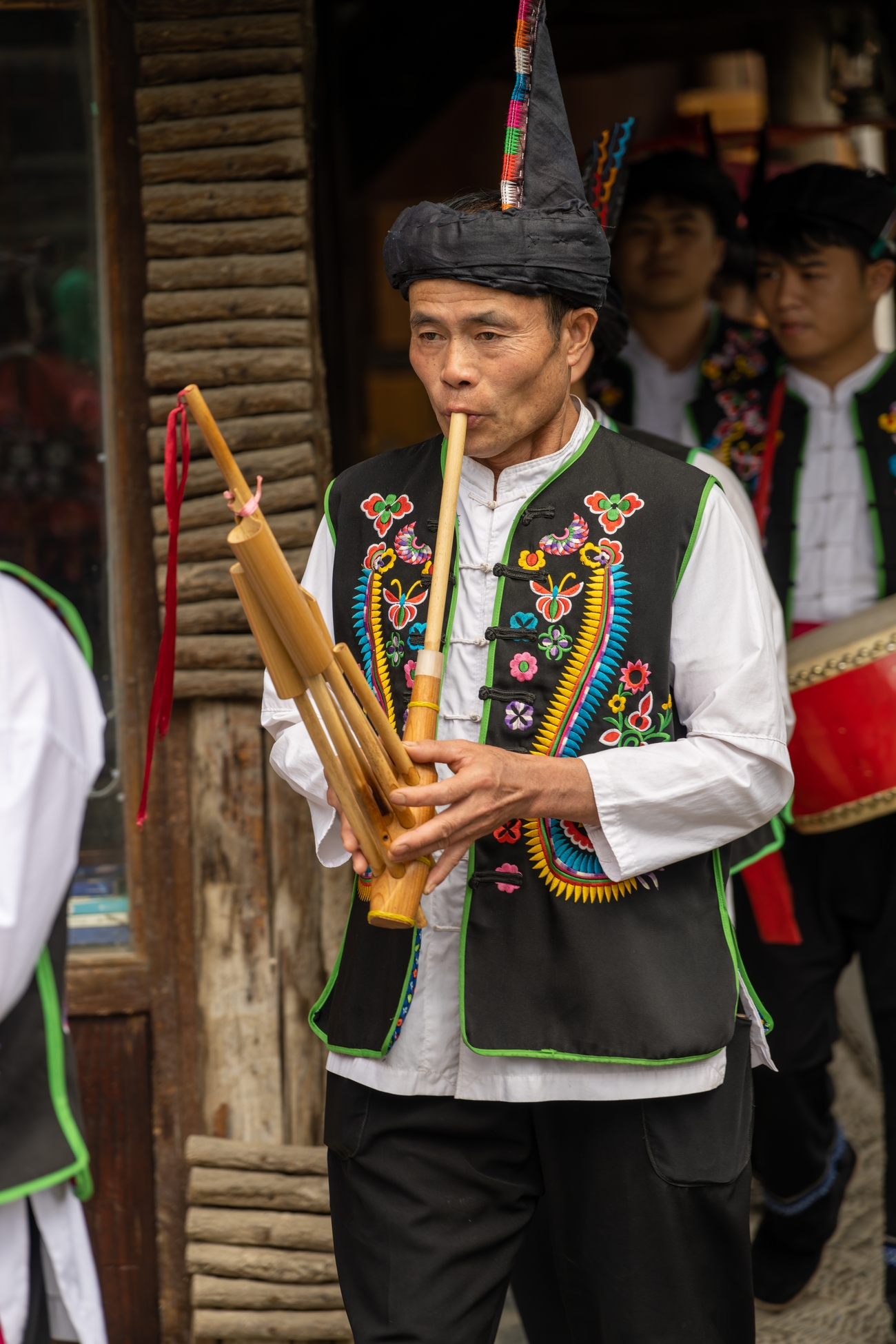
Local custom describes Langde as the hometown of Lusheng, the bamboo wind instrument central to Miao festival music, and its welcome ceremonies retain a directness that decades of tourism scale have, inevitably, smoothed out of Xijiang’s larger version of the same ritual.
The rice wine here tastes the same. The watching, while you decide whether to drink it, feels less like a routine.

Matang Gejia
Village: Batik and Guizhou’s “Fifty-Seventh Ethnic Group”
Matang holds a community of around four hundred people known as the Gejia, who occupy an unusual position in China’s official ethnic taxonomy. They are sometimes informally called the country’s “fifty-seventh ethnic group”, not among the fifty-five officially recognised minorities but distinct enough in custom, dress and self-identification that the description has stuck in everyday use regardless of its lack of formal status.
According to community legend, the Gejia trace their lineage to Hou Yi, the archer of classical Chinese mythology credited with shooting down nine of ten suns that were scorching the earth. Whatever the legend’s literal accuracy, the story functions as a clear marker of distinct identity within a region already defined by distinct identities layered on top of each other.
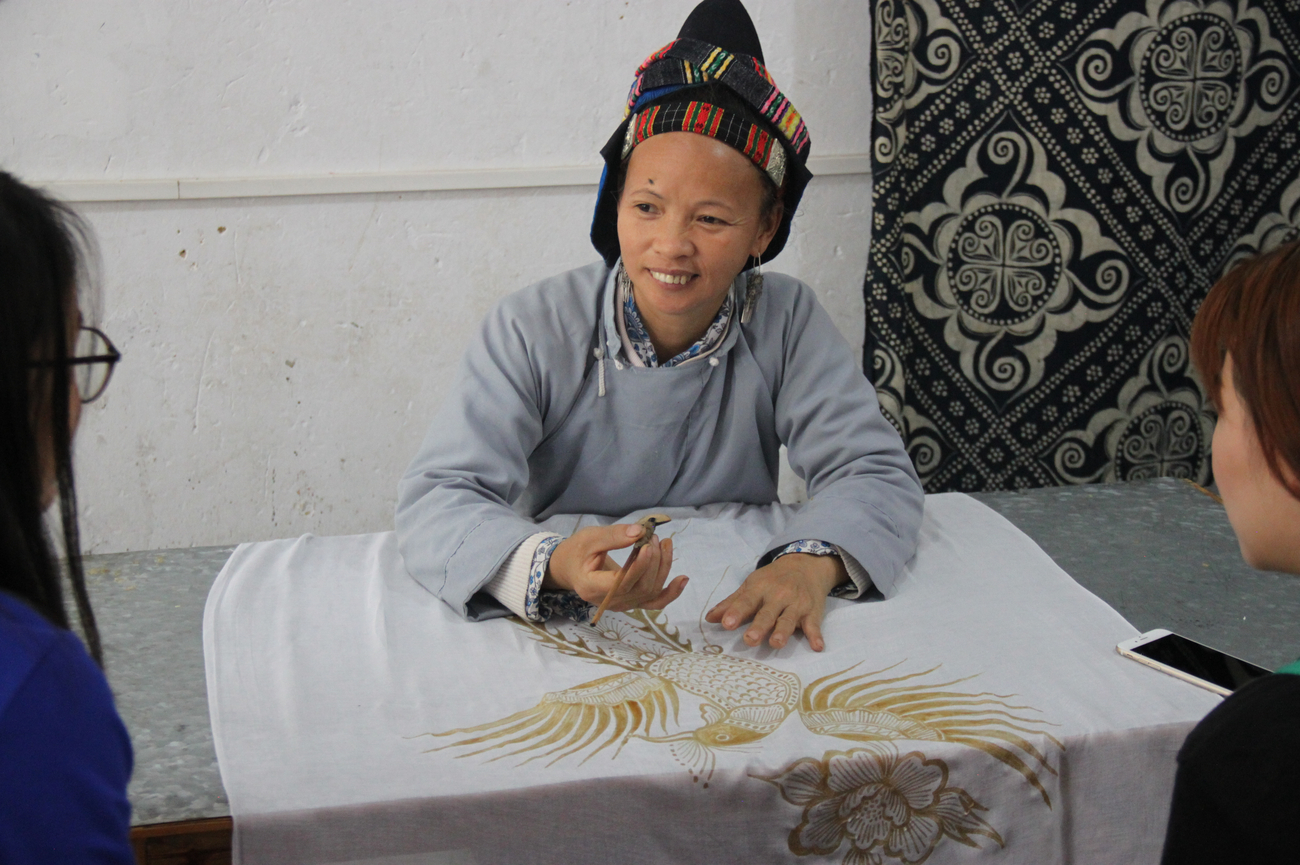
Matang’s defining craft is batik, wax-resist dyeing practised by the village’s women using techniques transmitted through direct instruction rather than formal teaching. The resulting indigo patterns appear on clothing, wall hangings and small workshop pieces sold to visitors who arrive with enough time to watch the process rather than just buy the result.
Shiqiao
Village: Handmade Paper in Rural Guizhou
Shiqiao receives a fraction of Xijiang’s visitor numbers and offers, in exchange, one of the more genuinely unhurried craft experiences on the circuit: handmade paper production using techniques that predate industrial papermaking by centuries.
The bark is stripped, pulped and formed into sheets by hand in a process that has not needed modernising to keep working. Watching it happen, rather than watching a demonstration staged for a tour bus schedule, is the specific difference between Shiqiao and several busier stops on the circuit.

Datang Village:
The Short-Skirt Miao Tradition
Datang is known, with a specificity that borders on the absurd until you have actually seen it, for a skirt style measuring barely 10 to 16 centimetres in length, worn by the village’s women year-round, including through Guizhou’s genuinely cold and damp winters.
The tradition is documented as over six hundred years old. Nobody, including the women currently wearing it, can offer a fully agreed-upon origin story for why the style developed the way it did.
The not-knowing is, in its own way, as honest an answer as Guizhou’s minority cultures tend to give about their own deep history: some things were simply always done this way, and the explanation stopped mattering generations ago.
Zhaoxing Dong
Village and Basha Miao Village: Drum Towers and the Last Riflemen
Zhaoxing, in Liping County, is the largest Dong settlement on the circuit, home to over six thousand people organised into five clans, each centred on its own drum tower. The cultural life here, the singing rehearsals, the elder gatherings and the informal conversation under the wind-rain bridges, runs on a rhythm dictated by clan structure rather than by any visitor’s schedule.
That is precisely what makes an evening spent here, after the day-trippers from Kaili have returned to their hotels, different from an afternoon spent here.
Basha, further south in Congjiang County, is the most anthropologically singular stop on the entire circuit. It is the only community in China still formally recognised for carrying firearms, muzzle-loading rifles, as part of daily dress. They are used in welcoming ceremonies and in a specific coming-of-age ritual that includes a sickle-cut hairstyle residents trace to the Qin Dynasty.
Basha has run as a designated tourist destination since the 1980s, and its scheduled welcome ceremony, complete with rifle fire as a greeting, is considerably more theatrical than the quiet daily life surrounding it. That daily life, watched rather than performed for, is where the village’s real character sits.
The drum towers at Zhaoxing and the wind-rain bridges connecting both communities are architectural achievements built entirely without nails.

Guizhou
Festivals: When the Miao and Dong Villages Are Most Themselves
Visiting these communities outside their festival calendar shows you the architecture and the daily rhythm. Visiting during a major festival shows you what all of that exists for.
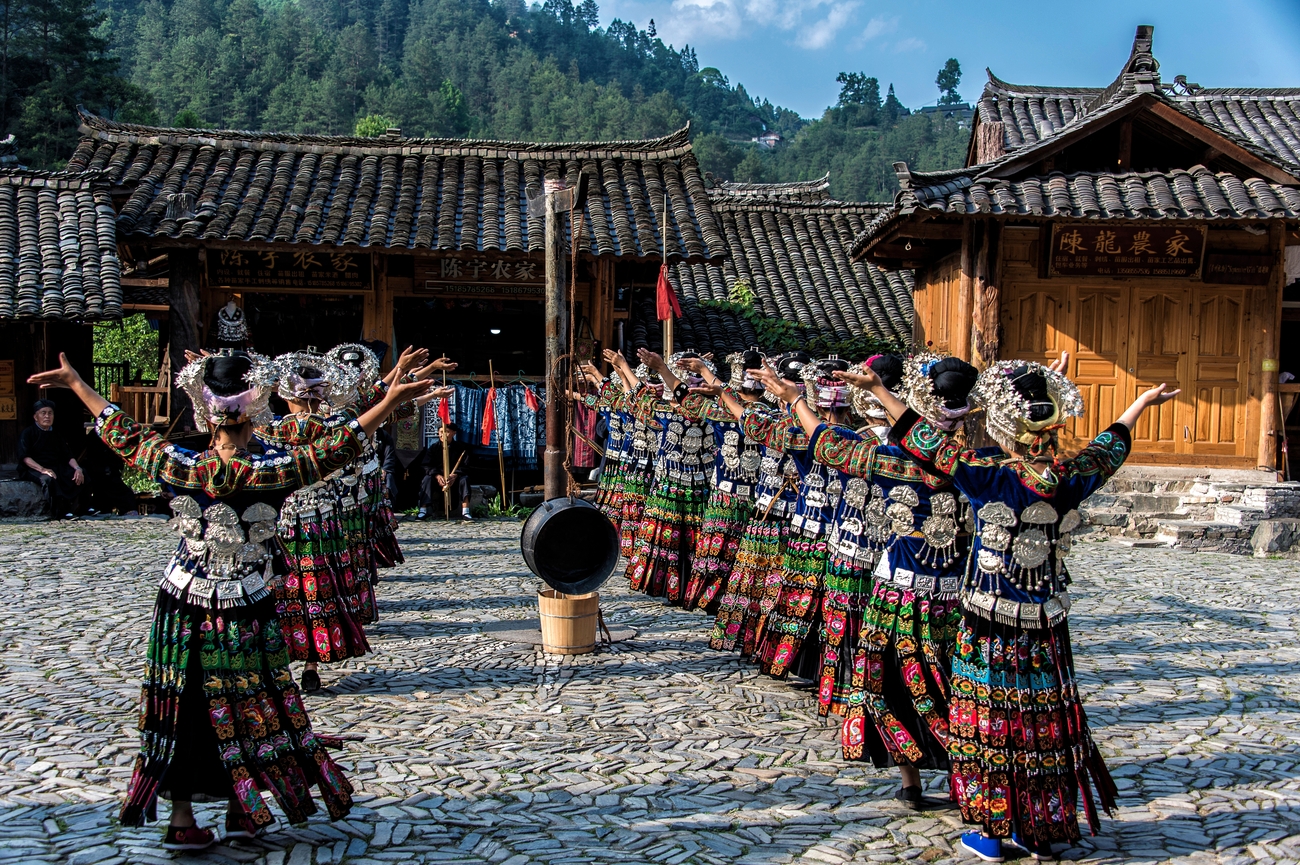
The Miao Lusheng Festival, held across Xijiang and the surrounding villages in the first month of the Chinese lunar calendar, typically January into February, is the most significant annual gathering. It brings together Lusheng pipe music, dance and full ceremonial dress, with the wider community participating rather than simply watching.
The silver worn on these occasions represents the fullest expression of the Miao silversmithing tradition. Headdresses and chest pieces are accumulated and passed down across generations rather than purchased fresh for the occasion.
Miao New Year, observed in the tenth lunar month, usually falling in November, brings bullfighting, horse racing and singing competitions across the Qiandongnan villages, with the specific timing shifting slightly from village to village according to local custom.
The Dong Sama Festival, held in the first lunar month, honours the mythological female ancestor Sama through community procession and collective singing, each Dong village holding its own version with its own particular emphasis.
And then, entirely outside any traditional calendar, there is the Village Super League: an amateur football competition between farming communities in Rongjiang that has, somewhat improbably, become a genuine national phenomenon in recent years, prized specifically for its unsponsored, unfiltered energy.
Catching a match here, with the local market still running behind the touchline and the crowd entirely local rather than assembled for visitors, is the clearest possible evidence that Guizhou’s minority villages are not a culture preserved under glass. They are a culture still actively making new things to be proud of, alongside the old ones.
Timing a visit to land on one of these dates, rather than arriving in quiet villages on an ordinary Tuesday, changes the entire character of the trip. Festival dates shift with the lunar calendar each year and need confirming for the specific year of travel, which is the kind of logistics worth handling before departure rather than discovering too late.
The China Villages & Gorges itinerary builds the village circuit around the actual festival calendar, rather than around whatever week happens to be convenient, and that is exactly what makes the difference.
Guizhou
Minority Villages: What Separates a Living Culture From a Show
Every village on this circuit, without exception, has some commercial layer: an entry fee, a scheduled performance, a souvenir shop near the main gate. Pretending otherwise would be dishonest, and visitors who arrive expecting an untouched anthropological time capsule are setting themselves up for a strange kind of disappointment when they find ticket booths instead.
The honest distinction is not between villages that have commerce and villages that do not. It is between villages where the commercial layer is a thin surface over a culture that continues regardless, and villages where the commercial layer has become the entire visible experience.
Xijiang’s main street is firmly the latter for the duration of the scheduled show. Xijiang’s upper residential terraces, twenty minutes later on foot, are firmly the former. The same split applies, in different proportions, to nearly every stop on this circuit.
Basha’s rifle-fire welcome is a performance. The grandmother sitting on her own porch fifty metres past the performance area, entirely uninterested in anyone walking by, is not.
Telling the difference requires either considerable time in each village or a guide who already knows which households, which hours and which side streets carry the culture that is not performing for anyone. That knowledge is exactly what turns a circuit of Guizhou minority villages from a checklist into something closer to what it actually is: a handful of mountain communities that have been doing this, largely the same way, for longer than anyone can fully account for, and who happen to let visitors watch some of it now.
The road from these villages eventually turns north toward Chongqing and the Yangtze, where an entirely different register of China takes over: cliffs instead of mountains, water instead of silver, two thousand years of poetry instead of two thousand years of oral song. That shift in register, and what it does to the journey, is explored in our Yangtze Three Gorges cruise guide.
Guizhou
Minority Villages: Cultures That Continue After You Leave
The Miao and the Dong did not build their villages, their silverwork, their songs or their welcome ceremonies for anyone outside their own communities to eventually find. They built all of it for themselves, across centuries that predate the dynasties most visitors to China come specifically to see.
The fact that some of it is now visible to travellers willing to make the drive from Kaili is a relatively recent accident of tourism policy, not the point of any of it.
That distinction is worth sitting with at the rice wine ceremony, in the moment before you decide whether to drink. You are not being shown a culture performing itself for your benefit. You are being allowed, briefly and on specific terms, into a culture that was already exactly this before you arrived and will continue being exactly this after you leave.
The version of Guizhou that holds onto that distinction, rather than flattening it into a checklist of villages, takes a guide who has spent real time here and an itinerary built around the festival calendar rather than around convenience.
Explore the full China Villages & Gorges itinerary.


Let us know what you love, where you want to go, and we’ll design a one-of-a-kind adventure you’ll never forget.
Get in touch
Miriam
Travel Specialist

Nina
Travel Specialist

Abigail
Travel Specialist
Our offices:



Revigorate, Iberian Escapes and Algarve Lifestyle are the registered brand names of APCS Lda . We are a fully authorised travel agency licensed by Turismo de Portugal RNAVT/6867.
In the event of a dispute, the consumer may refer to: RAL - Centros de Arbitragem
Avª. 5 de Outubro, nº. 55, R/C Dtº. 8000-075 Faro, Portugal | Tel: +351 289 823 135 *
* national landline call
E-mail: info@consumoalgarve.pt| www.consumidoronline.pt | Mon to Fri: 9:00 - 13:00 / 14:00 - 17:00