Galician Seafood: Percebes, Pulpo a la Gallega and Why Spain's Best Shellfish Comes From the Rías

Galician seafood is defined by the cold Atlantic, the nutrient-rich rías and a fishing culture that has shaped the region for generations. From percebes harvested on wave-battered rocks to pulpo á feira, scallops, spider crab and the great mariscada platters, Galicia is one of Spain’s most distinctive seafood regions, with its finest dishes closely tied to the waters they come from.
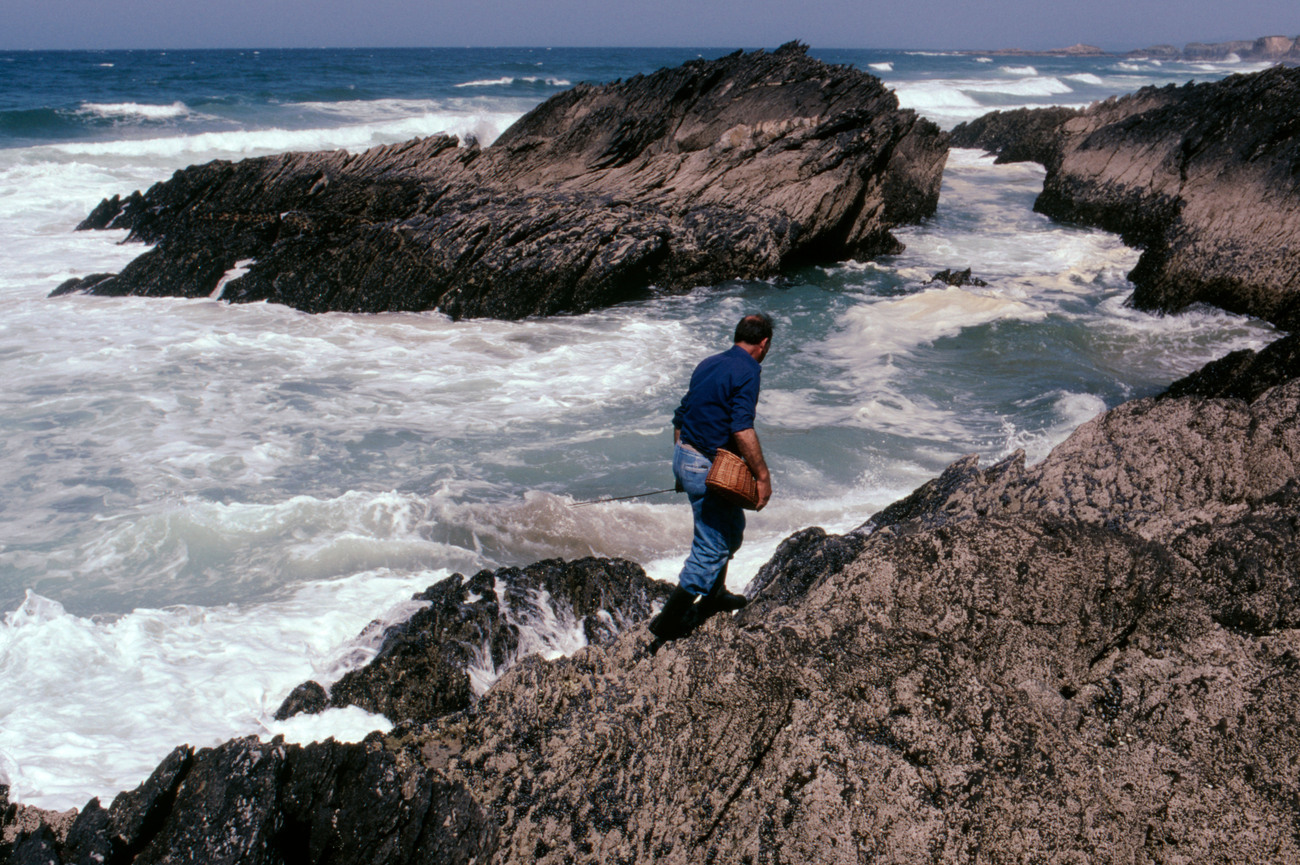
The percebeiro watches the seventh wave break and starts counting. He is roped to a rock on the Costa da Morte, the Coast of Death, named for the ships it has taken, and below him, in the white violence of the surf line, grow the goose barnacles. He has perhaps forty seconds. Down the rope, scraper against stone, a cluster of percebes prised into the bag, and back up the rock face before the next set arrives, because the barnacles grow best exactly where the sea hits hardest, and the sea does not pause for harvests. Men and women have died doing this work. The good ones read water the way pilots read weather, and they are paid accordingly.
That evening, at the fish auction, a kilo of what he prised loose can fetch the price of a very good bottle of wine, and at the December table it climbs higher still. The arithmetic tells you everything about Galician seafood before a single plate arrives: this is a coast where the finest things are paid for in risk, cold and early mornings, and where the eating, as a result, is taken with complete seriousness.
The seafood is the heart of our Galician gastronomy journey five days through Santiago, A Coruña and Vigo, and on our Galician Gastronomy Express Tour the tables where this coast eats best are reserved before you land.
The percebeiro takes the risk. You take the table.
Why
Galicia Has Some of Spain’s Best Shellfish
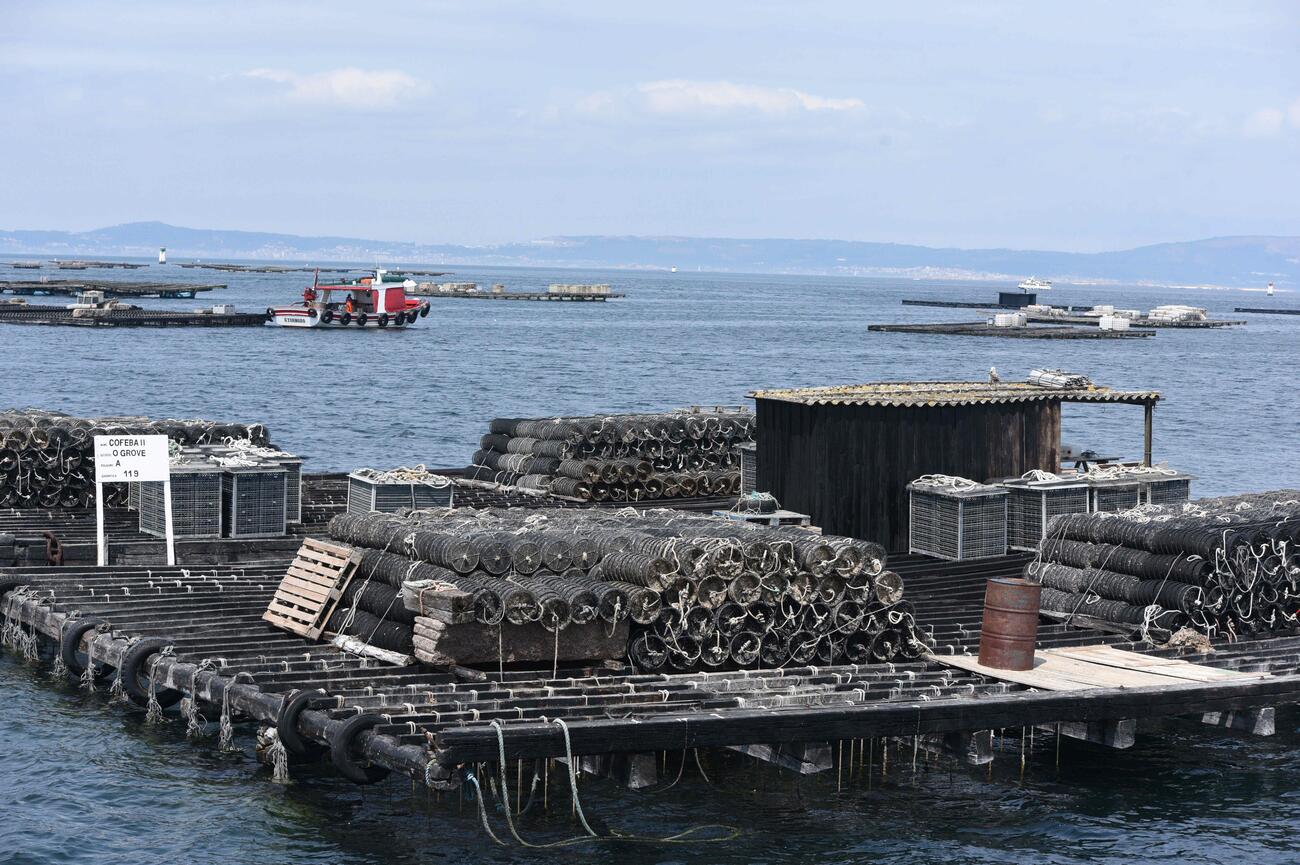
Galicia’s reputation for exceptional shellfish begins with the shape of its coast. The rías, drowned river valleys that cut into the shoreline, are influenced by cold Atlantic upwelling that brings nutrient-rich water towards the surface and supports abundant marine life. The Ría de Arousa is one of the region’s most productive estuaries, with conditions particularly well suited to mussels, oysters, scallops and other shellfish.
Look out across the Arousa and the bateas make that productivity visible. Hundreds of dark wooden rafts sit anchored across the water, each one trailing ropes below the surface where mussels and other shellfish are cultivated. One of the best ways to understand the system is from the water itself, travelling among the rafts and seeing how closely Galicia’s seafood culture is connected to the rías that produce it. In some places, mussels can be steamed and eaten within sight of the very rafts where they were grown, making the connection between water and plate immediate.
The wild harvest comes from the same Atlantic environment, from rocky shorelines, sandbanks and tidal waters. Galician seafood cooking traditionally reflects that proximity to the source. The emphasis is often on simplicity, with ingredients cooked carefully and served with minimal intervention so that the character of the shellfish remains the focus.
Percebes in Galicia: Goose Barnacles From the Costa da
Morte
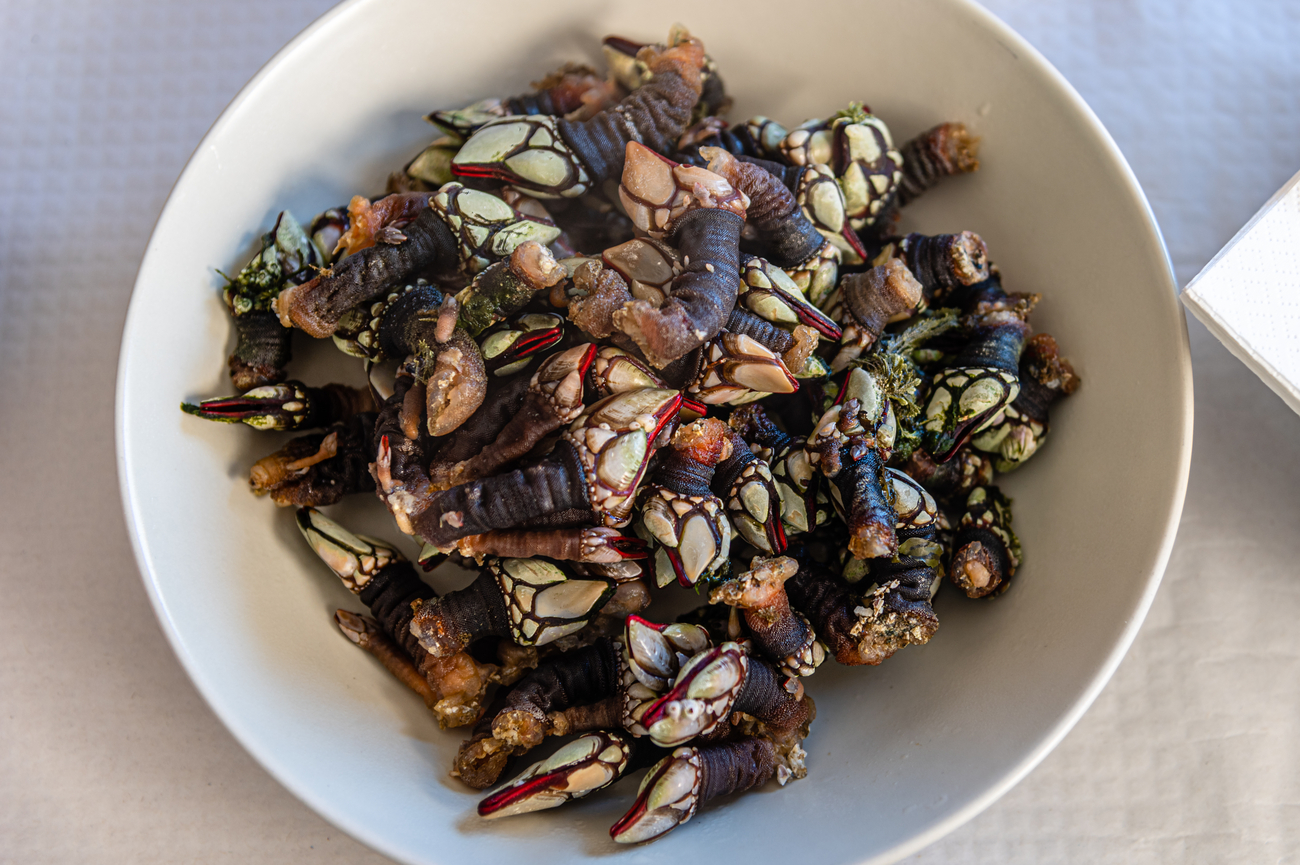
Percebes, or goose barnacles, are among Galicia’s most distinctive and prized shellfish. They grow on wave-battered rocks along the Atlantic coast, particularly around the Costa da Morte, where specialist harvesters known as percebeiros work in dangerous conditions to collect them by hand.
Begin with the strangest thing on the platter, because its story carries the whole coast’s character. The percebe looks like nothing you would choose to eat: a leathery dark stalk with a hoofed tip, closer to a dragon’s claw than to dinner. It thrives where the Atlantic strikes rock with full force, which helps explain both its intense flavour and the difficulty of harvesting it. Along the Costa da Morte, the percebeiros work the rocks in carefully timed intervals between waves, often secured by ropes and operating under strict quotas and seasonal controls.
The eating, by contrast, is almost comically simple. Percebes are boiled briefly in seawater or well-salted water, carried to the table steaming, and eaten with the fingers. Twist at the hoof, pull away the outer skin, and what emerges is a firm, briny morsel with an intensely marine flavour. Winter is particularly prized for percebes, while demand rises sharply around Christmas, when they become an important part of festive tables across Galicia.
The traditional accompaniment is simple: bread and a cold Albariño. On our journey they appear where they should, at a good marisquería table, in season and with the story of the harvest told properly, because a plate of percebes without its story is just a curiosity, and with it becomes one of the most memorable tastes of the Galician coast.
Pulpo
á Feira: The Dish That Stands for Galicia
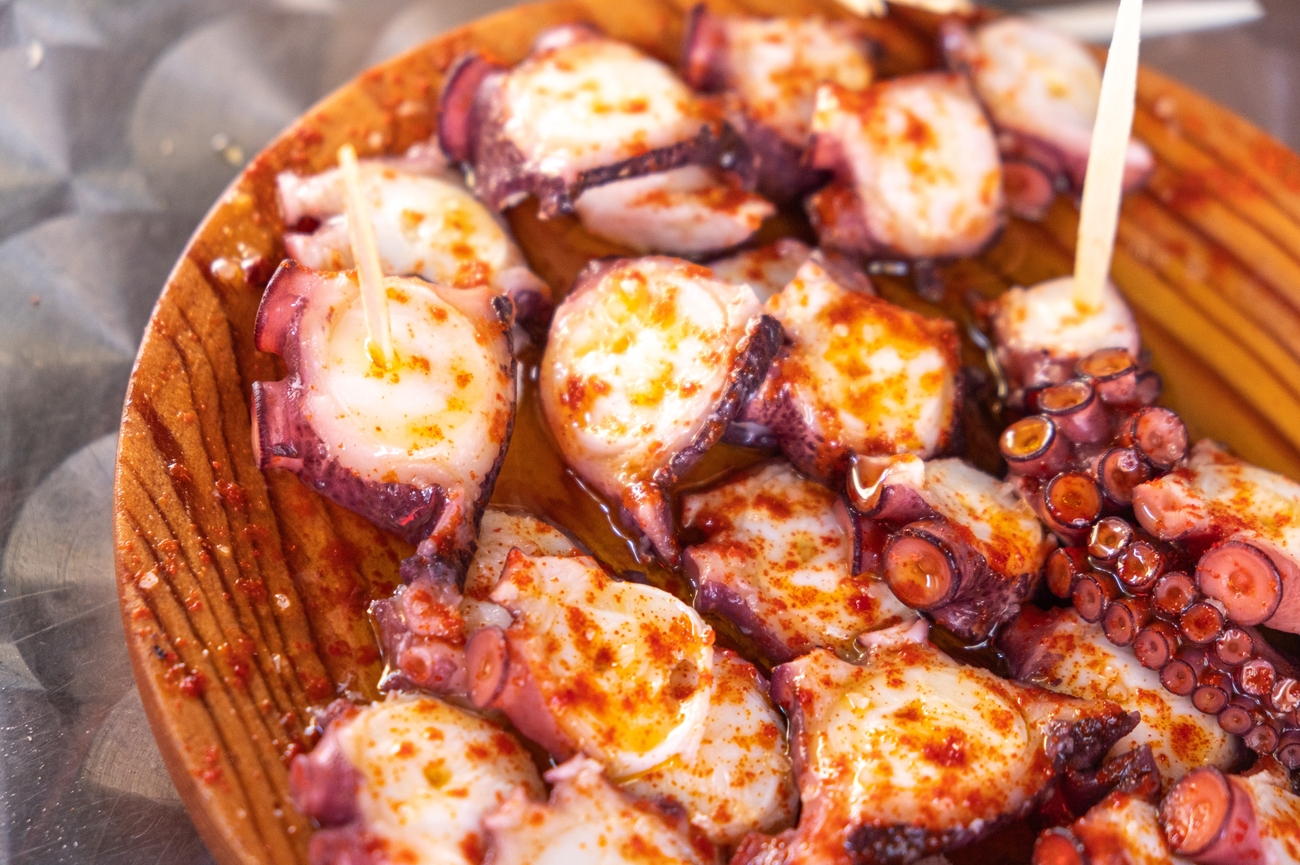
Pulpo á feira is one of Galicia’s most iconic dishes, traditionally associated with fairs, festivals and communal gatherings across the region. Also known as Galician-style octopus, it is prepared simply with olive oil, coarse salt and pimentón, but the technique behind it is part of the tradition.
From the rarest plate to the most beloved, its name tells its history. This was festival food, cooked in the open at the ferias and romerías where the whole countryside gathered, and it still is. The keepers of the tradition are the pulpeiras, women who boil the octopus in wide copper cauldrons, traditionally dipping it three times into the rolling water before the long simmer. When the timing is right, the tentacles are lifted, scissor-cut into rounds straight onto wooden plates, and dressed with exactly three things: olive oil, coarse salt and pimentón.
Eaten standing at a fair, with toothpicks and a cunca of young local wine, it remains one of the simplest and most recognisable expressions of Galician food culture. One detail surprises many visitors: octopus is often frozen before cooking because freezing helps tenderise the flesh. The authenticity of pulpo á feira lies in the preparation, the cauldron, the timing and the way it is served.
Some of the most celebrated versions are associated with inland towns and the festival circuit, which says something important about the dish. Galicia’s signature octopus is not confined to the coast. It belongs to communal tables, local fairs and gatherings where food is shared rather than staged. The luxury version is simply a better seat at the same tradition.
Galician
Scallops and the Camino de Santiago
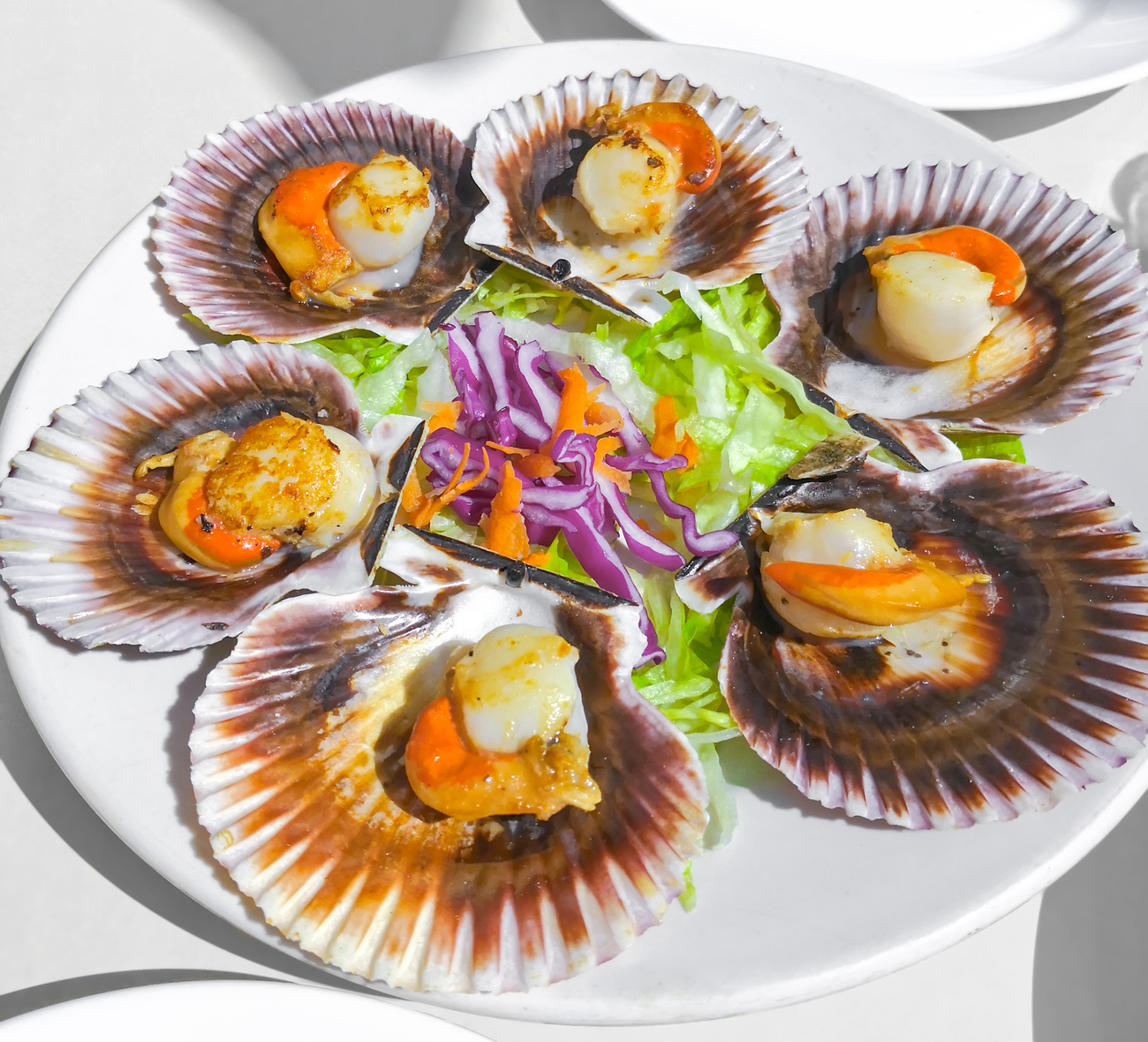
The Galician scallop, or vieira, is one of the most recognisable symbols of the Camino de Santiago and one of the region’s most distinctive seafood traditions. Pilgrims have carried the scallop shell as an emblem of their journey for centuries, and it still appears on waymarkers leading towards Santiago de Compostela.
One shell on this coast carries more history than the rest of the platter combined. The vieira links Galicia’s food culture directly to the Camino, appearing both on the pilgrimage route and on restaurant tables across the region. In Santiago de Compostela in particular, the connection between the scallop, the pilgrim and the city is difficult to separate.
The classic preparation honours the shell as much as the meat: the scallop is baked and served in its own vieira, traditionally with onion, a little ham and breadcrumbs. Scallops also appear as a filling for Galician empanada, alongside variations made with tuna or cockles. Between the shell on the Camino and the shell on the plate runs the whole logic of Galician seafood: here, the sea is never merely dinner. It is identity, history and welcome, served hot.
The
Mariscada: One Table, the Whole Coast
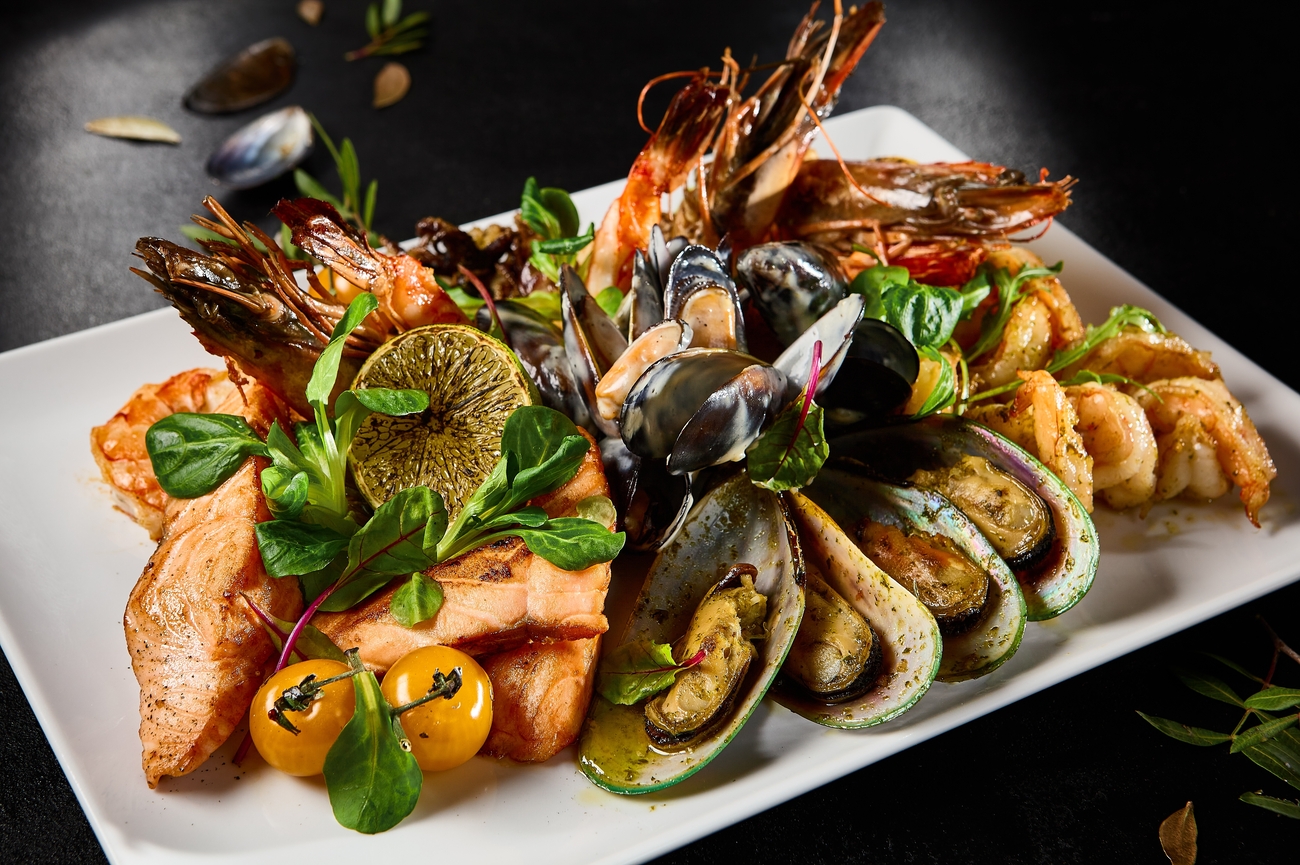
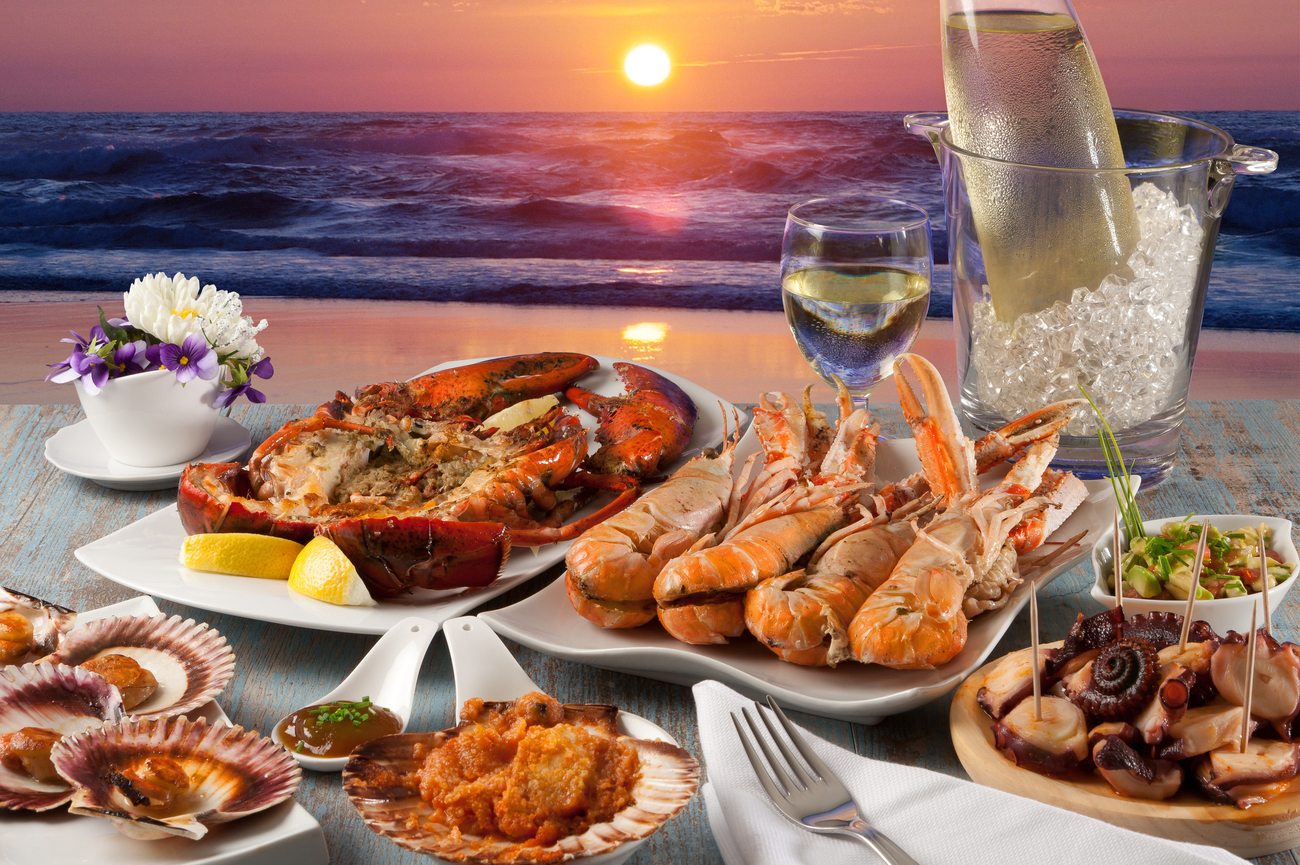
A mariscada is a traditional Galician shellfish feast, bringing together some of the region’s most prized seafood on a single table. If percebes are the coast’s drama and pulpo its folk song, the mariscada is its full orchestra, gathering the rías onto one vast platter: centolla, the spider crab; nécoras, the small velvet crabs; oysters; scallops; razor clams; cigalas; and the celebrated clams of Carril from the Ría de Arousa.
A good marisquería builds the platter in tiers and expects you to take your time. The more delicate shellfish come first, oysters and clams while the palate is clean, followed by the plancha dishes and finally the crabs. Bread stays on the table throughout, ready for the juices, and the whole meal is designed to be slow rather than rushed.
Beside it all comes Albariño from Rías Baixas, grown within sight of the mussel rafts and naturally suited to the shellfish of the same Atlantic coast. The wine’s fresh acidity and saline character make it one of Galicia’s classic seafood pairings. That wine has its own story, the granite-post vineyards, the palace cellars of Cambados, and we tell it in full in our guide to the best wineries in Rías Baixas.
Galician canned seafood also belongs at this table. Mussels in escabeche, cockles and small sardines are treated as delicacies in their own right and often appear in good wine bars alongside local wines. The tins are one of the easiest ways for the coast to travel, and they remain one of Galicia’s most distinctive edible souvenirs.
On our Galician journey, the set-piece evening belongs to Santiago: a gourmet dinner at one of the city’s finest restaurants, at a table chosen for what its kitchen refuses to do to good seafood, with the wine already cold and no clock anywhere in sight.
Where
to Eat Fresh Seafood in Galicia
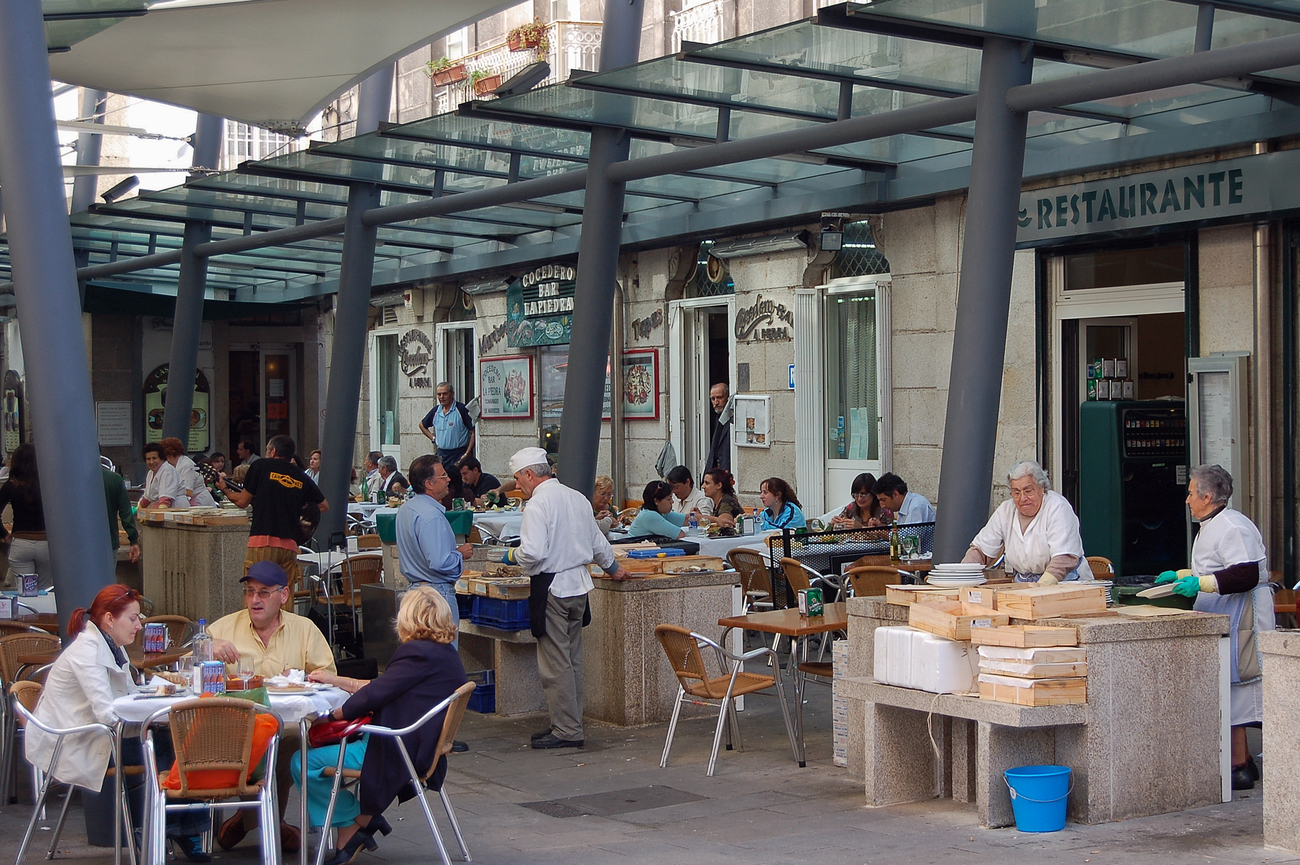
The last thing to understand about Galician seafood is that every plate traces back to a working port, fish market or coastal town. Along the coast, the lonxas, or fish auctions, begin before dawn, with hake, monkfish and other Atlantic catches moving through the markets while the towns are still waking. Vigo is one of the region’s great seafood hubs, with a working fishing port that shapes how the city eats.
In Vigo, the experience begins on Oyster Street, where the ostreiras shuck oysters at their stalls and serve them simply, often with lemon and a cold glass of Albariño. In Santiago de Compostela, the same Atlantic freshness arrives inland at the Mercado de Abastos, where stalls sell seafood from the rías and selected market eateries will cook what you buy on the spot. We explore that ritual in more detail in our Santiago de Compostela food guide.
Across Galicia, the simplest rule is often the best one: eat close to the source and order what has arrived that day. Each autumn, O Grove turns that principle into a celebration during its Seafood Festival, when shellfish, local cooking and the working life of the Rías Baixas come together around long communal tables.
Galician
Seafood Experiences: Take the Table
The best Galician seafood experiences begin long before the plate reaches the table: in cold Atlantic water, dawn fish auctions, carefully managed seasons and, for percebes, the dangerous rocks of the Costa da Morte.
Honouring that is simple, and it is the whole art of eating here. In season. Close to the boats. With the wine that belongs beside it. At a table chosen by someone who knows the coast, on an evening with no need to watch the clock.
Our Galician Gastronomy Express Tour exists to arrange exactly that: a carefully chosen dinner in Santiago, two regional lunches in two different cities, a Vigo kitchen where you cook the catch yourself, and Galician wine already waiting at the table.
Dinner is the easy part, and it is already reserved.


Let us know what you love, where you want to go, and we’ll design a one-of-a-kind adventure you’ll never forget.
Get in touch
Miriam
Travel Specialist

Romina
Travel Specialist

Laura
Travel Specialist
Our offices:



Revigorate, Iberian Escapes and Algarve Lifestyle are the registered brand names of APCS Lda . We are a fully authorised travel agency licensed by Turismo de Portugal RNAVT/6867.
In the event of a dispute, the consumer may refer to: RAL - Centros de Arbitragem
Avª. 5 de Outubro, nº. 55, R/C Dtº. 8000-075 Faro, Portugal | Tel: +351 289 823 135 *
* national landline call
E-mail: info@consumoalgarve.pt| www.consumidoronline.pt | Mon to Fri: 9:00 - 13:00 / 14:00 - 17:00