China Travel Etiquette: Dining, Gift-Giving and Regional Customs
China travel etiquette is easier to navigate once you understand the values behind it. Respect for hierarchy, social harmony and awareness of how your actions affect others shape everything from banquet seating and toasting to gift-giving and behaviour in religious settings. The details vary by region and occasion, but the underlying principles remain remarkably consistent.
At a formal dinner, a host may raise a small ceramic cup of baijiu and say ganbei, literally “dry the cup.” For a traveller unfamiliar with Chinese dining etiquette, the moment can feel like a test. In reality, the gesture is less about alcohol than respect, hospitality and understanding how to respond without disrupting the atmosphere at the table.
The setting matters. A formal banquet in Beijing follows different conventions from a Chengdu teahouse, where the social rhythm is more relaxed. Travellers adding Tibet encounter another layer of etiquette when visiting monasteries, where dress, photography, movement and interaction with religious spaces require greater awareness.
Our luxury China travel guide explains where these experiences fit within a Grand Tour of China. This guide focuses specifically on dining customs, gift-giving traditions and regional etiquette so that you can respond naturally and respectfully as the journey moves across China.

The Values Behind Chinese Etiquette
Chinese etiquette is not a long list of unrelated rules. Most customs are shaped by a small number of underlying values, particularly respect, social harmony, and awareness of how your actions affect others.
Understanding those values is more useful than trying to memorise every gesture. The expectations are also less theatrical than many travellers imagine. A few thoughtful choices are usually enough to show that you understand the setting and respect your host.
Mianzi: Understanding the Concept of Face
Mianzi, usually translated as “face”, refers to a person’s dignity, reputation, and social standing. It is one of the most important ideas in Chinese etiquette because it explains why public respect matters and why open embarrassment is best avoided.
Giving face can mean offering a sincere compliment, expressing gratitude, acknowledging someone’s position, or allowing a host to fulfil their role. Causing someone to lose face may involve criticising, contradicting, or embarrassing them in front of others.
At a formal dinner, for example, a host will often expect to pay the bill. Making a polite offer is appropriate, but insisting repeatedly can undermine the host’s role rather than appear generous.
Hierarchy and Respect
Age and seniority continue to influence behaviour in many formal and social settings. Respect is often shown through small physical gestures rather than elaborate language.
When clinking glasses with someone older or more senior, holding your glass slightly lower than theirs is a subtle sign of deference. At a shared meal, serving older guests or senior members of the group before serving yourself communicates the same respect.
These gestures do not require fluency in Mandarin. They simply show that you have noticed the relationships around the table and understand your place within the occasion.

Harmony Over Confrontation
Etiquette varies considerably between cities, generations, families, and social settings. Beijing and Shanghai may feel internationally familiar in everyday life, while more traditional expectations remain visible at family meals, formal dinners, and business events.
In these settings, maintaining harmony is often valued more highly than expressing disagreement directly. Public contradiction can embarrass the other person, even when the correction is factually justified. A quieter conversation later, or a more indirect way of raising the issue, is usually better received.
This should not be mistaken for passivity. It reflects a different view of productive communication, in which protecting the relationship can matter more than winning a single point in the moment.
Chinese Banquet Etiquette
A formal Chinese banquet brings several dining customs together at once. Meals are usually served at a round table with a rotating centre, and dishes are shared rather than ordered individually. The setting may feel relaxed, but seating, toasts, serving order, and the bill can all carry social meaning.
Seating at a Chinese Banquet
Seating is often arranged according to seniority and the roles of the host and guests. The guest of honour is usually given a prominent seat, often facing the entrance, with other guests placed around the table according to status or relationship.
Rather than choosing a seat yourself, wait for the host to indicate where you should sit. This avoids disrupting an arrangement that may already have been decided.
Punctuality is the safest approach, particularly for a formal or business dinner. Once the meal begins, follow the host’s lead and avoid leaving before they signal that the occasion is coming to an end.
Ganbei, Baijiu, and Chinese Toasting Etiquette
The host usually gives the first toast, followed by senior guests or the guest of honour. Wait for the host to begin before raising your glass.
When clinking glasses with someone older or more senior, hold your glass slightly lower than theirs as a sign of respect. A general toast may require only a sip, but ganbei literally means “dry the glass” and usually indicates that the cup should be emptied.
This distinction matters when baijiu is being served. The traditional Chinese spirit is often strong, despite being presented in small cups, and repeated toasts can quickly add up over a long meal.
If you do not drink alcohol, you can raise tea or a soft drink instead and say:
我以茶代酒 - wǒ yǐ chá dài jiǔ - “I will use tea in place of alcohol.”
A warm explanation is usually enough. The important thing is to acknowledge the toast and the hospitality behind it rather than refusing the gesture abruptly.
When someone pours tea for you, a light tap of two or three fingers on the table beside your cup is a discreet way to say thank you. The gesture, known as kòu zhǐ lǐ, is widely recognised and shows familiarity with Chinese tea etiquette.

Chopstick Etiquette and Shared Dishes
Never place chopsticks vertically in a bowl of rice. The arrangement resembles incense used in funeral rituals and carries a strong negative association. Rest them horizontally across the bowl or place them on the chopstick rest.
Use the serving utensils provided when taking food from shared dishes. If no serving utensils are available, follow the host’s example rather than assuming your own chopsticks should be used.
Allow the rotating centre of the table to move naturally from one person to the next. Avoid turning it while someone else is serving themselves, and take modest portions so that everyone can share the dishes.

Who Pays for Dinner in China?
When someone invites you to a formal dinner, they will usually expect to pay. Guests may offer to contribute, and there can be a brief exchange over the bill, but the host will normally insist.
A sincere offer is polite. Repeatedly trying to take control of the bill can undermine the host’s role and the generosity they are trying to show. Once the host has made their intention clear, accept graciously and thank them.
Where the relationship continues, the best response is not to win the argument over the bill, but to return the hospitality on another occasion.

Gift-Giving Etiquette in China
Gift-giving customs are generally more consistent across China than dining etiquette, although expectations still vary by age, setting, and relationship.
When giving or receiving a gift, use both hands. This simple gesture signals care and respect, even when the item is small. The recipient may initially decline the gift out of politeness, so offering it again once or twice is usually appropriate. The key is to be warm rather than insistent.
Do not be surprised if the gift is set aside rather than opened immediately. In more formal settings, opening it later can place greater emphasis on the relationship and the gesture rather than on the object itself.
What Gifts Are Appropriate in China?
The best gifts are thoughtful, well chosen, and appropriate to the relationship.
Quality loose-leaf tea is a safe and widely appreciated choice. Longjing from Hangzhou and Tieguanyin from Fujian are both well known, although a carefully selected tea from another region can be equally suitable.
A distinctive item from your home country can also work well, particularly if it reflects a local tradition or is difficult to buy in China. Premium chocolates, speciality foods, wine, or a well-made cultural item can feel more personal than a generic luxury gift.
For formal business settings or senior recipients, premium baijiu may be appropriate, though it is best chosen with local advice, as brands and expectations can carry strong status signals. Imported whisky or cognac may also suit recipients who already enjoy them.
A high-quality pen or a small, well-made object can be suitable when the gift needs to be refined but not overly personal.

Gifts to Avoid in China
Some gifts carry negative cultural associations and are best avoided.
Clocks are a common example because the phrase for “giving a clock” sounds similar to an expression associated with attending a funeral.
The number four is also considered inauspicious because its pronunciation resembles the word for death. Avoid gifts arranged in sets of four or amounts prominently featuring the number.
Green hats should not be given because they are associated with marital infidelity.
Shoes may also be unsuitable in some contexts because they can imply separation or walking away from the relationship.
When in doubt, choose something thoughtful, present it with both hands, and avoid gifts with strong symbolic associations.
How Chinese Etiquette Changes by Setting
Chinese etiquette varies according to the region, the occasion, and the relationship between host and guest. A formal dinner in Beijing follows different conventions from a Chengdu teahouse or, for travellers adding the optional Tibet extension, a monastery visit in Tibet. The safest approach is to understand the purpose of each gesture and follow the lead of your host or guide.
Formal Dining Etiquette in Beijing
A hosted dinner in Beijing, whether for business or arranged privately by a hotel or travel company, tends to be more formal than an everyday meal. Seating order, toasting, serving, and payment may all reflect hierarchy and the role of the host.
Baijiu and repeated toasts are more common at formal dinners in northern China. The host usually begins, followed by senior guests or other members of the table. Rather than trying to initiate every exchange yourself, follow the host’s lead and respond warmly when a toast is offered.
The aim is not to perform each custom perfectly. It is to show that you recognise the formality of the occasion and respect the people hosting you.
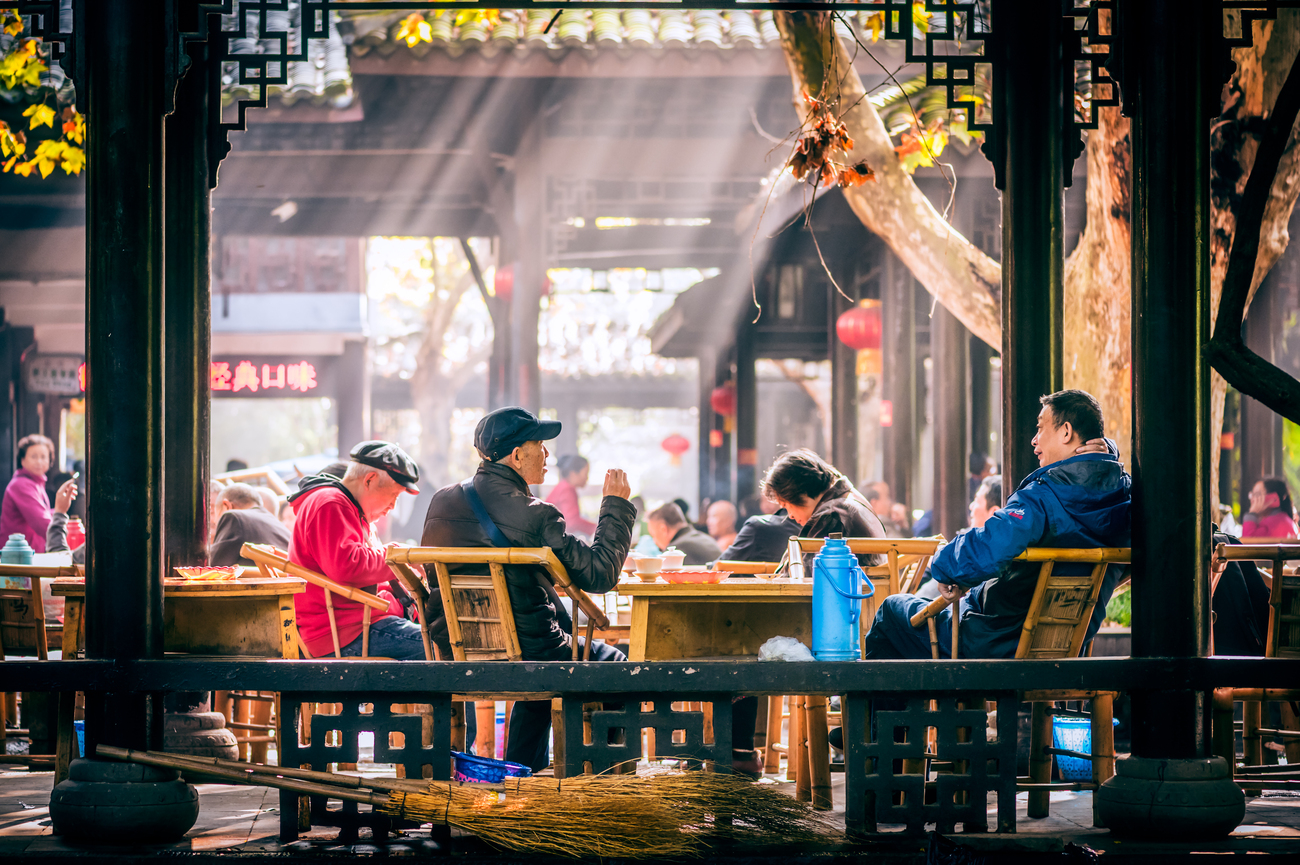
Etiquette at a Chengdu Teahouse
Sichuan's teahouse culture operates in a completely different social register from the northern banquet, and it is one of the more relaxed etiquette environments in China because relatively little of it is formal.
A teahouse afternoon is fundamentally about leisure and unhurried conversation. Basic tea etiquette still applies: serve others before yourself, show consideration to elders and hosts, and pay attention to empty cups around the table. The pace is part of the experience, and a Chengdu teahouse is best enjoyed without rushing.
The gaiwan, the traditional lidded tea bowl commonly used in Sichuan teahouses, has its own small signalling system. Resting the lid at an angle against the bowl can indicate that more hot water is needed, avoiding the need to attract an attendant's attention across a busy courtyard. The long-spouted kettles used by some teahouse attendants allow hot water to be poured from a distance, and the skill involved can become part of the experience itself.
Etiquette at Tibetan Monasteries
For travellers adding the optional Tibet extension, social etiquette at Tibetan monasteries becomes religious protocol. Sites such as the Jokhang Temple, Sera, Drepung, Tashilhunpo, and the Kumbum Stupa remain active places of worship, even when they are also major visitor attractions.
Dress modestly, with shoulders and knees covered. For practical advice on what clothing, footwear, layers, and weather protection to bring for the journey, see our What to Pack for China guide. If yak butter tea is offered, accepting the cup and taking a small sip is a respectful response, even if the salty flavour is unfamiliar.
Koras, the ritual circuits around sacred buildings and monuments, are normally walked clockwise. Follow the direction of pilgrims and avoid cutting across worshippers who are prostrating or moving through the circuit.
Photography rules vary between monasteries and even between individual chapels. Many interiors prohibit photography completely, while others allow it only in designated areas or for an additional fee. Never assume that permission in one room applies to the next.
This is where a knowledgeable private guide becomes particularly valuable. They can explain what is happening, identify when photography is inappropriate, and help travellers respond respectfully as conditions change. The wider case for this guide model is covered in the Private Guide vs. Group Tour guide.

How Chinese Etiquette Varies Across Regions
Dining customs and social expectations change noticeably across China. Northern cuisine is traditionally centred on wheat-based foods such as noodles, dumplings, and steamed buns, while rice plays a greater role in many southern regions. Formal drinking culture can also be more pronounced in northern China, where baijiu toasts may continue throughout a hosted meal.
In Beijing and Xi’an, formal dinners are more likely to involve structured seating, repeated toasts, and visible respect for hierarchy. For travellers adding the optional Guilin extension, meals in Guilin and Yangshuo often feel more relaxed, with greater emphasis on the food itself and less on formal ceremony.
Shanghai is more situational. A hosted dinner in a traditional private dining room may follow many of the same customs as a formal Beijing banquet, while a contemporary restaurant in the former French Concession may feel much closer to an international dining experience.
In Xi’an’s Muslim Quarter and other Hui communities, travellers should be sensitive to local customs and sensitivities around pork and alcohol. For travellers adding the optional Tibet extension, religious etiquette becomes particularly important at monasteries and sacred sites.

Travelling Through China with Cultural Awareness
The etiquette of a Chinese banquet, a Chengdu teahouse afternoon, and, for travellers adding the optional Tibet extension, a Tibetan monastery visit may appear very different, but the same principles run through them: respect for your host, awareness of the people around you, and an understanding that small gestures can carry meaning.
You do not need to perform every custom perfectly. What matters is arriving prepared to follow the lead of your guide or host, whether that means receiving a gift with both hands, responding warmly to a toast, asking before taking a photograph, or, for travellers adding the optional Tibet extension, walking clockwise around a Tibetan sacred site.
That awareness changes the experience. It allows you to take part in a formal dinner, a Chengdu teahouse afternoon, or, for travellers adding the optional Tibet extension, a religious visit with confidence rather than standing outside it as an observer.
A Grand Tour of China places travellers inside many different cultural settings. Knowing how to respond respectfully helps each encounter feel more natural, meaningful, and genuinely connected to the people who make it possible.
Discover the Grand Tour of China.


Let us know what you love, where you want to go, and we’ll design a one-of-a-kind adventure you’ll never forget.
Get in touch
Miriam
Travel Specialist

Nina
Travel Specialist

Abigail
Travel Specialist
Our offices:



Revigorate, Iberian Escapes and Algarve Lifestyle are the registered brand names of APCS Lda . We are a fully authorised travel agency licensed by Turismo de Portugal RNAVT/6867.
In the event of a dispute, the consumer may refer to: RAL - Centros de Arbitragem
Avª. 5 de Outubro, nº. 55, R/C Dtº. 8000-075 Faro, Portugal | Tel: +351 289 823 135 *
* national landline call
E-mail: info@consumoalgarve.pt| www.consumidoronline.pt | Mon to Fri: 9:00 - 13:00 / 14:00 - 17:00