Singapore
Art Week Gallery Districts: Gillman Barracks, Tanjong Pagar and Beyond

Spend enough Januarys following Singapore Art Week and a pattern begins to emerge. The most compelling gallery exhibitions rarely sit in isolation. They cluster in specific parts of the city that shape how the work is experienced.
Gillman Barracks draws the international gallery circuit to a quiet hill of restored colonial buildings. Tanjong Pagar Distripark shifts the focus toward the port, where vast warehouse spaces now host museum-scale installations and ambitious gallery programmes. The Bras Basah.Bugis and Civic District corridor connects photography spaces, arts centres, and major institutions within a walk that feels far more cohesive than it first appears.
Together, these districts form the underlying structure of Singapore Art Week’s gallery scene. What follows explores each in detail, while the wider context of fairs, museums, and citywide programming is covered in our insider guide to Singapore Art Week.
Gillman Barracks: Singapore’s Gallery Enclave Worth a Full Day
Gillman Barracks sits around ten minutes southwest of central Singapore, just off Alexandra Road, across 6.4 hectares of conserved colonial land. Established as a contemporary art precinct in 2012 through a joint initiative by Singapore’s Economic Development Board, JTC Corporation, and the National Arts Council, it occupies a position few art destinations in Southeast Asia can claim: a self-contained, walkable campus of serious international galleries in a setting that forms part of the experience.
The architecture matters here.
The gallery spaces occupy conserved black-and-white colonial barracks dating from the 1930s, set among mature tropical greenery. Verandas, courtyards, and covered walkways make movement through the precinct feel slower and more deliberate than any urban gallery circuit. It is an environment that encourages visitors to pause, which suits the programming unusually well.
The Galleries and What They Show
Gillman Barracks is home to a strong year-round roster of galleries, including Ames Yavuz, ShanghART Singapore, Sullivan+Strumpf, Mizuma Gallery, Richard Koh Fine Art, Ota Fine Arts, Sundaram Tagore Gallery, FOST Gallery, and Yeo Workshop.
Most are free to enter during regular opening hours. During Singapore Art Week, they launch new exhibitions in parallel and extend evening programming across the opening weekend.
The 2026 edition offered a particularly strong example of Gillman at full strength.
Mizuma Gallery presented Liminal Relic, Kemalezedine’s solo exhibition drawing on Balinese Kamasan painting traditions and ceremonial objects. The work was dense and layered, and particularly well suited to the quiet, enclosed scale of the space.
Sundaram Tagore Gallery staged The Unraveling, Anila Quayyum Agha’s first solo exhibition in Singapore, bringing together collages, embroidered drawings, resin paintings, and immersive light installations exploring race, gender, and colonial inheritance.
At Ota Fine Arts, Hilmi Johandi’s Destination Image used paintings and works on paper based on archival images of Singapore hotels, seaside scenes, and leisure infrastructure to examine how nostalgia is constructed.
Richard Koh Fine Art showed Hasanul Isyraf Idris’s Bintang Hijau, a quieter presentation of drawings and found materials rooted in a Malaysian forest reserve, offering a deliberate counterpoint to the larger installations elsewhere in the compound.
FOST Gallery’s Mirrorball: Reflections on Portraiture brought together six Singapore artists across painting, photography, and video, examining selfhood and the gaze in a way that felt especially resonant in a precinct so shaped by visibility and movement.
Gather at Gillman: Singapore Art Week Activation
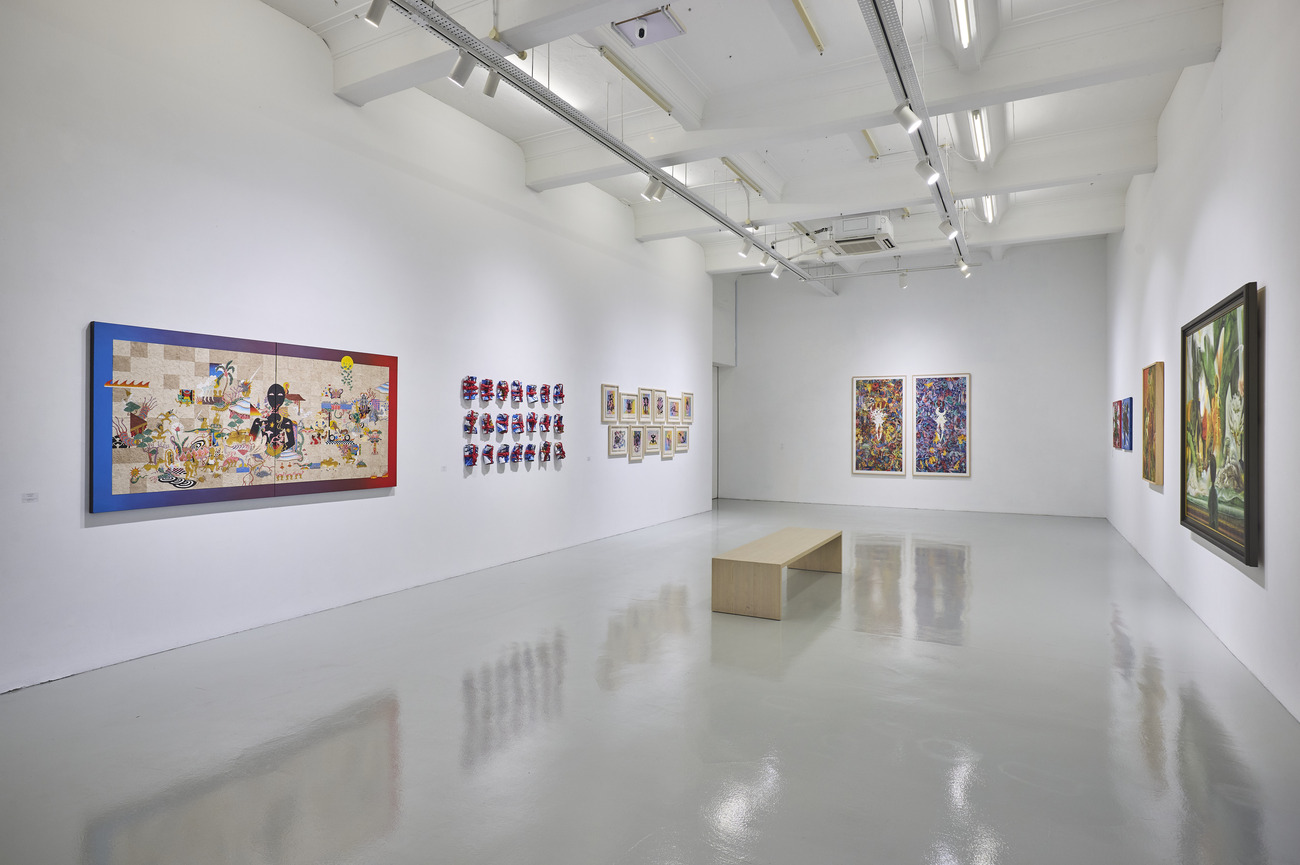
During Singapore Art Week 2026, Gillman Barracks operated as a precinct-wide activation under the title Gather at Gillman, coordinated by Art Outreach Singapore and supported by the National Arts Council.
Running from 17 to 31 January 2026, the initiative brought the independent galleries into a more unified programme through guided tours, extended hours, outdoor installations, and coordinated events, turning Gillman from a cluster of separate spaces into a more legible and connected destination.
The centrepiece was ANTZ’s The Last Tree Was a Building, four large inflatable monkey sculptures installed across Gillman’s rooftops and ledges. Drawn from the Singaporean artist’s long-running Urban Monkeys series, the works shifted in character depending on where they were encountered, playful from a distance, more unsettling at close range, and striking against the colonial architecture.
Art Outreach’s own exhibition, Cut, Ground by Ang Song Nian, operated on a quieter register. Through photographs and works on paper, it documented the maintenance workers who sustain Singapore’s urban environments, from security guards and cleaners to horticulturalists, bringing a new layer of meaning to Gillman’s own highly maintained landscape.
The high point of Gather at Gillman came on 24 January, when the precinct hosted a full-day activation with extended gallery hours until 10pm, an evening block party at Handlebar, and a curated video art screening as part of the official Singapore Art Week programme. This was the version of Gillman many visitors miss when they arrive on an ordinary gallery afternoon.
NTU Centre for
Contemporary Art Singapore
Also located within the Gillman Barracks compound, NTU Centre for Contemporary Art Singapore operates on a different register from the surrounding commercial galleries. As a research centre and exhibition space within Nanyang Technological University, it commissions residencies, produces publications, and stages exhibitions with longer development timelines. The result is programming that is often more formally demanding and less commercially oriented.
During Art Week 2026, NTU CCA presented Kent Chan’s Three Acts of the Sun, running from 18 January to 1 February, a multi-channel video meditation on climate futures, seasonal cycles, and planetary time. It also presented Reworlding, curated by Debbie Ding and running from 20 January to 15 February, a group exhibition recovering the history of virtual reality and early net art through the work of female Asian artists long overlooked within dominant digital art histories.
Both exhibitions demanded patience, and both rewarded it.
Tanjong Pagar
Distripark: Industrial Scale, Institutional Ambition
Tanjong Pagar Distripark occupies a working, port-adjacent industrial complex at 39 Keppel Road, beside the former PSA container terminal. It is not a stylised warehouse conversion. It remains an operational site, with all the spatial generosity and indifference to comfort that implies. Concrete floors, six-metre ceilings, and freight lifts that are exactly what they sound like.
Singapore Art Museum selected the site for these qualities when it opened its Tanjong Pagar space in January 2022, occupying two floors across approximately 3,000 square metres of exhibition space, including climate-controlled galleries, residency studios, and a port-facing F&B area. The decision was deliberate. The scale allows for commissions that conventional museum architecture cannot support, and the location carries its own history, the first Singapore Biennale was held in this district in 2006.
SAM at Tanjong
Pagar During Singapore Art Week
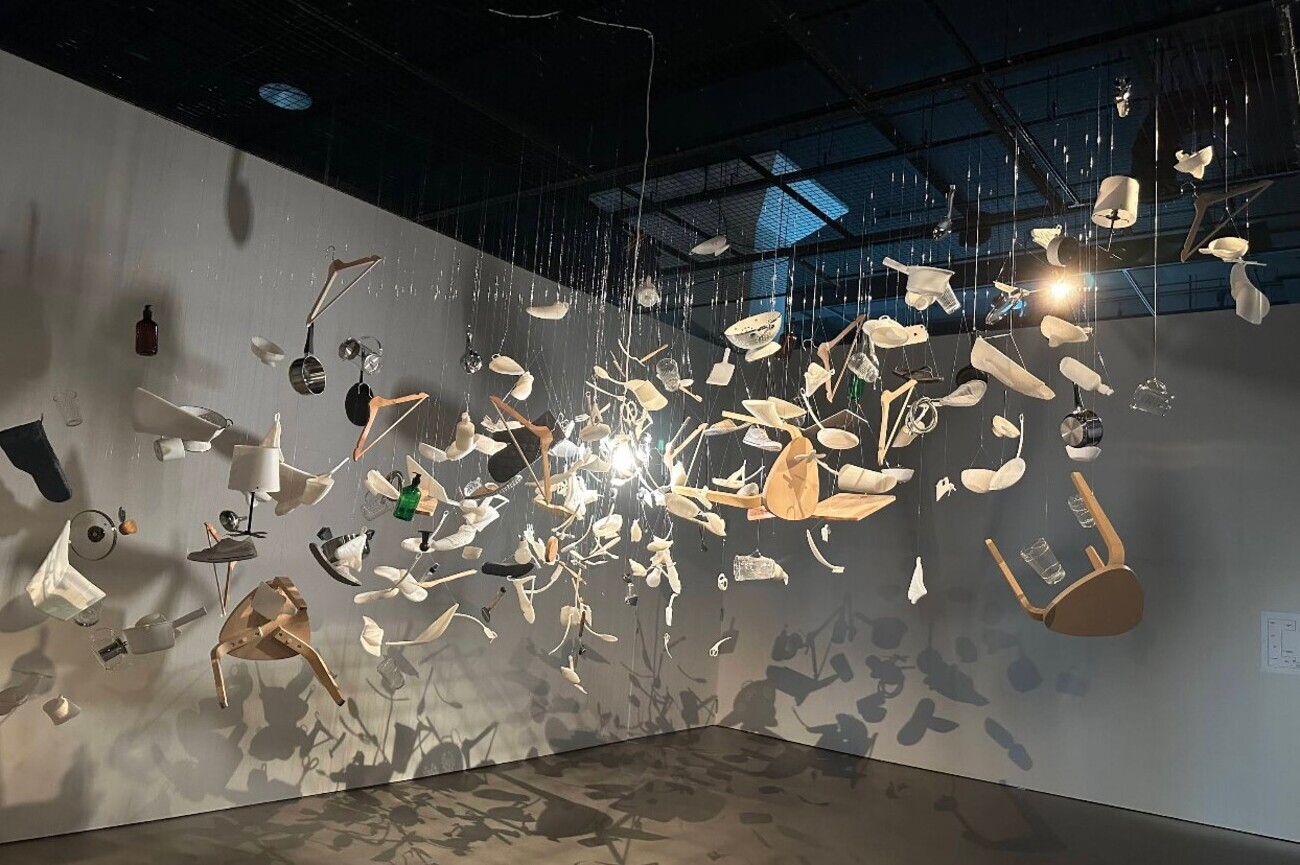
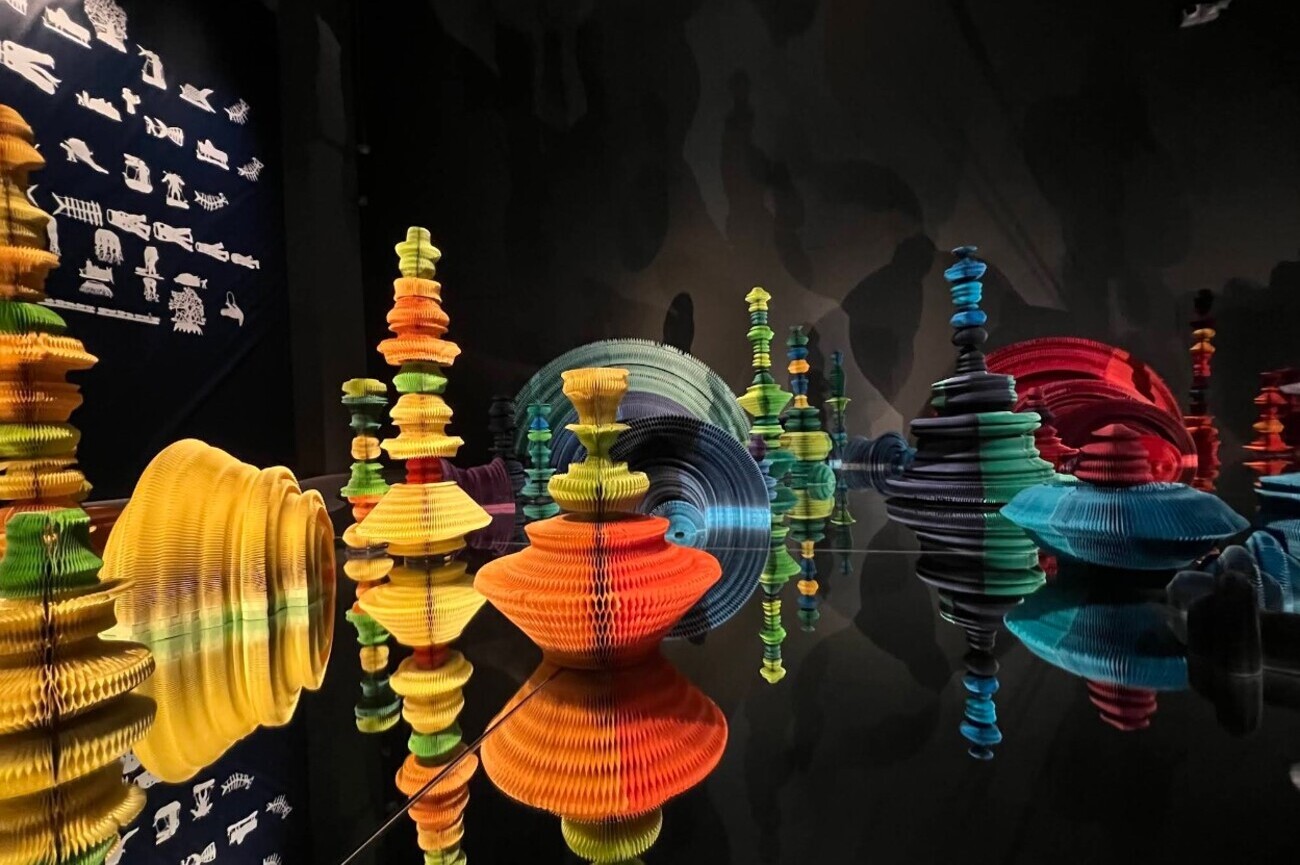
During Singapore Art Week 2026, SAM’s Tanjong Pagar space served as the primary institutional site for the Singapore Biennale 2025: pure intention, presenting major commissions across both gallery floors.
The scale of the site allowed works by Pierre Huyghe, Álvaro Urbano, Cui Jie, and Young-jun Tak to be shown as intended. Young-jun Tak’s Love Was Taught Last Friday, a single-channel video work exploring the body as choreographic extension, benefited in particular from the physical space it was given.
On 23 January, the Distripark ran extended hours, becoming the busiest single day of the Art Week programme at the site. SAM also hosted Sonic Shaman 2026: Borderless from 23 to 25 January, co-presented with TheCube Project Space from Taipei.
Taiwan’s first interdisciplinary sound festival brought together experimental electronic music, sound installations, and artist talks, transforming the museum environment into something that blurred the boundaries between performance, exhibition, and discussion. DJ Sniff and the noise-art duo lololol performed within a neon-grid setting that made the distinction between formats largely irrelevant.
SAM’s docent-led Biennale tours run throughout Art Week. They are ticketed and limited in size, and they offer access to curatorial context that is not available through the exhibition alone. In a space of this scale, the difference between a guided and unguided visit is significant.
The Gallery
Cluster at Tanjong Pagar
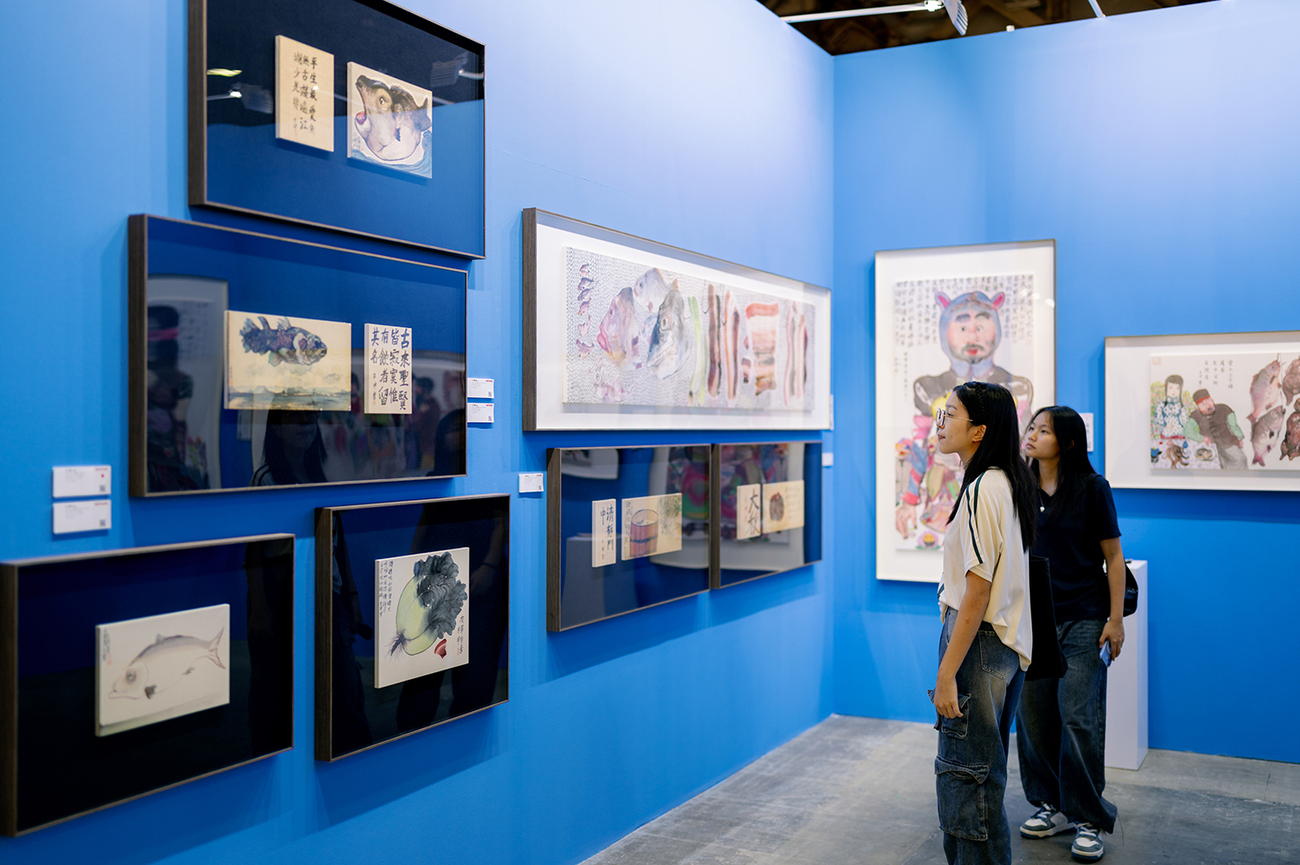
Alongside SAM, the Distripark houses a cluster of galleries and project spaces, including Gajah Gallery, ArtSpace@Helutrans, Haridas Contemporary, The Columns Gallery, Supper House, and Padimai Art and Tech Studio.
The experience is less a traditional gallery walk and more a movement through an institutional neighbourhood, where each space operates independently within a shared environment.
Gajah Gallery’s 30 Years, A Retrospective, running from 23 January to 28 February 2026, was among the most historically substantial presentations of the Art Week season. It traced three decades of Southeast Asian artistic exchange through works by Affandi, Yunizar, Chua Ek Kay, Suzann Victor, Bagyi Aung Soe, and Vasan Sitthiket, presented across two sections, Archives and Artists in Focus. Gallery founder Jasdeep Sandhu has been building this narrative since 1996, and the exhibition made its full arc visible.
The Columns Gallery presented Isang Dipang Langit: Fragments of Memory, Fields of Now, from 20 to 31 January 2026, a National Arts Council commission bringing together ten Filipino artists, including Oca Villamiel, Pete Jimenez, Alfredo and Isabel Aquilizan, Manuel Ocampo, Dominic Mangila, Eisa Jocson, and Leeroy New. The exhibition reinterpreted Amado V. Hernandez’s “sliver of sky” as a symbol of identity and hope through painting, sculpture, and performance.
At ArtSpace@Helutrans, chapalang, running from 22 January to 1 February 2026 and curated by Gunalan Nadarajan and Roopesh Sitharan, examined vernacular technological practices across Southeast Asia, focusing on how technologies are adapted, repurposed, and made local.
The VH Award Exhibition, organised by Hyundai Motor Group, presented five commissioned media works, including the Grand Prix winner Wendi Yan’s Dream of Walnut Palaces, a CGI animation using AI to reimagine knowledge exchange between China and Europe in the eighteenth century.
Supper House’s 空城 (Kong Cheng / Empty City), running from 22 January to 21 February 2026, reconfigured the gallery space into an HDB-inspired architectural installation, questioning display conventions and cultural hierarchies within the Singaporean art context. It was a proposition that the Distripark’s industrial setting made possible.
For a full view of the institutional programme at SAM and the wider Singapore Biennale, see our guide to Singapore Art Week museums and exhibitions.
Bras Basah.Bugis and the Civic District: Singapore Art
Week’s Most Walkable Cultural Corridor
The Bras Basah.Bugis precinct and the adjacent Civic District form the most walkable corridor of Singapore Art Week, running from photography spaces and arts centres along Middle Road and Waterloo Street through to the National Gallery and the wider Civic District along St Andrew’s Road. The distance is easily manageable on foot, and during Art Week the concentration of programming here is strong enough to fill an entire morning, and often well into the evening.
Bras Basah.Bugis: Photography, Media Art, and Independent Spaces
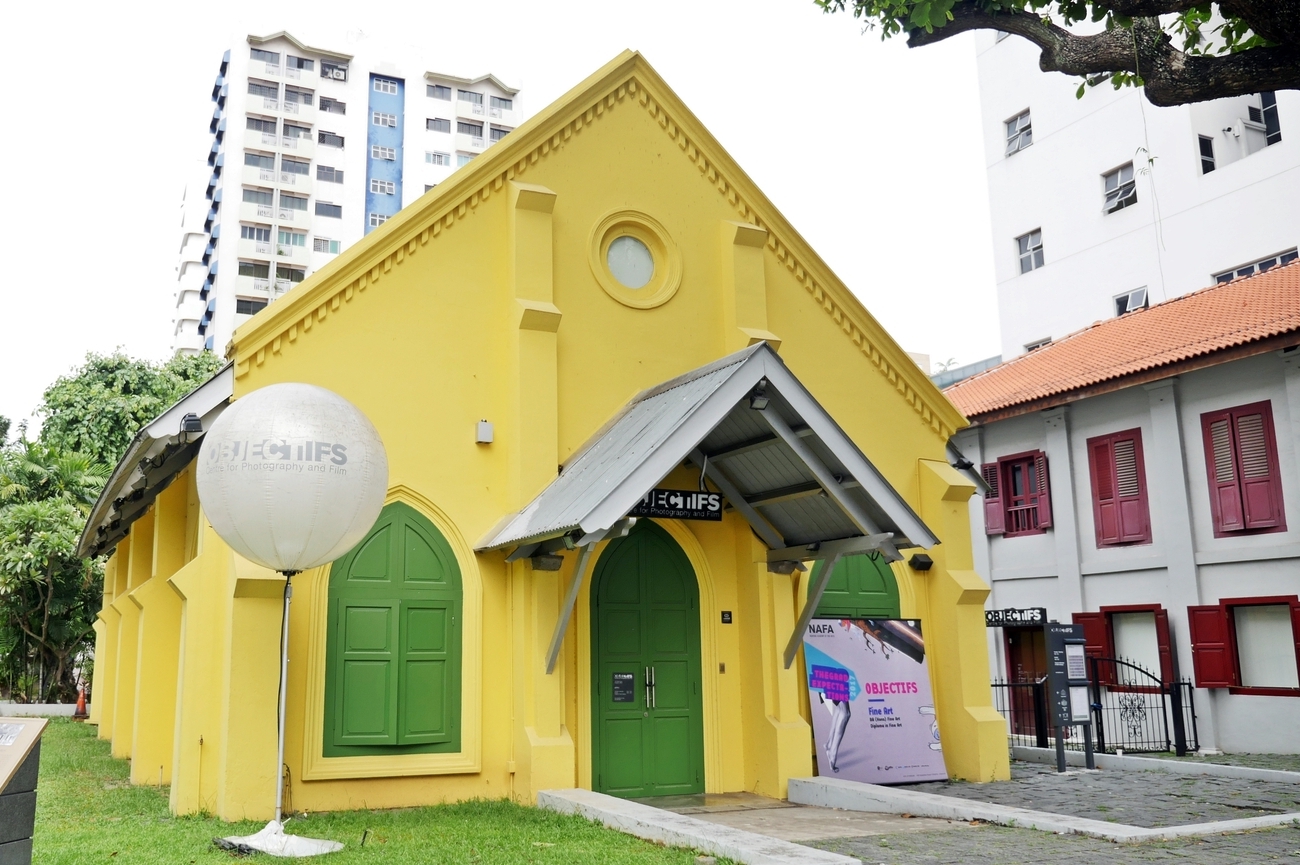
Objectifs Centre for Photography and Film on Middle Road presented In Our Own Frame through March 2026, a group photography exhibition that reinforced the centre’s reputation as one of Singapore’s most rigorous spaces for photographic and moving-image work. Just outside, Exposure_Exposure activated the building’s outdoor edges, placing works by five local artists along the busy intersection of Middle Road and across the surrounding streetscape.
The curatorial premise was that these works would shift in appearance as they were shaped by foot traffic, movement, and environmental conditions, a public programme that behaved differently depending on when it was encountered.
At DECK Photography Art Centre, Joanne Pang’s site-specific installation The Womb Never Forgets (Prinsep Street), running from 17 January to 28 February 2026, responded to the site’s proximity to the former Salmon’s Maternity Home. The work evoked the invisible infrastructures of care and the institutional memory embedded in the neighbourhood.
On Waterloo Street, Stamford Arts Centre continued its role as one of the quieter but more consistently rewarding spaces in the district, presenting independent programming throughout Art Week, including The Strange Archive, an exhibition that reimagined the archive as a living and contested space of care, continuity, and labour.
The Civic District: From Daytime Route to Evening Programme
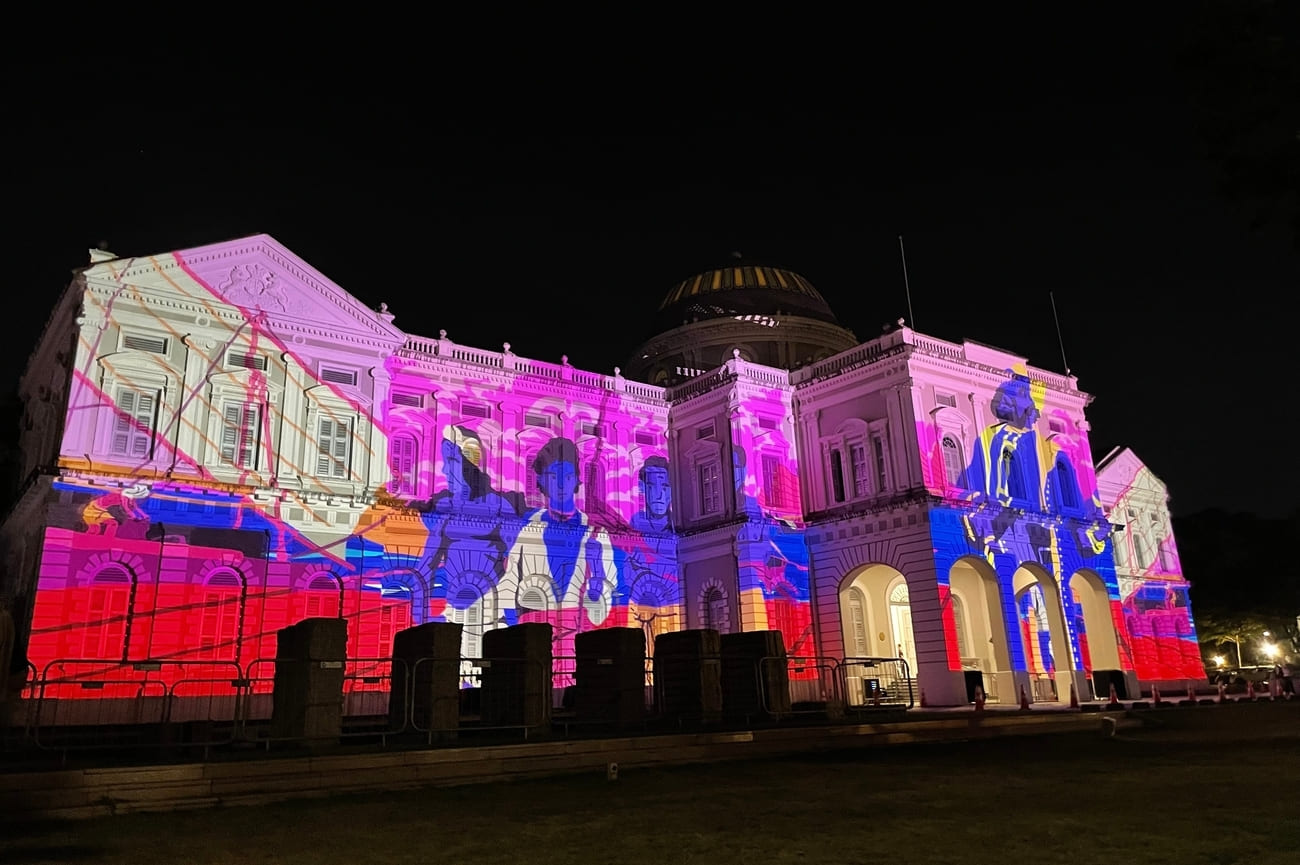
The stretch from the National Gallery Singapore to the Asian Civilisations Museum and The Arts House at the Old Parliament is where Singapore Art Week becomes most visible at street level. Public art trails link sculpture, installation, and architecture across the district, and during Light to Night weekends, façade projections and outdoor works turn the area into an extended evening programme.
No Wrong Turns Here!, an interactive mural guiding visitors through the Bras Basah.Bugis creative district with a map of hidden murals and neighbourhood stories, ran as a self-guided public programme during Art Week. It added an outdoor layer to the corridor that required neither ticket nor reservation. The Civic District art trail, one of six district trails presented during Singapore Art Week 2026, ran south from the National Gallery through the waterfront, connecting the daytime route to the evening programme.
The atmosphere here after dark is distinct from any other part of Art Week. The National Gallery’s colonial façade under projection, the installations along St Andrew’s Road, and the terrace at The Arts House belong to a specific combination of architecture, programme, and time of day that Singapore Art Week creates, and that the city does not replicate at any other moment in the year.
Planning the Singapore
Art Week Gallery Districts Properly
Reading about Singapore Art Week’s gallery districts and experiencing them with the right access already arranged are materially different things. The most important openings at Gillman Barracks there on the evening of 24 January carried a social and conversational dimension that depended on knowing the schedule and planning the evening around it. SAM’s curator-led Biennale tours at Tanjong Pagar were ticketed and limited in capacity. The extended hours at Distripark on 23 January made it the most productive day to visit, but only if the itinerary had been structured around it in advance.
Restaurants matter here too. Gillman Barracks has its own dining options, with Whitegrass, Naked Finn, and Timbre+ nearby, but the rhythm of the evening matters. Gallery openings move naturally into dinner, and the restaurants worth booking during Art Week are rarely available at short notice.
Revigorate’s six-day itinerary sequences these districts across dedicated days. Day 2 pairs the Civic District programme with Gillman Barracks, including gallery opening evenings and the Gather at Gillman extended hours. Day 3 is built around Tanjong Pagar Distripark and the ART SG fair floor. The sequence is deliberate, and gallery opening invitations, SAM tour bookings, and dinner reservations are confirmed before arrival rather than assembled on the day itself.
The Singapore Art Week Insider Access: 6-Day Art & Design Itinerary was designed to make these districts work as they are meant to, with the access layer already resolved.
After the Galleries Close: Singapore Art Week Evenings
The most interesting side of Singapore Art Week rarely appears on the programme itself. It unfolds in the in-between hours.
When Gillman Barracks shifts from quiet afternoon viewings to courtyards filled with collectors and curators comparing notes. When a performance at Tanjong Pagar Distripark ends, but the conversation continues elsewhere. The week moves through these smaller circles of access as much as it does through the exhibitions themselves.
Experiencing that layer of Art Week comes down to preparation. Knowing which evenings matter, which openings draw the city’s gallery network together, and which reservations need to be secured well before the week begins.
Our Singapore Art Week insider access 6-day itinerary was built around exactly this part of the experience. The galleries, museum programme, fair visits, and the dinners that follow them are already arranged in the right sequence before you arrive.
If Singapore Art Week is on your radar for next year, this is where the conversation begins.


Let us know what you love, where you want to go, and we’ll design a one-of-a-kind adventure you’ll never forget.
Get in touch
Miriam
Travel Specialist

Nina
Travel Specialist
Abigail
Travel Specialist
Frequently Asked Questions
- What are the main gallery districts during Singapore Art Week?
The main gallery districts during Singapore Art Week are Gillman Barracks, Tanjong Pagar Distripark, and the Bras Basah.Bugis and Civic District corridor. Together, they form the core structure of the city’s gallery scene during the week.
- Why is Gillman Barracks worth visiting during Singapore Art Week?
Gillman Barracks is one of Singapore’s most distinctive contemporary art precincts, set across restored colonial barracks surrounded by tropical greenery. During Singapore Art Week, it hosts major gallery openings, outdoor installations, guided tours, and extended evening events.
- Which galleries are based at Gillman Barracks?
Gillman Barracks is home to galleries such as Ames Yavuz, ShanghART Singapore, Sullivan+Strumpf, Mizuma Gallery, Richard Koh Fine Art, Ota Fine Arts, Sundaram Tagore Gallery, FOST Gallery, and Yeo Workshop.
- What is Gather at Gillman during Singapore Art Week?
Gather at Gillman is a precinct-wide activation coordinated by Art Outreach Singapore, bringing galleries together through extended hours, guided tours, outdoor installations, and events during Singapore Art Week.
- What makes Tanjong Pagar Distripark unique during Singapore Art Week?
Tanjong Pagar Distripark offers industrial-scale exhibition spaces near the port, hosting Singapore Art Museum, Biennale installations, performance programmes, and a cluster of contemporary galleries.
- What can visitors expect at SAM at Tanjong Pagar Distripark?
Visitors can expect large-scale Biennale commissions, installations, video works, and curator-led tours within a spacious industrial setting designed for ambitious contemporary art presentations.
- What is the Bras Basah.Bugis and Civic District corridor?
It is a walkable cultural corridor linking photography centres, arts venues, and major institutions like the National Gallery Singapore, offering a cohesive route during Singapore Art Week.
- How can Revigorate help plan a Singapore Art Week experience?
Revigorate curates tailored Singapore Art Week itineraries with VIP access, gallery opening invitations, curated scheduling, and restaurant reservations, ensuring a seamless and well-structured experience across the city’s key art districts.
Our offices:



Revigorate, Iberian Escapes and Algarve Lifestyle are the registered brand names of APCS Lda . We are a fully authorised travel agency licensed by Turismo de Portugal RNAVT/6867.