Sheung Wan & Tai Ping Shan: Medicine Streets, Temples & Hong Kong Heritage
Beyond the glass towers of Central lies Sheung Wan and Tai Ping Shan, a neighbourhood shaped by trade, ritual, and the resilience of its Chinese community.
These quarters are more than atmospheric streets. They reveal how Hong Kong’s Chinese population built commerce, civic institutions, and cultural life under colonial rule.
The scent of medicinal roots, dried seafood shops, and incense-filled air of Man Mo Temple immerse visitors in a part of Hong Kong where history remains active rather than static.
This exploration of Sheung Wan and Tai Ping Shan forms one chapter in our wider guide, Imperial Hong Kong: a deep guide to the city’s culture, art & living history, tracing Central, Yau Ma Tei, and the colonial and Chinese forces that shaped the city.
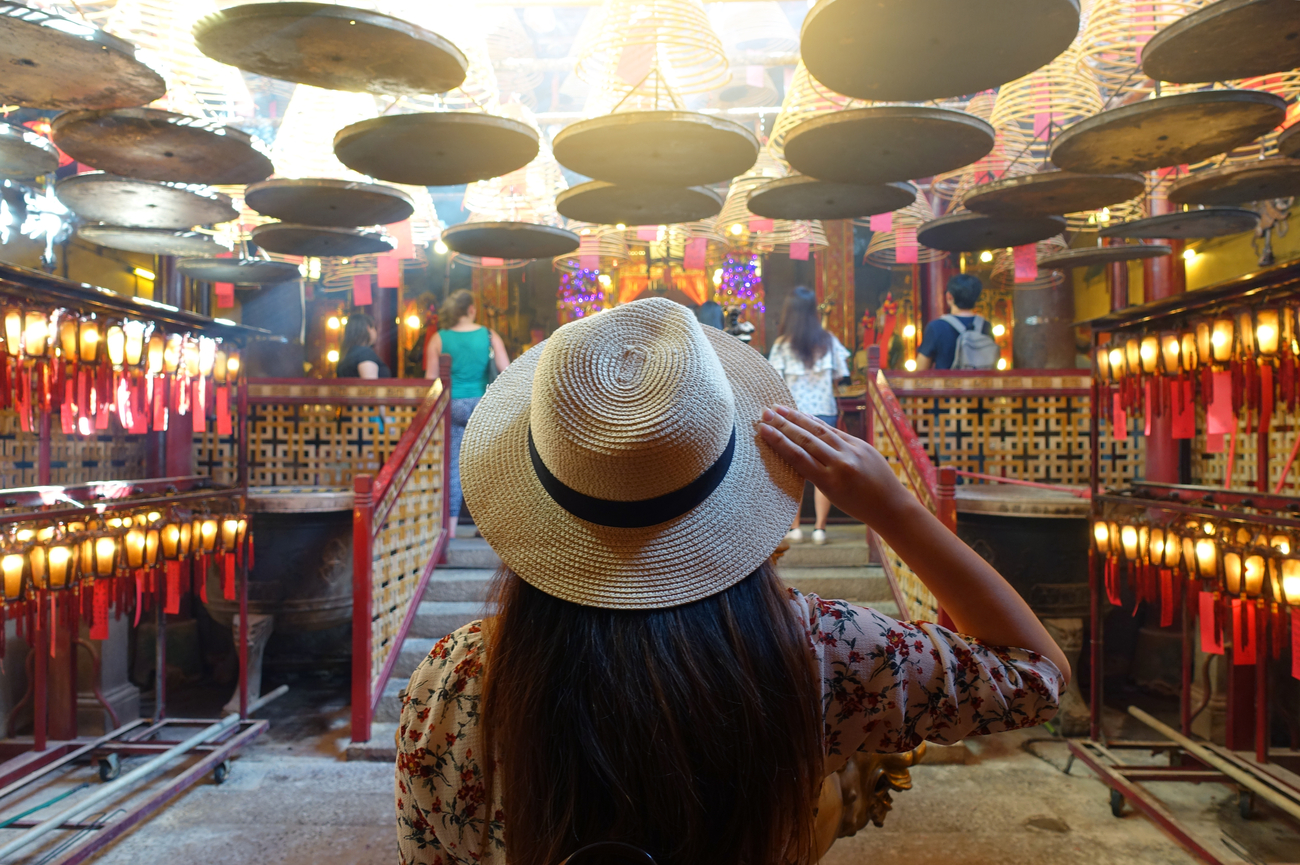
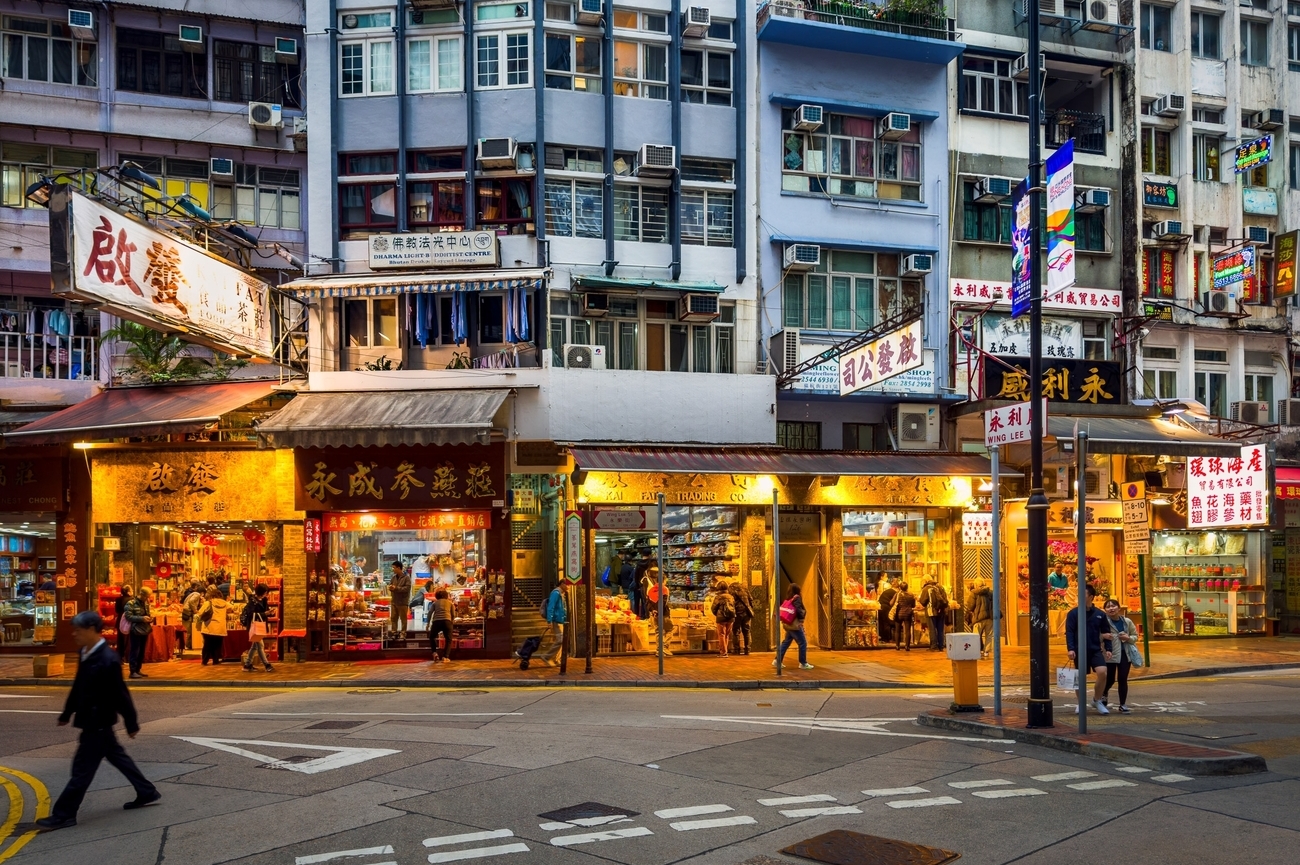
How Sheung Wan Came to Exist
When the British established Hong Kong as a colony in 1841, they made a decision that would shape the social geography of Hong Kong Island for generations. Prime sites in Central were reserved for Western-style buildings and European residents, while Chinese residents were directed westward to an area then known as Choong Wan, now Sheung Wan and Tai Ping Shan.
That distinction matters. The Chinese community did not settle here entirely by choice. It was pushed into a geography defined by colonial priorities, kept at a deliberate distance from the administrative core.
What followed says everything about the resilience of the community that made this area its own. Within a generation, Sheung Wan had developed its own hospitals, schools, legal institutions, and a commercial network built on the dried seafood and medicine trades. That economy would go on to fund the very social infrastructure the colonial government had failed to provide.
The British built Central to project authority. Chinese merchants built Sheung Wan to survive, and then to prosper. Standing today near Hollywood Road and Man Mo Temple, you are looking at the result of that determination.
The Medicine Streets: A
Living Wholesale District
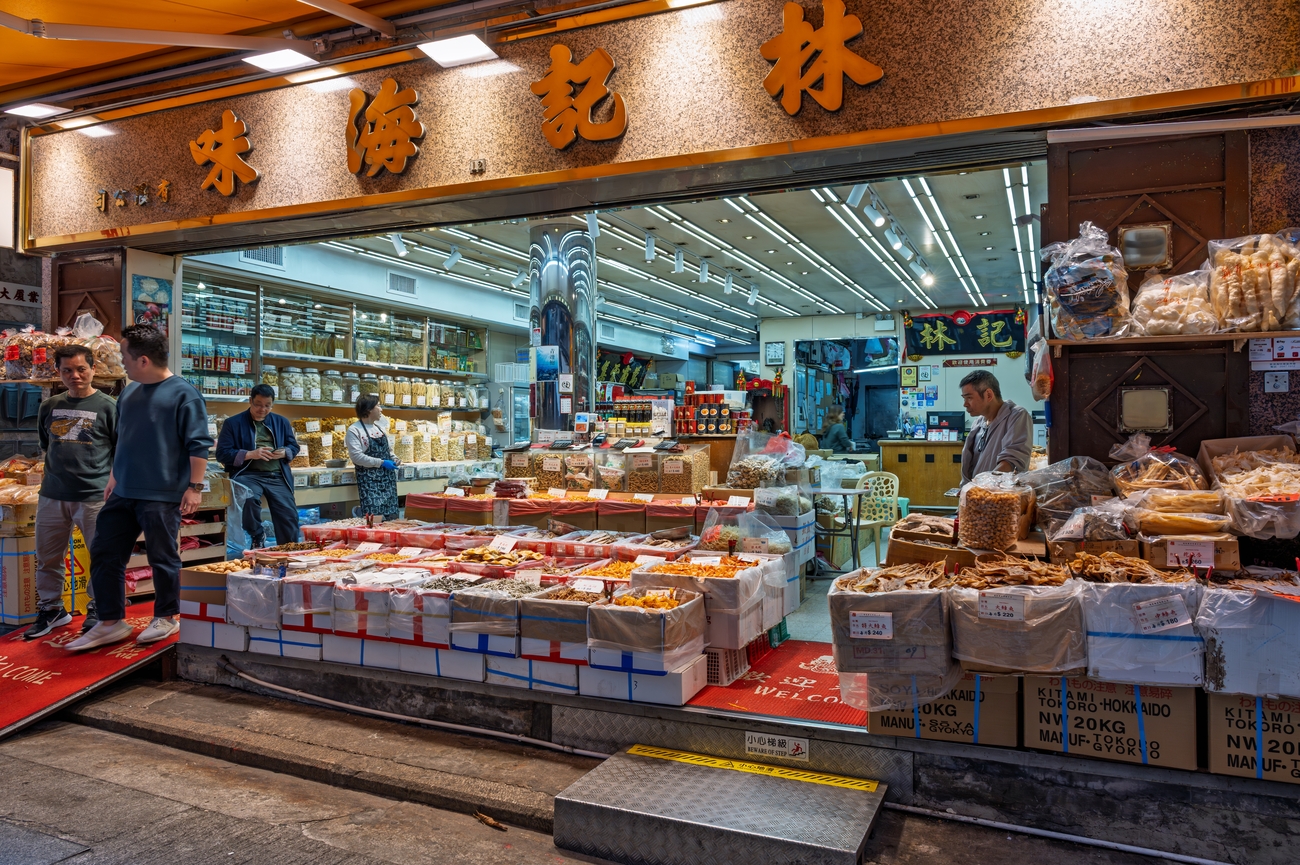
Des Voeux Road West, Wing Lok Street, and Bonham Strand West have formed the heart of Hong Kong’s dried seafood and traditional medicine trade since the mid-19th century. In the early 20th century, the area around Des Voeux Road West was known as the Salted Fish Compound, before the trade moved further upmarket and the streets became associated with what are now widely understood as Dried Seafood Street and Tonic Food Street. Today, more than 200 shops still line these blocks.
The goods traded here are not casual souvenirs, but the prized ingredients of Chinese banquet cooking and traditional medicine: dried abalone, sea cucumber, fish maw, bird’s nest, premium shiitake, and a vast range of roots, fungi, and tonic herbs documented in classical Chinese medical texts over centuries. This is not a market built for visitors. Prices are quoted by the kilogram to wholesale buyers who have often known the same vendors for decades. The paper boxes stacked along the pavement are heading into vans, not travellers’ luggage.
What makes these streets worth exploring slowly is their continuity. This is not simply an old district that has survived. It is a trading network that still functions much as it was intended to. Much of the trade was developed by Chiu Chow merchants in the 19th century and helped sustain the Nam Pak Hong trading community, which organised its own security, timekeeping, and firefighting before colonial institutions provided such services. The prosperity generated here also helped fund Tung Wah Hospital, which opened in 1872 and offered free medical care to the Chinese community at a time when colonial public health provision was lacking. Every sack of dried scallops, every herb drawer, and every storefront here carries more history than first appears.
- Des Voeux Road West, the main dried seafood corridor, known for abalone, sea cucumber, fish maw, bird’s nest, and dried shiitake. It is at its busiest from around 8am, when wholesale buyers begin to arrive.
- Ko Shing Street, the traditional Chinese herbal medicine wholesale strip, lined with roots, bark, cordyceps, ginseng, and medicinal herbs. The scent here is distinct from the seafood streets and worth experiencing in its own right.
- Wing Lok Street and Bonham Strand West, the wider trading network, where tonic food shops, rice merchants, and traces of the old Nam Pak Hong trading tradition still remain.
Man Mo Temple: More than a Place of Worship
Man Mo Temple at 124-126 Hollywood Road appears in almost every guidebook as a Taoist temple. That description is accurate, but incomplete. Built between 1847 and 1862 by wealthy Cantonese merchants, the three-block compound functioned not only as a religious site, but also as a community court and the closest thing Hong Kong’s Chinese quarter had to a civic hall in the colony’s early decades.
The main temple is dedicated to two gods:
- Man Cheong, the God of Literature and patron of civil examinations.
- Mo Tai, also known as Kwan Ti, the God of Martial Arts.
Their presence on the same altar expresses a Confucian ideal, the balance between scholarly and martial virtue. But the role of the compound extended far beyond religious devotion.
Kung Sor, the rightmost block, served as the community assembly hall, where merchants and neighbourhood leaders resolved disputes, drafted petitions to the colonial government, and managed civic affairs that colonial institutions had no direct mechanism to handle.
The oaths sworn in Kung Sor were recognised by colonial courts, largely because the courts had no more effective way of reaching the Chinese community. When the administration needed access to local society, it often had to rely on the very structure the community had created for itself.
- Lit Shing Kung, the middle block, was built for the worship of all heavenly gods, an intentionally inclusive designation that reflects the practical pluralism of Cantonese popular religion. The compound was declared a monument in 2010 and remains under the management of the Tung Wah Group of Hospitals, as it has been since the Man Mo Temple Ordinance of 1908. The annual Autumn Sacrificial Rites, held around the 25th day of the ninth lunar month, still bring the hospital board’s directors through Sheung Wan in formal procession.
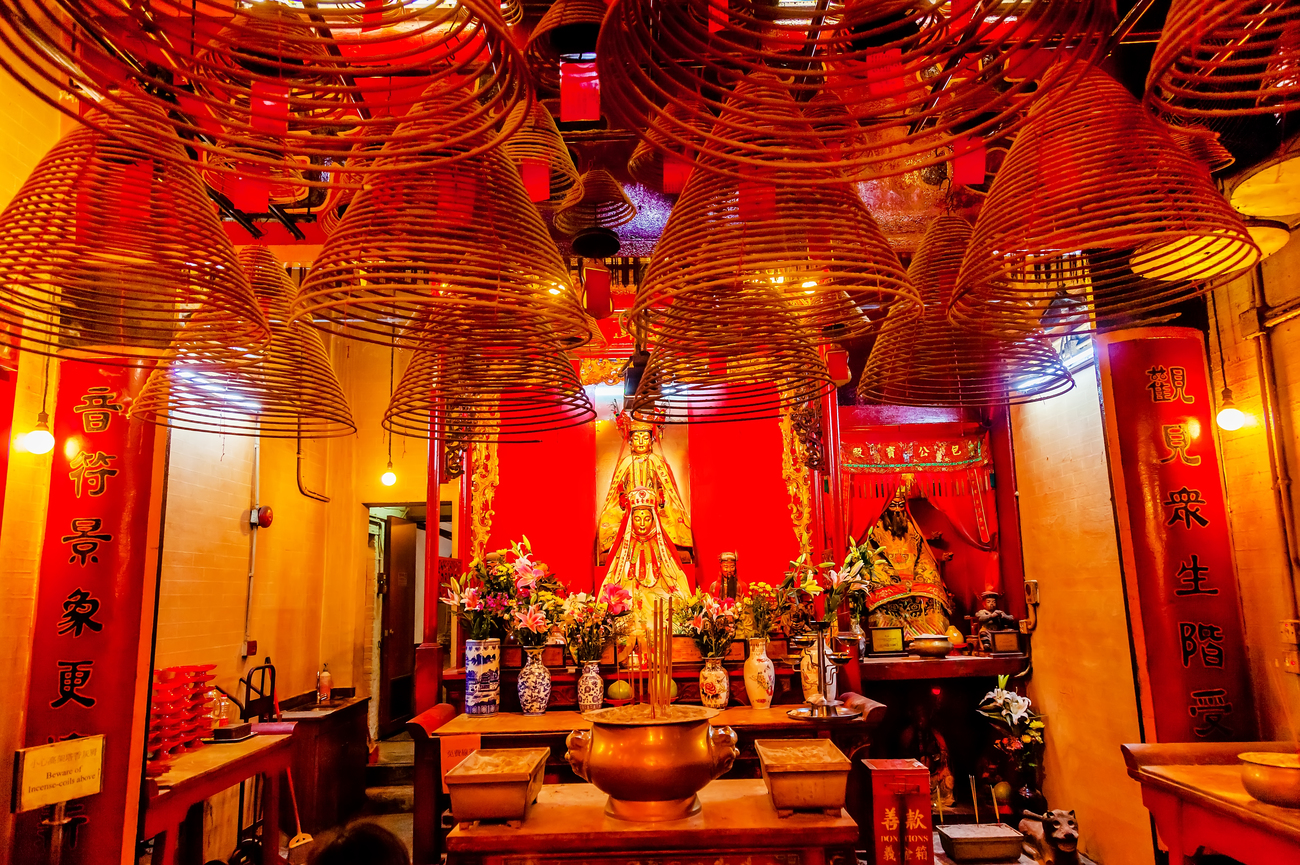
- Inside the main hall, the large hanging incense coils are not decoration, but offerings from worshippers, burning for weeks at a time. The air is thick with sandalwood. The 1847 bronze bell and the 1862 sedan chair once used to carry the deities’ effigies in ceremonial processions are still here. It is a place best experienced slowly. Entry is free, daily from 08:00 to 18:00.
The wider story of Hong Kong’s syncretic religious traditions, from Man Mo’s Confucian-Taoist duality to the three-teaching coexistence of Wong Tai Sin in Kowloon, is explored in Imperial China in Hong Kong: palace museum, Qing court symbolism & Chinese aesthetics.
Tai
Ping Shan: The Quarter Before the City Was Fully Formed
The 300-metre stretch of Tai Ping Shan Street, running parallel to Hollywood Road on the northern slope below Victoria Peak, is the oldest surviving Chinese residential street in Hong Kong.
Its name, Peace Hill, carries an obvious irony. By 1860, the Chinese writer Wang Tao described the street as lined with brothels, with brightly painted doors, windows, and curtains. The colonial administration had directed the Chinese population here while providing almost nothing in the way of sanitation or infrastructure. The consequences were severe, and entirely predictable.
In May 1894, the bubonic plague erupted in Tai Ping Shan. The disease had already been moving through Yunnan and Guangdong for decades, but when it reached Hong Kong, this was the district it devastated most severely.
- More than 3,500 people died in the first year alone, and the epidemic returned repeatedly until 1929, ultimately killing more than 20,000 people.
- The Swiss bacteriologist Alexandre Yersin arrived in Hong Kong in June 1894 and, working in a makeshift laboratory near Tai Ping Shan, identified the bacillus responsible for the disease.
- The pathogen was named in his honour: Yersinia pestis.
- The Bacteriological Institute, built in 1906 on the edge of the affected area and now the Hong Kong Museum of Medical Sciences at 2 Caine Lane, continued the research that helped turn plague from a catastrophic threat into a treatable disease.
The colonial response reshaped Tai Ping Shan physically. By the end of 1894, the Legislative Council had ordered the demolition of 384 houses in the district. Soldiers in the so-called Whitewash Brigade went from door to door burning furniture and wooden structures. The cleared land became Blake Garden, Hong Kong’s first public park, which still exists today. What replaced the overcrowded slum was a more orderly grid of streets. What followed socially was slower and far more complicated, the gradual building of institutions the local community actually needed. Tung Wah Hospital, already established on the edge of the neighbourhood in 1872, became one of its most important anchors.
Today, Tai Ping Shan Street is something the 19th century could not have imagined. Independent cafés, ceramics studios, craft galleries, and small local businesses now occupy the low-rise buildings that replaced the old tenements.
The older religious life of the area, however, remains fully present.
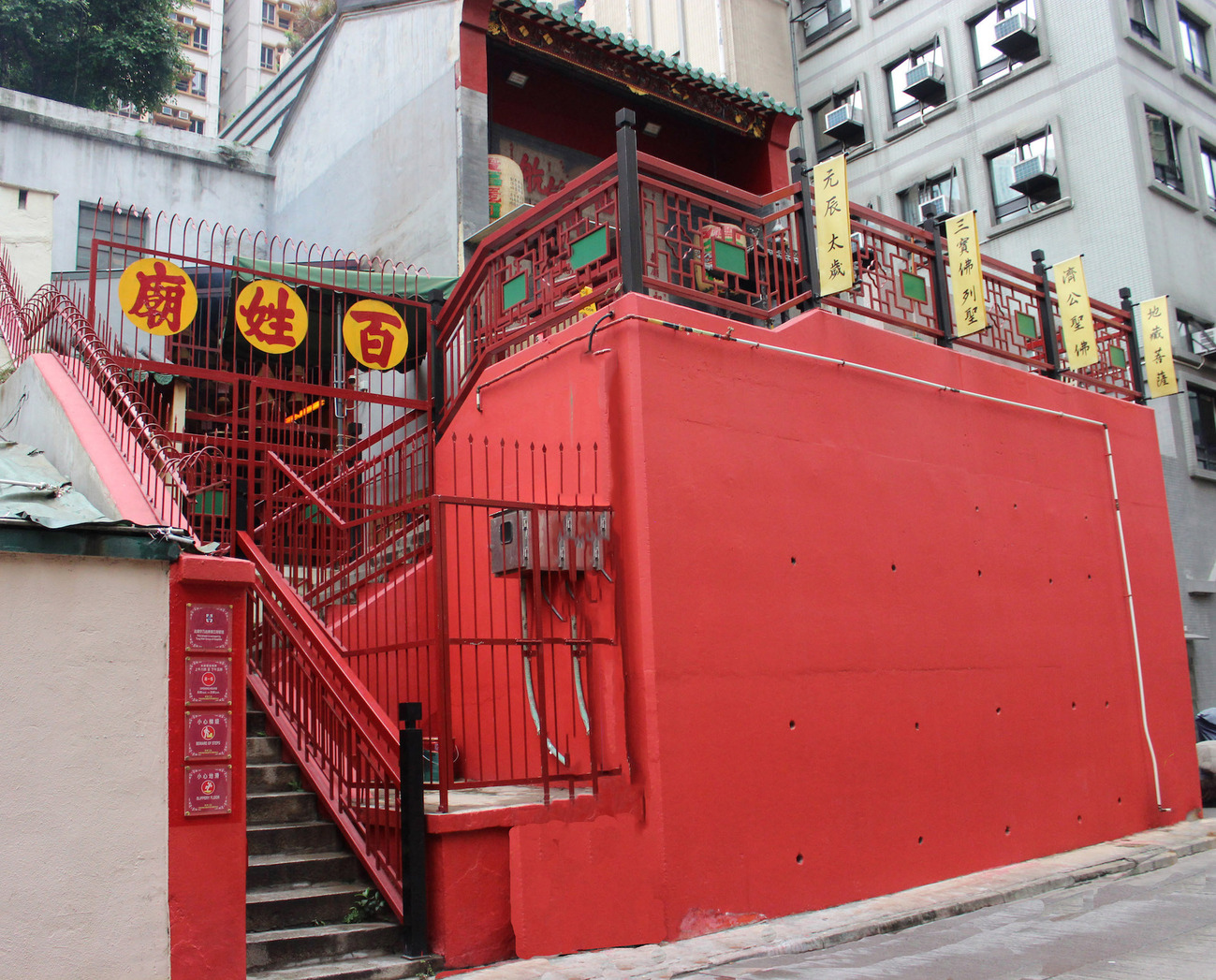
- The Kwong Fook I Tsz at No. 40, built in 1856, remains vermilion-painted and heavy with incense smoke.
- The Kwun Yam Tong at No. 34 dates to 1840.
These are not heritage set pieces. They are active shrines in a living neighbourhood that has absorbed nearly two centuries of upheaval without turning itself into a museum.
Hollywood
Road: The Antique Corridor and What Still Surrounds It
Hollywood Road is one of Hong Kong’s most revealing cultural seams. Completed in 1844 as the second major road in colonial Hong Kong, it runs west from the administrative core of Central through the antique district and into Sheung Wan, ending near Man Mo Temple. It was originally built to carry supplies between the military barracks at Possession Point and the colonial administrative buildings further east. Very quickly, it became something more, a trading corridor where Chinese and Western commercial worlds met, overlapped, and negotiated their terms.
The antique trade along Hollywood Road has a long history, but it accelerated dramatically in the 20th century as Qing furniture, Ming ceramics, and Tang dynasty objects moved through Hong Kong’s role as a transit market.
At its peak in the 1970s and 1980s, the street was one of the world’s major markets for Chinese imperial material culture.
- Objects from the Summer Palace, private Qing collections, and wholesale export channels opened during the Cultural Revolution all passed through Hong Kong.
- Some of the finest pieces acquired here during that period later entered major museums in Europe and North America.
The street is quieter now. Rising rents have reduced the number of galleries, and several historic dealerships have disappeared. What remains, however, is still substantial, and worth understanding before you walk it.
- Liang Yi Museum, 181 Hollywood Road: a private institution housing one of the world's finest collections of Ming and Qing dynasty huanghuali and zitan furniture, started in the 1980s by financier Peter Fung from pieces purchased on this same street. Four floors, by appointment only, which is part of what makes the visit worthwhile.
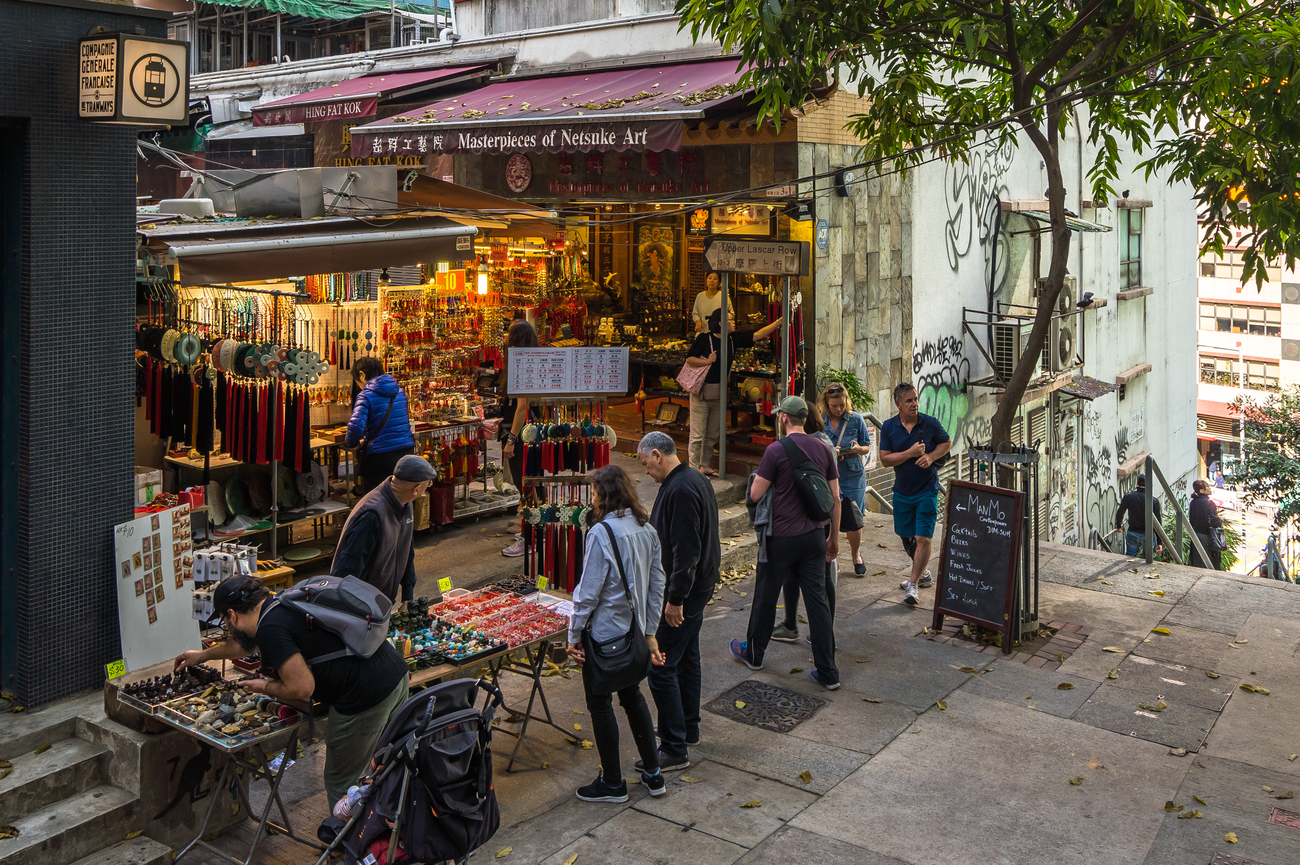
- Cat Street or Upper Lascar Row, running below and parallel to Hollywood Road, where curios, vintage coins, jade trinkets, old propaganda posters, and other overlooked objects reward patience and a careful eye. It operates in a very different register from the more serious galleries above.
- The surviving antique galleries, which still tend towards the serious end of the market, with Qing ceramics, scholar’s objects, and Tang tomb figures. Here, the difference between a documented piece and a reproduction matters, and it matters most if you know how to look.
PMQ at 35 Aberdeen Street, a short walk away, occupies the former Police Married Quarters built in 1951. Opened as a creative hub in 2014, it now houses around a hundred Hong Kong designers and independent studios across the original apartment blocks.
The building is an architectural curiosity, a mid-century institutional structure now occupied by exactly the kind of creative community colonial housing was never intended to support. Sitting between Hollywood Road’s antique past and Tai Ping Shan’s contemporary creative energy, it captures something essential about how this part of Sheung Wan continues to evolve.
The
Dr Sun Yat-sen Museum: Where Revolutionary Ideas Took Shape
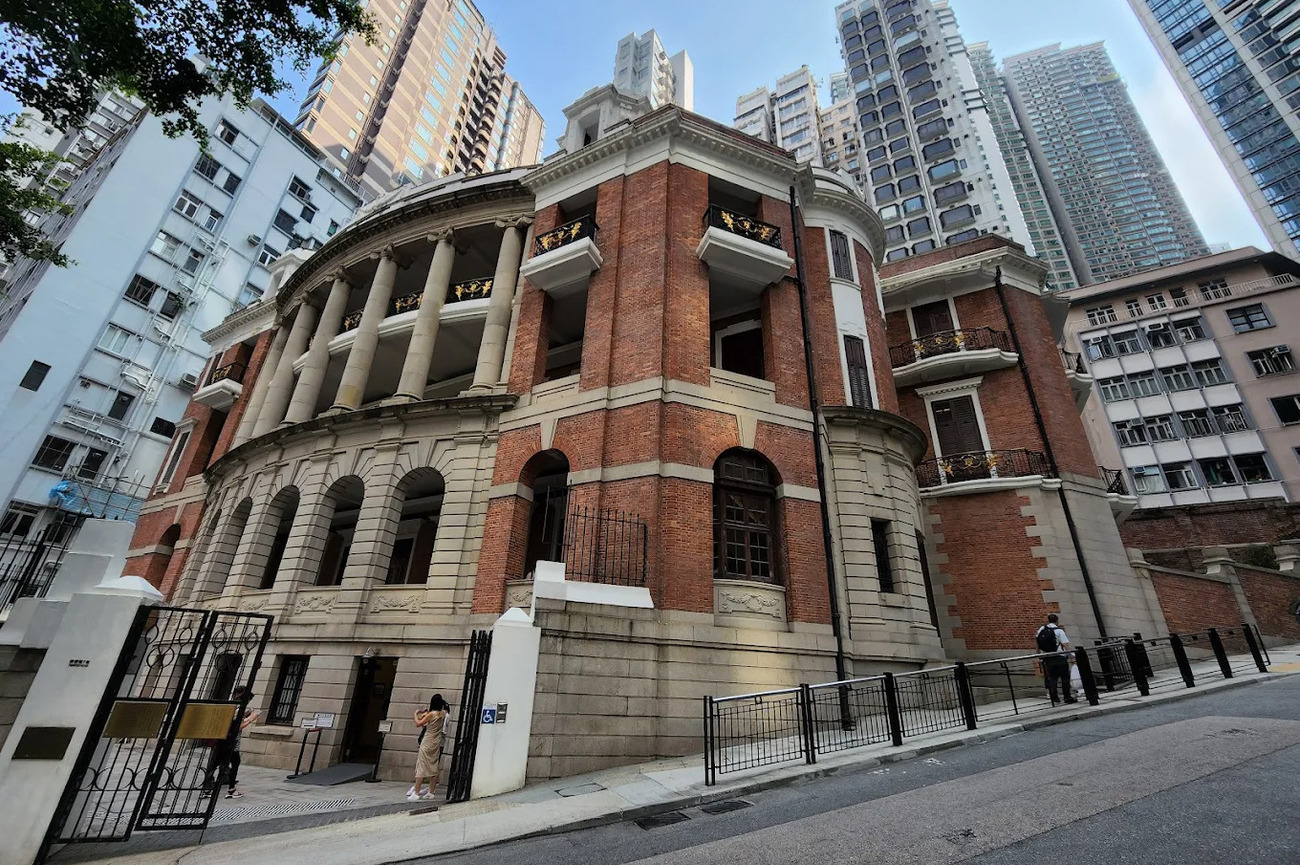
At 7 Castle Road in the Mid-Levels, a short walk from the Hollywood Road antique corridor, Kom Tong Hall stands behind granite columns with the quiet authority of a building that has lived several different lives and outlasted each of them.
Built in 1914 as the residence of the businessman Ho Kom-tong, younger brother of the philanthropist Sir Robert Ho Tung, the Edwardian mansion was among the first private homes in Hong Kong to be constructed with a steel frame and built-in electrical wiring. In 1960, it became the Hong Kong headquarters of the Church of Jesus Christ of Latter-day Saints, and around 5,000 people were baptised in its ground-floor hall.
Sun Yat-sen’s connection to Hong Kong was far from incidental. He received his secondary education at the Government Central School on Gough Street and his medical training at the College of Medicine for Chinese on Hollywood Road. He was baptised at the Preaching Home of the American Congregational Mission on Bridges Street, only a short walk away. In 1894, the same year plague was devastating Tai Ping Shan, he established the headquarters of his Revive China Society on Staunton Street. Hong Kong was not where he carried out his revolution, but it was where many of the ideas behind it were formed.
The permanent exhibitions trace both sides of that story, Sun’s revolutionary career and Hong Kong’s role as a base for political dissent in the final years of the Qing dynasty. Among the objects on display are:
- His examination answer sheet from the Hong Kong College of Medicine
- A dinner menu from his graduation ceremony
- The abdication edict of the last Qing emperor Xuantong signed in February 1912.
- A seal of 'Long Live the Republic of China.'
The building itself adds another layer to the story. It is a Chinese merchant’s Edwardian mansion, built in the architectural language of colonial prestige because, in 1914, that was the language of status available to wealthy Hong Kong Chinese. The point is visible before you even begin reading the labels.
- Address: 7 Castle Road, Central, Hong Kong (Mid-Levels)
- Opening hours: Monday to Saturday 10:00-18:00, Sunday and public holidays 10:00-19:00. Closed Thursdays.
- Admission: HK$10; free on Wednesdays and on November 12 (Sun's birthday) and March 12 (his death anniversary)
- Current special exhibition (through March 2026): 'From Healing Patients to Saving a Nation — Dr. Sun Yat-sen in Guangdong, Hong Kong and Macao'
The colonial power structures that shaped where Sun Yat-sen could and could not operate in Hong Kong, from the courthouse on Jackson Road to the police compound on Hollywood Road, are explored in Central & Tai Kwun: understanding colonial power in the heart of Hong Kong.
Lunch
in the Quarter: Yung Kee Restaurant
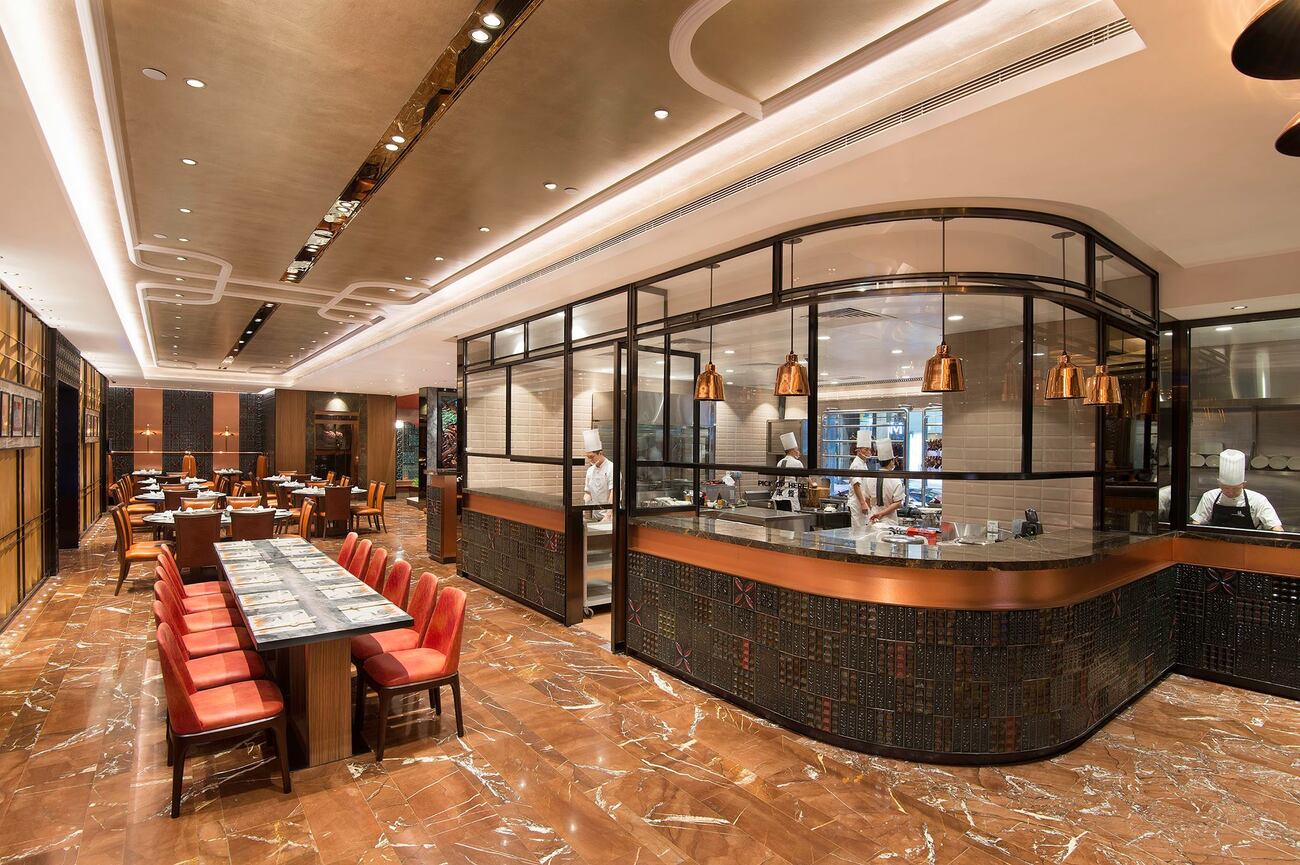
Yung Kee Restaurant at 32-40 Wellington Street in Central, just at the eastern edge of this walk, has been roasting goose since 1942 and remains one of Hong Kong’s enduring Cantonese institutions. The roast goose is the signature order, crisp-skinned, properly rendered, and served with plum sauce and pickled ginger that cuts cleanly through the richness.
The restaurant unfolds across three storeys of organised Cantonese intensity, shared tables, white-jacketed waiters, and a clientele that still includes plenty of regulars who have been coming here for decades.
- The Wonton Soup is another essential order, with large shrimp wontons in a clear pork and dried flounder broth layered with depth.
- The Roast Pork, siu yuk, and the Barbecued Pork, char siu, continue the same roast meat tradition at a standard that helps explain Yung Kee’s longevity.
A walk through Sheung Wan’s historic streets, the medicine trade, Man Mo Temple, Tai Ping Shan, and the galleries along Hollywood Road, followed by lunch at Yung Kee, is one of the best ways to understand this part of the city. The restaurant is not separate from that story. It is part of the same Cantonese commercial culture that shaped the district around it.
A guided walk through Sheung Wan and Tai Ping Shan, with heritage context at Man Mo Temple, the medicine streets, and Hollywood Road, plus a pre-reserved table at Yung Kee, forms part of the Revigorate 4-day Hong Kong imperial heritage itinerary .
A Community That Built Its
Own World
Sheung Wan remains one of the few parts of Hong Kong where history still feels inseparable from daily life. Families connected to the trade that helped fund the first Chinese hospitals in the 19th century still operate in the same streets, and the incense hanging inside Man Mo Temple still carries the atmosphere of a place that once served as both shrine and civic institution.
To walk these hills is to see how a community responded to exclusion not by disappearing, but by building its own networks, traditions, and institutions. That legacy is still visible in the streets, temples, shops, and trading houses that continue to define the area.
The story of Sheung Wan is best understood with the right context, and best experienced with the details already arranged. Our 4-Day Hong Kong Imperial Heritage Itinerary brings together expert guiding, carefully planned routing, and pre-reserved dining for a deeper introduction to the city’s imperial and colonial past.
Book your Revigorate imperial heritage journey.
Let us know what you love, where you want to go, and we’ll design a one-of-a-kind adventure you’ll never forget.
Get in touch
Miriam
Travel Specialist

Nina
Travel Specialist
Abigail
Travel Specialist
Our offices:


Revigorate, Iberian Escapes and Algarve Lifestyle are the registered brand names of APCS Lda . We are a fully authorised travel agency licensed by Turismo de Portugal RNAVT/6867.
In the event of a dispute, the consumer may refer to: RAL - Centros de Arbitragem
Avª. 5 de Outubro, nº. 55, R/C Dtº. 8000-075 Faro, Portugal | Tel: +351 289 823 135 *
* national landline call
E-mail: info@consumoalgarve.pt| www.consumidoronline.pt | Mon to Fri: 9:00 - 13:00 / 14:00 - 17:00